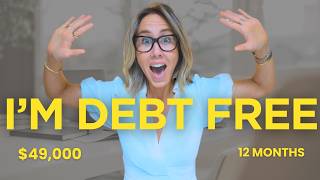

I Paid Off $49k in 12 Months!
45sThe raw emotion of a huge financial milestone and the promise of revealing the 'how' creates an irresistible click.
▶ Play Clip"The title accurately reflects the content: the creator details how she paid off $49k in 12 months and shares lessons learned."
The creator shares her personal journey of paying off $49,000 in debt over 12 months. She details the budgeting methods, mindset shifts, and behavioral changes that made it possible, emphasizing that discipline and delayed gratification are key.
Used the debt avalanche method (highest interest first) and rolled payments to next debt.
Paying off debt is 80% behavior and 20% math; spending less than you make is fundamental.
It took six to seven months to feel a true shift in mindset away from wanting things.
Delayed gratification is a superpower; resisting impulse buys leads to long-term freedom.
Now sees through marketing; walking into stores feels like seeing plastic and markup.
Emotional payoff: owning her car and feeling light; plans 75% savings rate going forward.
What is the debt avalanche method?
The debt avalanche method focuses on paying off the highest interest rate first.
01:46
What percentage split does the creator attribute to paying off debt?
80% behavior and 20% math.
03:29
How long did it take the creator to feel a fundamental shift in her spending mindset?
It took about six to seven months to feel a true shift in mindset and emotions about wanting things.
05:47
What tools does the creator use for budgeting and tracking debt payoff?
She uses the Quick and Simplify platform (affiliate link) and the Debt Payoff Planner app.
01:20
What is the creator's target savings rate after becoming debt-free?
She plans to maintain a 75% savings rate, not dipping below 65%.
15:09
Debt payoff is 80% behavior, 20% math
Highlights that discipline and habit change are more critical than financial formulas.
03:29Debt avalanche method
A practical strategy to minimize interest by targeting highest-rate debt first.
01:46Delayed gratification as a superpower
Shows how resisting impulse purchases can transform financial and personal life.
09:24Six to seven months for mindset shift
Provides a realistic timeline for breaking shopping addiction and changing spending habits.
05:4775% savings rate goal
Demonstrates aggressive saving post-debt to build wealth quickly.
15:09[00:00] At 10 a.m. today, I mean my last debt payment of $7,038. So in 12-ish months, I paid off about $49,000 in debt and it feels damn good. So I wanna go through what I did,
[00:15] how I got there, some of the difficulties, lessons learned, I have some thoughts and I also wanna discuss goals going into the future. Quick little caveat here, I am not a financial advisor, I am not a money expert, I know nothing about nothing.
[00:30] I'm sharing my experience, what I learned, what I messed up on and all of it. So don't think you're getting real money advice here, I'm just sharing what I did and how I did it.
[00:42] All right, let's do this. Let's quickly go through the logistics, the fundamentals, what everybody with a personal finance platform basically tells you, is that number one, you literally to do this, to pay off any debt and to get control of your spending,
[00:55] you have to budget, you have to know the numbers, you have to know what is going out and what is coming in. It is fundamental, you cannot get around this, it does not matter the method that you use,
[01:08] but you have to track everything if you want to get ahead of bills, money, debt, whatever. I use quite a few platforms before I found Quick and Simplify, I love Quick and Simplify,
[01:20] it's the thing I use now, it is linked below, it is an affiliate link, you do not have to use it, you can go search it on your own or you can use anything else, just find something, I don't even care for a pen and paper, you just have to be diligent about it
[01:33] and just make sure that you track everything, it's super important. Next thing is I use the debt avalanche method, and so with this method, you choose the highest interest rate first to pay off, and then you work your way down.
[01:46] I just, that's basically what I wanted to do because I didn't want to pay a lot of interest. Here's what's interesting. This is how I don't want to say ignorant I was to this, but this is how thoughtless I was that before I started really paying attention
[01:59] to my budget and my money and the debt that I had to pay off, I didn't even consider the fact that once I paid off one bill that, that money that was going towards that bill would go on to the next bill.
[02:12] So let's say I was paying 1,000 for the high interest and then 200 each for the other ones. If before I started this, I would have just paid off that 1,000 and then that 1,000 would have gone back
[02:25] into my pocket and I would have spent it like regular, and then I would have just kept paying the 100 or 200 onto my other bills. It was just so stupid, but obviously I learned, and so what I did was I paid off
[02:37] the highest interest rate bill first and then I took that money and then tackled it onto the next bill and then so on and so forth until we got down to today where we are at nothing. So I like that method.
[02:49] There's also the debt snowball method, debt avalanche and snowball are the two primary ones that most people use. I use the debt payoff planner app. I think it's what it's called. I think it is a paid app.
[03:02] It is not affiliated. I do not make money off of it. I like to visually see my debt going down and see when my payoff debt was. So that's why I like this app. I have it linked below. You can use it or not use it as up to you,
[03:15] but I liked that method personally. So let's go through some of the lessons and things that I've learned. I've kind of been jotting down thoughts and notes as I've gone along this process. The first lesson is that either paying off debt
[03:29] or getting better with your money is about 80% behavior in 20% math because if you really think about it, most of us know we kind of get bogged down because there's so much different advice and tips
[03:41] and there's so many voices out there telling you what to do. But when you break it down to the fundamentals is that the fundamental goal, the thing that has to be done is to spend less than you make.
[03:53] And if you really can, what's even better is to try to even increase your income and still spend a lot less than you make and not let lifestyle creep in. The challenge is that sticking with this
[04:05] is extremely difficult. We can be disciplined in some areas of our life. Like I was very disciplined in certain areas of my life, specifically anything that came to work. But when it came to spending money, I had zero, zero discipline.
[04:18] And so that's why I say the math is just that. Just spend less. Of course there's other things that go into it. But like the basic thing is to spend less than you make. It is discipline and delay gratification that is required.
[04:30] And that is the most difficult thing because it is uncomfortable and it is boring. It is so slow and it's just, it's so easy and fun to buy something new
[04:42] and get that dopamine hit. It is instant gratification and we're so used to that. So yeah, behavior is like 80% of it, which is why discipline moves the needle. So it's super important to know that and lock in.
[04:55] The next thing I learned is that wanting something or craving something is habitual. And if you have a strong propensity to impulsively buy or excessively shop, it is in some cases an addiction.
[05:08] But the good news is that with any addiction, with many addictions, I'll say, the urge to buy and spend fades away. The bad news is that this is kind of a slow process.
[05:21] I read Reddit forums all of the time and over and over and over again in the shopping addiction forum, you will hear people say, I slipped up, I slipped up, I spent a lot of money, I spent a lot of money
[05:33] because we are constantly wanting that quick fix. I see a lot of people doing no buys for a month and expecting drastic change. For me at least, I think it took me a good solid six or seven months
[05:47] to actually feel a true shift in my mindset and emotions on wanting things. I now look at materialism and consumption entirely different
[06:02] but it took a long time. It was very slow and it was very boring. But if you can just push through, if you can just figure out different things to do, stay focused on the goal, budget every day,
[06:16] pick up a free habit, learn a new skill, do something, get yourselves through about I'm gonna say six months. I'm pretty confident in saying you will see fundamental shifts
[06:31] in how you see money and how you spend money, but it takes a lot of effort. It is hard, it is really hard especially if you have an addiction to shopping. About 15 years ago, I gave up sugar
[06:45] because I could not stop. If I had chocolate cake or cupcakes or something, any sugar, once I started, I could not stop. It was a true addiction and it took me about a year.
[06:58] But after about a year, I can look at anything sweet and not crave it at all. It's the same thing. I just look at spending money so differently. I look at the way that I see materialistic things
[07:12] and other people and logos and other people. I just view it differently is basically what I'm saying. So the urge to shop, I promise you it does fade. I promise you just have to stick through it.
[07:25] The next thing is that you learned how to separate wants needs and wants pretending to be needs. This took me a while, okay, it was a slow crawl but I had cut out so much out of my budget
[07:39] that I really started as I went through this process to hone in on what I was spending and was it absolutely necessary. Down to my groceries, I even do that now.
[07:54] I've said this in other videos but I calculate everything as I go through the grocery store, I add it up on my calculator and I go through. And I really think about am I just buying this because it's kind of a nice to have
[08:06] or do I actually need this? Is this the fundamental part of my diet? Is this something I will really be missing and lacking? It just makes you think through all of your purchases
[08:18] whether big or small. I have made purchases on here obviously throughout this entire time, throughout this year but as you start to see what your money can do for you now in the future as it compounds
[08:30] and once you start to see the debt going down and your savings going up and not having to transfer money from account to account and not being stressed about making a purchase somewhere
[08:44] and having an overdraft fee or something coming out or a bill coming out and you not having enough money to cover it, there's none of that anymore. When you start to have less anxiety and more ease about your money, you really just start to pay attention
[08:57] of what's actually important and what you actually need and what truly makes you happy. Not the dopamine hit happy but like what actually brings you pleasure day to day
[09:10] and what is actually worth your money in your time? I said this little before but I'm gonna say it again because I, for me, this is, I believe so strongly in this because this was so hard for me to do.
[09:24] It is not in my genetic makeup but delayed gratification, mastering delayed gratification is a superpower. If you tend to impulsively spend money by things you do not need,
[09:37] find yourself excessively shopping. Once you see the ability to delay that purchase for a long time can change your life. In all aspects of my life, this is so challenging.
[09:50] Even if I wanna, even if it comes down to just like a conversation with somebody, I just need to get it out. Like I just need to do, once I get an idea in my head or I thought in my head whether it's a purchase
[10:02] or a conversation or a thought that I wanna do something, I just wanna do it right then. I sense a child have lacked the ability to delay gratification
[10:14] in every way. My parents never saw this and never tried to kick it out of me. It carried its way up through my adulthood and this was so hard to do because not only did I lack the skill to delay gratification
[10:27] but I also have some OCD. So I just like laser focus into something and cannot step thinking about it. And so because I lack the ability to delay gratification, I usually act on whatever that is. Unless it's like a legal or bad for you.
[10:40] Usually it's shopping. That's where, that's obviously where I got in trouble here. So if you can see that most things are designed and marketed to make you buy. And if you can figure out how to not buy that thing
[10:52] which is or delaying it for a very long time, you will win at so many things. You will win at so many things. Even if it comes to business or work, this is such a good skill to have.
[11:06] The next thing is that I rarely want things now. There are a few things on my, I don't even have a wish list. There are just a few things that have always, they've sat in my head for a while. Maybe at some point in the distant future,
[11:19] I might buy one of these things. Maybe I'll make a video about it, I don't know. But nothing pressing for the most part, I don't want anything and I feel like I see through this illusion now.
[11:31] So clearly that sometimes I walk into a store, it makes me mad. I used to walk into mostly any sort of retail store. It didn't matter what it was.
[11:43] Or see something online. And I would feel, physically feel an emotion of joy and happiness and elation. And just want to buy everything. Like it was overwhelmed by the beauty,
[11:55] whatever the beauty was. It could literally be anything. But now I walk into, I walk by a store, I walk into a store and all I see is marketing, I see plastic, I see fabric, I see markup.
[12:09] I feel like a fuzzy filter has been lifted from my eyeballs. I've been trying to think about how I can articulate how I feel about this. All of these companies, marketing companies
[12:22] or companies that make products and services are just trying to take my money. And I'm just like, hell no, I'm keeping my money. But it just feels like stuff. It's just like, I'm so turned off by all of it now.
[12:38] So yeah, I just feel like I see, I just see all the marketing tactics. I just, I see all of these overpriced things now and I'm like, what the hell are we doing? And it's just like more and more and more. It's just so much consumption, it's crazy.
[12:53] My camera died so I had to change out. I am sweating. I don't know why. I'm usually freezing all the time, but I'm sweating right now. The other thing I just wanted to talk about was just the emotion tied to it because I made the payment today over the phone.
[13:06] I called the loan for my car. The last payment was to pay off my car. And I made the payment. I just felt so light and so good. I didn't know if I would actually feel anything.
[13:18] I'm like, I'm just gonna do it and it's fine. But it just feels like a pivotal moment. It just feels like, okay, now I can take all of my money and just stack it, just save and save and save.
[13:33] Before I just feel like it was going into this black hole, I was just spending thousands of dollars of my harder money was just going into this black hole, a black hole that I created.
[13:45] And I didn't tell anybody about it. Nobody in my life really knows because I think it would be anti-climatic for them. They'd be like, oh, okay, great. I mean, my boyfriend knows, obviously, he's super happy for me. My sister is super happy.
[13:57] She's like my biggest cheerleader. But in life, nobody knows. But like I know and it's just so, it's such a good feeling. And I drove home today in my car and I was like, I own this car, like this is my car.
[14:09] It's my car. It's not their car, it's my car. I own this car and I'm gonna run it into the ground and I'm so happy to say that. It's such a good feeling. I promise you, if I have not already emphasized this enough,
[14:25] I just wanna reiterate it that it is such a good feeling and it's so freaking hard in the beginning and I understand if you cannot get control of your spending but I promise you it is possible. You just have to go through the suck.
[14:39] You just have to like fill up your time and do not, do not watch anything that will make you buy. Do not. It's so important. And so the last thing I wanna leave you with is that what I'm gonna do with the money
[14:54] because I was spending between $4,000 and $6,000 on debt monthly. And so going forward, my goal is to have a 75% savings rate. Now that might go down, it depends on where we move.
[15:09] My boyfriend and I will likely move at some point in the future and it depends on where we move. So my savings rate might fluctuate a little bit but I do not want it to dip below 65%.
[15:22] So that is my ultimate goal. But for right now, a 75% savings rate I think is solid and that's what I'm gonna do. And so cheers to being debt free in one year.
[15:34] I can't freaking believe it. And thank you to everybody who either just jumped on this journey or who's been with me since the beginning. I just got chills, I just got chills because there are some of you I see you in the comments
[15:48] that have been here since the beginning. And it's just crazy. So I appreciate you so much. Thank you. And I'll see you in the next one. Okay, thanks. Bye.
⚡ Saved you 0h 15m reading this? Transcribe any YouTube video for free — no signup needed.