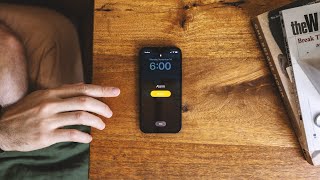

I Ditched My Alarm for 6 Months
39sThis real-world experiment challenges the necessity of alarms and sparks curiosity about flexible sleep.
▶ Play Clip"Delivers modest personal benefits but lacks quantitative proof or novel insights; title slightly oversells."
The speaker shares his experience of giving up alarm clocks for a year, finding that flexible sleep schedules improved his sleep quality, relationships, and daily motivation. He emphasizes that waking naturally, when possible, leads to better rest and less anxiety.
One year ago, the speaker decided to stop using an alarm clock after reflecting on how the harsh sound contributed to his anxiety.
During six months in Australia, a 14-hour time difference forced early wake-ups for calls, but on other days he avoided alarms entirely.
He began consistently getting eight hours of sleep, sometimes nine in bed, and felt more rested without forcing a rigid wake-up time.
Instead of forcing early rising, he goes to bed at the same time but sleeps in when he goes to bed late, striking a balance he finds works.
He realized that he doesn't need an alarm clock; he needs a full night's sleep to wake up early naturally.
Even without an alarm, he typically wakes around 7 AM and never sleeps past 9 AM, showing a natural rhythm.
Without commitments, he used to hit snooze repeatedly; now he wakes naturally and gets up.
His partner Nat is a light sleeper; waking naturally means he doesn't disturb her as often, improving their mornings.
He wakes up excited about work because he has a task list from the night before and a sense of purpose, making alarm clocks unnecessary most days.
If he has early meetings, he still uses an alarm, but otherwise he will never use one again.
The speaker advocates for a flexible sleep schedule aligned with natural cues, reserving alarms only for mandatory early commitments, and notes that this approach has improved his sleep and relationships.
How long has the speaker stopped using an alarm clock?
One year.
00:28
How many hours of sleep does he get per night typically?
Eight hours (sometimes nine in bed).
02:05
What time does he typically wake up without an alarm?
Around 7 AM.
03:18
What is his partner's name?
Nat.
04:46
What does he do if he has early commitments?
He sets an alarm.
05:58
What was his main realization about waking up early?
You need a full night's sleep to wake up early, not an alarm clock.
03:03
How did he handle early morning meetings while in Australia?
He woke up early for them but didn't set an alarm on other days.
01:24
How does he describe his sleep schedule?
Inconsistent but flexible: he goes to bed at the same time but sleeps in if he goes to bed late.
02:20
What positive change did he notice regarding his partner?
He doesn't wake her up as often because he wakes naturally.
04:46
Realization about sleep vs alarm
Challenges the assumption that alarms are essential for early rising.
03:03Greater purpose drives motivation
Highlights the psychological benefit of waking for meaningful work.
05:00Flexibility changed daily life
Shows that adapting sleep to natural cues can improve overall well-being.
05:42Snooze behavior without commitments
Illustrates how alarms can enable procrastination.
04:03Balancing rigidity with flexibility
Offers a practical technique for sustainable sleep scheduling.
02:48[00:00] that my YouTube course is closing its enrollment And so if you wanna learn all these strategies, tools, and to get more views on YouTube with integrity,
[00:16] go to slowgrowth.com/youtube to learn more. Hope to see there. One year ago, I decided to stop using my alarm clock
[00:28] I've been an early riser I've almost always started my day with the sound of- Is it any wonder that I struggle with anxiety?
[00:41] (phone ringing) but is there really an alarm So it wasn't just the guttural sound that got me to question how I wake up.
[00:57] Last year, I spent six months in Australia. - Now, I don't know if you're familiar, specifically from the small team
[01:11] and that makes for a brutal time difference. When I was there, 9:00 AM in Sydney was 7:00 PM in New York. just to get on a single phone call.
[01:24] On the days that I had to wake up early, But for the other five to six days every week, I decided not to set an alarm at all and the habit stuck,
[01:37] to that god awful sound of the alarm ringing, I wake up to people yelling on the streets of Philadelphia. Real nice!
[01:50] - So I've noticed a few positive changes First, I've been getting a full eight hours for the past month.
[02:05] and I've been consistently getting nine hours in bed depending on the day of the week, It's crazy how inconsistent my schedule has become.
[02:20] So instead of forcing myself to wake up early every morning, Every night I try to get to bed at the same time but when there are inconsistencies with my schedule,
[02:35] when I go to bed really late. And so if I get to bed at 12:00 AM or 1:00 AM I'm gonna sleep in
[02:48] For me, this strikes the perfect balance I've tried to keep a really rigid sleep schedule. That one didn't go so well.
[03:03] What I've learned is that neglecting sleep to be productive So I think the thing that surprised me the most is the realization that I don't need an alarm clock
[03:18] I need a full night's sleep to wake up early. I still typically wake up around 7:00 AM each morning. if you're not setting an alarm
[03:32] You'll sleep in until 11, 12, maybe 1. I'm waking up pretty consistently I don't think I ever sleep in past nine if I'm being honest.
[03:47] But if you take a look at it, there is quite a strong trend for waking up From my personal experience, if I don't have commitments
[04:03] I will hit the snooze button over and over again, Which brings me to my next point. It's also made someone else very happy.
[04:18] but she got sick while I was making it so... - No. - Sounds rough. - No.
[04:32] - Look, listen, right? Like who needs to wake up at 5:00 AM (both laughing)
[04:46] - [Matt] Long story short, Nat is a really light sleeper. I don't wake her up as often, So I guess you could say
[05:00] - Now this works for me for a few different reasons. wake up early for meetings. that I can set myself.
[05:15] is that I really do have a greater purpose When I wake up every morning, I'm excited about my work.
[05:29] I have that task list that I created the night before, about the things that I wanna get done. Everybody has their own schedules
[05:42] But I have found that being more flexible, not setting an alarm clock, has truly changed my day to day. or I'll never use an alarm clock.
[05:58] And when I have early commitments I'm not gonna be an idiot and leave it up to chance. But whenever I can, from here on out,
[06:13] I mean, look, listen, right? I'd rather be at the servo. I'd rather get a couple of sausage sizzles, right?
[06:26] and then just fill up a couple eskies, right? We never have a good time anymore. And I would love it if you could be in my video, Nat.
[06:42] Like, (groans) I can't believe I married a YouTuber. No.


⚡ Saved you 0h 06m reading this? Transcribe any YouTube video for free — no signup needed.