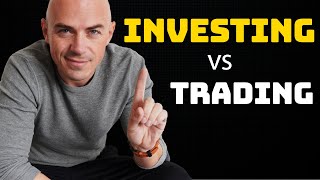
Investing vs Trading: Which is Right for You?
41sDirectly compares two popular money-making strategies with clear pros and cons, sparking debate.
▶ Play Clip"Title matches content exactly; delivers a clear, practical comparison without exaggeration."
This video breaks down the key differences between long-term investing and active day trading, explaining the mechanics, risks, and time commitments of each approach. It uses simple examples like compound interest and index funds to illustrate why most people may be better off investing rather than trading.
Investing is simple, not time-consuming, and accessible to everyone. The S&P 500 has historically returned 8–11% annually.
Compounding turns small gains into massive growth over decades. Example: $100 at 10% becomes $110, then $121, etc.
Index funds mimic major indices like S&P 500, providing instant diversification. Hedge funds manage similar portfolios for clients.
Investing has losing years; timing matters. A crash near retirement can devastate savings, as seen in 2008–2009.
Day trading requires extensive knowledge, practice, and emotional control. Many traders remain unprofitable for years.
Traders should only risk capital if they can consistently beat the S&P 500's 10% average. Otherwise, investing is more logical.
Ask: Are you willing to put in time? Can you outperform the market sustainably? If no, default to investing.
Time spent on trading vs. living life should be considered. Regret avoidance is a key motivator.
The video argues that most people should invest passively in index funds rather than day trade, unless they can consistently outperform the market and are willing to dedicate significant time to it. The final takeaway is to consider how you spend your time because it's a limited resource.
What is the average annual return of the S&P 500?
Between 8% and 11%.
00:29
Explain compound interest with a simple example.
Start with $100, earn 10% ($10), new base $110. Next year earn 10% ($11), total $121. The extra comes from earning interest on interest.
00:57
What is an index fund?
A single asset that mimics a major index like the S&P 500, providing instant diversification without buying individual stocks.
02:13
What is a major risk of investing for retirement?
If the market crashes the year you retire, your portfolio loses value and you may have to withdraw at a loss.
03:30
Why is day trading considered high barrier to entry?
It requires extensive knowledge, practice on demo accounts, and the ability to consistently outperform the market.
04:14
What two questions should a potential trader ask themselves?
1. Am I willing to put in the time and energy? 2. Can I prove I can outperform the S&P 500 sustainably?
06:02
What does the speaker say about time?
Time is an expiring asset; you never get it back, so consider how you spend it.
07:14
Compounding is the ninth wonder
Uses Einstein quote to emphasize the power of compound interest over long periods.
00:41Retirement timing risk
Highlights a common but overlooked risk: market downturn coinciding with retirement age.
03:47Opportunity cost of trading
If you can't beat the market, you're better off investing and using freed time elsewhere.
05:33Sustainability over decades
Asks whether trading performance can be maintained for 10-20 years, adding a long-term perspective.
06:17[00:00] Let's talk about investing versus trading and which one is right for you. Now, when it comes to investing, the barrier to entry is very low. Everyone has access to it and it's super super
[00:14] simple and not time consuming whatsoever. The returns, however, is where there's a little bit of an issue. On average, the S&P 500 or the overall stock exchange on average has returned between $8
[00:29] and 11% annually. So let's say you invested $100, you would get $8 to $11 in return for the entire
[00:41] year. Now investing is a longterm investment. You are investing for the future. So if you let that interest compound over time, it is the most wonderful thing known to mankind. Compounding
[00:57] interest is the ninth wonder of the world. And how it works is basically your base capital, the $100 plus, let's say 10%, which would give you a new base capital of $110. 10% of 100 is
[01:14] $10 plus the additional base capital. Now, the following year, you were invested $110 into the market. You get another 10%. You add $11 this year. So, now your 110 is $121.
[01:29] You see that extra bit that was added onto it? That's where the magic is. That little extra bit, that percentage that gets added to your capital and compounded interest-wise over the course of
[01:43] 50 years is something magical. Right here, you can see percentage gained without compounded interest. And next to it, you can see it with compounded interest. And this is over 30 years. The amount
[01:59] of money made due to the compound interest as opposed to without it is absolutely insane. Now, anybody can invest in the stock market. There are things called index funds which basically
[02:13] mimic the S&P 500 or the NASDAQ or the Dow Jones. And it's a single asset that you can buy and that portfolio has diversified into all of the S&P 500. So instead of you doing it yourself and buying
[02:30] each individual company, they allocate a specific percentage to each company and have an index fund that you can then invest into. This is how hedge funds make their money. The hedge fund has their portfolio and you give your money to a hedge fund and they invest it in accordance with their
[02:47] portfolio. Now investing is not without risk. When I say on average you're getting 10% returns, that's an overall average. Some years might be 20, some years might be minus 10. So you will
[03:01] have losing years and you will have winning years. But over time, the market has generally done this. The worst part about investing is that you are investing for a retirement fund. Correct? So when
[03:16] you retire, you want to pull out your capital and live your life as you wish as a retiree. Either fishing or yaching or whatever, sailing. Now let's say there is a huge market crash the year
[03:30] that you want to retire. Your entire portfolio has then decreased and you would get out having less value than you did 2 years prior. This is where chance, unluckiness or just bad happen stance
[03:47] comes into play. The timing of your retirement is relevant and some people just get unlucky. Let's say you turned 65 in 2008, 2009. There was a huge housing crisis. Basically,
[04:00] your portfolio melted. It sucks. But eventually, 10 years later, it rebounded. But now you're 75. You see what I'm getting at here? Now, let's get into trading and if it's right for you. Trading is
[04:14] a very high barrier to entry. You need to have a large knowledge base and an extended period of time where you've practiced this skill set before you can prove to yourself that you are
[04:26] good enough to trade your own capital in the live markets. Now, the issue with this is that I've seen traders be in this game for years and years and years and yet they are still not profitable.
[04:40] So, I don't know if that's due to lack of consistency or strategy hopping or just a mismanagement of funds and getting overly emotional and not having a proper strategy.
[04:54] But I've seen it thousands upon thousands upon thousands upon thousands of times. And to myself, I think you shouldn't be a day trader if you hadn't practiced on a demo account and can prove
[05:06] profitability to yourself before you enter in real capital into the markets. Once you do that, the real capital that you are trading, you should be able to outperform the S&P 500,
[05:20] that 10% annually, because of the amount of time that you're dedicating to your career, your job as a day trader, you should be able to outperform the market. Because if you can't,
[05:33] then it would be much more logical for you to just become an investor and have freed up a bunch of time versus spending 40 hours a week on trading because you're working at something to outperform
[05:46] the S&P 500. Whereas, if you do nothing, the S&P 500 gets 10%. On average, statistically over time. So, the thing that you really have to ask yourself is one, are you willing to put in the time,
[06:02] energy, and consistency that it takes to become a full-time day trader? If yes, the second question you need to ask yourself is, am I able to prove that I am able to outperform the overall stock
[06:17] market more than 10% annually? If so, by how much? And is it sustainable long term? Can I do this for the next 10 to 15 to 20 years? If the answer is no to any of those questions, you
[06:31] should probably default to just being an investor. This is something that has very little time input and you can still have a full-time job with it. So essentially, your job can pay for your day-to-day
[06:43] living expenses and your investment can be for your retirement or vacation money or however you want to allocate your funds in your personal life. This is just a quick food forthought video. Can you outperform the S&P? If so, is it worth your time? Because at the end of the day,
[07:01] at the end of your life, you'll think, "How much time did I waste sleeping? How much time did I waste being hung over? How much time did I waste at my job? What could I have done with
[07:14] that time?" Because the time is a expiring asset. Like it goes away and you never get it back. And I would prefer that at the end of your time, you don't look back and regret time not well spent.
⚡ Saved you 0h 07m reading this? Transcribe any YouTube video for free — no signup needed.