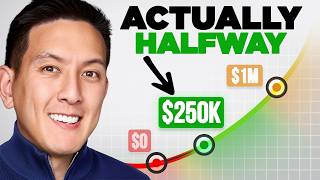

Why $250K is really halfway to $1M
44sThe counterintuitive claim that $250K is halfway to $1M due to compounding interest is a mind-blowing insight that sparks curiosity and shares.
▶ Play Clip"Delivers on the promise with clear math and actionable advice, though some sponsor content and repetition pad the runtime."
The video explains the concept that reaching $250,000 is halfway to $1 million in terms of time, not dollars, due to compound interest. It provides tables showing how different contribution amounts and return rates affect the timeline, and discusses psychological traps like the 'I made it' syndrome, Dunning-Kruger effect, and comparison trap. The video concludes with three strategies to accelerate wealth building from $250K to $1M.
With $10,000 annual contributions and 8% returns, it takes 13.8 years to reach $250K, and another 13.8 years to reach $1M. The $250K is halfway in time, not dollars, because of compound interest.
Increasing annual contributions shortens the time to $1M. For example, $12K/year shortens by 2 years, $24K/year hits $1M in 18.4 years with halfway at $324,723, and $36K/year takes 14.8 years with halfway near $355K.
The video demonstrates using Claude AI to generate tables for different return rates (5%, 6%, 10%, 20%). Claude initially provided takeaways but was prompted to create a table, showing how AI can assist in financial planning.
At $250K, a 2% gain on a good day equals $5,000, which can trigger lifestyle inflation. People may spend on luxury items, erasing months of savings. This psychological trap gives permission to enjoy success prematurely.
After reaching $250K, people may overestimate their investing skills, leading to risky moves like day trading or options. One overconfident move can erase 2-5 years of wealth building; a 50% loss requires a 100% gain to recover.
Comparing yourself to wealthier individuals or social media personas can make you feel poor. The '30K millionaire' phenomenon describes people who act rich but have little savings. Most actual millionaires live modestly.
Automate contributions to retirement and brokerage accounts to avoid emotional decisions. A coworker's example: pulling $100K from $300K to invest in crypto resulted in a peak of $450K but ended at $30K, while leaving it in S&P 500 would have grown to $800K.
Housing, transportation, and food make up 60-70% of budgets. Reducing rent by $1,000/month saves $12K/year, which compounds to $200-300K by the time you hit $1M. Similarly, avoiding a new car or eating out less adds up.
With $250K, you can afford to negotiate a better job, walk away from a bad one, or take a short-term pay cut for higher upside. Investing in certifications can accelerate the timeline to $1M from 13.8 years to 8-9 years.
The math is in your favor once you hit $250K, but psychological traps can derail progress. By automating finances, optimizing major expenses, and taking calculated risks, you can accelerate your path to $1 million.
What is the halfway point to $1 million in terms of time with $10,000 annual contributions and 8% returns?
$250,000, reached in 13.8 years.
00:02
How long does it take to go from $250K to $1M with the same contributions and returns?
Another 13.8 years.
00:15
What is the halfway point if you contribute $24,000 per year?
$324,723.
01:50
What is the Dunning-Kruger effect?
People with low abilities overestimate their skills and competence in that area.
06:37
What percentage loss requires a 100% gain to recover?
50%.
07:44
What are the 'big three' expenses that make up 60-70% of most people's budgets?
Housing, transportation, and food.
12:41
What is the '30K millionaire' phenomenon?
Individuals who make around $30,000 a year but act like they have millions of dollars.
08:55
What happened to the coworker's $100K crypto investment?
It peaked at $450K but ended up worth about $30,000.
11:10
Halfway point in time, not dollars
This counterintuitive insight reframes wealth building around compound interest.
00:02I Made It Syndrome
Identifies a specific psychological trap that can derail financial progress.
05:01Dunning-Kruger effect in investing
Explains why overconfidence after success can lead to costly mistakes.
06:23Crypto side quest example
Real-world illustration of how emotional decisions can cost hundreds of thousands.
11:10Calculated risks at $250K
Shows how financial security enables career moves that accelerate wealth.
13:36[00:02] doesn't make any sense and you're probably wondering what the catch is because the last I checked 250k is definitely one quarter of the way to a million. While you might be right in terms of dollars, in terms of time, this
[00:15] is where $250,000 is halfway. Contributing $10,000 a year and earning an 8% return, you will go from 0 to 250k in 13.8 years. So, how long does it take to make the next 750K? That's three times more you have to make. And if you
[00:30] that's where you are mistaken. It actually only takes another 13.8 years to make three times as much, that's because the 250k you have is earning you interest. And when you combine that with
[00:42] it's kind of like you're rolling a big snowball down a hill. That snowball gets bigger and bigger as you gain momentum towards your goal of, let's say, a due to the power of compounding interest, but that's not the only thing
[00:56] In fact, we have a lot more because at the $250,000 mark, something weird is going to happen. You will probably experience many different factors that can either accelerate you to a million dollars or perhaps derail you
[01:10] some psychological traps that make people too complacent or worse, makes them chase returns to the detriment of their net worth. While $250,000 is a great number to be at, some people get stuck at this number forever. And that's
[01:23] hope you stick around for this video because I'm trying to get you to a right, so looking at this table, we can actually see the relationship between how much you contribute and what the exact halfway point is in terms of time
[01:37] uh for hitting a million. As you increase your contributions per year, you will hit a million a lot faster. You can see that at $12,000 per year that your total years to hit a million will be shortened by two years. But this will
[01:50] of time. Next, if you're able to contribute $2,000 a month or $24,000 a year, you can hit a million in 18.4 years. But the halfway point is now increased. It's $324,723.
[02:07] a month or 36K a year, you can see that it only takes you 14.8 years to make a million, but your halfway point now is closer to $355,000. At the very low end of $5,000 per year, it will take you the longest to hit $1
[02:20] million in all of these scenarios. But the halfway point is actually $2,675. So, while we could have titled this video why 200K is halfway to a million, reasonable since many people can probably aspire to invest 10K a year or
[02:35] $833 per month. And when it comes to hitting a million, you can see how this table illustrates how your net worth will change very fast after you hit that change your return assumptions? Like what if you wanted to assume you got a
[02:49] what if you wanted to assume you got a 5%, 6%, 10%, or heck, even a 20% return. manually, but you can also use a tool like Claude to figure that out. So I'll I've built right here. You can see that I've attached it already, and I'm going
[03:03] to prompt it with the following. So this is all based on an 8% return. But what is all based on an 8% return. But what if I want a table with a 5%, 6%, 10%, or if I want a table with a 5%, 6%, 10%, or even a 20% return? create that table for
[03:17] me. So, while Claude is thinking here, I do want to share that these are some of helpful. I didn't want to have to calculate every single return percentage and the time that it takes a million dollars. So, if you're ever trying to
[03:31] time or you just don't have the patience, you can use Claude to act as your thinking partner to keep things moving along. All right, so here you go. takeaways, but it didn't actually create a table for us. It did tell us that at
[03:45] hit a million dollars in as little as 10.3 years, but I still want a table. little bit further. Create a table for me of this, please.
[03:57] table for us. And I think seeing all of these different perspectives right here will help you create a custom plan around reaching $1 million as quickly as And if you want to run scenarios like this for yourself, you can discover
[04:10] what's possible and try Claude for free using the link down below. And thanks again to Claude Anthropic for sponsoring this portion of the video. Now, next up, obstacles that you might hit when you're trying to hit your first 100K versus
[04:23] your first 250K because they are pretty different. The biggest obstacle in my that you're staying disciplined and you're stacking your chips up very slowly and it's going to take a lot of patience and you want to avoid those
[04:35] $250,000 are going to be completely different. So making good consistent decisions such as not buying the things impulsively or not
[04:47] opting for a flashy car payment. The $250,000 mark has way more psychological we're going to talk about. The first of these challenges is definitely what I like to call the I made it syndrome. So, it's at this point in time when you make
[05:01] $250,000 where you could earn more in one single good market day than an entire week of work. If your $250,000 portfolio makes a 2% gain, for example, on a good day, that's $5,000 that you might see in your investment account.
[05:15] And this is actually quite dangerous. This may actually lend itself to you in real life because you're thinking in the back of your head, "Wow, I just made can certainly buy these Golden State Warriors tickets for $500. Or even
[05:29] worse, you book a $10,000 vacation you've always wanted because you've been so disciplined, you hit the 250k mark. And the idea here is that that's erasing 6 months of your savings in a single week. What's actually happening
[05:42] is telling you that you've arrived, triggering your brain to give yourself permission to finally enjoy your success. This is particularly dangerous right around this mark of net worth of $250,000. So, this is where I implore
[05:57] you to keep your consistency up because you are actually a lot closer to hitting a million than you might think. Also, if you make 5K in your investment account, just kind of unrealized. So, that's something you have to understand as
[06:09] that. Let's say you don't fall for the lifestyle inflation, the I made it kind actually want to start investing more of your money and you want to get to $1 million faster. The other problem that I see at this level is that people are
[06:23] trying to chase returns. They start to really go after it. Since you brain concludes that you might be good at all financial decisions. And this is where the Dunning Krueger effect it really takes its final form right here.
[06:37] channel that I've talked about where people with low abilities in a particular area, they overestimate their skills and competence in that area. The it's very hard to overcome because someone that is incompetent at
[06:51] something. It keeps them from understanding how bad they really are at life with investing. So, people will often think that they are the next money day trading or perhaps they've managed to make some money on a real
[07:04] they are the god of investing. In a video game example, oftentimes I used to play League of Legends like 10 years ago, which was a team game. I thought I was pretty good at the game and actually the stats did reflect that. But whenever
[07:17] with lower skilled players, you would always see the chat be filled with the blame game. Lower ELO players tend to overestimate their abilities. And when things don't go their way, they blame their teammates. They blame anything but
[07:30] environment. To avoid the Dunning Krueger effect, you must accept that it can happen to anyone, and that includes you. It doesn't mean that you aren't expertise that you might believe you have. One single overconfident move in
[07:44] the stock market or investing in general can erase 2 to 5 years of wealth building. The math is actually really brutal. Let's say you lose 50% on an investment that will require a 100% gain to recover that. So, just because you've
[07:57] made $250,000 saving steadily, it doesn't mean that you can now go and put $50,000, for example, on options trading because you think you understand the Street Bets post on Reddit and you can
[08:10] itself. The name of the game at 250K is to keep accumulating wealth and not risk a sudden have to start all over. Now, while you are in this phase of acrewing on your way to a million dollars, there is one more psychological trap that I
[08:26] comparison trap. Now that you are doing well financially, it's going to be really easy for you to start comparing yourself to people with 500k, a million dollar, or maybe even $2 million. And it's really easy to feel poor. Again,
[08:40] is on their own path and you may have an entirely different set of goals when it friends or even worse, people on social media. The truth is, no one on social bank account. So, drawing a comparison to someone like that is probably just a
[08:55] waste of your time and energy. In fact, there's even a term called the 30k previous video. These are individuals that make around $30,000 a year, but they act like they have millions of dollars. It's actually really common to
[09:08] money, so perhaps they dress really well or perhaps they drive a really nice car. actual money. The people that actually have the actual money, they don't look modest. According to a study of millionaires, most wealthy people live
[09:22] got there in the first place. The best Door, is that quote, "If your goal is to become financially secure, you'll likely attain it. But if your motive is to make money, to spend money on the good life,
[09:35] quote is pretty powerful. I think it also rhymes a little bit. And it's a on our goals and living within our means, uh, we'll probably be well on our Instead of being a 30K millionaire, I want you to be a plain old million
[09:51] millionaire. I don't know if that's an actual term, but you get what I'm a million dollars as quickly as possible, I want to share with you three on how to get there as quickly as possible. The first strategy is to
[10:04] automate everything. So, if you still haven't automated everything at this where you must. You have enough money now at the 250K level that you can't afford to make big mistakes. And touching your investments is often one
[10:17] If you can just automate your contributions from your paycheck to automatically hit your 401k, your IRA, or your brokerage account and have it systematically invested, you're going to be ahead of a lot of people. From 250k
[10:29] to a million, we know that we need roughly 13.8 years contributing $10,000 a year at 8% returns. That's 168 months. And if you're checking your portfolio every week and making emotional decisions, the chances that you make it
[10:43] through the full 168 months and not touch anything is virtually zero. Emotions get in the way all the time and you actually might make a mistake. And I actually have a co-orker that did this. He had $300,000 back in 2017. This was a
[10:56] long time ago, I know, but he was on track for a million. Now, back in 2017, on one of these bull markets, and he pulled out $100,000 out of his total 300K to invest in various crypto projects. What's crazy is that his 100K
[11:10] projects. What's crazy is that his 100K in crypto did hit a peak of $450,000, a 4.5x return on his money. I vividly remember this too. He would show up to anymore?" And show show me his portfolio balance. And he thought it would even go
[11:24] higher. Well, he was wrong and he held on for way too long. And in the end, his 100K in crypto actually became worth about $30,000 when all of it was said and done. Meanwhile, if he had just left his money alone, that 300k total would
[11:37] be worth way more today. For example, 300K compounded for the past 8 years in 300K compounded for the past 8 years in the S&P 500 would amount to $800,000. But because he only had $230k after the crypto losses, that amounts to $613,000
[11:51] crypto losses, that amounts to $613,000 363. That would be $187,000 less because of the crypto side quest he went on. Of course, I am assuming that he didn't contribute anything at all since 2017, which is not the case. But I'm just
[12:03] that the difference of 70K would have had over the past 8 years. So the first to automate your finances and get it invested and then don't touch it. The second strategy to hit a million dollars quickly is to optimize the biggest three
[12:17] expenses in your life. And that would be housing, transportation, and food. So, in the first situation, when you're trying to save your first $100,000, I think every dollar matters. So, the $6 latte you might have, the $15 lunches
[12:29] you might eat out, and perhaps some subscriptions, those will all add up and can slow down your wealth building. But at the 250k mark, the big three variables of housing, food, and transportation matter much more because
[12:41] they typically make up what 60 to 70% of most people's budgets are. If you're spending $3,000 a month on rent in a high cost of living city, but you could spend, let's say, $2,000 a month on a comparable apartment that's out of the
[12:53] city, that's going to be $12,000 a year extra that you're going to have. So yes, extra 12K per year invested will compound to an additional 200 to 300K by the time you hit a million dollars. That one decision you make has a huge massive
[13:09] same thing will go for transportation or food. I'm sure that you know you don't need to have a brand new car that will cost you an extra $300 a month in eat out that many times per month that it's going to cost you an extra $200 to
[13:23] $500 per month. All of that can be put towards your path to a million dollars. possible. It's just to be intentional with your spending and to understand that the biggest three categories of expenses will have the biggest impact on
[13:36] strategy I have for you is a simple one because at $250,000, you're going to I don't think you have enough money at the 250k mark to completely quit your do think you have the means to take more calculated risks. You can negotiate a
[13:53] walk away from a really bad job without panicking completely. You can even take a short-term pay cut for a role that you know has much higher upside later on in life, perhaps 5 years down the line. The idea is that this 250K will let you
[14:06] leverage what you have going for you already. So, if you wanted to spend 25K on a certification that you knew could increase your income for the next 10 to 15 years, you can afford to do so without having to take on a loan. you
[14:18] accelerate your timeline of making a million dollars from, let's say, 13.8 years to maybe eight or nine years. My main point of this video is that the math is in your favor once you hit 250K and that it's not the time to get
[14:31] the math. You guys know the psychological traps. And if you hit this 250k benchmark at a relatively young age, you're going to be very well of your life. If you aren't at 250K or even $100,000 yet, make sure to check
[14:45] out my video on how to go from zero to 100K in one year. I think that's one of learning to build wealth. Thanks again to Claude for sponsoring a portion of future video on the channel. All right, peace.



⚡ Saved you 0h 15m reading this? Transcribe any YouTube video for free — no signup needed.