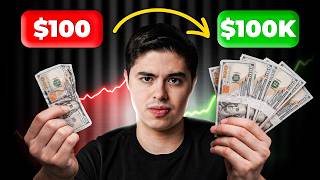

Start at 20 vs 35: The Shocking Difference
45sThe dramatic comparison of two investors with the same total contribution but vastly different outcomes immediately grabs attention and challenges common assumptions.
▶ Play Clip"Delivers a clear, engaging explanation of compound interest with a compelling example, though it includes some filler and a self-promotional plug."
This video explains the concept of compound interest, contrasting it with simple interest, and demonstrates its powerful impact on investments over time. It uses a comparative example of two investors to show how starting early, even with smaller contributions, can lead to significantly greater wealth due to the exponential growth of returns. The video also highlights the negative effects of compound interest on credit card debt and bad habits.
A person who starts investing at age 20 with $2,000 monthly for 30 years ends up with approximately $4,520,000, while someone who starts at 35 with double the monthly contribution ($4,000) for 15 years ends up with only $1,657,000, despite contributing the same total amount. The key factor is time.
Compound interest is described as a mathematical force that exponentially increases results, turning small actions into significant outcomes over time. The quote attributed to Einstein emphasizes that those who understand it win, and those who don't pay the price.
Simple interest is linear: you earn a fixed percentage on the initial capital each period. Compound interest is exponential: the return is added to the capital, so the base grows, leading to interest on interest. The formula for compound interest is capital times (1 + interest rate) raised to the power of time minus capital.
The concept applies beyond finance: going to the gym, building habits, and learning all compound over time. Small consistent actions lead to significant results, while procrastination punishes you.
To achieve compound interest, invest in instruments that reinvest profits, such as ETFs tracking the S&P 500 (e.g., SPY). The 10% average annual return is based on the last 30 years, with good and bad years but a positive average.
Compound interest is not exclusive to stocks. In fixed income, if you reinvest coupons and principal, you achieve compounding. The key is reinvesting profits to generate more profits.
Credit card debt compounds negatively. If you owe $1,000 and don't pay it off, at a 50% annual rate, the debt grows to $1,632.90 after a year, a 63% increase without any additional spending. This illustrates how compound interest can work against you.
Bad habits, like smoking or eating ultra-processed foods, compound negatively over time, leading to serious health issues. Conversely, good habits compound positively, improving your life.
Compound interest is a powerful force that can either build wealth or destroy it, depending on how you use it. Starting early, reinvesting profits, and cultivating good habits are key to harnessing its benefits, while avoiding high-interest debt and bad habits is crucial to prevent its negative effects.
What is the formula for compound interest?
Capital times (1 + interest rate) raised to the power of time minus capital.
01:55
In the example, how much does the person who starts at 20 with $2,000 monthly end up with after 30 years?
Approximately $4,520,000.
04:17
What is the key factor that made the first investor more successful despite contributing the same total amount?
Time (starting earlier).
04:44
What is the average annual return of the S&P 500 over the last 30 years?
10%.
05:28
How does compound interest work in fixed income?
By reinvesting the coupons and principal, so that profits generate more profits.
06:56
What happens to a $1,000 credit card debt at 50% annual rate after one year?
It grows to $1,632.90, a 63% increase.
08:49
What is the difference between simple and compound interest?
Simple interest is linear (earn on initial capital), compound interest is exponential (earn on reinvested profits).
01:13
Einstein's Quote on Compound Interest
This quote sets the tone for the video and emphasizes the importance of understanding compound interest.
00:46Time is the Most Important Factor
The example clearly shows that starting early is more powerful than contributing more money later.
04:44Negative Compound Interest on Debt
Illustrates how compound interest can work against you, leading to significant debt growth.
07:53Compound Interest in Habits
Applies the concept to daily life, showing that small actions compound over time.
09:14[00:02] The first one starts today at age 20. He doesn't have much money, but he contributes 2,000 a month for 30 years. The second one decides to wait until she has more money and starts at age 35. But to compensate, he contributes double each month, that is,
[00:18] 4,000 pesos monthly for 15 consecutive years. Both achieve an average annual return of 10%. They both end up contributing exactly the same total amount, but when we look at the final result, the difference is
[00:33] enormous. Stay here, I'm going to explain how compound interest literally prints millions for some people, but for others it leads to total ruin. Compound interest is the eighth wonder of the world. Those who
[00:46] eighth wonder of the world. Those who understand it, win; those who don't, pay the price. This is a famous quote attributed to Albert Einstein. And although it is not known for sure if she really said it, one thing we can be certain of, it is
[00:59] Compound interest is a mathematical force that exponentially increases results, meaning it turns small actions today into giant things over time. And it is this force that, in the right hands, can transform thousands into
[01:13] millions of pesos over time. But to talk about compound interest, we first have to talk about simple interest. The formula is very simple. Capital plus interest over time. That is, I invest 100,000 pesos at a
[01:26] rate of 5% per year for 5 years. The relationship here is great. It's a very simple operation because all you're doing is taking 5% of 100,000 and adding it up five times. Profits increase linearly because the
[01:39] initial capital remains stable, meaning you will always earn the same amount, 5% of 100,000. However, in the case of compound interest, something different happens, since the formula changes. The formula is capital times 1 plus interest
[01:55] raised to the power of time minus capital. This is no longer a direct multiplication, meaning that the growth is no longer linear, it is now exponential. And this subtle change makes all the difference. In finance, the
[02:10] the capital from which the return is obtained also increases over time. With simple interest, you could simply multiply 5% of 100,000 by five times. But that doesn't work here,
[02:23] since in compound interest from the second period onwards, the 5% return is added to the initial capital of the investment. That is, next year you won't get 5% of 100,000 again, but rather 5% of
[02:37] 5,000, which is the return from the first year plus 100,000 of initial capital, that is, 5% of 105,000 because the earnings from the first year were added to the initial capital and now the base is larger. In other words,
[02:52] initial 100,000, but on the final 105,000, because the profits from the first year will also generate profits. In year zero it is 100,000, in year 1 it is 105,000, but in year 2 it is already 110,250
[03:08] constantly, while in simple interest the result will always be linear, which inevitably makes compound interest generate a greater benefit in the long term. And this small change may not seem so
[03:22] important at first, since it makes no difference in the first year and is barely noticeable in the second, but as time goes on, the impact becomes increasingly greater. And what I love is that this also happens in real life. You go
[03:36] to the gym one day, it's no big deal. A week has passed, and nothing has happened yet. You go for a month, and something minor happens. But years go by and out of nowhere you become someone unrecognizable. There are decades where nothing happens and there are years where decades go by, but it all
[03:51] stems from the same root: taking action. Because compound interest is a force that rewards action and punishes procrastination. In the initial example, two people want to invest and both already know how to do it. But if you're
[04:04] still not sure how to invest, keep watching this video and I'll explain it to you right here. The first person started at age 20. It doesn't matter if it was with a lot or a little, but it started. He invested $ 2,000 monthly and in 30 years ended up with
[04:17] 2,000 monthly and in 30 years ended up with approximately $4,520,000. However, the person who decided to wait, who postponed the action and was stopped by the analysis, started at 35 years of age and even contributed 4,000 pesos
[04:30] monthly for 15 years, literally double. However, despite having contributed the same amount of money as Person 1, simply by starting Person 1, simply by starting late, he ended up with only 1,657,000.
[04:44] much monthly, he ended up earning less than half of what person one earned. They ended up in the same place, but one with much more than the other. And all because of the most important factor: time. And I know, I know that 30 years seems like a very long time and
[05:00] both you and I want money today, but both things are not compromised. Creating and multiplying are two processes that complement each other, not that repel each other. The years will pass anyway, and if you ask me , I prefer to arrive at any
[05:13] destination with more money. Now, the million-dollar question: what did they invest in way to invest directly in compound interest, since it is not an instrument in itself, but rather a mathematical effect that impacts
[05:28] do is invest in instruments that the 10% comes from the average annual return of the last 30 years of the SP500, which is an index that tracks the 500 most important companies in the
[05:43] United States, such as Apple, Microsoft, Nvidia or Google. To invest in the SP500 you have to buy an ETF such as SPY and that way you would be exposed to this type of company. Remember that 10% is not a fixed return, it is the
[05:58] annual average of the last 30 years. This means that there were good years and bad years, but the result is still the same. Now, why does the stock market or this TF have compound interest? It's easy because the
[06:12] profits are constantly being reinvested. If you buy a stock at $400 on Monday and it rises 2.5% during the day, it would be worth $410 by the end of the day, meaning that if it rises another 2.5% the next day it would end up at $420.25 because the
[06:30] most recent increase is calculated on the new base. Then, since the money is constantly being reinvested, the compound effect is generated. But this effect is not only achieved in the stock market; it is actually achieved anywhere
[06:43] where profits are reinvested in capital to generate more profits. For example, in Fixed Income, a 2-year bond with periodic coupons operates with simple interest if you collect those earnings and spend them, because you
[06:56] are always earning the same percentage on the same initial capital. The earnings from each period do not add up to the next, and that causes simple interest. one-year sets, collected your return at maturity, and reinvested in
[07:11] sets adding the initial capital plus the profits you generated, then you would have compound interest because you are reinvesting everything, capital and profits. Therefore, it's not about stocks versus fixed income, it's about allowing
[07:24] growth to compound. In compound interest, the past adds up to the future, and that is the magic and the most natural thing in life. Every day you go to the gym you don't train from scratch, but you build on previously destroyed muscle and
[07:40] every fiber destroyed strengthens the whole body. In other words, you don't go back to base the next day, but you constantly improve. But this compound effect can also work against you. Albert Einstein's quote
[07:53] makes sense because those who understand compound interest invest in it, whether in the stock market or any other compounding instrument, but those who do n't understand it pay the price, since negative compound interest does exist and
[08:06] is found in credit cards. Many people believe that nothing will happen if they don't pay off their credit card debt completely each month. And that's where the completely each month. And that's where the bank literally makes millions, because
[08:18] , the remaining balance generates interest, which then makes that same interest generate even more interest. If you owed 10,000 pesos and only paid 9,000, the 1,000 you were missing accrues interest. At an annual rate of 50%, which
[08:34] is common for credit cards, the first month you should pay 10,041.67. It does n't seem like much, but if another month goes by and you still haven't paid, by the second month you'll already owe $1,085.70, and after a year of not paying that $1,000 it
[08:49] would be $1,632.90 . In other words, your debt grew by 63% without you adding a single penny more. Similarly, bad habits in your life are broken. One cigarette a day
[09:02] may not affect anyone, but over years it causes cancer. Eating ultra-processed foods today won't make you gain weight, but over years it can cause diabetes, and so on with many other examples, because those who understand
[09:14] compound interest win, whether by investing or adding good habits, but those who don't pay it, either in debts with high interest or with bad habits. life, it is the small, constant efforts that change our
[09:29] reality. And not just a great, isolated effort. The drop does not pierce the stone by its force, but by its persistence. And understanding the power of compound interest will undoubtedly help you become a millionaire. But not
[09:41] only in money, also in health, love, and in anything you apply it to.


⚡ Saved you 0h 09m reading this? Transcribe any YouTube video for free — no signup needed.