
Why Money Has Value (It's Not What You Think)
60sChallenges common assumptions about money's value with a simple, thought-provoking explanation that viewers will want to share.
▶ Play Clip"Delivers a solid, comprehensive overview of financial terms as promised, though it's more of a primer than an in-depth guide."
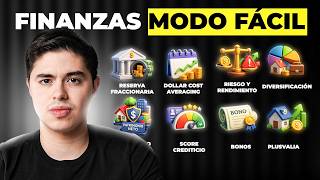
This video provides a comprehensive, beginner-friendly overview of essential financial concepts, from the nature of money and supply/demand to income types, taxes, banking, saving, investing, and wealth-building strategies. It aims to demystify finance for those who feel it's complicated, using relatable examples and clear explanations.
Only 36% of adults in Mexico have basic financial knowledge, and two out of three people experience financial stress, largely due to a lack of proper explanation of financial basics.
Money's value is not intrinsic; it's sustained by trust and government backing. Historically, currencies were backed by gold or silver, but today they are fiat, and if trust collapses, money becomes just paper.
Price is what you pay, value is what you receive. The example of a bottle of water costing more at the airport illustrates that price is determined by context and willingness to pay, not just cost.
Prices are determined by the interaction of supply and demand. High demand with low supply raises prices, while high supply with low demand lowers them, affecting everything from salary to rent.
Active income is earned by exchanging time for money (salary, freelance). Passive income comes without active work (rent, royalties, dividends). Both contribute to total income.
The government charges income tax (ISR) on earnings, which increases with income. Additionally, VAT (16% in Mexico) is embedded in the price of most goods and services, meaning you're taxed both when earning and spending.
Net income is what remains after taxes. Cash flow is the result of subtracting expenses from income. A positive cash flow is good; a negative one indicates financial trouble.
Banks don't store your money in a vault; they keep a small fraction and lend the rest to others. This is called fractional reserve, and banks profit from the interest rate spread.
Saving means setting aside money before spending, not keeping what's left. The first priority is an emergency fund covering 3-6 months of fixed expenses, for real emergencies only.
Liquidity is how quickly an asset can be converted to cash without losing value. Cash is highly liquid; real estate is not.
Debt used to acquire assets that generate income (business, rental property) is good debt. Debt for items that lose value (clothes, vacations on credit) is bad debt.
Your credit score is a financial reputation number. Paying debts on time increases it, while late payments decrease it, affecting your ability to borrow and the interest rates you get.
Inflation is the silent loss of money's value over time. For example, 50 pesos in 2010 bought 5 kg of tortillas, but today it buys barely two. To beat inflation, you must invest.
Investing puts your money to work. An asset puts money in your pocket (e.g., an investment that grows), while a liability takes money out (e.g., a car with maintenance costs). Wealth builders buy assets first.
Stocks are small ownership pieces of companies. Dividends are periodic payments from company earnings. ETFs are baskets of many stocks (e.g., S&P 500) offering diversification with low cost.
Bonds are loans to governments or companies that pay interest, generally safer but lower yield. Real estate can generate capital gains and passive income, but requires more capital. REITs (Fibers in Mexico) allow investing in real estate with small amounts.
Cryptocurrencies are digital, not controlled by governments or banks, with high potential but extreme volatility, capable of losing half their value in a day. Not for everyone.
Simple interest is calculated only on the initial principal. Compound interest is calculated on the principal plus accumulated interest, leading to exponential growth. Example: 1,000 pesos at 10% for 20 years yields ~7,000 with compounding vs. 3,000 with simple interest.
Higher potential returns come with higher risk. Diversification spreads money across different investments to reduce risk. Your collection of investments is your portfolio.
Net worth is total assets minus total liabilities. It's a true measure of financial health, regardless of income level.
Investing a fixed amount regularly, regardless of market conditions, averages out the purchase price over time. This strategy avoids trying to time the market, which is impossible.
Markets are cyclical: bull markets (rising) and bear markets (falling) are normal. Volatility is short-term price fluctuation. DCA takes advantage of volatility instead of fearing it.
Investing 200 pesos a month from age 25 can yield over 1 million pesos by retirement, but starting at 35 yields less than half. Time is the most valuable asset for building wealth.
The video demystifies finance by explaining core concepts in simple terms, emphasizing that financial literacy is accessible to everyone. It concludes that understanding and applying these principles, especially starting early and investing consistently, is key to building wealth.
What percentage of adults in Mexico have basic financial knowledge?
Only 36%.
00:13
What is the fundamental basis of money's value today?
Trust and government backing.
01:21
Define the law of supply and demand.
Prices rise when demand is high and supply is low; prices fall when supply is high and demand is low.
02:13
What is the difference between active and passive income?
Active income is earned by exchanging time for money (salary), while passive income comes without active work (rent, dividends).
03:06
What is the VAT rate in Mexico?
16%.
04:25
What is fractional reserve banking?
Banks keep a small fraction of deposits and lend the rest to others, profiting from the interest rate spread.
05:46
What is the recommended size of an emergency fund?
3 to 6 months of fixed expenses.
06:41
What is liquidity?
How quickly an asset can be converted to cash without losing its real value.
06:55
What is the difference between good debt and bad debt?
Good debt is used to acquire assets that generate income; bad debt is for items that lose value.
07:08
What is inflation?
The silent, constant loss of the purchasing power of money over time.
08:02
What is an asset vs. a liability?
An asset puts money in your pocket; a liability takes money out.
09:10
What is compound interest?
Interest calculated on the principal plus accumulated interest, leading to exponential growth.
13:52
What is diversification?
Spreading your money across different investments to reduce risk.
14:46
What is net worth?
Total assets minus total liabilities.
15:15
What is Dollar Cost Averaging?
Investing a fixed amount regularly regardless of market conditions to average out the purchase price.
16:10
Price vs. Value
Uses a relatable example (water bottle at airport) to clarify a fundamental economic concept.
01:34Fractional Reserve Banking
Reveals the often-misunderstood mechanism of how banks actually use deposits.
05:46Inflation Example
Concrete example (tortillas) makes inflation tangible and easy to grasp.
08:02Compound Interest Illustration
Clear numerical example demonstrates the power of compounding over time.
13:52The Power of Starting Early
Highlights the critical role of time in wealth building, a key principle for young investors.
17:20[00:01] believe that talking about finance is complicated, that to understand money you need to study finance, economics or something related. However, none of this is true. The problem isn't that it's difficult, it's that nobody has
[00:13] explained the basics to you properly. Only 36% of adults in Mexico have basic financial knowledge, and two out of three people experience financial stress. And all because of one thing: a lack of
[00:27] video I'm going to explain all the financial terms you need to know, from what money is to how to make it grow. Everything in one place. This is so that you can understand how money really works
[00:40] once and for all, because it's already in your life, you already pay taxes, you're already affected by inflation, and you already make financial decisions daily. The difference is whether you make them informed or blindly. Without further ado, let's get started. To understand everything that's
[00:54] to understand three concepts that are the foundation of everything. They sound simple, but I assure you that most people probably don't understand them clearly. I want you to think about this. Between a 500 peso bill and a wooden stick, the stick is physically
[01:07] more useful, but with the bill you can buy food. The question here is, why? Easy, because we all agree that it's worth something. Central banks issue it, governments back it, and we all use it to exchange things. But
[01:21] this wasn't always the case. Previously, many world currencies, including the Mexican peso, were backed by metals such as gold or silver. Today none of them are. The only thing that sustains the value of a banknote is trust.
[01:34] If we stop believing in him tomorrow, he's just paper and nothing more. We're talking about money. So why does a bottle of water cost 15 pesos at the supermarket, 30 pesos at the gym, and 70 pesos at the airport? It's the same water and the same
[01:47] bottle. What changes is not the content, but the place where it is found. If you're at the airport and you 're thirsty, there's no other option. And if you want to drink, you have to pay. It's not the cost, it's what people are
[01:59] willing to pay for music. As Warren Buffett aptly put it, price is what you pay and value is what you receive. You paid for a bottle, but what you received was the cure for your thirst. That's called courage. But who decides
[02:13] how much things cost? Imagine that 2,000 people want to buy apples, but due to a plague, only 500 are available today. The price obviously goes up. Now imagine there are 5,000 apples available and only 2,000
[02:26] people want them. The price naturally goes down. Demand is how many people want something. The offer is how many things there are for those people. If there is high demand and low supply, the price goes up. If there is a lot of supply and little
[02:39] demand, the price goes down. And that's how everything moves: your salary, your gas, and your rent. This is the law of supply and demand. Now you know why things cost what they cost and why a banknote is worth something. But now the
[02:52] question is, how does that money get into your pocket? Imagine you work a whole month without a break, your deposit arrives and you see the number, but when you check what you actually received it is much less than you expected. Because? Because a lot
[03:06] happens between what you earn and what you receive . We'll explain each one. money. The first way is the one we all know, exchanging your time for money. You work 8 hours and get paid a salary. You are a freelancer and you get paid per
[03:19] project. This is active income. But there is a second way. when money comes in without you working for it, a rent, a royalty, or a dividend. This is passive income and these two make up what we call
[03:33] you do the math on how much income you made, there's someone who's already taken their share and [music] that's the government. When you earn money, the government charges you a percentage of everything you generated. That charge is
[03:46] called ISR (Income Tax) and the more you earn, the higher that percentage is. [music] This is known as taxes, but there is another distinction that you have to really have to subtract what they charge you in taxes. And that amount, even
[04:00] without subtracting taxes, is known as gross income. And once you have your gross income, you have to subtract what the government took. If you earned 20,000 pesos in a month, the government takes approximately 2,600. In the end, you
[04:12] receive 17,400. That which you keep in your hand, what is truly yours, is known as net income. And when you go to spend that money on clothes, electronics, or services, those products already have a hidden charge in
[04:25] the price. This is called VAT and in Mexico it is 16% and applies to the vast majority of what you consume. In other words, the government charges you when you earn money and also when you spend it. Now, on the other side there's everything that goes out, your rent,
[04:39] [music] Some things have to be paid month after month, without exception. These are known as fixed expenses, but others depend more on your decisions and these are your variable expenses. And these two
[04:53] together make up what is known as expenses. If you subtract what actually get an amount. [music] If the result is positive, all the better. If it's negative, no matter how much you earn, [music] you're in trouble. That
[05:07] simple operation is your cash flow. At this point you've already earned the government and another part went to expenses. What you hold in your hand is what is truly yours, and what you do with it from now on is what
[05:19] separates you from someone who merely survives, from someone who truly moves forward. And the first thing most people do with that money is put it in the bank. But there's something that almost nobody knows about what goes on in there . Most
[05:33] money in the bank, it stays there. sitting in a vault waiting for you as if it were a safe with your name on it. But the reality is very different. And understanding how the financial system really works changes the way
[05:46] you handle everything else. If you deposit 10,000 pesos, the bank keeps a small part of it and lends the rest to someone else. Your money isn't being stored away, [music] is circulating. And this is called
[05:59] fractional reserve. But why do they do it? Because that's how they make money; they pay you charge a lot to lend it out. The difference is a business. It's that simple. This is a bank. But before you put your money in the bank, you first have to
[06:13] have it. And this is where most people fail. They think that saving means keeping what's left at the end of the month, but it's not. Saving is setting aside a portion before spending. It's the first thing that comes out, not the last. This
[06:27] decision to intentionally set aside money is saving. And what's the first thing you should save? Money you do n't touch unless it's a real emergency. Not a vacation, not a sale, a real emergency. Ideally, you should
[06:41] have 3 to 6 months of your fixed expenses saved. This is an emergency fund. But be aware that not all money is equally accessible. The money use today, but if your money is tied up in a house, you can't use it
[06:55] tomorrow. To convert it into quick cash, you would have to sell it below its real value. And how quickly you can convert something into cash without losing its real value, that's liquidity. Now, what happens when you don't have enough money
[07:08] [music] Here's something you need to know. Not all debt is bad. If will generate more money for you, such as growing a business or buying a rental property, that's good debt. But if you
[07:22] borrow to buy something that loses value the next day, like clothes or a vacation on credit, [music] that's bad debt. And the difference between the two can change your life. The general concept is debt. And when you
[07:35] borrow, there's a number that decides whether you get [music] lent easily or not. If that number is high, they lend you more and at a lower price. If that number is low, everything becomes more expensive or they simply won't lend to you. It's basically your
[07:48] financial reputation. If you pay what you owe on time, it goes up; if you fall behind on your payments, it goes down. That number is your credit score. Okay, now you know where your money is going, how to protect yourself, and how banks value you, but there's something that's affecting
[08:02] everything you've saved right now, without you even realizing it. And the fact is that with each passing day your money loses value, it literally starts to rot. With 50 pesos in 2010 you could buy 5 kg of tortillas. Today, with 50 pesos you can
[08:17] barely buy two. The money is the same. What's changed is how much you can buy with it. And that silent, constant loss of the power of your money is called inflation. And to beat inflation there is only one answer. The question
[08:32] is not whether saving your money is enough. You already saw that it isn't. The question is, what do you do with it to make it grow faster than it rots? If you already work hard for your money, you can also put your money to
[08:44] work for you. It's hard for you, without being present and without supervising it every day. This is investing. And if someone tells you that they need to be an expert to know what to invest in, they're complicating things. The main options are
[08:57] few and we will understand them in the next few minutes. But before you see what you can invest in, you need to understand something more fundamental. Not everything you buy works for you. Imagine two things. The first is an investment that
[09:10] do anything. Your money is there working and over time it increases in value. The second one is a car that just came out of the dealership. The moment you take it out it's already worth less, and every year that passes it still has value. Meanwhile, you're
[09:25] putting in gas, insurance, and maintenance. The first one puts money in your pocket, that's an asset. The second one, it takes it out, that's a liability. And be aware, just because it's a liability doesn't mean you don't need it. A car
[09:39] can be absolutely necessary in your life. The difference lies in knowing that you are buying it because you need it, not because it will make you rich. An asset works for you, a liability works against you, and those who build wealth
[09:52] buy assets first and use the income from those assets to buy everything else. And I want you to think about the following. Today you have more assets or liabilities in your life. Think about it carefully and leave it in the comments so that when you
[10:07] watch this video again in the future you can notice that the change started today. Now that that's clear, let's talk about the options. What's coming up are the main vehicles where you can put your money. They're not the only ones that exist, but they're the ones you
[10:19] need to understand before putting a single penny anywhere. To invest in a company, you don't have to buy the whole thing. You can buy just a small piece of the biggest businesses in the world. If the company grows,
[10:31] your piece is worth more. But if the company goes under, your little piece is worth less. You don't need to buy the entire company. With a small down payment you can already own it and you can start with just 20 Mexican pesos. That's what stocks are. And there are companies that,
[10:45] in addition to growing, pay you just for having them. They deposit a portion of their earnings into your account periodically. You don't have to sell anything. Just by owning a piece, you get money. These recurring payments are
[10:58] called dividends. But what if instead of choosing just one company you wanted to having to buy them one [music] by one, well this is possible. Imagine a basket that you can buy and that
[11:11] contains hundreds of companies, Apple, Amazon, Google and many more. And by buying that basket you get pieces of the 500 largest companies in the entire United States . All at once. If things are still going badly, it's not a big deal because
[11:25] If things are still going badly, it's not a big deal because you have 499 other companies backing you up. This is the simplest and cheapest way to make many investments at the same time. And these baskets are known as ETFS. What if you don't want to
[11:38] own any company, but simply lend them money? Well, you can do it. You can lend money to the government, the bank, or a large company. They return your money after a while and pay you
[11:50] safer than stocks, but it usually yields less. And this is a bonus. There do with the stock market. You buy a property, it increases in value over time, someone pays you rent every month, and you still own the asset.
[12:05] You need more money to start, but it generates capital gains and passive income month after month. It is one of the assets that has generated the most wealth throughout history. We're talking about real estate. And if you don't have the capital to
[12:17] buy a property, there is an instrument that pools the money of many investors. That money is used to buy large properties such as shopping centers, offices, or warehouses. And the income generated by those properties is
[12:29] shared among everyone. It's like buying stock, but for real estate. You can start with very little money and you're already participating in the real estate business without needing millions. These are the fibers. And finally, there is a
[12:42] completely out-of-the-box option. These are currencies that exist only on the internet, they are not controlled by any government, they are not backed by any bank, and they can but they can also lose half their value in a single day. This is the
[12:56] potential of all the ones we saw. It's not for everyone, but it's important that you understand what it is before making any decisions. We're talking about cryptocurrencies. Very well, you already know the vehicles. Now the question is,
[13:10] how exactly does your money grow within them? Let's start with the basics. whether it's a bank, the government, or a company, you get paid extra for basic version, that extra amount is always calculated on top of what you put in at the beginning.
[13:25] You invest 1,000 pesos at 10% per year for a period of 20 years. In the first year you earn 100, in the second year you earn 100, in the third year you earn 100. You will always earn the same amount. This is because the profit will always be calculated on the same
[13:38] 1,000es from the beginning. At the end of the 20 years you earned an extra 2,000 and ended up with a total of 3,000 pesos. It's not bad, [music] this is simple interest. However, there is another type of interest that really changes the game, because here
[13:52] your money doesn't just win, it multiplies. You invest 1000 pesos at 10% annually. The first year you earn 100 pesos and end up with 1100. The second year you no longer earn 10% 1100. The second year you no longer earn 10% on 1000 but on 11100, which is 110.
[14:06] on 1000 but on 11100, which is 110. You end up with 12,210. In the third year, you earn 10% on 12,210, which is 121. It seems like little, but in 20 years those initial 1,000 pesos become almost 7,000. same initial amount and same
[14:20] percentage of return. The difference is that your performance generates more performance, and so it multiplies. This is compound interest. However, every time you put your money into something, there is an exchange. The greater the
[14:33] chance of winning, the greater the chance of losing. There is no such thing as high profit without risk. And if someone promises it to you, run away. That relationship between what you risk and what you can gain is called the risk-reward ratio. And
[14:46] how do you protect yourself from that risk? Easy, by not putting everything in one place. If you put all your money into a single company and that company goes bankrupt, you lose everything. But if you divide it among several, when one falls the others will support you.
[15:00] Spreading your money to reduce risk is called diversification. And when you put all your investments together— stocks, bonds, funds, properties— all of that together as a collection, that's your portfolio. And how do you know if
[15:15] all this is working? It's simple: add up everything you have, your assets, and subtract everything you owe, your liabilities. The result is your true score, because you can earn a lot of money and still have a negative score if your debts are
[15:29] greater than what you own. That final number is your net worth. Look, all this knowledge is amazing, but it's not very useful if it's not put into action, so I need you to commit. At what age do you plan to start investing? Leave it
[15:43] in the comments. And if you've already started, help someone else who hasn't. Give your comments. This is how we build a better community and a better country. Perfect, now you have the options and the
[15:55] ways. Now what's missing is the strategy. But what strategy do people who actually build long-term wealth use? And pay attention time and tell myself just one thing about money, it would be what I'm about to
[16:10] explain to you, because this is what really moves the needle. Many buy when the price is low and of course, it makes perfect sense. [music] The problem is that nobody, and literally
[16:24] nobody, knows when it's going to be down or when it's going to be up. So, what do you do when you have this uncertainty? It's easy, you invest the same amount every month, regardless of whether the market is up or down. One
[16:37] month you buy expensive, another month you buy cheap, and your average price balances out over time. And this strategy is called Dollar Cost average. But why does the market go up and down? Because it's cyclical. There are times when everything goes up,
[16:51] people are optimistic, companies grow, and everyone wants to invest. And there are seasons when everything slows down, there is fear, people go out and the news is frightening. When everything goes up it's called a bull market, when everything goes down it's called a
[17:05] fair market. Both are completely normal, and the most expensive mistake you can make is to buy when the whole market is down just because you got scared. market, which sometimes happen in a single day, are called volatility. And that is
[17:20] precisely why the Costa Brush dollar works, because instead of fearing these movements, you take advantage of them. And we have arrived at the most powerful concept of all, and it is something you already have today. If
[17:33] you invest 200 pesos a month from the age of 25, assuming a return similar to the historical performance of the SP500, by the time you retire you will have more than 1 million pesos. But if you start at 35 doing exactly the same thing, you'll reach
[17:47] less than half. The difference isn't how much you invest, it's when you start. And the most valuable thing you have to build wealth is not money, it's time. And it 's your decision what you want to do with it. We started by asking what
[18:02] money is and ended with the strategy to make it grow. The entire trip in one video. If at first you felt that finance wasn't for you, I hope you now see that it always was. All that was missing was someone to explain them to you.
[18:15] As always, it's a pleasure to serve you, and we'll see you in the next video. Bye.



⚡ Saved you 0h 18m reading this? Transcribe any YouTube video for free — no signup needed.