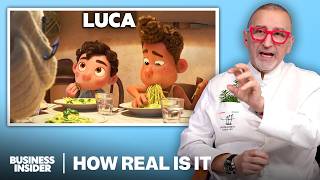

Michelin Chef Reacts to Pasta Scene
45sThe chef's passionate reaction to a cooking scene draws viewers in with expert critique.
▶ Play Clip"Delivers exactly what the title promises: a Michelin-star chef rating 21 scenes with authentic insights, though some ratings feel subjective."
Michelin-starred chef Cesare Casella evaluates the authenticity of Italian food scenes from movies and TV, offering insights into traditional Italian cooking techniques and ingredients. He rates each scene based on realism, from carbonara and pizza to tiramisu and lasagna.
Cesare Casella, a Michelin-star chef with 30 years of experience, introduces the video's premise: judging Italian cuisine in movies and TV for realism.
Incorporating flour gradually into eggs is an old-school technique used by home cooks, emphasizing the importance of method in fresh pasta.
Carbonara must use dry pasta, not fresh, to achieve al dente texture. Romans use guanciale (pig cheek) and the fat is essential for the right consistency.
Chef Casella uses all eggs and finishes cooking them with the pasta's heat off the fire, a technique that ensures creamy texture without scrambling.
Rates the carbonara scene 6/10, noting that ingredients are important but the execution in the scene may not be perfect.
The wrist movement is crucial in pizza tossing; it helps spread the dough, though not strictly necessary. There are world championships for pizza acrobatics.
In Italy, pizza traditionally has less cheese for balance, unlike American versions that often get complaints for not enough cheese.
Cucumbers on pizza are not acceptable; it's not a pizza. Pineapple is also controversial, but chef acknowledges some freedom in toppings, rating a pizza with french fries as not bad.
Rates the pizza scene 10/10 because while not traditional, it's realistic that you can find such pizzas in many places.
Gabagool comes from the pig's neck, is strong in flavor due to muscles and fat, and is easier to age than prosciutto, making it cheaper.
Gabagool, capocollo, and coppa are the same; the term 'gabagool' is an Italian-American blend. Chef didn't know it when he arrived in New York.
The Sopranos scene is very realistic; high production in the US uses more nitrates for safety, and cheaper products have more fat and nitrates.
Rates 10/10 because it accurately depicts Italian-American life.
Adding pasta back to the pot with sauce and butter is common; chef agrees with the technique but notes Italians typically use olive oil instead of butter.
Chef disagrees with 45 seconds; he cooks pasta in sauce for 2-3 minutes to enhance flavor, rating the scene 7/10.
Rabbit was a common meat in Italy historically because cows were for work and chickens for eggs; rabbits were cheap to raise and available for Sunday meals.
Use good wine when cooking; bad wine concentrates bad flavors. Wine adds acidity and flavor.
Chef shares personal experience of working with an injured arm, emphasizing necessity in professional kitchens.
Scenes involving killing and cooking rabbit are not very realistic; rating 8/10 for the recipe aspect.
Trenette al pesto is very realistic; it's a Ligurian dish with green beans and basil from that region. The director being from Genoa ensures authenticity.
Pesto Genovese is made with basil, pine nuts, cheese, olive oil, and a bit of garlic; it's the most traditional dish of Liguria.
The way they eat pasta in Luca is correct; using a fork to twirl spaghetti is proper.
In Italy, there are thousands of pasta shapes, each region has its own; basic shapes include rigatoni, spaghetti, tagliatelle, and penne.
Cutting the head off and cleaning the fish is realistic; the head may be sold separately or for stock.
Rates the fish scene 10/10.
Chef prefers room temperature meat, salted only, and cooked over wood fire or in a very hot oven to form a crust and retain juices.
Cooking steak in a very hot oven creates an envelope that keeps juices inside, unlike grilling which loses juice.
Three onions might be too many; balance between garlic and onions is key. Fresh onions are sweeter, while older ones are stronger.
Slicing garlic thinly with a razor allows it to liquefy in oil; cooking at low temperature confits the flavor, while high heat makes it smelly.
Rates the garlic technique 10/10 as it's perfect.
Timpano (or pasticcio) is a labor-intensive dish taking three days to prepare with multiple recipes; it's stressful because you don't know if it will come out perfectly.
Greasing the pot is crucial; if not done well, the pasta sticks and the timpano breaks. It's a stressful dish even for professionals.
Chef shares a personal story about receiving compliments from customers, highlighting his passion for making people happy through food.
The feast scene with suckling pig is a majestic banquet from the south; rating 10/10 for realism.
Traditional cannoli is sweet with ricotta and chocolate or fruit; savory versions with parmigiano are creative but less traditional, rating 7/10.
Chef acknowledges that starting with good ingredients and respecting them makes great dishes; adding tomato paste and parmigiano to Hamburger Helper is a good idea.
Rates the Hamburger Helper scene 10/10 for realism.
The techniques used by a non-professional are realistic; filling coming out is normal. A pizzaiolo would do it differently.
Calzone should have a balance of dough and filling; too much filling is common but not ideal. In Tuscany, calzone is only what's inside, like tomato, mozzarella, and ham.
Rates the calzone scene 10/10 for realism.
Use good canned whole tomatoes, never chopped or ground, as they are the worst. Fry garlic in oil, add tomatoes, and simmer.
Using sausage instead of ground meat adds seasoning and stronger flavor, especially if aged a few days.
Adding sugar is not standard but some people do it; chef prefers carrots or slow-cooked onions for sweetness.
Rates the sauce scene 10/10.
Eating spaghetti with a spoon is not correct; twirling with a fork is more authentic. Sucking spaghetti is more correct than using a spoon.
Avoid splashing by going slow and ensuring spaghetti is dressed properly; rates the eating technique 6/10.
Neapolitan pizza is cooked in very high ovens (800-900°F) for 90 seconds to 2 minutes. It should be eaten with hands, not fork and knife.
A good pizza should hold its shape when held; if it droops, it's not good. Avoid mushy Neapolitan pizzas.
Rates the pizza scene 10/10 as everything is perfect.
Tiramisu is like an Italian cheesecake made with mascarpone, eggs, and savoiardi. It's often made ahead to let flavors meld.
Dumping charcoal (cocoa) on top doesn't make it look professional; it's not correct from a professional standpoint.
Rates the tiramisu scene 10/10 for realism, though the tart-like version is unusual.
Boiling chicken makes broth and meat for a full meal; it's a practical cooking method.
In traditional Italian homes, the stove is always on, keeping coffee and broth warm all day. Women were the great chefs, like the chef's mom.
The father is the leader at the table; women often eat last after serving. This is a traditional family structure.
Herbs vary by region: Tuscany uses rosemary, others use oregano. You can taste immediately if they are present.
Fellini's films express real life in those years with attention to detail; rates 10/10 for authenticity.
The salad scene with whole lettuce and big tomato chunks is realistic for bad takeout places; rates 10/10.
Mozzarella in carrozza is a Roman dish with leftover bread, mozzarella, and anchovies, breaded and fried. The stringy cheese is a sign of good mozzarella.
Mozzarella doesn't melt as well as cheddar, but the stringy texture is characteristic when prepared correctly.
The lasagna scene is energetic and correct; each person does the right thing with the right ingredients.
Italian cuisine is not standardized; lasagna varies from north to south. Northern lasagna doesn't use ricotta or mozzarella, while southern does.
When tasting sauce, balance sweetness and acidity; adjust salt and pepper before building the lasagna.
Five to six layers of pasta are typical; the pasta should be rolled thin. There's a trend for 100-layer lasagna.
Rates the lasagna scene 10/10, saying it's better than many places.
Tortellini are hard to make by hand; they must be closed perfectly or they open during cooking. The sfoglina (pasta master) is particular about perfection.
Chef recalls crying in school when forced to make tortellini; he now ensures someone in his restaurant can make them.
Use the right flour, start with simple noodles like tagliatelle, and practice before attempting tortellini. Pasta making is fun.
The scene is cute and from the 50s; spaghetti and meatballs are cooked together with sauce on top.
For a main course, use equal parts pasta and meat (e.g., 3 oz each). Traditionally, meatballs are small, but American versions are bigger.
Rates 10/10 for realism and cuteness.
Chef's favorite movie is 'Big Night' for its energy. He shares his background: born in Lucca, took over family restaurant, gained Michelin star, moved to New York, opened Beppe, wrote books, and works at Center for Discovery.
What type of pasta should be used for carbonara?
Dry pasta, not fresh, to achieve al dente texture.
00:54
What cut of pork is traditionally used in carbonara?
Guanciale, from the cheek of the pig.
01:28
Why is fat important in carbonara?
The fat gives the right consistency to the dish.
01:44
What is the ideal temperature for cooking Neapolitan pizza?
800-900 degrees Fahrenheit, cooked for 90 seconds to 2 minutes.
23:56
What is gabagool?
It's capocollo or coppa, from the neck of the pig.
04:32
Why is rabbit considered a traditional Italian meat?
Because cows were used as tractors and chickens for eggs, so rabbit was cheap and available for Sunday meals.
07:22
What is the proper way to eat spaghetti?
Twirl with a fork, not with a spoon.
22:30
What are the ingredients of Pesto Genovese?
Basil, pine nuts, cheese, olive oil, and a little garlic.
10:14
Why should you use good wine when cooking?
Because bad wine concentrates bad flavors when reduced.
08:17
What is the traditional filling for cannoli?
Ricotta, with chocolate or fruit.
17:40
How long does it take to prepare a timpano?
Three days to prepare all ingredients and one day to assemble.
14:36
What is the role of the sfoglina?
A pasta master who makes pasta by hand, particularly tortellini.
35:22
What is the recommended ratio of pasta to meat for a main course?
Equal parts, e.g., 3 oz pasta to 3 oz meat.
37:33
Carbonara Rules
Emphasizes the strict traditional rules for carbonara, including dry pasta and guanciale.
00:54Pizza Freedom
Chef acknowledges that while traditional pizza is important, some freedom in toppings is acceptable.
03:49Wine in Cooking
Highlights the importance of using good wine to avoid concentrating bad flavors.
08:04Garlic Slicing
Demonstrates a professional technique for slicing garlic thinly to confit its flavor.
13:10Neapolitan Pizza
Explains the high-temperature cooking and hand-eating tradition of Neapolitan pizza.
23:41Regional Lasagna
Illustrates the lack of standardization in Italian cuisine, with regional variations.
32:28Chef's Journey
Personal story of a Michelin-star chef's career, adding credibility and human interest.
38:16[00:00] You start out with a little bit of oil. Then you throw in some tomatoes, some tomato paste. You fry it. You make sure it doesn't stick. It's a better to use a good canned tomatoes. Never chopped tomatoes or ground tomato. Never. Ciao. I'm
[00:13] a Cesare Casella. I'm a Michelin-Star chef. I cooking Italian food for the last 30 years. Today we looking at Italian cuisine in a movie and TV and then we judging how real they are.
[00:37] You put inside, you beating inside because you want the incorporate the flour little bit at a time. So that is a the old school, the housewife or the cooker, the home cook.
[00:54] Carbonara is another dish that it [has] rules. It's a dry pasta and not fresh pasta. Dry pasta is al dente and the eggs [in] fresh pasta,
[01:10] it's a very difficult to be al dente. Al dente is perfectly cook pasta. First of all, uh, no, I think the Romans, they're going to be upset. Look like it is
[01:28] a weird meat. The look like almost like a type of prosciutto. The Romans, for the carbonara, it's a religion and they have a very specific recipes. They use guanciale. So
[01:44] from the cheek of the pig. What is good carbonara (or amatriciana) is when you make it with the guanciale or pancetta. Must to be fat because the fat is what that gives [it] the right consistency.
[02:09] For me, the carbonara, I use all eggs. And then I like to finish to cook the eggs with the pasta. So I take out from the fire and then with the heat of the pasta,
[02:25] you cook the eggs. I rate this six [out of] ten. So the ingredients, that is important. Your wrist. It's all in the wrist. Not too high! How you throw the pizza? How? You don't need to
[02:42] make it that way, but it's helpful when you spread the dough. There are championships, world championship, for the pizza...when they...people dancing with the pizza,
[02:56] for their ability to do [it]. Cheese. Not too much. The pizza. There must to be a lot of tomato, a lot of cheese and then in Italy, traditionally,
[03:09] is less cheese for two reason. Why? Because it is a balancing what is there. But if you do here sometime you can have a complaint: Why is there not enough cheese? It's cucumbers. No. No
[03:23] you can't put a cucumbers on a pizza. Why not? I like cucumbers. That's not a pizza. It'll taste-a terrible. It's [like] people that put the pineapple. I remember three or four years ago,
[03:36] I went [with] some of my friends, brought to my home town. And then this pizza place they get the pizza with the french fry on top. What? And then I needed to taste,
[03:49] and it wasn't bad! So some freedom to do something, I think is real. So it's a 10 because the pizza maybe is not real but you can go in to every place to find. Gabagool, over here.
[04:08] Sopranos is, sometime they exaggerate, but it's the real life, the everyday. The gababgool, it comes from the neck of the pig and is a part
[04:20] where it is very strong because there are a lot of muscles and but the fat too. The aging [is] very easy. And then there was, the meat wasn't so expensive like the prosciutto.
[04:32] Gabagool, capocollo, or Copa, they are the same. Because sometimes, the language it's when they blend, some language
[04:50] between Italia and America. When I arrive in New York there was a gabagool and I didn't know what it was. It's a prosciutto, but call prsoscuit. Tony gabagool grandma, it's nothing but fat
[05:04] and nitrates. I think it is very realistic. In the US when they make a very high production, what they doing there was a make a very high nitrate for to make it to be safe for the scare.
[05:21] So that is a why because...true; to more cheap the product is, more fat and more nitrates to make sure they are safe. It's a 10 because it's a Italian-American life.
[05:39] Now this is the most crucial part. You put the pasta back in the pot. You add a little gravy. It's fun. And a little butter. The Italian community normally they use
[05:52] more olive oil the butter. So he added butter. Because that is a French recipe, they use butter. So the butter was something for me that I don't know how much is a real. You put
[06:08] the fire back on for 45 seconds and stir it up real nice. Yes, that I agree 100%. I don't think that is enough 45 second. I think I doing, I put in there two/three minutes because I try to cook
[06:29] less possible in the water and then I'm going to add a finish to cook in with the sauce. If you give a little bit more the sauce, the pasta can be more flavor. I think it's seven. 7/10.
[06:54] Mother---. He's upset because the rabbit they eat everything in the garden. I agree with him because when, between woodchuck or rabbit they eat, and they eat the rabbit. Arthur, a lot of
[07:10] people don't like rabbit. My grandfather's way only with provincelo I've been thinking about. I think the people they like rabbit more than what we think. Many people they connect the rabbit with
[07:22] the bunny. A lot the bunny, especially for kids. So that is a little bit more difficult. But in Italy if we talk [about] a long time ago, that was practically the only meat they eat because
[07:35] the cows they was the tractor. The chicken, you have a lot of chicken but for eggs. Rabbit they was easy to be the food of the Sunday because you raise the rabbit with non too expensive because
[07:52] they eat the grass. So the rabbit there was very available for the meat that you want to eat.
[08:04] The wine it's important when you cook. One the acidity and the second, what they add is the flavor from the wine. In fact when you cook, you want to use a good wine. Now normally
[08:17] the people they cooking and they try to use the worst wine or the wine that cost $2. You want a good wine especially because it's a good wine you keep all the flavor. When the
[08:29] bad wine reduce they're going to be more bad because you have the concentrated bad wine.
[08:44] Yes, there was a time that I hurt my arm, I can't use. So there I know was not 100% effective but I
[08:56] must work because I was the head chef and the owner. So if you need to work then you can't work because it's a difficult to work only with one hand. The fact that they take the
[09:11] recipes from the grandfather maybe eight. You know the killing the rabbit and the cooking, they are not so realistic. Trenette del pesto. The scene is very very realistic. Trenette pesto is,
[09:30] in Leguria they have the trenette, they are made in the very traditional way with the green beans. And then the basil that is from that region. And then the director is Italian
[09:43] is from Genoa and then for that he want to be very specific and very particular very realistic in the what is the ingredients that they have. Liguria and near Genoa is
[09:58] that where they grow the perfect basil because of the air from the ocean and they where they growing this basil. The speciality is this pesto. Pesto al Genovese is a basil, pinoli, cheese,
[10:14] and olive oil, a little bit of garlic. And this is the most traditional dish from all Liguria.
[10:29] The way they eat the pasta, they know and then teaching about the pasta that you use the fork. If you see in Luca at how they correct they make...it'ss there. It's a correct. And then
[10:43] it's a when you going around you try to have more spaghetti possible. Wait what? Every year they change the pasta. You have to be ready for anything. Could be cannelloni,
[10:58] penne, fusilli, trofie. Even lasagna. In Italy we have it so thousands. because everybody they...hey, each region they make in this way. The basic from a rigatoni, spaghetti,
[11:13] tagliatelle, penne. So you cut the head and then you have the rest of the fish that you clean. Maybe the head they going to sell separate or maybe they sell it for the cuts. I
[11:29] rated this a 10. I'm sorry you choose. It's your fault. He didn't choose something, something bad. Johnny Dio did the meat. We didn't have a broiler, so Johnny did everything in pans. But
[11:42] he still cooked a great steak. No, you can cook a steak in the pot. For me, when I cook my meat, I want it room temperature. And after it's at room temperature, I put in the fire. I don't put
[11:54] the salt, pepper, anything. I salt only. And then the meat. If there are pot or broiler, I prefer a wood fire. My home town in Luca, I used to go to it in this pizza place and he make the steak
[12:09] inside the oven. It's one the best way to make it because the power from the bottom and the top and you have this fire that comes between the two and they form a crust on both sides. Then in the grill
[12:25] they're going to lose the juice. The steak when they put in the oven and they create this envelope around and all the juices inside. Vinnie was in charge of the tomato sauce. Three small onions.
[12:41] That's all I did. Three onions? I felt he used too many onions, but it was still a very good sauce. You need to have the balancing between what is the garlic, the onions. And the onions sometime they taste different because if they are fresh onions they harvest from not too long,
[12:57] is a more sweet. In the spring or in the summer time you have these onions that are much more strong. So it's a very...it's a one [of those] ingredients that you won't check very well. And
[13:10] he had this wonderful system for doing the garlic. He used a razor and used to slice it so thin that it used to liquefy in the pan with just a little oil. When they slice the garlic with the razor, the slice of the garlic is important because it's how the part of the garlic they have a contact
[13:27] with the the oil. At the same time it's important the how you cook the temperature. For example, slicing that away and then you cook at a very low temperature, you confit the flavor. But if
[13:43] you cook it very high, you're going to have this smelly flavored garlic that you continue to have in your mouth for all dinner. In this case, it's a good. A 10...that can be...it's a very perfect.
[14:05] That is pasta. It's a pasta you make...from there you make a to that case they don't cut, but you start with the materella with the pin roll pin you make the pasta
[14:18] there today you make it with the with the machine. Yes I made timpano before and in my Tuscan way. Practically call timpano,
[14:36] timpano, or pasticho. But take all these [guys] three days to prepare because there are six seven eight different recipes. Depends how many ingredients you put inside.
[14:58] Because you don't know when you open, you take [it] out, you don't know if it's broken or what's happening. So it's stressful. When you make a timpano or pasticho, all the time it's a unknown, especially when it's are so big. When you grease the pot,
[15:17] some spot small stay there, the pasta still stick there, they don't come out. So it's a very stressful because you work three days to prepare all the ingredients, one day to put everything
[15:35] together. Not all the time they come out perfectly like this. I believe they tried many times. God damn it. It's so good I should kill you.
[15:53] Sometime I see manager coming to call. "There is a customer at table 32. They have a complaint for you." And then you going to the table already ready for [them to] tell
[16:06] something...it was so fantastic. So I was lucky and I get a lot [of the] same response in the back. So I born in the restaurant and then that is a something making me happy. And
[16:20] then cook and make a happy people. This is what my life [is]. It's-a beautiful.
[16:35] It's like a private party. It's like a feast. So they try to send out everything they have in the house to make like an important banquet. And then they send out the tomato, the artichoke,
[16:50] and then the pig. The pig there was a look nice because the suckling pig it's something considered like a delicatessen. So and no and then it's a food from the south, this like a
[17:07] majestic banquet. I think it can be 10 by 10. I can understand the fact of what they [are] doing and then the frustration they have. I think the timpano they did it in a perfect way.
[17:23] I've been thinking about cannoli and more specifically savory ones. Okay. It's got the mortadella moose parmesan shell. Yeah. Yeah. Dipped in pistachio. That's something. Traditional cannoli is a dough that you make this tube and then you
[17:40] fill up with the ricotta and then inside you can put the chocolate, you can put the fruit under the sugar. So it's a sweet but they keep the flavor. Special savory dish. Wow. Wait one second. This one is a little bit of all of us.
[17:57] It's a very interesting the cannoli they make with the parmigiano. I feel that is a real cannoli because they are so perfect. The parmagiano tube, it's a more difficult to make. He created this
[18:12] dish with some ingredients from everybody. So they put the salmon eggs, they put the pistachio. It's a nice when you can make your team feel part of the team. I think this is a more American-Italian,
[18:29] Italian-American. Because this is supposed to be fancy, I think maybe seven [of] 10. At that house it is not... I didn't know that what
[18:44] was "[Hamburger] Helper." I did the research. If you start with good ingredients and then you respect the good ingredients, you make great dishes. I'm about to add some tomato paste to deepen the flavors and make it taste basically like it did
[19:02] not come out of a box. Because Sydney, she's a great chef. So, she tried to make this little bit more upscale to add the tomato paste and the parmigiano. So, I agree with her.
[19:15] I'm curious and maybe one day I cook and I taste. How much is a realistic is a 10 by 10, these two. And seal the edges by crimping with a fork. Ah crap.
[19:28] I think the techniques they use is for nonprofessional because he is nonprofessional. It's the right way that he's doing [it]. Here you see the filling come out, I feel that is
[19:40] very realistic. If he was in the pizza place, the pizziolo doing this, that is ridiculous. that is its own container. It's a whole new spin on Italian fast casual dining.
[19:56] I like a calzone. Many time the calzone, there are too much stuff inside. Because I like for me the one is the balancing the dough, but many time this mountain with it inside. Now
[20:10] you of all people will like this. I'm going to use lowfat ingredients. Game changer. The calzone depended where you came from Italy. Where I come from in Tuscany, the calzone is only what you have inside — the tomato, the mozzarella, and maybe some mushroom,
[20:30] prosciutto cotto, cooked ham. If you like the pizza with the cucumber or you like the pizza with the pineapple or the margarita. It depends what you put inside. It is the same. Okay, I rate this a 10/10 because it's very realistic.
[20:47] You start out with a little bit of oil and you fry some garlic. Then you throw in some tomatoes, when you make a sauce, it's a better to use a good canned tomatoes because it's a
[21:01] more difficult to find good fresh tomatoes. It's easier to find good canned tomatoes. I try to use a good canned tomatoes. Never chopped tomatoes or ground tomato. Never. Because that is
[21:14] the worst tomato that you can have. When it is the whole tomatoes, it's where you want to go. You get it to a boil. You shove in all your sausage and your meatballs. The idea for him to use the this sausage instead of using the ground beef or ground
[21:33] pork because the sausage already has a seasoning. If you have the sausage that you have already ,few days or whatever it is at the time, the stronger flavor.
[21:46] And then you put the sugar. Is that a standard Italian cooking? It's not standard but is a people they are...they use sugar. Like a normal. And there is
[21:59] a people they say that sugar is a no good to use the sugar inside. For me instead of sugar I put maybe the carrots or I cook very slow the onions and the carrots;
[22:12] they help to be more sweet without to put the sugar. I think they are real. I rate 10/10. Now remember you're getting off easy because we haven't got sauce. Yeah.
[22:30] You no eat with the spoon. The spoon is a very rare but you no eat with the spoon. Sucking the spaghetti is almost more correct that they no eat with the spoon. Look more chic to use the
[22:46] spoon but many people they use because they look they are more correct. But they are not correct. That it [to] make it more easy for somebody but no eat spaghetti. Eat something else. It's like
[23:03] somebody [if] they eat risotto with the spoon. It's the same. Risotto you eat with the fork. I'm going to say splash anytime I see problems. Splash. You just
[23:17] You no splash if you're going slow and you try to get the spaghetti to be already dressed in the right way. I can rate six how they eat the spaghetti.
[23:41] First of all, I love the movie and I love the pizza. This is Michele, the pizzeria. And the pizza they eat, if you see, is very good. What is the pizza napolitana? They cook in very high oven.
[23:56] So 800, 900 temperature. So is so high. And they cook in the oven 2 minutes, 90 seconds, 2 minutes.
[24:10] One way to judge the pizza, it's that you need to keep it in your hands. So if they [pizza] going down, means the pizza they are no good. Sometime today you find these napolitana
[24:26] they are mushy. The pizza you need to eat your hands. Pizzas are not to eat with the fork and knife. These are the hands. What are you doing? I rate this 10. Everything is a [perfect].
[24:43] Yeah, it's a very realistic. The tiramisu are very bad. Where are you judging all of these? How realistic, it's the fact the what's happening? Or the product is made in the right way? Tiramisu,
[25:02] it's a something like a call in some way the Italian cheesecake. I don't know, somebody going to kill me, but it's mascarpone. Instead of using cream cheese. And then you put inside eggs, the the savoyardi.
[25:20] Aover with charcoal the whole thing. Just dump it on. Serious. Okay. And now it looks professional. That is not right. From a professional point of view,
[25:34] no, if you put a cacao in top, it doesn't make it look better. The fact is very realistic how real you you you can make, because the guy they
[25:52] did a very good [job]. I don't know what type of tiramisu is this because this is more like a tart. The tiramisu you use in mascarpone or use somebody use a cream, a heavy cream
[26:07] and then lady finger. If you look at this it's a perfect. They don't need to set overnight. Some people they can make the the tiramisu and in the moment. I prefer maybe not overnight but
[26:23] the few hours deep with the every flavor they're coming together. I think I can rate this a 10. When they say to use the chocolate you put in top everything and make it well, it's not true.
[26:47] They look like the boiled chicken. So you make a boil. So in that way you have the broth plus the meat from there and then you can have a full meal.
[27:08] They was doing laundry because the the stove in the house like this where a lot of people they are on 24-hour day because you keep the coffee there,
[27:20] you keep the the broth to make the the soup all day. The women cooking. My mentor is my mom. I went to cooking school but I still today to cook with the the idea
[27:39] and what is the food in my mom in Italy the mother the women there was the great chef.
[27:51] It's not so much that you take what you want. So the father is the leader and then you need for him to give it to you. I remember when I was a kid in the family, to have my grandfather, my uncle and to be there, you must to eat at
[28:10] the table at that time. Many times what's happening the women who work in the kitchen and they continue to work and then they [are the] last people that sit down at the table.
[28:29] I think the herbs depends where you come from in Italy. In Tuscany, is a lot like rosemary we use. Other parts more oregano. You taste it right away if they are there or not.
[28:45] "Amarcord" is from Fellini and every movie from Fellini, they're a little bit interesting,
[28:57] but at the same time what it is, they express really what is the real life in those years. And you see the details. What is in the wall. What is in the stove. I need to rate
[29:10] it is a 10 because they have everything and then there is not one thing wrong. okay four pizzas and a salad. Salad? How do you make a salad? First you throw in the whole head
[29:22] of lettuce. Even the hard to eat white part at the bottom? That's what the people want. Yeah, I have... I think I have had a lot of bad salad or bad take out for different reason. I had a lot of bad food in here and in Italy, too.
[29:38] What about this tomato? Cut it into thirds. It should be big enough to but you can't really eat them. No problem. Dump them all in. Yeah. they use this oil. They are greasy. I think there are bad places in Italy. But because I
[29:57] think the people in Italy, they know more what is a good pizza or what they like. on top of the pizza so it stays nice and warm. Hello, every pizza place.
[30:09] This is what you find. They come from some takeout place and they you order and they deliver it to you and this is what you find. It's-a real. You can write this: 10!
[30:32] And they use the hands. And the mozzarella en carrozza, it's made perfectly, with the string that came out. It's how it's supposed to be. Like that is a right. Meaning the mozzarella
[30:48] was very good. Many times time when I was a going with my father, especially we going to the market to buy vegetable for the restaurant, we used to go to eat and it was the same way.
[31:08] The mozzarella makes a good cheese from melting. It's not the best melty cheese like the cheddar that can be melt better, the American cheese, but in the way they are making this string it's the way they are prepared because that is the way they make
[31:26] where they come and make this string when you cook [it]. In Rome, very specific from a Rome, mozzarella en carrozza is just mozzarella so you take the bread the leftover bread the and then you
[31:40] put the inside the mozzarella and then you can put anchovie because that gives it much more flavor. And then you put that in the flour, eggs, and you fry. This is more realistic. I can rate 10.
[31:55] Ladies, thank you so much. I need that dough. It's so energetic, so happy. Each one doing the right thing. The right ingredients from
[32:12] the tomato sauce, the lasagna. It's a correct. All they make the eggs, the flour, the tomato sauce, they are correct. You weigh it and then you try to use that. The French cuisine,
[32:28] they are very standardized more the kitchen have the codification. The Italian cuisine, the lasagna, they change from a north to the sud (south). Never
[32:40] somebody in the north in the house make a lasagna with ricotta. In the south, they make ricotta. They put mozzarella too. But if you going the north, they don't use mozzarella.
[32:55] And then practically you use what you like. Is a very flexible. So there not really one recipes. Taste that. Is that too sweet for you?
[33:09] When you test the sauce, you want to be not only sweet. If too much acidity, [there's] not too much to do, but if salt, pepper, it's a very in important to [balance] before you build the lasagna.
[33:27] All I see are magnificent ribbons of perfection. Five, six layers [in] the pasta. How they make the pasta from the machine,
[33:42] it's in the in the way that you want. In the oven, you see when they put. So now there's a trend in where there's 100 layer lasagna. And then the lasagna, you look at the lasagna is a perfect. It's a everything that you want [with] the ingredients
[33:59] and the product to make the lasagna. The perfect lasagna is a for each one can be different. But when we talk before about it's like a orchestra. They need to be this balancing in the ingredients
[34:14] they make together from the cheese, the pasta, the sauce inside. This was so happy. I need to I need to rate this 10/10. I think they made the lasagna better than in many places.
[34:38] It's a very realistic that. The techniques they use is a very good technique and the way they roll the pasta is the perfect way, is how you doing with the mattarello.
[34:55] They make the tortellini. The tortellinis are very hard to make by hand. The way that you close them, because they need to be perfectly. Because when you cooking if you don't close perfectly they open and then they're going to be something else. Bruto.
[35:22] So the lady, the pasta boss, la sfoglina, it's a the teacher. The master for to make the pasta. They are very particular very the perfection. When I was in school,
[35:39] they make me to do this one day. They make I was a cry because I can't work in that way. From that day I want every restaurant, I always make sure...or I buy from somebody...or
[35:53] I have somebody in the restaurant they know how to make. And that is a for Christmas, in most of the the menu the in the houses, you have the tortellini. You see how they need to
[36:07] be very particular in the way they make in the way that you close. I think this it's a way that she check, "this brutto this good, this..." because really it's art.
[36:29] If you have to make a pasta, [here's] some tips. It's important to use the right flour. Not every flower is right. And then don't go right away to tortellini. Start before with some simple noodle,
[36:44] tagliatelle or something else. And then it's fun to make pasta is fun. And then...but if you want to go something more difficult you need to have practice. I rate this 10/10.
[36:58] He says he wants two spaghetti speciale heavy on the meatball. You the boss. It's just so cute. I think it's from the 50's. And then they spaghetti meatballs and then the
[37:17] way they cook together, you know, put the sauce on top look like the you know what they do.
[37:33] The proportion the meat pasta in the sense that the pasta is a from main course so you want to use a more meat. For me like if you use 3 oz pasta, use 3oz meat. Like I say,
[37:48] in Italy today it's a more popular that what it was. Traditionally we make a very small meatballs and then the only difference they are bigger and then here they are more. They
[38:01] become more popular because is a easy food is a protein that don't cost too much when they cook. From the pot they take is the sauce inside, so is a correct and is so cute. I rate 10 to 10
[38:16] My favorite movie that we saw today. it was "Big Night" because the what is the energy....the when they come out it's a great great movie. I [was] born in Italy in Luca. <y
[38:29] parents have a restaurant. I took over the restaurant. My family restaurant in Luca was a 'Vipore.' I gained the Michelin star. I moved to New York because New
[38:42] York was my dream life and I open my my first restaurant in New York was 'Beppe.' And after that I open couple more restaurant. I did a show in Rome with Anthony Bourdain. I wrote
[38:55] a few books and one is "Diary of a Tuscan Chef." Now I spend my time at the Center for Discovery in upstate New York and I work in the program, the food farming program. They are
[39:10] working for the special needed people [there]. Long time, it's 20 years that I'm involved.



⚡ Saved you 0h 39m reading this? Transcribe any YouTube video for free — no signup needed.