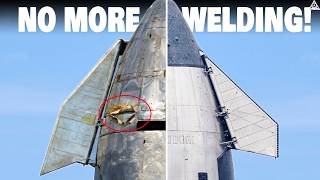

Welding Starship: 100x Harder Than You Think
45sImmediately contrasts the immense challenge of welding a skyscraper-sized rocket with the thinness of paper, creating an engaging hook.
▶ Play Clip"Delivers on the promise of explaining SpaceX's welding mastery, but includes some fluff and a call to action."
This video explores how SpaceX transformed its welding techniques to make Starship reusable and reliable. It traces the evolution from the rough Starhopper prototype to the sleek Starship 39, highlighting the critical role of welding in surviving extreme temperatures and pressures. The narrative covers the shift from FCAW to advanced methods like laser welding and friction stir welding, along with material upgrades and rigorous inspection.
Welding Starship is extremely difficult due to its size, thin steel skin, and extreme temperature swings from -183°C to over 1000°C. A single uneven weld could cause structural collapse.
Starhopper, the first ancestor, had ugly, messy welds and looked like a rusty tin can. It was built using FCAW (flux-cored arc welding), which is fast and cheap but not suitable for rockets.
Welds are the weakest points, especially under cryogenic contraction and violent vibrations from 33 Raptor engines. Microscopic cracks can propagate and cause catastrophic failure.
In November 2019, Starship Mark 1's tank ripped apart due to poor welds, serving as a wake-up call for SpaceX to improve welding and materials.
SpaceX switched from 301 to 304L stainless steel, which has lower carbon content, reducing brittle precipitates and improving toughness at cryogenic temperatures by up to 4 times.
SpaceX developed its own stainless steel alloy called 30X, which outperforms 304L in strength, weldability, and performance under extreme conditions. Its composition is a closely guarded secret.
Tip Tig welding uses a mechanically fed and vibrated filler wire, resulting in narrower heat-affected zones, deeper penetration, and less distortion. This allowed thinner plates and a 20% mass reduction.
The planisher hammers completed welds with mechanical force to compress metal grains, restoring strength and hardness, and flattening the weld for a mirror-like finish.
SpaceX adopted handheld laser welders in 2023-2024. Laser welding focuses heat into a tiny spot, minimizing warping. Destructive testing showed the weld was stronger than the base metal.
Within 30 days of testing, over 100 laser welders were deployed, and the tech was integrated into robotic arms (KUKA and Liberty) for circumferential welds, increasing production speed 5-6 times and reducing mass another 20%.
Friction stir welding does not melt the metal; it stirs it in a plastic state, avoiding solidification defects. This produces welds with properties nearly identical to the parent material, crucial for propellant tanks.
Every weld is x-rayed, ultrasonically scanned, and dye penetrant inspected to detect microscopic flaws. A single missed defect could lead to failure under cryogenic pressure.
The Space Shuttle's SSME engine was a manufacturing nightmare, costing $40 million each and requiring extensive maintenance. SpaceX aimed to avoid that by innovating welding and materials.
SpaceX's mastery of welding, from material selection to advanced techniques like laser and friction stir welding, has made Starship significantly lighter and more reliable. This innovation is key to achieving reusability and reducing costs, setting a new standard in aerospace manufacturing.
What was the initial welding process used for Starhopper?
FCAW (flux-cored arc welding), which is fast and cheap but not suitable for rockets.
03:14
Why did SpaceX switch from 301 to 304L stainless steel?
304L has lower carbon content, reducing brittle precipitates and improving toughness at cryogenic temperatures by up to 4 times.
04:21
What is the proprietary alloy developed by SpaceX for Starship?
30X, which outperforms 304L in strength, weldability, and performance under extreme conditions.
05:04
What is the function of the planisher?
It hammers completed welds to compress metal grains, restoring strength and hardness, and flattening the weld.
06:27
How does laser welding differ from traditional TIG or MIG?
Laser welding focuses heat into a tiny spot, minimizing warping and producing welds stronger than the base metal.
07:20
What is the advantage of friction stir welding?
It avoids solidification defects, producing welds with properties nearly identical to the parent material and high fatigue resistance.
09:31
What inspection methods are used on Starship welds?
X-ray, ultrasonic testing, and dye penetrant inspection.
10:52
How much did the Space Shuttle's SSME engine cost?
Around $40 million each.
12:40
40% Weight Reduction
Welding improvements alone made Starship 40% lighter without losing strength, a significant engineering achievement.
08:35Weld Stronger Than Base Metal
Laser welding produced welds that tore the base metal first, demonstrating superior strength.
07:49Inventing Custom Alloy 30X
SpaceX developed its own alloy when the market didn't meet its needs, showcasing their innovative approach.
05:04The Planisher's Genius
A simple mechanical hammering technique restores weld strength, a clever solution to a complex problem.
06:27Learning from Space Shuttle's Mistakes
SpaceX avoided the shuttle's costly manufacturing approach, aiming for reusability and lower costs.
11:45[00:01] hard. Welding Starship is a hundred times harder. This is a vehicle the size of a skyscraper wrapped in a skin of steel as thin as a sheet of paper built to be fully reusable facing temperatures that swing from hundreds of degrees
[00:15] below zero to over a thousand degrees Celsius. Just one uneven weld could send the entire structure collapsing in an instant. But somehow SpaceX pushed its welding technique and technology to the point of true mastery. And now this
[00:31] rocket is closing in on something once unthinkable, flying dozens of times without a scratch. So, how did they pull this off in such a short amount of time? That's a journey worth telling. Look at this. This is Starhopper, the very first
[00:45] ancestor of Starship. It looks wrinkly, rough, and covered in ugly messy welds like a rusty old tin can. Be honest, do you think this thing could survive coming back from space? Of course not. Yet just 7 years later, its descendants
[00:59] look completely different. This is Starship 39, a sleek mirror shining 50 m tall stainless steel tower screaming toward Earth at hypersonic speed wrapped toward Earth at hypersonic speed wrapped in 1600 degrees Celsius plasma. And it
[01:14] survived. It landed in one piece. Same program. It looks like it went through a century of evolution in less than a decade. It's not just about size or the raw power of the Raptor engines. The most obvious difference is in the welds.
[01:27] Those welds might look like a cosmetic detail, but they're actually the thin line between a rocket that comes home safely and one that explodes in a fireball. Welding a spaceship like this isn't just hard, it's insanely
[01:39] difficult. It starts before launch. The tanks are filled with liquid oxygen at tanks are filled with liquid oxygen at minus 183 degrees Celsius and liquid minus 183 degrees Celsius and liquid methane at minus 162 degrees Celsius. At
[01:52] those temperatures, metal contracts. Massive steel plates shrink in every direction, and the welds, zones that already experienced extreme heat during fabrication, are the weakest points. They're most likely to crack under that
[02:05] contraction. Then comes lift off. 33 Raptor engines ignite at once, 33 Raptor engines ignite at once, generating 7,400 tons of thrust. The entire rocket shakes violently with terrifying frequencies and amplitudes.
[02:18] Those vibrations travel straight into every single weld across the vehicle. If there's even a microscopic crack thinner than a human hair, those vibrations will spread it open. And if a weld on a propellant tank fails
[02:31] while it's holding hundreds of tons of cryogenic fuel under high pressure, well, you know what happens next. A single weld on Starship has to survive all of that in one flight. And there are hundreds of these critical welds across
[02:45] the entire vehicle. Starship isn't a one-and-done rocket. It's designed to fly again and again. This is why welding isn't a detail. Welding is the foundation of the entire program. And this is the journey of how SpaceX
[02:58] transformed Starship. Back in 2019, SpaceX was doing something that, technically, you're not supposed to do with a spacecraft, welding inside tents welders who were used to building water towers. They were using a process called
[03:14] FCAW, flux-cored arc welding. It's fast, cheap, and doesn't need a controlled environment. Perfect for water towers, terrible for rockets. FCAW dumps a huge
[03:27] amount of heat into a wide area around the weld. Stainless steel expands when hot and contracts when it cools, but not uniformly. The weld cools faster than the surrounding metal, so the plates warp
[03:39] early prototypes looked like crumpled tin cans. But the problem wasn't just tin cans. But the problem wasn't just looks. FCAW also left sharp edges and microscopic cracks at the toes of the welds. Under extreme pressure,
[03:53] especially cryogenic pressure, those tiny flaws become stress concentrators. tiny flaws become stress concentrators. They propagate until the Starship Mark 1 tank ripped itself apart in November 2019 because of those poor welds. That
[04:07] was the wake-up call. Improving the welding wasn't enough. They also had to improve the material being welded. Early prototypes used 301 stainless steel. It's very ductile and easy to form into large curved panels, perfect for shaping
[04:21] a rocket, but it had a fatal flaw. When heated by the welding arc, the chromium reacts with carbon and forms precipitates at the grain boundaries. Those areas lose corrosion resistance and become brittle at cryogenic
[04:34] temperatures. So, SpaceX switched to 304L. The L stands for low carbon. Less carbon means far fewer destructive chemical reactions in the heat-affected zone. Even better, at -162°C,
[04:49] 304L can be up to four times tougher than 301. When you're holding hundreds of tons of super cold propellant, you want the material to get stronger when it gets colder, not more brittle. That's exactly what 304L does. And SpaceX
[05:04] didn't stop there. When standard 304L still wasn't good enough for Starship's extreme demands, they developed their own proprietary stainless steel alloy called 30X. The exact composition is still a closely guarded secret, but this
[05:18] custom alloy has already been implemented on later Starships. It implemented on later Starships. It outperforms regular 304L in strength, weldability, and performance under both cryogenic cold and the blazing heat of
[05:31] re-entry. This is pure SpaceX. If the market doesn't have what you need, you invent it yourself. From there, they moved to tip tag welding. This is an advanced tungsten arc technique where the filler wire is fed mechanically and
[05:44] vibrated to stir the molten pool. The results were immediate. Narrower heat-affected zones, deeper penetration, and much less distortion. This allowed SpaceX to use thinner steel plates and reduce structural mass by around 20%.
[05:59] Elon himself confirmed this on X, but even tip tig had limits. Steel arrives from the mill cold rolled. Massive rollers stretch and work hard in the metal, making it extremely strong. But when you weld it, the heat reverses that
[06:14] process. The area around the weld softens, creating the one thing you never want, a joint that's weaker than the rest of the ship. SpaceX solved this with a machine that sounds almost brutal, but is pure engineering genius.
[06:27] The planisher. This machine runs along every completed weld and hammers it with enormous mechanical force. It compresses the metal grains, [music] restoring the original strength and hardness to match
[06:39] the surrounding plate. As a bonus, it flattens the weld almost flush with the surface. That mirror-like shine on modern Starships, that's why. But this modern Starships, that's why. But this was only the beginning. In 2023 to 2024,
[06:52] SpaceX adopted a technology that even their own engineers initially laughed at, until they tried it. When the first handheld laser welders showed up at Starbase, the reaction was pure skepticism. They looked like sci-fi
[07:06] movie props, not serious production tools. That skepticism lasted right up until someone pulled the trigger. Laser welding is completely different. Traditional tig or mig spreads heat over several centimeters. That wide heat zone
[07:20] causes warping as the steel expands and contracts unevenly. Laser, it focuses thousands of watts into a spot smaller than a fraction of a millimeter. The energy density is so high that the metal fuses almost
[07:33] instantly. The surrounding material barely has time to heat up. No expansion, no warping. The result shocked even SpaceX engineers. When they did destructive testing, the base metal tore apart first. The laser weld stayed
[07:49] intact. The weld was stronger than the steel it was joining. In the welding world, that's the absolute pinnacle. But, the real game-changer wasn't the technology itself. It was how fast SpaceX deployed it. Within 30 days of
[08:03] successful testing, over 100 handheld laser welders were running across Starbase. Then they integrated the tech into robotic systems. KUKA and Liberty arms handling circumferential welds dozens of meters long with superhuman
[08:18] precision and consistency. The combined result, thinner plates, fewer welds, production speed five to six times faster than tip tig, and another 20% reduction in structural mass. Add it all up from Starhopper to today's Starships.
[08:35] Improvements in welding technology alone have made Starship roughly 40% lighter without losing a single gram of strength. Only SpaceX could pull that off at this pace. But, there's still one more technique that SpaceX uses for the
[08:48] most critical parts of the entire vehicle, the propellant tanks. And it welding method we've talked about so far. It's called friction stir welding. Unlike every other process we've covered, friction stir welding does not
[09:03] melt the metal at all. Instead, a high-speed rotating tool is plunged into the joint. The friction generates intense heat, but not enough to liquefy the steel, just enough to soften it into a plastic clay-like state. The tool then
[09:17] moves along the seam, literally stirring the metal from both sides together at the molecular level. Because the material never becomes liquid, there's no solidification phase. And no solidification means no gas pockets, no
[09:31] hot cracking, no solidification defects, the usual enemies of traditional fusion welding. The result is a weld whose mechanical properties are nearly identical to the parent material with exceptionally high fatigue resistance,
[09:45] absolutely vital when the tanks have to survive the violent vibrations from 33 Raptor engines firing at once. It also produces almost zero distortion. This technique was originally pioneered by NASA in the late 1990s for the aluminum
[09:59] external tank of the space shuttle. SpaceX didn't just copy it, they adapted and upgraded it for stainless steel and deployed it exactly where failure is not an option. The massive cryogenic propellant tanks
[10:12] of Starship. Now, welding at this level isn't something you pick up in a weekend course. So, tell me, do you know how to weld? If SpaceX handed you a job offer tomorrow to weld Starship's propellant tanks, would you have the confidence to
[10:25] take it? Drop a one in the comments if you think you could handle it. Let's see how many legends we have watching. Because here's the thing, even the best welder in the world can't tell you, just by looking, whether a weld will hold at
[10:38] minus 162° C under hundreds of tons of pressure. So, before any section of Starship is integrated into the full vehicle, it process that leaves zero room for
[10:52] guesswork. Every weld is x-rayed and scanned with ultrasonic testing. Sound waves that can reveal a void or crack buried deep inside the metal, invisible from the outside. Then comes dye penetrant inspection. A special liquid
[11:05] is applied to the surface, seeps into any microscopic crack too small to see with the naked eye, and gets pulled back out to reveal exactly where the flaw is hiding. A single missed defect at this stage isn't a quality issue.
[11:19] It's a tank that could fail under cryogenic pressure mid-flight. That's the standard SpaceX is holding every single weld to. So, what do you get when you combine the right materials, the right processes, and inspection
[11:32] standards this unforgiving. You get a rocket that looks like it came from the future, yet is being built at a speed and cost that was considered impossible just a few years ago. And to really understand how impossible that was
[11:45] supposed to be, you have to look at what came right before Starship. The program that pushed aerospace welding to its absolute limit and still couldn't escape its own cost. That program was the space shuttle. Its main engine, the SSME, was
[12:00] a technological miracle, but a manufacturing nightmare. Its most critical components were forged from nickel-based superalloys like Inconel 718, a material notorious for being brutally difficult to weld because it
[12:15] tends to crack during solidification. The turbo pumps ran at chamber pressures of roughly 200 atmospheres at temperatures high enough to destroy almost any other metal. Getting those welds right demanded the kind of
[12:28] painstaking hand-built craftsmanship that took specialists years to master. The SSME was so complex, so punishing to manufacture, that each engine cost around $40 million
[12:40] and required hundreds of hours of maintenance and overhaul between flights. That was the world SpaceX was staring at when they sat down to design Raptor and Starship. And they understood something critical. If they built to
[12:53] those same old standards, they would never reach the cost or the reusability they actually needed. That context is exactly what makes everything SpaceX did exactly what makes everything SpaceX did next so extraordinary.



⚡ Saved you 0h 13m reading this? Transcribe any YouTube video for free — no signup needed.