
Greedy Jump Game: Beat the Brute Force
44sThis segment contrasts an intuitive but slow brute force solution with a clever greedy approach, sparking curiosity and engagement from problem solvers.
▶ Play Clip"Title is accurate but generic; content delivers a clear explanation of the greedy solution."
This video explains the Jump Game problem, a classic greedy algorithm challenge. The goal is to find the minimum number of jumps needed to reach the last cell, given that each cell has a maximum jump distance. The video contrasts a brute-force exponential approach with an efficient greedy solution that runs in O(N) time and O(1) space.
The Jump Game is a greedy problem where each cell's value represents the maximum distance you can jump forward. The task is to find the minimum number of jumps to reach the last cell.
The brute force method tries every possible path, branching from each cell to all reachable cells. This creates an exponentially expanding tree, which is too slow.
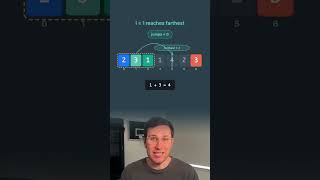
Instead of exploring all paths, scan the current reachable range and pick the cell that reaches the farthest. That farthest point becomes the new range for the next jump. Count jumps until the range covers the last cell.
Starting at index 0, the first jump can land up to index 2. Scanning indices 0-2, the cell at index 1 reaches index 4, so that's the best. After jump 2, the range is 1-4. The cell at index 4 reaches past the end, so jump 3 completes the goal. Total jumps: 3.
The greedy solution is a single pass, O(N) time and O(1) space. No backtracking or dynamic programming is needed.
The Jump Game can be solved efficiently with a greedy algorithm that scans the current range, picks the farthest reach, and extends it. This approach is optimal with O(N) time and O(1) space.
What is the Jump Game problem?
Given an array where each element is the maximum jump length from that position, find the minimum number of jumps to reach the last index.
00:01
What is the time complexity of the greedy solution for Jump Game?
O(N) time and O(1) space.
01:09
What is the brute force approach for Jump Game?
Try every possible path by branching from each cell to all reachable cells, leading to exponential time.
00:14
In the greedy algorithm, what do you do at each step?
Scan the current reachable range, find the cell that reaches the farthest, and set that as the new range for the next jump.
00:26
In the example, what is the minimum number of jumps needed?
3 jumps.
01:09
Greedy Insight
The key idea is to always choose the cell that reaches the farthest, which is the core of the greedy strategy.
00:26Optimal Complexity
Achieving O(N) time and O(1) space is optimal for this problem, demonstrating the power of greedy algorithms.
01:09[00:01] actually just a greedy problem. So, number is the maximum distance you can jump forward from that spot. Your job then is to find the minimum number of jumps needed to reach the last cell. The
[00:14] brute force idea is to try every possible path. From the first cell, branch into every cell you can land on. From each of those, branch again. The tree of possible paths expands exponentially, which is of course just
[00:26] way too slow. There's a much simpler greedy way. Think of it like this. After you could have landed on. Look across that whole range and find the single cell that lets you reach the farthest. That farthest spot becomes the new range
[00:40] you can reach with one more jump. Keep counting jumps until your range covers an example. We can start on the first cell. With one jump, we land anywhere up to index two. So, index zero through two is our first range. Scan it. The cell at
[00:55] index one carries us all the way to index four. That is the best reach in this range. Take jump two. Now, our new range stretches from index one to index four. Scan it again, and the cell at index four with value four shoots us
[01:09] well past the end. Take jump three. Our range now covers the last cell. The goal is reached. Three jumps total. In each step, we just scan the current range, pick the farthest reach, and extend it. No backtracking, no DP required. It's
[01:23] just one pass, O of N time, and O of one space. Try this and more problems with hellomaybe.com. Like, share, and subscribe.




⚡ Saved you 0h 01m reading this? Transcribe any YouTube video for free — no signup needed.