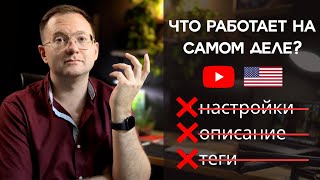

SEO for YouTube is Garbage?
45sChallenges common advice, sparking curiosity and debate among creators.
▶ Play Clip"Title accurately reflects the core message: SEO myths debunked, with actionable advice on what truly matters."
The video debunks common YouTube SEO myths, arguing that tags, descriptions, and settings have minimal impact on channel growth. Instead, success depends on creating engaging content that retains viewers, with the title and thumbnail being the most critical factors for clicks.
Most SEO advice about tags, titles, and settings doesn't make content interesting or generate views.
Viewers click videos for entertainment (emotions) or useful content (hacks/tutorials).
Most channels fail because creators don't understand how YouTube works and rely on ineffective advice.
YouTube's algorithm determines who to show videos based on audience behavior, not settings buttons.
The creator's videos with only a title and thumbnail got hundreds of thousands of views, proving tags/descriptions are unnecessary.
The title and thumbnail are the primary factors that determine whether a user clicks on a video.
After clicking, watch time, rewinds, shares, and comments signal YouTube to recommend the video further.
US viewers have expensive ads, so YouTube prefers showing videos there, but you can't directly target the US.
Forget about tags and settings; focus on creating compelling content with a strong title and thumbnail that keeps viewers watching. Engagement metrics drive YouTube's algorithm, not technical tweaks.
What percentage of YouTube channels die at the start?
90-95%
01:14
What two things do viewers primarily see when scrolling through recommended videos?
The picture (thumbnail) and the title.
05:44
What does YouTube's algorithm rely on to determine recommendations?
Audience behavior (watch time, engagement) rather than settings buttons.
02:22
Why is the US audience valuable for monetization?
Because the US has the most expensive advertising, so YouTube shares more revenue.
07:49
What did the creator discover about videos with no description or tags?
They still got hundreds of thousands of views, proving tags/descriptions are unnecessary.
03:00
SEO Advice Is Garbage
Directly challenges common YouTube growth advice, setting the contrarian tone.
00:0190-95% Channel Failure Rate
Stark statistic emphasizing the difficulty of YouTube success.
01:14Personal Proof: No Tags, High Views
Real-world evidence supporting the main argument.
03:00Title and Thumbnail Are Everything
Core actionable takeaway for creators.
04:12US Audience and Ad Revenue
Explains the financial incentive behind targeting US viewers.
07:49[00:01] American YouTube? You create and launch your YouTube channel and start hearing SEO advice from everywhere: how to write tags, how to create a title, what kind of image to use, and what settings to set
[00:15] on YouTube to ensure YouTube promotes you in its algorithms. And you try to implement all this, but there are no views. All this technical magic in parentheses is garbage. It doesn't make your content, your videos, your clips
[00:29] interesting. She doesn't let you make money. All these settings do on your video. People click on videos to either get emotions, that is, entertainment videos, or useful content where they can
[00:45] hack do it in order to make such a video and get a because beginners, as a rule, are very eager to run to such videos. And think that the whole point is that you really need to tick some
[00:59] channel to take off, for its algorithms to pick up and for the views to start coming in. But this is just another scam. These things have virtually no impact on your YouTube channel. And according to statistics, about 90-95% of
[01:14] channels simply die at the start. That is, even before you start watching any videos, you can already understand that this channel Or this specialist who does something will not receive anything for
[01:26] views. Why? Because, as a rule, they don’t understand how YouTube works, and they start looking at recommendations and advice from . First of all, a channel is not just a set of settings,
[01:39] checkboxes that you click somewhere and that's it , and YouTube understands that now your channel needs to be promoted. It doesn't work like that at all. Including the phrase "American YouTube" itself, it is fictitious. Why? Because it’s
[01:53] to perceive that this is something that’s going to the English-language market, videos, yes. But in reality, these videos, it doesn’t matter whether they are American or not , the videos are still watched by people all over the world. Even
[02:06] videos are made entirely in English, and people from determine for itself who to show them to. But again, what is he starting from? It doesn't rely on settings buttons, it relies on the
[02:22] audience. Where are these viewers located? Who might find these videos potentially interesting? That is, if all these buttons really worked, then click
[02:34] certain settings, and their channel would automatically be promoted to the desired audience. But it doesn't work that way at all. When I was starting out, I also looked at all these recommendations, guides, bought advice from people on American
[02:46] YouTube, and received exactly the same advice that goes: "Click here, set up tags here, and write this here," and then your channel will the likelihood that it will get views. As I started gaining
[03:00] YouTube, I noticed that I had videos on my channels that had no description or tags. They only have a title, a picture and the video itself. And the channel itself, including, is not designed.
[03:16] And the videos get a huge number of views, 100, 200, 300,000. That's when I realized that everything they teach there, everything they tell their main smart things, which maybe even the GPT chat wrote, it, as a rule,
[03:30] either doesn't work, or works. But in percentage terms, when I put a lot of effort into these actions, they give very little result. And continuing to trust bloggers who, as a rule, don’t even have an American
[03:44] channel, or they only managed to do something somewhere once. Really American YouTube market works. After that, I studied hundreds of different channels that were getting views, and they all had the same trend. That is, the people there didn’t even
[03:58] write any descriptions; they didn’t have anything at all. That is, all they had were the videos they make, a title and a picture, that is, a preview. And, accordingly, their videos are clicked on, their videos are watched. They are watched very
[04:12] well, because, judging by the thousands of views, this is the needs to be assessed. It's quite possible to forget about all these tags and unnecessary things. But what exactly works and what really matters? If you're a newbie, the
[04:25] first thing you'll need to do is start your own channel, right? That is, it will be necessary to create it. I wo n't even show you how to do this. There are a lot of instructions on YouTube. You can google it without any problems at all. And
[04:38] this is done in 2 seconds. Write a name on it and put an avatar. All. Moreover, you can simply put some random name in English will simply like. I have Mango on this channel now. Well, I
[04:53] some kind of teenage or children's channel, you can come up with something daring, something provocative, something memorable, because the viewers, when they watch your channel, they will, you know, that is, and when
[05:06] you get good views, they will remember these things, they will recall: "Oh, I saw this channel, this is exactly where I watch." And it often original, great content and viewers
[05:20] come back to you and watch it, your content is copied by your content is copied by competitors. This happens all the time, but your viewers know that it’s your content, and when they go to other people’s channels, they
[05:32] say: “He stole this here, this is his content.” And that is, they understand, they, you know, how they become fans of your YouTube channel. What is really more important? But it’s important that before a user goes to
[05:44] your video, they need to determine what they’ll click on. That is, a person, most often now people watch videos from their phones, and a person, scrolling through, yes, there are phones, tablets, a person scrolling through this feed of recommended videos, he sees
[06:00] first of all the picture and the title of your video. Accordingly, if it is a picture, then it depends on the niche. There, in the adult niches, for example, it is more bright, like in the children's niches, if you compare, yes, in the children's niches there may be a
[06:14] bright picture, and in the adult niches it is less bright, but more thematic, it can be somehow recognizable. And the name, accordingly, is also, that is, in children's cases you can even forget about the name, but in adult cases it is important. And,
[06:27] accordingly, these various moments influence whether a person will come to see it or not. So it turns out that you create your own channel and make your videos in English. That's it, it automatically becomes
[06:39] yours, well, you could say that you have it, ah, even the American YouTube channel. And after a person clicked on your video, he went on to watch it. What matters is how long he will watch it. Plus that, plus it’s also important
[06:53] is, maybe he rewinds some moments, presses the share button, leaves comments. Doesn't matter. That is, any additional actions, any additional actions, they, accordingly, arouse interest. And
[07:08] YouTube algorithms pick up on this. And this is how YouTube determines who is actually watching these videos and can make recommendations. So it turns out that only after he, uh, you get a
[07:21] if you don’t have subscribers, you get a certain number of views on your video. In this situation, YouTube picks up: "Oh, and here, potentially, this audience needs to be recommended to other people like this." That is, it has a
[07:34] lot of algorithms that analyze this, it understands this, and no buttons or settings will help with this. What does the US audience really influence? The US audience only affects the
[07:49] Because, well, America has the most expensive advertising. That is, there are advertisers who show these ads, and they pay YouTube money. And YouTube shares this percentage with you 50/50 . And,
[08:03] accordingly, in advertising, since the USA has the most expensive advertising, it is therefore most profitable to show your videos there. But we can’t directly saying: “We’re just showing it to America .” We can't do that.
[08:16] India, Europe, Eurasia, and so on. And we can only help ensure that on. And we can only help ensure that
[08:29] making a video in English, the title, and creating the content, which includes the script and so on. What will be inside the video will also be in English. And then the
[08:42] . And these bloggers, they say that if you set up the right do it with the channel, and you will definitely get views. This doesn't actually correct solution and the most effective solution is to work with the viewer. And
[08:56] perhaps you are once again thinking, where is the truth, what needs to be done then, and how to work with all of this correctly. Maybe I should just forget about YouTube and do something else. But no, you just
[09:08] chose the wrong path, where you can simply waste your time, resources, energy and money, among other things. And that's why I've prepared an intensive course for you that will help you understand what really works.
[09:21] It costs a symbolic amount of money, but it will save you time, money, and nerves when working with YouTube. Well, to make sure you don’t miss my videos, click the miss my videos, click the subscribe button.
⚡ Saved you 0h 09m reading this? Transcribe any YouTube video for free — no signup needed.