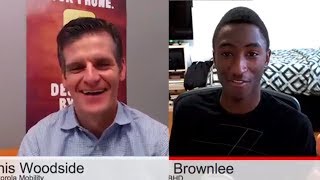

MKBHD & Motorola CEO: Epic Hangout
45sHigh-profile personalities and direct CEO interaction grab attention immediately.
▶ Play Clip"Title accurately describes the interview; content delivers exactly what is promised."
In this Google+ Hangout, MKBHD interviews Motorola CEO Dennis Woodside about the Moto X, Moto G, Project Ara, and Motorola's strategy under Google. They discuss the overwhelming demand for the Moto X Cyber Monday sale, the importance of off-contract pricing, and the company's focus on fewer, better devices.
Motorola was underprepared for the $150 off Moto X offer, selling tens of thousands of devices in four minutes. They learned there is high demand for reasonably priced, contract-free phones.
Wood backs for Moto Maker are in development but require testing for radio frequencies and sustainability. Dennis says they are coming soon.
Moto X is available in Latin America and is a top seller in Chile and Brazil. Europe is next, likely within the next year.
Moto G is designed to bring the mobile internet to the next 4 billion people. It offers iPhone 5-like quality at a third of the cost and is available in Western Europe, Latin America, and online in the US.
Project Ara aims to modularize phone hardware so users can swap components like cameras and sensors. A prototype exists with a skeleton and sliding modules.
Motorola operates independently from Google, focusing on fewer devices (7 in the last 12 months vs 45 previously) and faster software updates.
Motorola re-architected its code base to deliver Android updates quickly, exemplified by the Moto X getting KitKat on Verizon 20 days after the public code drop.
Moto X focused on usability, intuitive software, and broad appeal with a curved back and accessible UI. Moto Maker allows consumer customization.
The first words from the moon were transmitted over a Motorola radio, built by engineers working 24/7 two months before the launch.
Motorola is exploring new storytelling mediums for phones, like 'Windy Day', which uses phone movement to change perspective.
Motorola is working on wearables but emphasizes they must have killer functionality, long battery life, and durability to compete with traditional watches.
Motorola is focusing on innovation in modular hardware, affordable smartphones, and wearable tech while maintaining independence under Google. The company aims to deliver quality devices with quick updates and consumer-centric features.
How many smartphones did Motorola launch in the 12 months prior to the interview?
Seven.
20:22
How many days after the public code drop did the Moto X receive the KitKat update on Verizon?
20 days.
21:04
What was the price discount offered on the Moto X during Cyber Monday?
$150 off.
01:21
What is the goal of Project Ara?
To modularize phone hardware so components like cameras and sensors can be swapped.
12:26
What historic event involved a Motorola radio?
Transmission of the first words from the moon (Neil Armstrong's 'one small step').
29:03
What is the name of the storytelling app that changes perspective when the phone is moved?
Windy Day.
31:17
What is the website to sign up for Project Ara missions?
dscout.com/ara.
14:06
How many smartphones did Motorola launch the year before Google acquired it?
45.
20:22
Moon Landing Radio
Reveals Motorola's historic role in transmitting Neil Armstrong's first words from the moon.
29:03Cyber Monday Overwhelm
Dennis admits Motorola was underprepared for the massive demand, selling tens of thousands in four minutes.
01:21Windy Day Innovation
Describes a new storytelling medium where phone movement changes perspective, created with former Pixar folks.
31:17[00:00] Hey, how's it going? Hey, how you doing, man? Pretty good. This is the MKBHD and Dennis Woodside Google Plus Hangout on air.
[00:12] So, first time I've done one of these in a long time, but I'm excited for this one. So, first of all, if you want to introduce yourself, I'm assuming you don't really need a huge introduction to the people who are watching this, but in three sentences, who are you, Dennis Woodside?
[00:26] So I'm Dennis. I'm the CEO of Marola. I'm a dad. I've got two kids, a 12-year-old, actually a 13-year-old now and an 11-year-old, who are actually fans, Marquez, of your reviews and are aspiring tech reviewers themselves.
[00:44] They critique everything that we do. Nice. But it's great to be on our review. All right. Yeah, that's good to have. So, basically, we have the event page up for, I think, two days or so, and there's a lot
[00:56] of questions that people have about Motorola and everything that you guys are doing, and it's a good time of year to talk about stuff like this. So, I'm just going to go straight into, like, the most popular stuff, which is the Moto X,
[01:08] because everyone's talking about it. Everyone wants to know about it. So, the whole Cyber Monday, huge spike in demand, what kind of, can you describe, like, break down what happened, basically with that whole thing.
[01:21] Yeah, so, you know, we were overwhelmed by the response to the offer, the $150 off offer. And as I said, in sort of the notes that I sent out earlier in the week,
[01:35] we were underprepared for the kind of demand that we saw for that offer on Monday. And we shouldn't have been, but we were. Now, the good news is that we rallied and were able to change the system
[01:50] so that we could issue coupons for folks to come back and come into the MotorMaker site and make their devices. And even then, the demand was overwhelming. We sold literally tens of thousands,
[02:03] or we issued tens of thousands of coupons in four minutes, which was our allotment of the devices that we could actually build for the promotion. So I think we learned a lot.
[02:15] You know, there's clearly demand for devices that are not tied to a contract at prices that are reasonable. And I think, you know, we're going to listen hard to that, to what the consumer told us on Monday or on Wednesday.
[02:34] You know, we're going to do it again on Monday of next week. So 9 a.m. Pacific, noon, Eastern, we'll have the same offer. we have you know again we can't
[02:47] put massive quantities into that kind of an offer but I think we're going to explore this notion of different pricing or price points and trying to do a little bit more for consumers that want those
[02:59] devices that aren't tied to plans and I think that that's a big opportunity for us yeah yeah because I was I did a video just on the Moto X for that off contract
[03:11] during the trailer price for a Nexus 5, two very popular options. And it's funny because in the United States, not a lot of people actually buy phones off contract until, obviously, this gigantic spike.
[03:23] So I was interested to see how many of you guys sold. But that's pretty impressive. Tens of thousands of people decided that that was a good idea. Yeah, maybe more, right? We don't really know how significant the amount was. I think you're also seeing it with the carriers are realizing this too.
[03:37] So AT&T just this week announced that they have a new share plan, which allows you to bring your own phone, and then your bill is $15 less a month. So I think, you know, as the market broadens, I think about my kids.
[03:52] You know, for students, students don't necessarily can afford a data plan, an annual plan. And a lot of students don't have the credit scores to get an annual data plan.
[04:06] so they're going prepaid and they're bringing in their own device and they're going month to month and that's a real opportunity and we also fell with Republic Wireless so we partnered with Republic Wireless to bring X to them
[04:18] they're doing incredibly well with a combination of X and their service which again allows for a much more flexible data pricing month to month you can actually change your plan mid-month
[04:31] from a $5 plan to a $40 plan if you need 4G you know so I think you're going to see a lot more creative plans and you're going to and we're going to try to provide the devices that help those plans come to fruition yeah definitely I think pricing is extremely important when it
[04:47] comes to that kind of stuff just because of the the type of people that would want to buy an off-contract phone or just any phone happens to be a good deal but continuing along continuing continuing along Moto X so a lot of people
[05:02] were asking about the wood backs because the whole customization thing is really important for the Moto X and a lot of people are interested. When are people going to be able to get wood backs from Moto Maker? Yeah. So, you know, we're working hard to get wood into the mix.
[05:18] The issue is simply making the product manufacturable and making sure we're using materials that are sustainable and so forth.
[05:31] So I wanted to say coming soon, and my team isn't letting me say anything more than that, but believe me, it's soon. Yes, I mean, I was really surprised by actually how many people were interested in a wood-backed device.
[05:44] I have a Moto X in the sort of black and yellow combination, and I like that. But I was surprised by how many people care about, like, having that wood back on their phone and are willing to wait for it. So that's pretty interesting.
[05:56] Yeah, I think what's cool about Moto Maker is it's really just the start. We can do lots of things with different materials over time, which we're working on for next year and even into the early part of January, February.
[06:10] So I think you'll see more choices in Moto Maker as we bring some of these materials. Now, each time we do a new material, you have to test all the radio frequencies and make sure the phone actually still works.
[06:23] So it's actually a lot of work to add new material into the mix. Yeah, definitely. And there's already a ton of options already. But speaking of options, a lot of people are also curious about availability of the phone in general. Because we mentioned in the United States, you know, that particular market has a sort of a change in the way of how they buy phones off contract. There's a wrong contract, there's a different caries and stuff like that. Then there's a whole international market and a ton of people have been asking me, when can I buy a Moto X in Europe or in South America or in Asia and a whole bunch of different countries?
[06:55] Yeah, so Moto X is available now all throughout Latin America. And in fact, in some places like Chile and Brazil, it's among the top-selling smartphones right now. So the market is clearly there.
[07:09] We're working to bring Moto Maker into Latin America so you have the customization options as well. There's a much more limited set of custom choices that we have made available mostly in Brazil.
[07:22] And then outside of Latin America, we're scoring a bunch of places. Europe is obviously a key area for us. So I would just say stay tuned. We're going to get there certainly for some time in the next year.
[07:36] Okay. Yeah, that's good. A lot of people are, like, that's probably the number one question I've gotten, like, in my inbox is, I live in this country. Why not? I'll get it. Well, we wanted to make sure we were successful in our home market in the U.S.
[07:49] and in Latin America where we're also historically been strong before we went outside with Moto X. Right. And so it's also, the Moto Maker, I guess every Moto X is being manufactured in or assembled in the United States.
[08:02] Does that have an effect in the way you guys are scheduling, like where you ship to next? Well, they're assembled really around the world. So for the Moto Xs that we ship to Brazil,
[08:14] we make them in Brazil. We have a manufacturer there. We make them in Argentina as well for other markets. So, yeah, one of the things that's challenged, though, with Moto Maker is you need to be close to the consumer.
[08:28] So we really had to re-engineer our entire supply chain to be able to bring Moto Maker to consumers. And that will be the same for any other country where we bring Moto Maker in. We're going to have to really think through the supply chain issues, which are challenging.
[08:42] Right. Okay. I'm going to move to the next big question or big topic. I'm just going to say it. My next video is a review of the Moto G. Cool. Great. That's the first time I've said that, like what my next video is about.
[08:56] So my next video is about the Moto G. Spoiler alert, I really like it. And obviously for the price, it's a great option for a ton of people, especially because it's so cheap off contract again. And availability is also another thing because this, I believe,
[09:11] is going to be available in more countries like right off the bat? Is that right? It is. Yeah. So MotoG is part of our vision to, we think of the product that we're selling as not just a device.
[09:23] It's really the mobile internet. And if you think about the world today, there's a billion people with smartphones, but there's 5 billion people without smartphones. And 4 billion of those 5 billion are using feature phones today.
[09:35] So a challenge that we've given ourselves is how do we help bring those 4 billion people into the mobile web? Because once you're on the mobile web, your life improves, right? You're more efficient.
[09:47] You can get around easier because you understand navigation and traffic and all that stuff that you get on any smartphone today You can communicate better with your friends You can record your world with the camera
[10:03] So we just think it's a good thing. And so Moto G is really the first product that's headed in that direction, which is how do we create a phone that's as good as iPhone 5, objectively as good as iPhone 5, for a third of the cost?
[10:17] That was the challenge for the team. And really, the technology has gotten there. The screen technology and the cost of the screen technology has gotten to the point where you can build that. And so that's what we did with Monoji.
[10:29] It's available now in the major Western European countries, so the U.K., France, Spain, and all throughout Latin America, primarily Brazil and Mexico.
[10:41] It's available online in the U.S. And then in Q1, it will be available at Verizon and a whole bunch of other places. So pretty much everywhere you would want to buy it from. we're doing pretty well.
[10:53] So if you go to Amazon.co.uk or Amazon site in France or Spain or Germany or even Amazon in the U.S. now, it's typically the number one selling smartphone.
[11:06] And what I like to do is read the reviews on Amazon because those are consumers who bought the phone and the reviews have been really good. Everybody understands that this is like an amazing phone for a totally exceptional price
[11:19] and people are excited about it. Yeah, and I was fast that it's already on top of those charts, which is really impressive. Yeah, check it out. Check it out. Yeah, so I've owned it for a little bit now, but I also have a Moto X, and I've just got KitKat, Android 4.4.
[11:36] So my natural question is, when is Moto G going to see Android 4.4? So we'll ship in the U.S. We'll ship in the beginning of January on KitKat. And then for markets outside the U.S., we're going to get up to KitKat as quickly as we can probably sometime in January.
[11:54] Okay. That's awesome. Yeah. So next big topic, I guess, is sort of a more ambiguous one. People are just generally curious about Project Aura. Yeah. I also did a video on Project Aura just because that whole phone blocks concept where that sort of video initially went viral and everyone was talking about it.
[12:14] And I was surprised by how many people were talking about it because I didn't realize that so many people were interested in the idea. So just if you could tell me generally what are you guys working on with Project Aura?
[12:26] What does that look like for you guys? Yeah, well, so the idea behind Aura is, well, what if you could change the camera on your phone to have maybe a more expensive camera but one that has super zoom properties?
[12:40] Or what if someone invents a sensor that you can port onto your phone that measures my health in some interesting and new way? Right? But right today, your phone can't, once you buy it, it really can't change that much.
[12:53] The software can change, but the hardware can't change. Right. And we wanted to think about how do we, how do we modulize the phone? Because different parts of the phone are developing at different speeds, right? Imaging technology is developing at a different speed than the core processing technology.
[13:09] And consumers are going to have different times in their lives when they might want to do different things with the phone. If I'm going on a trip, I might want a different camera. So that's the whole idea behind R,
[13:22] is how do we modularize the phone to enable innovation in different ways and enable people to innovate in ways that are hard to do now because everything is in one phone. So we've opened up a site basically to solicit participants in Project Zara,
[13:41] and then we give them missions. And the missions are things like, you know, basically idea-driven. Come up with an idea for a new sensor that we could incorporate into a Project Zara fund.
[13:53] So that's the kind of thing that we're working on. We're going to see where it goes. You know, will we have a product in the next 12 months? It's hard to say, but we're pretty excited about what we're doing.
[14:06] And if people are interested who are watching the site, just look for dscout.com forward slash RR. And you'll see the way to register.
[14:19] Yeah, I actually registered for that pretty recently. So technically speaking, a lot of people talking about RR are really confused. Like, how is anything like this possible? I think I read the sort of tagline for the one-sentence idea
[14:35] was sort of making the hardware as modular as Android was able to make the software, which is really, that's a pretty bold statement. And I think of other, like, more dedicated technologies,
[14:47] like if I'm really into cameras and I buy a DSLR, I have interchangeable lenses, and that's sort of modularity in itself. So it's definitely interesting to see a phone with the as compact as packages. we're used to seeing phones as tightly knit is that becoming,
[15:02] at least the idea of becoming feasible that it's modular. How close to the phone blocks video or the phone blocks concept is RF? You know, there is a prototype, and it is pretty close.
[15:18] I mean, the idea is that you have a skeleton that holds together a set of components, and the components literally slide in and out. And if we have the interfaces and the protocols that enable the speaker to speak directly to the CPU,
[15:37] then this would all be possible. You could change your speaker out. But the industry really hasn't yet set standards for those interfaces. So every phone has a somewhat proprietary set of interfaces. And a lot of what the engineers at Motorola do are design those interfaces.
[15:53] And that's how you build a phone today. But what's cool about phone blocks and just the concept is, if you have the skeleton and you define those interfaces, it does become possible to start plugging and playing, and that's what we want to enable.
[16:06] And then also, you're going to have people around the world inventing stuff, and we're not going to know what that is. No individual is going to invent the perfect imager or the perfect speaker. But luckily, it's very possible someone will come up with something really cool.
[16:21] Yeah, so that's another thing. to sort of, once you have the ability to have, like, modular parts, and like you said, it's really cool that you can actually slide in and slide out a certain part, like, figuring out who makes the parts and where do you get the parts, and maybe, you know, third-party
[16:37] manufacturers or companies or just entrepreneurs will come up with cool stuff. Is there any idea of, like, hardware partners or anyone you'd want to work with specifically? Like, it would be really nice if you get XYZ to make parts for something like this.
[16:50] Well, you know, there's already a bunch of companies that are involved that have thought that they wanted to get into this space, but it's hard now. So let's say you are really good at making speakers in very small form factors, and there are companies who specialize in that.
[17:06] To get your product into a phone, you have a limited number of companies that you can work with. You can work with us, you can work with Samsung, and so forth. But if you didn't have to have that limited company,
[17:20] if you can just put it out into the market, just like you can an application, wow, that's pretty cool. Maybe there are 10,000 people out there who really want what you've produced. And all you need is that kind of open approach
[17:33] and a different approach to hardware. That's what we're really trying to do. And if we can kind of kickstart that innovation in hardware, that would be, we think that's going to result
[17:45] in some really interesting devices down the road. Yeah, definitely. And so another, one more thought on Aura. I'm taking a class called Computers in Society this semester where we, like, really look into this idea of, like,
[18:00] you have a ship that sails the 70s or whatever, and as it gets old, you start to replace the parts, so you replace, I don't know, the hull to replace the deck. You slowly replace parts. Right. by the end of maybe five years later,
[18:14] that ship is still sailing, and you've replaced all the parts. Is it still the same ship? And that's the sort of question we looked into. So with Aura, you kind of have that skeleton. I guess the question is, how long would that skeleton last?
[18:27] And if you replace all of the parts, the star compatibility becomes an issue? It's going to be interesting. So, yeah, and then you can imagine releases every year of the, just like Anarch,
[18:40] and has a new release every year. There could be new releases each year that allow even more functionality to be changed and modified. We're going to have to see where it goes. Right. Okay, cool.
[18:52] So back to just the whole Motorola thing. As you guys, as Google and Motorola work together, I have no idea how closely or far apart they're working. So what are, like, Google and Motorola
[19:04] working on together? Because Moto X was a pretty awesome collaboration in the first place. Well, now, Moto X was all Motorola. I mean, so Motorola is, we're owned by Google, so we have financial support from Google,
[19:16] but we operate completely independently, and Google has been pretty clear that it wants to preserve that independence because Android is an open-source platform, and it's important for any partner who wants to build a product based on Android to be treated the same way.
[19:32] So, you know, Motorola has a long history of innovating, and you really saw that with Moto X. I think what Google ownership has brought to Merrill is the ability to think a little bit longer term because we have a patient investor that thinks about opportunities over a long period of time and understands that all computing is going mobile It a really massive opportunity
[19:58] And then over time, everybody ought to have a smartphone. So we just sort of, at Motorola, have taken that guidance and that freedom to think big, and that resulted in Moto X and Moto G, and then, of course, there's a bunch of other things
[20:10] that are in the pipeline. And that's how it's been working. Okay. So has anything about the way Motorola operates changed since Google's backing or ownership?
[20:22] Oh, yeah, tons of things. I mean, you know, the company had launched 45 smartphones the year before we acquired it. And in our product portfolio now, in the last 12 months, we've launched seven. So we want to do fewer things, and we want to do them better.
[20:36] we had changed the software strategy pretty dramatically to focus on providing updates and upgrades as quickly as we could. We thought that was something that the market just wasn't doing
[20:50] and that consumers want the latest version of Android as close to its public release as possible. So we re-architected our entire code base in order to do that and you saw it with Moto X which upgraded 20 days after the public code drop
[21:04] on Verizon, which is a very advanced network and requires very high certifications and stability in order to be able to upgrade.
[21:16] So we've changed quite a bit about the approach of the company, the philosophy. Motorola hadn't had a product that was marketed globally and that could compete with iPhone and the Galaxy line.
[21:31] And we're building that brand with Moto X. and the Moto brand. We think that's really important. We're trying to engage a lot more directly with consumers. You know, I respond to emails all the time
[21:43] and go on all the blogs and look at the comments and then send my P notes. Why are we doing this? You know, someone's complaining about it. And actually, I think it makes for a much more responsive company, and that's really important because the consumer's moving so fast
[21:56] that we have to listen. So we've actually changed quite a bit about how the company operates, But that doesn't mean that Google is actually running Motorola on a day-to-day basis.
[22:08] We're still pretty independent. Okay. Yeah, so that's a new direction. It's something I've seen a lot more recently where companies try to focus on less devices and better maintain them.
[22:22] So obviously, kick out on the Moto X on Verizon blew my mind, blew a lot of people's minds, because that was probably the best example of getting a product updated as quickly as possible on a network like that.
[22:37] So that was really impressive to me. So props for that. So, yeah, okay, that's about all I have to say about that because having those quick updates and having exciting updates. I agree with this word.
[22:49] I mean, we can't leave consumers behind, and it's just to make, when something new is out there, the consumer wants it as fast as possible. It's pretty simple,
[23:01] but it actually required us to change a lot in order to deliver that. Cool, okay. My next topic, and a lot of people also have questions about this, is this whole tablet game. So, first question is,
[23:13] what tablet do you use? So, yeah, so I use Nexus. I have the latest Nexus 7. Okay. Yeah, I have a Nexus. I'm probably like the last remaining Nexus 10 loyalist.
[23:27] Like, I love my Nexus 10. I love the front-facing speakers. What sort of future plans does Motorola have for tablets? You know, we wanted to focus on what is the largest market today
[23:41] and the market that we think where we can offer the most, which is really to start with, the phone. The phone is the device, the primary device for everybody. Usually, a tablet is the secondary of the device.
[23:53] No one really buys a tablet unless they already have a smartphone, and lots of people in the world don't have smartphones. So, again, that's why we went with Moto G. So tablets are interesting.
[24:05] I think larger form factors in general are interesting. I can't share anything about our product plans, but it's certainly an area that we're exploring. Again, we're just starting to release products.
[24:18] You have X, you have G. There's a whole set of products that are coming. so I'd just say yeah I thought the Nexus 7 success was really interesting because of the price point getting people
[24:31] again accessibility to a really high quality bar if that's a low price so interesting to see the philosophy with the Moto G being successful as well so another thing is
[24:44] I read recently that Samsung basically takes up more than half or something like that of the Android device market share.
[24:57] How does anyone compete with that, or do they compete with that? How do you guys move and change your strategy? Well, you have to look at this market. If you were to go back just eight years,
[25:09] Motorola was the number two player globally with something like 22% share. Motorola shipped 220 million devices in 2006. that's a huge number of devices.
[25:22] And things changed. The iPhone came out, Blackberry was successful, and Nokia was the number one player at that time. So this is a market where the technology is changing all the time,
[25:34] the approaches are changing all the time, what's important to consumers changes all the time. So I think it's just a matter for us of let's do what we know we can do best. Let's build products that still needs that we think are not being met in the marketplace.
[25:50] Focusing on what the consumer wants. You know, we think that there's, we just keep doing that and good things will happen. Okay. So speaking of focusing on what the consumer wants, another popular question in the Google Plus events page was just about just the general philosophy behind the Moto X.
[26:07] When I went to the launch earlier, it seemed like the philosophy was that people don't really want necessarily a 1080p display. They're really happy with like a high-quality 720p display.
[26:22] And the sort of philosophy of getting the right compromises to make a device hit that nice price point of the Moto X and the really, really nice experience. do you think people want like a just all around
[26:35] no compromises just high quality flagship high end device like something yeah so our philosophy with Moto X was we wanted to design
[26:47] a device that was really usable and had a simple and intuitive customer experience and and in Android believe it or not that's often not the case a lot of Android devices
[26:59] are not intuitive The software, you have conflicting applications. You have two address books. You have two music players. You have lots of software on top of what's become a very beautiful operating system, which is Android.
[27:14] So that was one clear goal that we had. Another goal was we wanted a phone that hit the sweet spot of the market and was really something that had broad appeal. and we thought that having the curve back, a very accessible UI,
[27:33] the screen size choices, all those choices were made with the broadest set of consumers in mind. And we also thought that consumers wanted to be involved in actually designing their device and having some choice.
[27:46] So that's why we went and we built MotorMaker. But we also thought that MotorMaker was the beginning of a much kind of more exciting and longer-term story, which is how do we involve consumers in building their phone and give them more choice.
[27:59] And Aura is much further out, but you can see how those two things tie together and how if we introduce new materials into Moto Maker, we're going to pursue that theme across our product line going forward.
[28:11] So that was what we were trying to do with Moto X. Nice. So do you think in between Moto X and Aura, there's going to be more customizable, more roll of phones with similar... Yeah, well, what you'll see is you'll see more materials,
[28:24] and that's already in the process. You'll see different materials that have different properties, which some things could be pretty cool that we're working on. And what we'd like to eventually get to
[28:37] is functionality in the device. So that's where the line between our and what we're doing with MotorMaker might converge. And that might take some time, but that's okay. Yeah. Okay.
[28:49] So what is some random thing that you think a Motorola fan would not know about Motorola, some random interesting fact about, or you, or Motorola in general? Ah. Well, here's a random interesting fact that may have been out there.
[29:03] So, did you know that the first transition from the moon, the famous word, one small step for man, one giant leap for mankind, those were made over a Motorola radio.
[29:17] Wow. And the story is that NASA had a radio that it already had planned planned for the lunar mission, but it wasn't going to be the quality of voice to transmit that to the world.
[29:30] And they realized there's all this attention. We have to be able to transmit what Neil Armstrong says to the world. So they called up a bunch of Motorola engineers two months before the launch, which is not a lot of time, and said, hey we need a radio that going to have telephone quality sound and that can reach the moon And they literally work 24 hours until the launch to get that into the spacecraft
[29:54] So that's a pretty cool story. I think it also shows that heritage is still with Motorola. It's a company that tries to take big leads. Hey, let's build a phone for one-third the cost of the iPhone, but with a bigger screen, a better screen, you know, latest OS, all that stuff.
[30:10] And the team responds really well to those kinds of challenges. Definitely. So what other kinds of challenges are you guys focusing on at MotorWheel? Because we went over having a very refined product selection and working on maintaining them,
[30:25] which I'm assuming is a huge challenge in the first place. And the challenge of being able to receive a massive amount of orders with Moto Maker and supply and all that. What other sort of challenges do you guys face?
[30:37] So I think one thing that we're also excited about is the future of entertainment on the mobile device. If you think about movies, when the projection camera was invented, entertainment totally changed.
[30:50] It went from stage acting to films, and the whole medium came to being. And then television came along, and you had series and all that. And now, but with the phone, we're kind of watching the same stuff that we watched on TV or on the Internet.
[31:04] Even though the phone's smaller, it can do a bunch of different things. And with Windy Day, we said, okay, how do we change the medium and create a storytelling medium that responds to the phone?
[31:17] And when you move the phone, the perspective changes. There's not a single perspective that the director defines. So we worked with a bunch of former Pixar folks and an Academy Award-winning director to build Windy Day.
[31:31] But that's at the beginning, and you can think of this as more of a platform. Imagine if artists and animators and eventually directors could produce entertainment with the phone in mind.
[31:46] And there are going to be 5 billion smartphones out there. So there's no doubt that the phone is going to be its own form of entertainment, the medium is going to change. So we think that's really cool and potentially really big.
[31:59] And so we're going to continue to do things like Windy Day. and eventually that could become a platform on its own that could be really, really significant. So that's a big challenge for the team, the one we're excited about.
[32:12] Nice. So yeah, I've heard a lot about people just waking up their Moto X and finding a new day and just being blown away by it. So people love that, so it's really cool. Yeah, a little gift that we wanted to give to. Yeah, yeah.
[32:24] No, a lot of people. I know someone who's just recently got a Moto X and couldn't stop telling me about it, like playing with it, like literally what I'm doing with this phone right now I think you can use it. Oh, cool. That's awesome. So I want to shift a little bit to new form factors.
[32:39] So Project Aura, I don't know if I consider it a new form factor, but it is a totally new technology. But stuff like wearable tech is definitely a new form factor. And I play with Galaxy Gear, so that's a sort of wearable on your wrist.
[32:54] And Google Glass, which is, I guess, closer to home because you guys are with Google, and that's sort of a more popular thing that people know about. So what do you personally think of wearable tech
[33:06] and I guess what is more role as velocity towards wearable tech? Yeah, so we're working on a lot of things, let me put it that way. There are a couple different areas. There's clearly going to be something that changes on your wrist.
[33:19] How it works and what exactly it is is something that our teams are working on hard. but whatever it is it has to compete with what works now so watches now
[33:31] they can be very expensive in my jewelry or they can be very inexpensive even the inexpensive watches battery life is I never have to worry about changing the battery in my Timex watch
[33:43] you don't really think about it they tend to be indestructible so any product that comes along that really wants to change that human behavior has to think about those
[33:55] basic problems and what you're competing against, which is usually an inexpensive watch that works pretty well for the consumer. So that's the challenge we've given the team. We can't have something that's fragile. You can't have something you have to charge every day. You're
[34:09] going to have to have some functionality that's just killer. Otherwise, why spend the money on yet another product? So that's when we come to watches. That's how we're thinking
[34:21] about it. I think there's other areas that are interesting. There's, in general, imaging in general is changing radically and how you take pictures and how you record. And one of the killer apps for Google Glass is, of course, taking a picture and taking video.
[34:33] Right. So there's some things there that are exciting for us. And then in-ear technology is also pretty interesting. And Motorola has been the leader in Bluetooth headsets for a while. We can take that technology and shrink it down
[34:47] and you can start thinking about really cool things you can do, both related to your phone, and commanding your phone or listening to information that might be supplied by your phone in a way that's much more subtle.
[35:00] So we think there's some interesting things there as well. Yeah, what you said about, I guess, just giving more functionality outside of or just giving a sort of unique functionality when you talk about wristwatches, that's really important to a lot of people.
[35:13] And a lot of watches, there's the Pebble, there's the Sony smartwatch, there's the Galaxy Gear. The challenge is giving you a reason to buy that. Exactly. A reason. Why is it going to be so awesome that you have to ask the question?
[35:28] Yeah, that's a huge challenge. And I think the second that someone finds a really genuinely useful or unique way to utilize a wearable tech and give you something extra, some extra functionality or something,
[35:42] that's going to be really important. So good to hear you guys are working on that. Yeah. You know, Motorola's done that before, right? There was the MotoAxib and a lot of sports oriented watch. So we have the tech, we certainly have the skills to do something
[35:54] pretty interesting. Right. Okay. So to wrap up, I think I've gone through all of my, like, general, like, most frequently asked questions and I've... Wait, you have one? Yeah,
[36:06] go ahead. Okay, what do you want in a, let's play forward a year from now. What are the things that you would like to see in any device that no one is thinking about today? Ooh, that no one is thinking about. Well, I'm right now looking at, like,
[36:20] the things that everyone is thinking about. Like, I want a better camera and, like, every phone I buy. I want a beautiful screen. I think I made a little rant video earlier this year on battery technology and how just the fact that
[36:35] it seems weird that we, if you go back maybe seven or eight years, you didn't charge your phone every night. You charged it maybe every three or four nights, and they weren't smartphones and they weren't huge, super powerful devices.
[36:48] But the amount of things your phone can do now has gone up so much. And accordingly, our battery life has not. You can get a Razor Max. Go buy a Razor Max right now. Two days back and light be great. I'm messing with a couple of phones that have massive batteries.
[37:03] Razor Max is one of them, and I love that it lasts two days easily on a charge. So that's good. But I want to see more of that. I want to see no people pushing the envelope in terms of how long a phone can last.
[37:17] And just sort of a no worries phone, I guess, is what I would want. A no worries. You don't have to worry about taking a picture. You just take it and you know it's going to be a good picture. You don't have to worry about, you know, charging your phone every day. You just use it and whatever, you know, it's fine.
[37:31] So that's, I think, what a lot of people look for in terms of functionality. And that's personally what I'm most pumped for is better battery life. And another thing is 4K, which I don't even know if it makes any sense to have anything 4K-related in a mobile device.
[37:48] I have a 4K TV behind me. Just the little burst of 4K products I've seen in the last, like, month is pretty impressive. And I know of one phone that I've used that can shoot 4K video.
[38:01] But anyone who watches my videos knows I'm like a pixel junkie. I love pixels, lots and lots of pixels. So I love the Razor Max's display. I love 1080p displays and phones.
[38:13] So just looking for a way to get more pixels. Seeing 4K everywhere is great, but it might not have anything to do with phones. Yeah, good. Okay, cool. Yeah, so that's basically it for the questions.
[38:25] If you had anything else to plug where people can follow. I know you showed the, what is it, the ARA link? What was it? It's dscout.com. Okay. backslash Aura.
[38:38] Okay, so that's where people can keep up with Aura. Yeah, you can sign up there, and then you'll be given missions or asked if you want to participate in missions
[38:51] that the team is charting people on. What they're doing is they're soliciting ideas for an actual project. So it's pretty interesting. Okay, so that's Aura.
[39:04] You guys, if you're watching this now and you haven't already registered and you want to do something cool, do that. And, of course, you can follow Motorola and Vanish on Google+, and you can follow me anywhere you want at MKBAC everywhere.
[39:18] But that's about it. Thank you for your time. I know you guys are so busy with all the things you're doing with Moto X right now and all the things you're working on. So I appreciate you taking the time to do this hangout.
[39:30] But I think that's going to be it. I'm going to wrap it up. Thanks again. and I'll talk to everyone or maybe almost everyone who's watching in the next one. Thanks for listening. Take it easy. You too.
⚡ Saved you 0h 39m reading this? Transcribe any YouTube video for free — no signup needed.