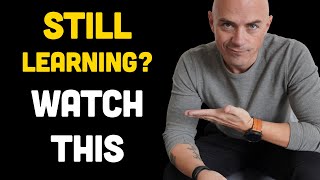

The Hard Truth About Day Trading
30sImmediately grabs attention with a bold reality check that counters get-rich-quick fantasies.
▶ Play Clip"Delivers exactly what the title promises — honest, realistic advice without exaggeration or fluff."
This video delivers a sobering reality check for aspiring day traders, emphasizing that trading is a skill requiring thousands of hours of practice like any other craft. The speaker uses analogies from medicine and boxing to illustrate the need for delayed gratification and extensive training with demo accounts before risking real money.
Like bike riding or skiing, day trading requires consistent practice over time to become proficient.
Online content is often designed to excite, not educate, feeding into shiny object syndrome and impatience.
Putting money into the market without preparation is foolish because you're competing with elite traders who won't let you win easily.
Train with imaginary money for an extended period, similar to boxing training on a punching bag before sparring.
After about six months of demo trading, review your performance to see if you are consistently profitable before going live.
You likely won't get rich this week, month, or even year. The speaker himself spent 11-13 hours daily for a long time.
Avoid overeducating yourself with conflicting strategies. Stick to a simple, repeatable approach to minimize emotional decisions.
The core message is that day trading mastery demands immense patience, extensive practice with demo accounts, and a simple, consistent strategy. Success is not possible without a long-term commitment to learning and improvement.
What is the recommended minimum period for practicing with a demo account before trading real money?
At least 6 months.
02:42
What does the speaker compare day trading practice to?
Training in a boxing gym: first on a punching bag, then sparring, then real fights.
01:58
Why does the speaker advise against overeducating yourself?
Because learning too many strategies can lead to conflicting thought processes on a trade.
03:49
What is 'shiny object syndrome' in the context of day trading?
Seeing an incredible result and wanting it immediately without accepting delayed gratification.
00:30
According to the speaker, how long did he spend learning day trading each day?
11 to 13 hours a day for a very long time.
03:21
Trading Takes Time
Establishes the core principle that trading is a skill requiring consistent practice over time.
Internet Content vs Education
Warns viewers that most online content is designed to excite, not educate, feeding unrealistic expectations.
00:30The Doctor Analogy
A powerful analogy showing the absurdity of expecting quick success in a complex skill.
01:01Demo Account Training
Provides actionable advice: use imaginary money for extended practice before risking real capital.
01:44Don't Overeducate
Contrarian advice to keep strategies simple to avoid analysis paralysis.
03:36[00:00] There's a hard reality in day trading and it's kind of a hard fact to swallow. Like any skill in life, it takes time and effort consistently. And the time is the most important thing. Like any
[00:17] skill like bike riding, skateboarding, skiing, you need to do it over and over and over again and practice in order to become proficient at the skill. Now, I'm choosing my language
[00:30] very specifically here. Sometimes what you see on the internet is designed to get you excited, not designed to educate you. Most people have shiny object syndrome. They see something incredible and
[00:45] they want it now. They are not willing to accept delayed gratification. But I want you to tell me if this sounds ridiculous. An 18-year-old person sees a doctor slash surgeon driving a really,
[01:01] really nice Porsche GT3 RS and he says to himself, "I want to be a doctor. I think I can do it by next week." Does that sound logical to you? I'm glad we're on the same page. If you want to
[01:16] learn how to day trade properly, you will have to commit thousands of hours every single month. And you will have to practice this skill every single day. It is absolutely foolish for you to put money
[01:29] into the market and expect a return at all, even a dollar. You are competing with the most elite of elite day traders in the entire world. If you win, that means they lost. They are not willing to
[01:44] let that happen. So, in order for you to gain the confidence to enter the market with actual money, you need to do it with imaginary money for an extended period of time. This is like training
[01:58] in a boxing gym. You will train on a punching bag for an extended period of time to make sure that you have the technique right. Then you will spar in pads with an opponent for an
[02:11] extended period of time before you actually get into a real fight, obviously sanctioned and professional. The same goes with your day trading. You want to open up a demo account, which you can get anywhere for free, and you will practice buying and selling. Practice,
[02:28] practice, practice, practice, and more practice. and you will see how many times you've lost and how many times you've won with this imaginary money. And after let's say 6 months of practice,
[02:42] you can look back at all of your fake trades that you entered and you can see, okay, at first I sucked and then I started getting better. And for the last 3 months, I've been quite consistent,
[02:55] winning half of my trades and losing half of my trades. And depending on the percentage of account balance that you've risked of your imaginary money demo account, you will see if you are profitable
[03:09] or if you are not profitable and you still need to practice more. I know it's a hard thing to hear, but you will not get rich this week, you will not get rich this month, and you probably will not get
[03:21] rich this year. I'm an absolute freak of nature. And when I started learning about this stuff, I spent 11 to 13 hours a day learning it for a very long time because I was interested in
[03:36] it. And when something piques my interest, I dive head first into it full force. And one of the main things that I would like to suggest to you is don't overeducate yourself.
[03:49] Reason being is that if you learn every single path, sometimes you will get contradicting thought processes on that trade that you want to enter. One says it's long, one says it's short,
[04:03] depending on which strategy you're looking at. I highly suggest keeping it simple, something that you can do every single day without putting too much thought or emotion into it. One of my favorite strategies that I've been working on lately, you can see in this video right here.
[04:20] I just want you to be patient and be understanding that this is going to take a lot of time.

⚡ Saved you 0h 04m reading this? Transcribe any YouTube video for free — no signup needed.