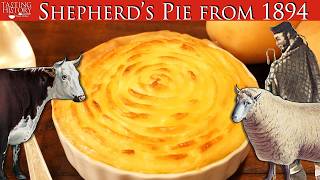

Shepherd's Pie vs Cottage Pie: The REAL Difference
33sDebunks a common internet myth about lamb vs beef, sparking debate and curiosity.
▶ Play Clip"Delivers exactly what the title promises: a recipe and history, with clear answer on beef vs lamb."
This video explores the history of shepherd's pie, tracing its origins to Scotland and Ireland, while making a recipe from 1894 that allows for either beef or lamb. The host discusses the ambiguity between shepherd's and cottage pie, and demonstrates a simple preparation using minced leftover meat, spices, and a mashed potato topping.
The video begins with the question of whether shepherd's pie is truly Irish, English, or Scottish.
Common belief: shepherd's pie uses lamb, cottage pie uses beef. But this distinction is relatively new (last 50 years). Historical recipes allow either meat.
The recipe calls for minced beef or lamb, cloves (if beef) or summer savory (if lamb), salt, pepper, topped with mashed potatoes mixed with cream and butter, brushed with egg wash, and baked.
Shepherd's pie was originally a way to use leftover meat, so the meat was already cooked.
The host adds mushroom ketchup, an ingredient from an 1850s recipe, to add flavor. Historical ketchups were thin and savory, like Worcestershire sauce.
4 pounds of golden potatoes are peeled, boiled in salted water, drained, and mashed with cream, butter, and salt.
In the 19th century, the dish was about 1/3 meat and 2/3 potatoes, opposite of modern versions where meat is the star.
Finding provenance is difficult due to many names (sanders, saunders, cottage pie) and varying definitions.
Reverend James Woodforde's diary (1799) mentions cottage pie, but no description; later entries mention 'cottage pie made of veal etc.'
Maria Rundell's 'New System of Domestic Cookery' includes a recipe for sanders: minced beef or mutton with onion and gravy, topped with mashed potatoes.
1845 recipe layers meat between potatoes and suggests using fresh meat or sausage for a superior version.
The name may have changed from 'cottage' or 'shepherd' to 'sanders' to avoid association with lower classes or Scots, who were looked down upon.
The first recipe under the name 'shepherd's pie' appears in 'The Practice of Cookery and Pastry' (1850s, Edinburgh).
An Irish journalist lists shepherd's pie as a Scottish dish, suggesting it was considered Scottish at the time.
By the late 19th century, Irish newspapers feature recipes for both shepherd's and cottage pie, often using mutton.
The host enjoys the dish, noting the golden color from the egg wash, the texture of minced meat, and the subtle clove flavor. The potatoes are the highlight.
What is the traditional distinction between shepherd's pie and cottage pie?
Commonly, shepherd's pie uses lamb and cottage pie uses beef, but this distinction is only about 50 years old; historical recipes allow either meat.
00:33
What was the original purpose of shepherd's pie?
To use up leftover meat, so the meat was already cooked before being used.
02:49
What unusual ingredient did the host add from an 1850s recipe?
Mushroom ketchup, which was a thin, savory condiment similar to Worcestershire sauce.
03:48
Who is the earliest known diarist to mention 'cottage pie'?
Reverend James Woodforde, in 1799.
10:36
What is the name of the similar dish found in Maria Rundell's 1806 cookbook?
Sanders.
13:28
Where was the first printed recipe for 'shepherd's pie' published?
In Edinburgh, in 'The Practice of Cookery and Pastry' (1850s).
17:14
According to an 1872 Irish newspaper, which nationality was shepherd's pie associated with?
Scottish.
17:41
Modern distinction is new
The common belief that shepherd's pie uses lamb and cottage pie uses beef is only about 50 years old, challenging modern assumptions.
01:06First mention of cottage pie
Reverend Woodforde's diary provides the earliest known mention, but lacks description, making it tantalizingly vague.
10:36Name change hypothesis
The shift from 'cottage' or 'shepherd' to 'sanders' may have been an attempt to disassociate the dish from lower classes or Scots.
15:08William Cobbett's anti-Irish quote
Cobbett's derogatory quote about Irish potato eating reveals the class and ethnic prejudices of the time.
16:14Tasting notes on clove
The host notes that the clove adds depth without being overpowering, a key flavor insight.
22:08[00:00] When I think of an Irish meal, one of the first dishes that comes to mind is shepherd's pie. But is it actually Irish? Could it really be English or even Scottish? Well, I'm going to endeavor to answer that question as I make this recipe for shepherd's pie, published in 1894.
[00:18] So thank you to Thrive Market for sponsoring this video as I eat my absolute favorite preparation of meat and potatoes, shepherds pie, his time on Tasting History.
[00:33] When deciding on a recipe for today's episode, I kept going back and forth between shepherd's pie and cottage pie. Shepherd's pie being made with lamb and cottage pie being made with beef, or so they would have you believe. They being overly opinionated people on the internet.
[00:49] See, I had read this fact so many times that I just assumed it to be true. The story goes that shepherd's pie uses lamb because shepherds raise sheep, and cottage pie uses beef because cottagers or people who live in cottages have cows.
[01:06] Yeah, the whole story kind of falls apart there. And as it turns out, that idea is relatively new. Relatively being like in the last 50 years. Many 19th and early 20th century recipes, including the first printed recipe for each dish,
[01:22] allow for either beef or lamb, or don't specify a meat at all. Heck, some old shepherd's pies even allow for chicken and still others for corned beef. So knowing that historically either meat is allowed to be in either of these dishes,
[01:36] I have decided to choose a recipe that allows for this. "Shepherd's Pie. Minced beef, or lamb; if beef, put in a pinch of pulverized cloves;
[01:48] if lamb, pinch of summer savory to season it, very little pepper and some salt, and put in a baking dish; mash potatoes mix them with cream and butter and a little salt, and spread them over the meat;
[02:01] beat up an egg with cream or milk, a very little, spread it over the potatoes and bake it a short time, sufficient to warm it through and brown the potatoes." So this is pretty representative of both shepherd's pie and cottage pie recipes from the 19th century
[02:16] along with several other dishes that are pretty much the same exact thing only under different names like sanders, And these old recipes rarely call for anything other than minced or sometimes sliced meat and potatoes.
[02:33] Now, a lot of modern recipes add cheese and sometimes vegetables and then very often gravy and onions. And I did find some older recipes that call for gravy and or onions, but most of them are just this. It's spiced meat and potatoes.
[02:49] It was really just a way to use up leftover meat, which is why none of the recipes actually have you cook the meat. It should already be done. It's leftover meat from yesterday or the day before or last weekend for all that matters.
[03:02] So, this recipe allows for either beef or lamb. And I have decided to go with one pound or 450 grams of roast beef. Then an 1/8 teaspoon of cloves, 1/2 teaspoon of pepper, and a 1/2 teaspoon of salt.
[03:16] So to prepare the meat, all you have to do is mince it up as fine as you can. Now by the time this recipe was written, many people actually had hand crank mincers or meat grinders in their home kitchen, and it did make life a lot easier, but it really gives a different texture, more of a mashed meat
[03:32] than truly minced meat. That is meat that's just cut up as small as possible. It's a real pain in the- well in the wrist, but it is what the recipe called for so that's what I did. Once it's all minced up, add in the cloves, the salt, and the pepper, and mix all that in.
[03:48] And then I decided to add one more ingredient that isn't in this recipe, but it is in the earliest known recipe, that I could find at least, for shepherd's pie. It's from the 1850s, and that ingredient is mushroom ketchup.
[04:01] Now today usually when we think of ketchup, we think of tomato ketchup. But historically, ketchup could be made with all sorts of things. Everything from mushrooms to walnuts to grapes to- there are tons of kinds. I've even made one of them. I made white ketchup here on the channel a few years back.
[04:19] And so, I kind of want to actually revisit the topic and maybe make one of the others. Now these older versions of ketchup were really nothing like tomato ketchup, which is very thick and sweet.
[04:33] These were more thin and kind of like Worcestershire sauce. And so, that's what I'm going to be adding cuz I think it'll really add some flavor to what is otherwise pretty plain roast beef. So, I added about 1 tablespoon of the mushroom ketchup to the meat just to add some extra flavor.
[04:50] then might I suggest securing your ingredients via today's sponsor, Thrive Market. Thrive Market is an online membership-based grocery store which can help you keep to a healthy diet while staying on a budget.
[05:04] I use them for a constant supply of high protein and low sugar snacks They even have an assortment of things like cleaning and personal care products. And when it comes to their food, they really make it easy to find what you want
[05:18] And they're constantly adding more products, so there is always something new. and I've gone through nearly the entire box in just a few days. Absolutely delicious.
[05:31] And what's more, these cookies are actually less expensive than if I bought them in the store. In fact, many of the items on Thrive Market are less expensive than if you get them at the grocery store. And right now when you join Thrive Market using my link in the description, thrivemarket.com/maxmiller,
[05:47] you will get 30% off of your first order plus a free gift worth up to $60. That's 30% off $60 free gift at thrivemarket.com/maxmiller.
[06:00] And now on to our potatoes. So the amount of potatoes that you're going to need for this dish really varies. It kind of depends on how big of a dish you end up baking this in. But I have never heard anyone say, So I decided to go with 4 pounds or about 1.8 kilograms of golden potatoes. You can also use Russet potatoes.
[06:20] Then 3/4 of a cup or 175 ml of cream, 1/3 cup or 80 grams of butter, 1 teaspoon of salt, plus two more tablespoons of salt for the water that we're going to boil the potatoes in. So start by peeling the potatoes, and then cut them into small pieces, either in quarters or eighths,
[06:37] Then add the two tablespoons of salt to the water. Bring it to a boil and add in the potatoes. Let them boil uncovered for about 15 minutes or so. You're looking to get them to be easily pierced by a fork, but you don't want them mushy.
[06:51] Once they're done, you can drain them and leave them in the colander for another 10 minutes to completely drain so they're not watery. Then put them back in the pot that you boiled them in and mash. You can also use a potato ricer if you like, but I like to mash as it lets me release any negative energy
[07:06] Who needs therapy when you have potatoes? And it helps if the butter and cream are at room temperature or even a little bit warm. Also, just like snowflakes, no two potatoes are exactly the same.
[07:24] So, some potatoes will need a little more cream. Some potatoes will need a little less cream. You don't want this to be too liquidy. You want it a fairly stiff mashed potato mixture. So just add a little bit of a cream at a time
[07:37] Then once the mashed potatoes are all ready, you can decide on what container you want to bake these in. You could do like one large 9-in pie tin, or you could do some smaller, more personal individualized shepherd's pies,
[07:54] and that's what I decided to do. So add in a layer of the meat on the bottom and pack it down. And mind you, this dish should be about 1/3 meat and 2/3 potato. Today, I find those amounts kind of flipped. The meat tends to be the star of the dish,
[08:07] but in the 19th century, most of the recipes call for almost all potatoes and just a little bit of meat. Once the meat is layered down, then spread ample mashed potatoes all over the top
[08:19] Then the recipe wants us to get a nice golden color on these potatoes. And to do so, it says to mix an egg with a couple tablespoons of cream or milk.
[08:32] I went with cream because there's already cream in the potatoes, so I figured in for a penny, in for a pound. Brush this egg mixture on top of the potatoes. And then create some lines on the top. And this is going to let the heat catch on some edges of the potato, which helps with the appearance.
[08:47] Then set those dishes onto a baking sheet and put that into the oven at 400° Fahrenheit, 205° C, and bake for about 20 minutes or until it's a nice brown color on top. Also, definitely don't forget that baking sheet or some sort of tray because they do tend to kind of bubble over
[09:05] So this dish always is a bit of a bone of contention on the internet at least. Obviously, about the name shepherd versus cottage pie and what's in those
[09:18] Like frankly, if you add peas to my shepherd's pie, I'm I'm going to send it back or at least eat it begrudgingly. The other cause for dispute with this dish has to do with the origin of it because
[09:33] the English, the Irish, and the Scottish all take credit for inventing the dish. So, make sure you are subscribed to Tasting History. It really does help out the channel as I delve into the origins of shepherd's pie.
[09:51] Finding the provenence of shepherd's pie or cottage pie or whatever you'd like to call it is really quite difficult. Partly because there are so many names for this dish and partly because you have to decide on what constitutes a shepherd's pie.
[10:08] Like there is an early recipe from around 1750 in the English cookbook, 'The Country Housewives Family Companion' which calls for roast or boiled pork leftovers to be made into a pie with potatoes in a crust.
[10:22] But these potatoes aren't mashed, they're just cut up along with the meat and then baked in a crust. So I wouldn't say that it is a shepherd's pie, but maybe shepherd's pie adjacent, a precursor to the pie.
[10:36] So maybe the answer is in the actual name, shepherd's pie or cottage pie. And so we can look to the first known mention at least of cottage pie, which comes from the diary of Reverend James Woodforde, who lived in southern England in the late 18th and early 19th century.
[10:54] Now this is the exact kind of person that leads me to often say that history is not written by the victors, but written by people who write things down because he kind of was unremarkable. I'm sure he was remarkable, you know, to himself and to his mother, but
[11:10] in historic terms, he was an unremarkable man. And really he's only known for writing down the rather banal activities that he did as a country parson and as an Oxford student in the late 18th century.
[11:26] And while it's nice to get these daily activities of, you know, somebody living at the time in the country, he doesn't really give a lot of information. He doesn't give any feelings on what he's doing very often.
[11:38] It's kind of like today I went ice skating... And most of the lines in the diary are actually just telling himself what he ate for meals that day.
[11:51] "March 8th, 1799... Dinner today, a boiled pike and cottage pie. Throughout the 1790s, he makes multiple mentions of having cottage pie,
[12:07] but since he doesn't really give a description of the dish, it's hard to know if that cottage pie is anything like what we think of as cottage pie today. The closest thing that he gives us is a mention in 1801.
[12:21] "October 28th, 1801... Dinner today, a cottage pie made of veal etc. Thank God! I was finally today not so nervous. Well, I'm glad that he's given up smoking and that he feels better because of it, but I would much rather have him
[12:40] use those lines to describe a little bit more in detail what cottage pie was "made of veal etc." Now, often when we see mentions of a dish like that just kind of
[12:55] fly by night, there's no description in a published work or in a newspaper. That's because the dish was so common by then that it required no further explanation. it could possibly be that he invented the name for this dish.
[13:13] That this is the only mention of cottage pie to have existed at the time. Like maybe his cook made him pie that reminded him of his cottage or made it in the cottage, and so that's just what he called it. We just don't know and it really kills me.
[13:28] Anyway, the next time that we find a dish like shepherd's pie or cottage pie is in 1806, but it has a totally different and just as enigmatic name, sanders.
[13:42] The recipe is in Maria Rundell's 'New System of Domestic Cookery', originally published in London. And this dish is made with minced beef or mutton along with onion and gravy. and then mashed potatoes are put on top and baked.
[13:55] What's interesting is that unlike most later 19th century recipes for this dish, this one actually has more meat than potatoes. And she specifies that. And I'm not sure why that is, but it might be
[14:10] because meat was not as dear to the people that she was writing for because she was writing for more well to-do private families. And the same goes for the cookbook by Eliza Acton,
[14:22] "Modern Cookery for Private Families'. Her 1845 recipe is not for sanders, but for saunders. Though her version of the dish has the meat sandwiched between layers of potatoes, and she gives an option to make the dish even nicer, saying
[14:38] "A very superior kind of saunders is made by substituting fresh meat for roasted; Sausage meat, highly seasoned, may be served in this way instead of beef or mutton."
[14:52] then where did the term cottage pie or shepherd's pie come from? Well, I'm not entirely sure, but I have a hypothesis that might have some merit. I'm not really sure.
[15:08] See, at the time, the term cottage or the term shepherd would have had a connotation of lower class working people. These recipes all come from cookbooks for a bit of a higher class clientele.
[15:24] And so maybe they changed the name to sanders or saunders simply to not have that connection with the lower working classes. Now, it's also possible that this name change had to do with the fact that the dish was associated
[15:43] with a group of people that many of the English looked down on at the time, and that is the Scots. And I know what you're going to say. Don't you mean the Irish Max? Well, yes, this dish I associate with Ireland, but in this case,
[15:58] I do mean the Scots. Now, at this period of time, the English were even more down on the Irish, especially in their use of the potato. As William Cobbett, the English politician, wrote in 1833,as he lamented England's relying on potatoes,
[16:14] "For it must be a considerable time before English people can be brought to eating potatoes in the Irish style; that is to say, scratch them out of the earth with their paws, toss them into a pot without washing, and when boiled,
[16:27] turn them out upon a dirty board, and then sit round that board, peel the skin and dirt from one at a time, and eat the inside... I hope we shall, in the words of D. Drennan, 'leave Ireland to her lazy root,'
[16:42] if she choose still to adhere to it. It is the root, also of slovenliness, filth, misery, and slavery..." I don't know what was wrong with this guy back then.
[16:55] The Scots in general, especially the people from the Highlands, were very often looked down upon kind of as second class citizens, especially by the wealthy people in England. And when looking through newspapers from this time, it does seem that the dish, at least under the name shepherd's pie,
[17:14] The first printed recipe in a book for the dish under that name comes from "The Practice of Cookery and Pastry' published in the 1850s in Edinburgh.
[17:26] Now, just because the first recipe was published there, that doesn't mean that the dish originated there. But let me draw your attention to exhibit number two, an Irish newspaper article written by an Irish reporter in 1872.
[17:41] We learned that there was a strong flavor of national dishes in the menu, which include cockie leekie, Scotch broth, haggis, sheep's heads, shepherd's pie, and white and black puddings.
[17:56] All excellent things in themselves, but not amalgamating very readily with the light French and German wines on the table." Yes, this Irishman from 1872 deems shepherd's pie to be keenly a Scottish dish,
[18:10] Now, does that mean that there were no people in Ireland mixing old meat and potatoes and layering them and baking them? Absolutely not. I'm sure it was happening, but it doesn't seem that they called it shepherd's pie.
[18:25] But it is around this time, the latter part of the 19th century, that Irish newspapers start to be filled with recipes for shepherd's pie and cottage pie, which are indistinguishable. Both are made with beef and mutton in pretty much all of the recipes.
[18:43] Or in the case of one Dublin recipe from 1895, it actually says that you can use "Scraps of cold meat, game, or poultry that there may be in the house, and served either as mints or shepherd's pie for luncheon..."
[18:56] So that means that they might have been eating a shepherd's pie with rabbit or even chicken, Now it does seem that by the early 20th century, the Irish, at least in their newspaper articles and and recipes, are calling it
[19:11] cottage pie far more often than shepherd's pie. But they still call for either beef or mutton, never lamb. It is almost always mutton. And that's because sheep were not being raised for meat, especially in Ireland.
[19:28] At first, they were being raised for their wool. So, you wait until it's three or five or even 10 years old before doing so. Now, the thing with mutton is it tends to actually be more flavorful than lamb, but it also tends to be tougher. And when looking through the old Irish newspapers from
[19:44] the turn of the century and a little bit later, I came upon some wonderful Irish humor in an article or a little joke from 1924, I believe. Essentially,
[19:56] a man orders a dish which he finds particularly tough and says, " 'What is this dish, waiter.' 'Cottage pie, sir.' I bet that's even funnier in a proper Irish accent.
[20:09] Now, whether you call this dish shepherd's pie or cottage pie or sanders or saunders or simply a nice little dish with beef, that was actually what they wrote in the cookbook. It does seem that by the late 19th century, all of the British Isles
[20:24] So, call it whatever you will and argue in the comments about what should actually go into it as I enjoy my shepherd's pie from a Victorian Scottish newspaper
[20:40] And here we are, a shephardd's pie from 1894. I got to say, they both turned out really, really lovely. I think that this one with the kind of swirl, it's the second one I did, looks even better. So, that's the one that I'm going to dig into.
[21:01] Oh yeah. That's so nice. Oh my god.
[21:13] Really is just like one of the perfect dishes. I love the color that the golden potatoes make. They are golden,
[21:25] and then you add the cream and egg on top and it makes it even more golden on top. And is it less meat? You know, it's it there's still a line of meat at the bottom,
[21:39] but it is less than very often you would find today. I think it's plenty. The texture is very different from using ground beef or ground lamb, which is what is usually used today. That minced texture, it just gives a little more
[21:56] bite to it. But if you cut it small enough, The flavor of the meat is really lovely. That-
[22:08] You know it has like the clove is not overpowering which it very often can be. but it is there and it adds this kind of just interesting-
[22:21] interestingness, a little depth rather than just roast beef which you can do but this add adds something. they should be the star of the show. And in my mind, they really are.
[22:33] [chomp] Honestly, the whole dish could just be mashed potatoes. That would be fine with me. But yeah, absolutely fantastic.
[22:48] Make this or any other version of shepherd's pie. They're all delicious. If you want to add cheese, go ahead and add cheese. Just stick with this honestly. It's just perfect. It's wonderful. It's simple. It's easy.
[23:02] And I will see you next time on Tasting History.
⚡ Saved you 0h 23m reading this? Transcribe any YouTube video for free — no signup needed.