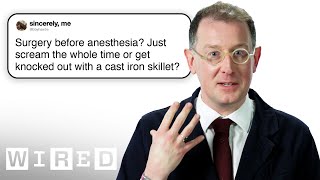

300% Mortality Rate: The Deadliest Surgery
44sThe shocking story of a surgeon with a 300% mortality rate is both macabre and fascinating, guaranteed to hook viewers.
▶ Play Clip"Delivers exactly what the title promises: a medical historian answering questions, with rich content and minimal fluff."
In this WIRED Tech Support video, a medical historian answers a range of questions about the history of medicine, covering topics from ancient practices like trepanning and bloodletting to modern breakthroughs like penicillin and vaccines. The video provides a fascinating look at how medical knowledge and practices have evolved over time, often with surprising and sometimes gruesome details.
Before anesthesia, patients had to endure surgery awake. Surgeons emphasized speed, with Robert Liston famously performing amputations in under a minute, though sometimes with fatal errors.
Cupping involves placing heated glass cups on the skin to create a vacuum, based on ancient ideas of balancing humors. Despite its popularity in wellness trends, there's little evidence of clinical effectiveness beyond placebo.
Louis Pasteur developed vaccines by weakening pathogens, starting with animal diseases and then rabies. In 1881, he successfully tested an anthrax vaccine on farm animals, and later treated a boy bitten by a rabid dog with an experimental rabies vaccine.
Radithor, a patent medicine containing radium, was popular in the 1920s. The radium craze led to health issues and deaths, including that of Eben Byers, whose addiction to the product contributed to its ban in 1932.
In 18th-century Britain, tobacco smoke enemas were used to revive drowning victims, based on the idea that smoke was an irritant. This practice was part of early resuscitation attempts.
Antonio Egas Moniz developed the lobotomy, which involved cutting brain connections. Despite severe side effects, it became popular due to the lack of effective treatments for mental illness, but was later discredited.
Maggots were used for debridement, cleaning wounds by eating dead tissue. This practice was observed in traditional medicine and used by military surgeons when other treatments failed.
The iron lung was a mechanical respirator used to keep polio patients alive by creating negative pressure to inflate and deflate the lungs. It was crucial during polio epidemics before vaccines.
Bloodletting was based on humoral theory to balance excess blood. George Washington was treated with bloodletting, which may have contributed to his death.
Mary Mallon was an asymptomatic carrier of typhoid who was forcibly quarantined. Her case raised ethical questions about individual freedom versus public health.
Trepanning, drilling holes in the skull, is an ancient practice with evidence from Neolithic times. It was used for various purposes, and modern surgeons still use it to relieve brain pressure.
Historically, surgeons learned through apprenticeship, gaining practical experience with the body's materiality, rather than just from texts.
Plastic surgery has ancient roots, with early nose reconstruction techniques described in the Ayurvedic tradition, using skin flaps to recreate the nose.
Despite the invention of the microscope in the 17th century, it took centuries for surgeons to accept that germs cause disease, due to the difficulty in proving causation and the nature of infections.
Barbers and surgeons were historically connected, with barbers performing basic surgical procedures. The barber pole's red and white stripes symbolize blood and bandages.
Alexander Fleming accidentally discovered penicillin when mold contaminated his Petri dishes. It was later developed into the first successful antibiotic by Florey and Chain, leading to a Nobel Prize.
Hatters suffered from mercury poisoning due to its use in hat-making, leading to neurological damage and the 'mad hatter' stereotype.
Measles eradication is difficult due to its high contagiousness and vaccine skepticism, unlike smallpox which was eradicated. The COVID pandemic also set back measles control efforts.
Wilhelm Roentgen discovered X-rays in 1895, which could pass through the human body and capture images on fluorescent screens, revolutionizing medical imaging.
Cataract surgery has ancient origins, with 'couching' being an early technique. Modern surgery began with local anesthesia using cocaine and later artificial lens implants.
Leeching was used to remove blood, but could lead to infection and excessive blood loss. It was part of the broader practice of bloodletting.
The history of medicine is a testament to human ingenuity and the often painful process of scientific discovery. From ancient practices to modern breakthroughs, the evolution of medical knowledge shows how far we've come, while also reminding us of the importance of evidence-based medicine.
Robert Liston
person
Louis Pasteur
person
Marie Curie
person
Antonio Egas Moniz
person
Alexander Fleming
person
Howard Florey
person
Ernst Chain
person
Edward Jenner
person
Wilhelm Roentgen
person
Harold Ridley
person
Mary Mallon
person
Walter Freeman
person
Joseph Meister
person
Eben Byers
person
Institut Pasteur
service
What was the name of the surgeon known for extremely fast amputations?
Robert Liston
01:12
What is the principle behind cupping therapy?
It uses heated glass cups to create a vacuum, based on humoral theory to draw out excess humors.
02:05
How did Louis Pasteur develop vaccines?
By weakening pathogens and using them to create immunity, as demonstrated with anthrax and rabies.
03:41
What was Radithor and why was it banned?
A patent medicine containing radium, popular in the 1920s, banned in 1932 after causing health issues and deaths.
05:04
What is a lobotomy?
A procedure that cuts connections in the brain, used for mental illness but causing severe side effects.
07:21
How does maggot therapy work?
Maggots eat dead tissue (debridement) but not live tissue, helping clean wounds.
09:36
What is the function of an iron lung?
It creates negative pressure to inflate and deflate the lungs, helping patients who cannot breathe on their own.
10:33
What is trepanning?
Cutting or drilling a hole in the skull, an ancient practice with evidence from Neolithic times.
14:12
How did surgeons learn surgery historically?
Through apprenticeship with a master surgeon, gaining practical experience.
15:17
What is the earliest record of plastic surgery?
Nose reconstruction from the Ayurvedic tradition, using skin flaps.
15:57
Why did it take so long for surgeons to accept germ theory?
Because it was not clear that germs cause disease, and proving causation was difficult.
17:06
What was the connection between barbers and surgeons?
Barbers performed basic surgical procedures, and the barber pole symbolizes blood and bandages.
18:39
How was penicillin discovered?
Alexander Fleming accidentally discovered it when mold contaminated his Petri dishes.
19:22
What is the 'mad hatter' disease?
Mercury poisoning from hat-making, causing neurological damage.
21:23
Why hasn't measles been eradicated like smallpox?
Due to its high contagiousness and vaccine skepticism, unlike smallpox which was eradicated.
22:05
Robert Liston's 300% Mortality Rate
Illustrates the extreme risks of surgery before anesthesia and antiseptics.
01:12Pasteur's Vaccine Development
Shows the scientific method applied to medicine, leading to modern vaccines.
03:41The Radium Craze
Highlights the dangers of unregulated patent medicines and public fascination with radiation.
05:04Lobotomy's Popularity Despite Harm
Demonstrates how desperation for treatments can lead to harmful practices.
07:07Typhoid Mary's Quarantine
Raises ethical questions about public health vs. individual rights, relevant today.
12:54Accidental Discovery of Penicillin
Shows how chance observations can lead to revolutionary medical breakthroughs.
19:22[00:00] move it back and forth to cut the nerve fibers. Just wait till we get to poop transplants. from the internet.
[00:15] [upbeat music] "So like surgery before anesthesia, what did you do? Well, pretty much the former in fact.
[00:31] various dentists, surgeons start experimenting Now, the first widely publicized and the procedure very, very quickly spreads after that.
[00:46] you pretty much had to grin and bear it. to keep their patients awake. in early surgery isn't pain.
[00:59] if you start drifting off into unconsciousness So there's a sense that pain at least kind of helps and helps to kind of survive this assault on the body,
[01:12] There's a real emphasis on being as quick as possible. while you hack away at their leg. a man called Robert Liston
[01:26] because he could have somebody's leg off for this sometimes is inaccuracy. which may or may not be apocryphal,
[01:40] He accidentally took off the patient's testicles One of the burly surgical assistants That man got an infection and died.
[01:52] to have dropped down dead from fright. in history with a 300% mortality rate. "what in the world is cupping
[02:05] Cupping makes use of little glass burn it inside to create a partial vacuum, The vacuum inside would pull up
[02:19] which could then be left or it could be lacerated Now the ideas behind this are very ancient indeed, and phlegm govern health and disease.
[02:34] to draw out some of these excess humors in the last few decades and especially the kind of the wellness boom.
[02:47] some sort of placebo effect behind it, that it has really any kind of clinical effect. Pasteur might be rolling in his grave
[03:01] in the middle of the 19th century. in the kind of problems that affect French agriculture. that really upset French people, like,
[03:15] on the chemistry of fermentation. or when milk ferments and turns into cheese, and when things go bad,
[03:28] So as part of this, grape juice or wine or beer or milk and as we now say to sterilize it.
[03:41] and does great work to improve the health of many foods, because he very sensibly patents it. He begins his work trying to understand the kind of diseases
[03:59] Pasteur works out that if you identify you can actually use it to make a vaccine. and then you can use those weakened,
[04:11] So in 1881, Pasteur carries out a very large, involving dozens of farm animals. on a human disease, rabies.
[04:24] Not only is there no effective treatment for it, Pasteur starts to, again, to making a vaccine for rabies.
[04:37] is savaged by a rabid dog. Pasteur tries out this experimental vaccine 13 injections into the abdominal
[04:52] So poor Joseph Meister goes through quite a trial, Pasteur really does become a French national hero. The Institut Pasteur still works in France.
[05:04] that the French state can throw at him. Radithor was an American patent medicine and it was immensely popular.
[05:19] You were drinking distilled water mixed Now, why on earth were people doing this? that historians have called the radium craze.
[05:34] it's a great deal of public fascination especially around the idea of radiation. Marie Curie gets the Nobel Prize
[05:48] There's a lot of medical interest in radiation as well, but also through the idea that radioactive substances Probably the most famous victim
[06:01] He seems to have been absolutely addicted to the stuff. of it during his lifetime. which in its very late stages led
[06:14] And it's largely as a result that Radithor was eventually banned in 1932. the expression blowing smoke up your
[06:26] How is the smoke blown? If you think about 18th century Britain, about how to revive sailors who've been washed overboard.
[06:40] Tobacco smoke is seen as a kind of irritant. So some physicians start to experiment that have a sort of little tobacco pipe built into them.
[06:53] the bottom of some poor drowned person and blow it in. left inside this person, And I think it's probably fair to say that it would.
[07:07] "Share your most controversial Nobel Prize winner. I think I'd agree with that. Antonio Egas Moniz was a Portuguese neurologist.
[07:21] Lobotomy literally means lobe cutting or brain cutting. that connect the frontal lobes with a new treatment
[07:37] He very quickly found that people but the procedure caused tremendous problems They very often suffered changes in character.
[07:50] So the question really is why did lobotomy become if it had such terrible consequences for patients? All sorts of new institutions,
[08:04] to the what's seen as a growing problem of insanity But by the early 20th century, for mental illness.
[08:18] psychiatrists don't really have much for treating madness. in the early 20th century,
[08:31] using insulin to put patients the idea that this might This is also the period
[08:43] to be used for certain kinds of conditions, notorious of these heroic therapies. so popular is the work of an American Dr. Walter Freeman.
[08:55] which is called the transorbital lobotomy. you make an incision just above the eyelids, and through that, you can get directly into the brain.
[09:08] States moving from asylum to asylum, in waiting rooms or in doctors' offices. he was banned from medical practice,
[09:22] restrictive kind of psychiatry. you'll know that the lobotomy It's not really a kind of therapy at all.
[09:36] "Were maggots ever purposely cultivated maggots, which are the larvae of certain kinds of flies. but they won't eat live tissue.
[09:50] for what's called debridement, Now, this is a rather kind of counterintuitive idea. this would be a very, very bad thing.
[10:04] in many traditional medical cultures around the world, military surgeons working in Europe start on a battlefield for days,
[10:19] very often that wound will actually stay uninfected in situations where no other kinds Of course, the most important thing is
[10:33] So Wowerful asks, what is the iron lung and how does it work?" looks a little bit like a railway carriage,
[10:46] Now imagine you lie inside that tube so that you're sealed inside it, that's pumping air into the tube and out of the tube.
[11:00] So for patients who've lost the ability to breathe, to inflate and deflate their lungs and keep 'em alive. initially for treating victims of coal gas poisoning.
[11:16] of the early mid 20th century. that largely affects the nervous system. but it can also leave them in a situation
[11:28] So iron lungs became a way of keeping through this epidemic at a great cost You do have cases of people being infected
[11:41] and living decades inside an iron lung. Effective vaccines come along in the 1950s and 1960s. to try and eliminate this disease.
[11:56] sleepymteverest asks, especially in medieval and classical medicine. So if you have too much blood inside your system,
[12:13] fiery kind of overstimulating humor. so it can kind of make you overexcited and feverish. out of your body, it'll calm you down.
[12:27] of bloodletting carried to kind of extraordinary excesses. few days of the life of the first American president, him over and over again,
[12:40] And there's an argument that actually his death not of the disease he was suffering from. Typhoid Mary was Mary Mallon.
[12:54] In the early 20th century, with the households in which Mary had worked. Department investigated this case
[13:07] was what's called an asymptomatic carrier of the disease. for typhoid, but she didn't suffer from the disease herself. she was forcibly quarantined for a while.
[13:20] but in 1915, a further series of outbreaks And sadly enough, She died in quarantine in 1938.
[13:32] a figure of sort of gothic folklore, issues that are very familiar to us in the last 10 years. the COVID lockdown of how do we balance individual freedom
[13:45] There's also a question She was far from the only asymptomatic but she was the only one who was incarcerated for so long.
[13:59] with the fact that she was working class, and the fact that she was a woman "Is trepanning still used today?"
[14:12] It's the idea of cutting or drilling a hole in the skull. techniques that we have evidence for. as the Neolithic have found skulls
[14:26] presumably with quite sort of simple flint tools, some evidence of healing. from these ancient societies,
[14:39] intervention perhaps or to treat some kind of head injury. was perhaps some kind of initiation rite.
[14:52] because there are easier ways Modern surgeons will use it sometimes to try and relieve pressure on the brain
[15:05] or in some other kinds of diseases like brain cancer. 3KCarlo asks, "Yo, how did surgeons learn that stuff? If you're going to learn surgery,
[15:17] the best way to do it is not learning through texts, the way that you learn surgery You'd be apprentice to a master surgeon,
[15:30] so you'd learn very much in practice. of the kind of materiality of the body. the fine detail of movement or circulation of the blood
[15:45] come from getting to grips messy materiality of the body. "What is the oldest example of a plastic surgery
[15:57] So we may think of plastic surgery but in fact, it's a very old idea indeed. we find interventions that are intended not only
[16:10] but also its appearance. The earliest records of this come of the Ayurvedic tradition.
[16:23] or you've suffered some awful disfiguring disease. to try and at least recreate the appearance of a nose, leaving a little strip
[16:37] and kind of fold it down and then attach it And the idea is that the tissue will heal but at least something that that looks like a nose.
[16:53] "Why did it take so long for surgeons to recognize the need It's a very simple question that opens Now, in some ways, there's a paradox here.
[17:06] in about sort of the middle of the 17th century, to look at all sorts of objects and substances. previously unsuspected tiny little dots
[17:20] But it's not until the 19th century and disinfection are kind of central So why did it take two and a half centuries
[17:34] I suppose, is that it's not at all clear to the first observers that germs actually cause disease. that early microscopists look at,
[17:47] So many people say, well, how can they possibly cause disease? immediately of this overwhelming infection?
[17:59] That really only kind of comes There's also a question about the kind of the nature It can be very hard in practice actually
[18:12] So a working surgeon might say, well, Perhaps, it's a consequence of the body trying So there are lots of reasons that it's quite hard
[18:25] connection between cleanliness of surgical instruments JDNelson asks, "Well, barber-surgeons were a thing. but barber surgeons certainly were a thing.
[18:39] who cut your hair might also or 400 years is that both barbers and surgeons You can imagine a barber
[18:55] It's maybe not an enormous step carrying out basic kinds of surgical procedure. historically, there was a very close connection
[19:08] in the old blood and bandages, that you still see outside many modern barbershops. "Was the discovery of penicillin really an accident?"
[19:22] and bacteriologist Alexander Fleming. on the body's natural defenses against bacteria. which the body secretes in things like snot
[19:38] So Fleming is very interested but the discovery of penicillin In the summer of 1928,
[19:51] goes on holiday, comes back about a month later of bacterial cultures that he's been using Now he's about to throw these away,
[20:05] and makes a fortuitous and fantastic discovery. on this Petri dish is clearly secreting the bacteria that were growing on the Petri dish.
[20:19] he tries to extract a drug, and he calls this drug penicillin. kept getting infested with others,
[20:32] and make sure that only the bacteria But in the 1930s, two things happened. antibacterial drug called Prontosil
[20:44] Second, the outbreak of the Second World War. to need effective treatments for battlefield injuries. which essentially kind of combs the literature
[20:58] This project led by Howard Florey They start work on developing penicillin
[21:10] It becomes the world's first successful antibiotic. And Florey, Chain, and Fleming share the 1945 Nobel Prize penicillin turns out
[21:23] Runnerlovejul asks, continuous exposure to mercury "Alice in Wonderland," we all know
[21:37] in the strange way that he does. is the characteristic trade disease of hatters Mercury was used in the preparation
[21:50] So hatters in the course of their work they'd often suffered quite severe neurological damage. even forms of madness from this long exposure to mercury.
[22:05] "Why wasn't measles eradicated like smallpox?" for measles to be eradicated. and there are many global programs associated
[22:17] that are working towards this aim. and this was made much worse by the COVID pandemic. medical resources were diverted elsewhere.
[22:31] After the end of the pandemic, where it had been declining for decades. infectious disease like smallpox.
[22:45] It was a very serious disfiguring, often fatal disease. The English doctor, Edward Jenner, vaccination technique against smallpox.
[22:59] the disease was the subject of one to eradicate a disease, and this was finally successful. Part of the problem with measles
[23:13] We tend to think of it as a kind of childhood disease, But it's a very, very serious disease. It can also leave your immune system
[23:26] And of course, a big problem in the West has been the rise of vaccine skepticism. in 1998 published a paper which claimed
[23:38] and the development of childhood autism. and The Lancet to its great credit but unfortunately, it has very much contributed
[23:51] but if you're lucky enough to live programs against measles, for heaven's sake, get vaccinated. Well, if you think back to algebra
[24:06] and science for the unknown quantity. in 1895 by Wilhelm Roentgen, Now, Roentgen is working
[24:19] vacuum tubes, cathode ray tubes that seem He discovers very quickly that these that they can pass through the human body,
[24:32] which you can capture on a fluorescent screen There's a famous story of Roentgen that she's supposed to have exclaimed,
[24:45] her own mortality for the first time. out of the eye with a fish hook, but when did that start?" such a delicate, sensitive part of the body
[25:00] But actually operations for cataracts are some of the oldest Now, cataracts arise when the lens that sits for focusing light onto the retina and goes cloudy,
[25:12] with cataracts was called couching. from many different traditions. and you just insert it into the eye
[25:26] Now, this restores vision, very, very blurred vision, the European physicians start removing
[25:40] In 1884, an Austrian neurologist, starts to use cocaine as a local anesthetic And this makes cataract surgery
[25:54] and the roots of modern cataract surgery we try and insert an artificial lens An English surgeon called Harold Ridley
[26:06] Many of them had been in bad crashes, and bits of acrylic had got into their eyes. a piece of acrylic in the eye isn't rejected
[26:21] with replacement lenses made out of acrylic. of modern cataract surgery. "Did leeching actually do anything?"
[26:33] and they live by sucking blood from other creatures. and it really had all of the kind of downsides to get a leech that was infected with a disease,
[26:47] And as with bloodletting, it could be done to excess. and compromised by losing too much blood to a leech. Thanks so much for watching History of Medicine Support.
⚡ Saved you 0h 27m reading this? Transcribe any YouTube video for free — no signup needed.