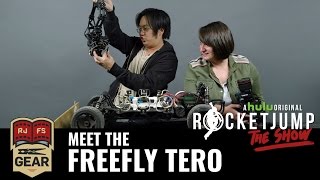

Building a 3-Fly Tarot: RC Car Camera Rig
45sThe unique and visually intriguing setup of mounting a cinema camera on an RC car immediately captures attention and curiosity.
▶ Play Clip"The title promises a build tutorial and the video delivers exactly that, with no fluff or misleading content."
Kevin Senzaki introduces the three-fly tarot, a piece of equipment used in the short film 'High-Plane Drifter' for driving around horses. The video will cover the build process and the ins and outs of using the equipment.
Kevin Senzaki introduces himself and the Rocket Jump Magicka School, and explains that the video will cover building the three-fly tarot used in one of their shorts.
The three-fly tarot was used in the short film 'High-Plane Drifter' for driving around horses, and the video will cover its build and usage.
The build process begins, with the video focusing on the construction of the three-fly tarot.
Introduction to the Three-Fly Tarot
Sets the context for the video, explaining what the three-fly tarot is and where it was used.
Build Process Begins
Marks the start of the main tutorial content, transitioning from introduction to the build.
01:05[00:00] Hi, my name is Kevin Senzaki, and this is Rocket Jump Magicka School. Today we're going to be building the three-fly tarot, which we actually used on one of our shorts.
[00:27] to the first shore. High-plane drifter would use the Tero around horses. So we want to introduce you guys to this awesome piece of equipment. We'll talk a little bit about our use of it and the ins and outs of driving around
[00:39] your very expensive camera on an RC car. Well, Matt was doing that. It's very dangerous. You also want to use the Tero with the three-fly Moby, which is usually the M10 or the M5.
[00:51] I'm a huge camera gear nerd, so when the M10 came out, we actually bought that with our own cold hard cash. But the taro here was actually supplied to us by Preflex System that shipped it down from Seattle for use in high-flow structure.
[01:05] All right, what do you want to cover first, the build? The build. I need a camera to bounce off of that. I'll grab you a camera. First things first. Just shake it until it works.
[01:17] This is going to be the stand, which is based off it. Very complicated-looking piece of machinery, but really actually not that complex. It's really just a gimbal here to stabilize pan, roll, and tilt.
[01:34] Those are basically your three axes. So balancing the movie is a whole separate video, and we're going to have that come up next year in 2016. Or it could be 2016 right now and it's ready, in which case you can click here. If there's nothing in front of my finger, then you gotta wait.
[01:49] Oh, crap. But there is, click on it. Oh look, we balanced it. Look, it's all done. It's all ready to go. So as I said, this will reduce pan, so this kind of motion, you'll notice it's not going anywhere.
[02:01] Tilt, not doing much, and roll. So you can do weird, crazy stuff like this. And it's like, whoa, whoa, whoa, it's not going anywhere. Grab the table Once it balanced and good to go you shut off because we going to transfer it over now to the tarot For reverse remote control remote control card
[02:27] There we go. So one thing that we have done on this is we put a weight right here, this is just a
[02:44] RedRock camera weight, a little aftermarket modification with gas. It keeps the center of gravity a little bit lower and when you're doing hard turns, especially once you have the whole setup on it, there is a potential of it to get a little rocky
[02:58] so we found that just again, a little too pound but it helps keep it more stable. That seems to be a good rule of thumb with any moving camera piece like dollies, swiders, anything like that, the more, what did you do?
[03:11] I brought something. So we have a square, cheap, white, sound-mouthing plate, and with a hole in the middle, and to interface this with the Moby, we're going to go through the
[03:24] pre-fined-in just like that. Get our top like that, screw it all in, and it'll, uh, sell fast. So, montage time! This is just a bunch of unscrewing.
[03:38] There are no instructions.
[03:56] These little screws go into the Ninja Star. I think I'm doing this right. Oh, I did it in the wrong order. I lied.
[04:08] The ninja star goes on second. Oh. The ninja star plate goes on to the Moby first. After you take it off of the handlebar. Yep. There.
[04:20] There we go. Here we go. You can take the other plate. The cheese plate Swiss cheese was very much a post War II invention Oh no I sorry Pre War II because of rationing Right Because the holes in the cheese is where the cheese is
[04:35] Oh, doesn't cheese cool? Now the plate goes on to the other part. If you're looking for hot whispery voices, then you've come to the right channel.
[04:47] Here at the Rocket Channel, we cater to all manner of propensity and taste when it comes to whispery videos. This is the best meal. This is the best meal. This is stock.
[05:00] Alright, so now we have the M10 here screwed into the plate, the base plate. And we've inverted it, right? It's upside down now, that's right. So you want to make sure that any cables or stuff like that is tucked away so they can spin freely.
[05:15] That's basically it. And once we get this up here, so now that's on the taro here, you're not going to control it by moving it. obviously you can control it with this. The Spectrum DX7, you can program these to do
[05:28] anything. You can fly quadcopter with this. You can use it to drive cars around. This case it's controlling just the movie. Now, to see what you have coming out of it, there's a lot of equipment involved here. To see what you have coming out of it, you need a wireless
[05:41] video. Wireless because you don't want to be tethered to this thing. You can be speeding around set. Any sort of wireless system, you take the HDMI or SDI out from the camera and and then we'll get up the monitor and you can see what you're doing.
[05:54] Our first AC, Alicia, with the monitor, with our remote follow focus, and she was pulling focus on most of the tarot stuff throughout the day. So we wanted on high planes, we wanted some shots to whip by and go past horses from a low angle.
[06:10] So looking around, we saw the tarot as a way of getting fast, low angle shots at horse leg height. And we're like, this is going to be perfect for a high plane drifter. So some of the stuff that we learned was, first and foremost, dirt roads does not let it grip very well, obviously.
[06:27] The way we counteracted that was we added a weight here to bring the weight down a little bit more. And a lot of times for the shock where we need to start off relatively quickly and not have it spin its wheel when it went, we would put like a piece of wood or a piece of plywood underneath the back tire so that it had a little bit of momentum going into that It was very stable even on dirt roads there three things going on here You have the shock of the vehicle helping it out You have this wire frame additional shock mount here helping it out
[06:54] And then you have the gimbals themselves holding it in position. So we were able to get a very, very cool, very smooth shot. Did you do any image stabilization after, or was it minimal? Not really. Occasionally, if you were punching in and you see a little bit of jitter,
[07:08] we'd pop a warp stabilize on it and then the warp stabilizer just took care of it. Very, very little additional stabilization. Again, you're having three different mechanical things trying to hold it steady
[07:20] and hold the camera steady. And that's basically the tarot. We mention it kind of very briefly in the show, but I'm sure some of you gearheads out there are like, hey, what is that? How are they using that? And the thinking behind this, we want to give you kind of an in-depth
[07:32] look at why we used a remote control car and the kind of shots that we had. So we want to do more gear-oriented videos, so we're going to start showing you different tools and introducing you to both tools that, you know, you're familiar with, but also things like the tarot that you might not have access to yet.
[07:51] So we want to just get you guys familiar, and if you have equipment that you're curious about, let us know in the comments, talk to us on the forum, tweet us so we can get our hands on it and explore it and start testing stuff out.
[08:03] And we will show you how to balance the movie, because that's a whole thing. As one of the world's foremost Moby Balancers. I can watch you in the whole world. In the top 10,000. Top 10,000 of Moby Balancers.
[08:17] Not quite operators. I haven't cracked the top 10,000 of operators yet. But boy, can I balance this thing. Look forward to that. Or if it's already out, click on it now. It's going to be here in 2016. Or right now.
[08:29] Or right now, if it is 2016. Time travel. Or in the past. Oh, dang it. Right? No, wait. Yeah, think about it. We've got to end this video now. Okay. Okay. I'm not stopping you.
[08:41] Thanks, guys.

⚡ Saved you 0h 09m reading this? Transcribe any YouTube video for free — no signup needed.