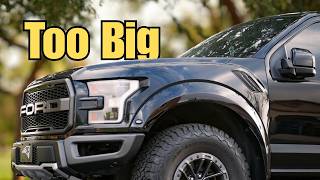

75% More Pedestrian Deaths? Here's Why
38sShocking statistic that blames larger vehicles, sparks outrage and curiosity.
▶ Play Clip"Title accurately reflects the video's core argument that modern trucks are dangerously large, backed by multiple studies."
Pedestrian fatalities in the US have surged 75% since 2009, a trend not seen elsewhere. A new New York Times study and decades of research point to the American auto industry's shift toward larger vehicles—trucks and SUVs with hoods averaging 3 feet high—as a key driver. These vehicles create massive blind zones, increase the likelihood of fatal collisions, and even distort drivers' perception of speed.
Pedestrian deaths in the US have increased 75% since 2009, a statistic not replicated in any other developed nation.
The NYT study estimates 200–400 pedestrian deaths per year could have been avoided if vehicles had stayed the same size as 25 years ago, representing about 10% of the recent increase.
Average hood height is now ~3 ft. A 5'8" person is 43% likely to be knocked down by today's vehicles vs. 31% in 2002. Blind zones on trucks like the Silverado have nearly doubled.
2009 rollover safety laws forced thicker A-pillars, reducing visibility. Combined with higher hoods, they raise the center of gravity, increasing rollover risk and the 'monster truck effect' in collisions.
A 2006 study found drivers in high-ride-height vehicles drove faster with more variability and worse lane discipline, due to a disconnect from the sensation of speed.
Researchers warned NHTSA in 2022 about pedestrian dangers, but no action was taken. Studies from 2003, 2009, and 2022 all confirm that light trucks (pickups, SUVs) are 50–100% more likely to cause fatal pedestrian injuries than cars.
While consumers buy popular large vehicles, automakers aggressively advertise and profit from them, creating a cycle. Smaller options are scarce, especially outside EVs.
By what percentage have pedestrian deaths in the US increased since 2009?
75%
00:36
How many pedestrian deaths per year does the NYT study estimate could have been avoided if vehicles remained the same size as 25 years ago?
200 to 400 deaths per year (about 10% of the recent increase).
02:52
What is the average hood height of passenger vehicles today?
Roughly 3 feet (36 inches).
04:29
What percentage of American adults are shorter than 5'6", making them more vulnerable to being rammed to the pavement by modern hoods?
About half (50%).
04:35
What 2009 regulation led to thicker A-pillars and reduced visibility?
Laws requiring roofs to support three times the vehicle's weight to reduce rollover deaths.
06:38
According to a 2006 study, how does higher ride height affect driver behavior?
Drivers drove faster with more variability and were less able to maintain a consistent lane position.
09:43
How much larger are the blind zones on the Chevrolet Silverado compared to older models?
Nearly doubled (about 100% increase).
10:32
What did the 2022 IIHS study find about pickup trucks and fatal pedestrian hit-and-runs?
Pickup trucks were 51% more likely than cars to be involved in a fatal pedestrian hit-and-run.
14:04
How many pedestrian deaths could have been avoided if all light trucks were replaced by standard cars, according to economist Justin Tyndall?
Over 8,000 pedestrian deaths between 2000 and 2019.
15:19
At lower speeds, how much more likely are pedestrians struck by SUVs, pickups, and vans to suffer traumatic brain, thoracic, and abdominal injuries?
Approximately two times as likely.
16:19
75% Increase in Pedestrian Deaths
This stark statistic frames the entire video and is unique to the US, making it a powerful hook.
00:36200–400 Preventable Deaths Per Year
Quantifies the human cost of vehicle size increases, directly from the NYT study.
02:52Average Hood Height Now 3 Feet
A concrete measurement that makes the danger tangible for viewers.
04:29Rollover Laws Created New Danger
Highlights an unintended consequence of safety regulations, a key insight into systemic failure.
06:38Speed Blindness from High Ride Height
Reveals a psychological effect that makes drivers less safe, not just pedestrians.
09:438,000 Deaths Avoidable with Smaller Vehicles
A large-scale estimate from a peer-reviewed study that underscores the magnitude of the issue.
15:19[00:00] Alright, so if I were to tell you that pedestrian fatalities were on the rise in the United States, you'd probably think the cause was some kind of distracted or impaired driving, right?
[00:12] Texting, touchscreens, talking to passengers, buzzed driving, drunk driving, bad driving, all of the typical causes. Except, smartphones are everywhere, modern tech is pervasive in cars throughout the world,
[00:27] and bad or irresponsible drivers aren't exclusive to one nation or region. But you know what is? The statistic that pedestrian deaths have increased by 75% since 2009.
[00:46] And that statistic that exists nowhere else in the world belongs to the good old red, white, and blue. Because of course it does. But why?
[00:59] Well, a new study suggests that the American auto industry's obsession with larger vehicles is contributing to an inescapably bleak landscape of pedestrian danger.
[01:14] And that sounds pretty ominous, but this is also just what one study is saying. And you know me, I can never just look at one study. Okay, maybe not never, just rarely.
[01:26] So we're going to get to the bottom of this. Is the blame on large trucks and SUVs for pedestrian fatalities misplaced, or is it squarely where it belongs?
[01:38] And is this ultimately the fault of the drivers whose appetite for these cars increases every year, or is this on an industry that prioritizes size at the expense of pedestrian safety?
[01:53] Or is it something else altogether? Moment report at the end of the month And I make what I want when I feel like discussing cars
[02:06] On June 21st, the New York Times published an extensive investigative study on the cause of the 75% increase in pedestrian motor vehicle deaths in the United States since 2009
[02:22] and they came to the same conclusion as far too many people on Hinge. Size, or more particularly, height, matters. As the report notes,
[02:36] quote, After analyzing federal and industry records, including never-before-examined data on vehicle dimensions, we found that the rise of large pickups and SUVs is an important factor.
[02:50] Our estimate is that about 200 to 400 pedestrians a year would not have died if vehicles had remained approximately the same size over the past quarter century.
[03:05] That represents about 10% of the recent increase in pedestrian deaths. End quote. I've linked the article in the description, and I highly recommend checking it out.
[03:19] It's fairly interactive with 3D recreations and a drop-down menu for you to put in your height to see how much likelier you are to get knocked down by today's cars and how much lower that likelihood would have been roughly 25 years ago.
[03:35] So for me, I'm a short king at 5'7 and a half. So let's round that up to 5'8 because shut up. And I'm likely to be knocked down by about 43% of vehicles today.
[03:47] In 2002, the same model year as SL, my Toyota Camry that I drive every single day, that number would have been 31%.
[03:59] Either way, I'm clearly in peril, but I was in considerably less peril in 2002 than I am today, and I really hope I'm not changing anything by saying that. Regardless, it's a dramatic increase caused by what the reports found was the even more dramatic increase in the average hood height of American cars today.
[04:21] And they're talking all cars, not just trucks and SUVs, as the average passenger vehicle today has a hood that's roughly three feet high, meaning that, as the study notes,
[04:34] Quote, anyone shorter than 5'6", about half of American adults, would frequently be rammed to the pavement. So would most children.
[04:49] End quote. Basically, in instances where a pedestrian is struck by a vehicle with a lower hood, the chances are better for the person to be sent rolling over top of the car rather than the car
[05:03] rolling over top of them. The hood essentially absorbs a lot of the momentum so that by the time the pedestrian falls off of the car they're hitting the ground at a lower speed than they would have been had they been struck by a vehicle with a higher hood line that caught them higher
[05:20] on the body and just you know planted them straight onto the ground at full speed. But then taller hoods aren't the only issue here with regards to visibility. There's another aspect
[05:32] of large trucks and SUVs that makes them uniquely dangerous to pedestrians and even to drivers themselves. And it's something we complain about a lot on this channel. And that's thick A-pillars.
[05:50] I mean, really, with a lot of the contemporary trucks we've done recently, it's a huge problem. When the A-pillars are big and chunky, they hamper visibility so that it feels like you're
[06:02] driving with one eye closed, or wearing a dope eye patch like some kind of pirate of the turnpike. Just from the vehicle you chose, you're starting off with a smaller visual space
[06:15] than you might have had in a smaller passenger car. Your vision is as limited as the availability of the McRib, and your experience is hardly ever better for it, because the entire reason those A-pillars are so thick has nothing to do with improving visibility or sight lines or anything like that.
[06:37] Rather it because of laws enacted in 2009 that required automakers to build roofs that could support three times the weight of the car in response to an increase in rollover deaths Except reinforcing the roofs meant they had to also reinforce the A to support them And ironically in trying to solve the problem of rollover deaths they created a new problem that
[07:06] shifted the mortality rate to a different cause. While also potentially contributing to exactly the kinds of deaths they were trying to prevent in the first place. Because those taller hoods and
[07:19] reinforced roofs with the chunky A-pillars are going to have a center of gravity that's a whole hell of a lot higher than your average Camry or Corolla, all the heavy front-end components
[07:32] necessary for the car's operation are going to be higher off the ground than they would be in that aforementioned Camry or Corolla. So, at best, you're at increased risk of body roll,
[07:46] And at worst, you're increasing the possibility for a rollover. And worse than that, by being higher off the ground, a collision with a smaller car could lead to a sort of monster truck effect,
[08:01] where you're overriding their engine or trunk components rather than having that energy dispersed through crumple zones. And now you're risking causing fires, causing explosions, all the ridiculous action movie BS that leaves investigators checking dental records.
[08:20] And this is to say nothing of the psychological effect of larger vehicles on their drivers, namely the false illusion of security that being higher off the ground will give you.
[08:33] I mean, it's true that in some ways you are safer than the hypothetical car that your truck would be hitting, but you are not invincible up there in your Chevy Colorado.
[08:45] Pickup truck drivers have reported instances of speed blindness, which is theorized to be a byproduct of command seating, because the height can create a disconnect from the sensation of speed
[08:57] so that you don't feel how fast you're really going. And in fact, while researching this topic, I read a 2006 traffic injury prevention study that actually measured this by putting test subjects in a driving simulator.
[09:14] One group had their simulator set to the ride height of a sports car, while the other group had theirs set to one of these Mount Everest-ass trucks. And while you would think that the people with the sports car ride heights would be going faster, the study found that while ride height ultimately didn't influence things like follow distance or driver aggression, they did influence speed and consistency.
[09:43] Quote, End quote.
[10:05] But okay, what about the visual obstruction of tall hood lines? Well, the New York Times study compared the hood height on current models to their counterparts from 25 to 30 years ago.
[10:20] In this case, the Chevrolet Silverado, the Ford F-150, the GMC Sierra, and the Toyota Tacoma. Their findings? Quote,
[10:32] The Silverado's blind zones have nearly doubled. End quote.
[10:54] Per their example, there's been an alarming jack-in-the-beanstalk kind of growth in production cars the past two decades and change. As they put it, a 2002 Toyota Corolla had a 26-inch hood.
[11:09] Twelve years later, the 2014 Ford Escape would have a 36-inch hood. By 2022, the Chevrolet Silverado had a 47-inch hood.
[11:21] And now, options like the Ford F-250 and the Chevrolet Silverado 2500 have hoods in excess of 50 inches.
[11:33] Now, while I appreciate the Times' study, I find it kind of dumb to compare completely different classes of vehicles as if a sedan transformed into an SUV and then into a pickup.
[11:47] But even just by looking at, say, a 2002 Toyota Tacoma rather than a Corolla, the hood height was around the mid-30s in inches, while the current Tacoma has a hood height around 48 inches.
[12:03] And frankly, that difference is stark enough to be a problem, because at four feet high, that truck is not hitting you in a way that simply disperses anything except brain matter.
[12:16] It's hitting you higher up on the body, and your likelihood of survival is likely to drastically decrease as a result. But I think what's most troubling about all of this is how none of it is new.
[12:31] Yeah, the information gleaned from the New York Times study is new, but the concept of higher ride height vehicles being a nightmare for pedestrian safety is about as far from new information as we can get,
[12:44] short of an email blast about the color of the sky and the price of printer ink. Researchers allegedly met with senior officials from the National Highway Traffic Safety Administration
[12:56] to warn about the dangers to pedestrians as far back as November 2022, only for no action to be taken, supposedly. Worse, there was outright denial, as a senior official for the NHTSA
[13:12] argued that safety was already improving thanks to pedestrian-sensing technology in cars. And while I'm sure that's true, it's bad enough that we rely on technology for as much as we do.
[13:26] But if we're really expecting sensors to replace our own eyes, then I'm not even sure why cars need drivers in the first place. Because as we've learned through years of experimentation with autonomous driving,
[13:41] sensors fail and even when they don't they're not exactly batting a thousand when it comes to detecting an object in the road before it too late But even ignoring the New York Times article completely we can find instances going back nearly 30 years of height being an issue on American cars
[14:02] starting with a report in 2022 by the Insurance Institute for Highway Safety, which researched causes of 14,000 fatal pedestrian accidents and found that pickup trucks were 51% more likely than cars to be involved in a fatal pedestrian hit and run than an average car,
[14:22] while SUVs were 25% more likely. And the likelihood of a pedestrian accident occurring during a left turn jumped through the roof if you aren't driving a run-of-the-mill passenger car like a sedan or a coupe,
[14:38] as SUVs saw double the accident rate of cars, vans and minivans nearly triple, and pickup trucks nearly quadruple.
[14:50] A year prior to that study, Consumer Reports found that the average hood height of passenger trucks has seen an 11% increase since 2000, with some heavy-duty trucks having hoods as tall as the roof of some sedans.
[15:07] A completely different study by economist Justin Teindahl of the University of Hawaii, which analyzed traffic fatalities between 2000 and 2019,
[15:20] theorized that had all light trucks involved in those accidents been replaced by standard cars, over 8,000 pedestrian deaths could have been avoided. And we can keep going further back, like a different traffic injury prevention study, this one in 2009, that found that the risk of fatal injury for pedestrians is 50% greater in collisions with light truck vehicles than in conventional cars.
[15:52] And this is backed up by a 2003 report by the Association for the Advancement of Automotive Medicine, citing that light truck vehicles have greater instances of severe injury or death than standard passenger cars.
[16:10] Meanwhile, a study on pedestrian injuries by vehicle type in Maryland between 1995 and 1999 noted that, quote, at lower speeds, pedestrians struck by sport utility vehicles,
[16:27] pickup trucks, and vans were approximately two times as likely to have traumatic brain, thoracic, and abdominal injuries. At higher speeds, there was no such association.
[16:42] End quote. So at higher speeds, you're pretty much boned either way, but at lower speeds, the danger is evident. And look, I can keep going on, but at a certain point,
[16:55] the past becomes prologue, and then main story, and then epilogue, and then sequel, because we've been warned about this forever while virtually nothing is ever done about it.
[17:07] I mean, I guess you could say that pedestrian detection technology is something being done about it, But I don't know that it accounts for the basic problem that people have less visibility now than they did a quarter century ago.
[17:22] And while I like giving both potential sides to the story, and even consider trying some kind of devil's advocacy for taller trucks and SUVs, you know, really making an argument on their behalf,
[17:34] I kind of feel like that would have been irresponsible, but even if I were to go through with it, I couldn't find a single scholarly source that could point to this fear being overblown in any way whatsoever.
[17:48] Bigger vehicles impose bigger dangers and greater risks for pedestrians and for drivers. And so, if the dangers are not being overblown, then that leaves us the question, who's at fault here?
[18:01] Is it automakers for producing these taller vehicles, or is it consumers who buy these vehicles that compel automakers to continue making them? After all, the F-Series pickups are routinely among the top-selling vehicles in America in any given year, in addition to being among the tallest.
[18:23] And the companies that have abandoned internal combustion sedans might not have done so had people still bought them, or had tall crossover SUVs and pickup trucks not been as popular at high dollar values as they became.
[18:40] At least theoretically, right? But think about it. Consumers are often at the mercy of what's advertised to them and how it's advertised to them.
[18:52] There's more than a little manipulation involved in talking people into a car. Our buttons are pressed and our strings are pulled, and sometimes we're compelled into cars we didn't know we wanted.
[19:05] And it's because we didn't want them. Not at first, anyway, but we got talked into them by seductive advertising, celebrity endorsements, or just the envy that goes along with keeping up with the Joneses.
[19:19] Like, oh, my neighbor has the new Tacoma. I want the new Tacoma because that guy sucks and I'm better than him, so why shouldn't I have it too? Hell, why shouldn't I have better?
[19:31] It's a confusing rat race that has the potential to affect even those who consider themselves immune to targeted advertising. People who feel their brains can never be touched by the subliminal or the overt.
[19:44] but as advertising becomes more sophisticated and more integrated into our everyday lives I don't actually know how to finish this sentence because I realize now that there's a non-trivial
[19:58] chance YouTube interrupts it with an ad and torpedoes any kind of point I'm trying to make so the question back to the question the central question that remains and it's this
[20:12] If we say grace, eat the meal, and then go up for seconds, do we need to say grace for the seconds? Wait, sorry, wrong notebook. That is my notebook for toilet seat observations.
[20:30] Alright, you know what, just... Oh, oh, okay, here. The real question. Who is truly to blame for cars getting larger?
[20:42] And at the risk of having already made my own argument for myself just now I do think this is a corporate issue People defending the automakers might say that they had large, tall vehicles
[20:57] imposed upon them by legislation that required them to start making reinforced roofs by legislators who have no idea what goes into making a car or what the trickle-down effects of such a mandate would be.
[21:13] That by being forced to build sturdier hoods, they would need to obstruct visibility through chunky A-pillars, and that the hoods would rise to meet all these dimensional changes over the years
[21:26] once people actually started buying these bigger cars en masse, to where the American automotive industry couldn't have survived without them. And maybe there's something to that, since the law about the rollover prevention was instituted on the back of the near collapse of the entire industry in 2009.
[21:49] But even if we allow that, I don't think it absolves automakers from nearly two decades of concerted advertising intended to get consumers into ever-growing monstrosities to justify profit margins.
[22:05] Because while these trucks aren't cheap to make, it's always been my understanding that the production cost difference with a smaller crossover isn't that extreme. Yet because these sell at such a high dollar value, these bigger vehicles stand to be more profitable.
[22:25] And so we see trucks with dollar values and hood lines that reach eye level with NBA nutsacks, while consumers in search of smaller options find slim pickings among new offerings,
[22:38] unless they want to get an EV. and EVs aren't always practical in certain regions because the infrastructure might not be there yet. So pedestrian bodies stack like flaccid hotcakes
[22:51] while ads convince emotionally stunted gas pump sticker vandals that they need a heavy-duty road hulk just to go see their divorce attorney or convince a married mother of one that she needs a three-row boulder of sisyphus
[23:07] just to get her son to karate practice. But by instilling in consumers the desire for these cars, automakers have reinforced the belief that they deserve these cars, which presumably would make this a lot harder for the industry to walk back if they ever did try and shrink their collective automotive output.
[23:28] It's getting to the point where we're going to need to start putting amusement park ride height signs by the front door of every home. You need to be this high to go outside unless you're cool with getting flattened playing the world's most dystopian version of Frogger.
[23:45] It's like the solution to the danger is to simply retreat from it or to get a tall vehicle of your own. You know, if you can't beat them, join them. And it got me thinking, there have been a lot of comedians over the years who have made a mink on talking about the old days and how parents didn't care where you went as long as you were back by dark and how soft current generations are because their parents only let them play between the front porch and the family car in the driveway and all because they're afraid of their kid being swiped by some weirdo in an unmarked van.
[24:21] And maybe that's true, but honestly, I don't think it's entirely implausible to suggest that there's a parent out there who tells their kid to stay close not simply because of some vague threat of a weirdo in an unmarked van, but because that weirdo's unmarked van is too high to see their kid in the first place.
[24:43] But, okay, that is all just worst-case scenario dooming. It's outlandish, it's over-the-top, and it's probably unnecessary.
[24:55] But then maybe it's not. Maybe the thing that's really unnecessary is pretending that tall cars and trucks and SUVs aren't a problem. Either way, it does seem that the likely outcome for this, sadly, is that pedestrian injuries continue unabated, and people find that they have to adjust by exhibiting an abundance of caution.
[25:21] Call it an evolutionary adoption of additional precaution. But the reason these studies and their results matter is because they suggest that not everybody has the information available to them to be cautious.
[25:39] I mean, if a driver doesn't have visual evidence of your presence, if their eyes are not taking in that visual information because they've been physically impeded from doing so,
[25:51] then they can't adjust their speed, they can't adjust their movement. And by the same token, the pedestrian can't adjust their behavior to account for the sudden acceleration or turning of a driver who doesn't even see that they're there.
[26:09] Is the solution shorter cars? Probably. But I also feel like putting the toothpaste back in the tube is harder than just brushing with the excess.
[26:21] Which is to say, we need to make the best of a less than ideal situation. And while fighting for lasting change is always going to be the best route forward,
[26:34] sometimes you kind of have to figure out how to exist in a world that resists change. Then again, maybe I'm just bitter because I'm 5'7". And a half.
[26:46] And a half. But what do you think? Are taller trucks and SUVs really the bane of pedestrian existence, or do you think that there's an argument that this has all been blown out of proportion?
[26:59] I really want to hear your thoughts. Hit me up in the comments. I'll be in there too. Keep an eye out for me. My screen name is Limited Time Roman. If you enjoyed this video, like, comment, subscribe, share the video,
[27:12] or join us on Patreon for just a dollar, where you'll get exclusive content and videos just like this early and ad-free, including my new two-hour RCR stories on the complete history of the drive-in movie theater.
[27:28] But regardless, I just want to say your viewership is enough, and thank you for giving it. Have an outstanding rest of your week.
⚡ Saved you 0h 27m reading this? Transcribe any YouTube video for free — no signup needed.