
Multi-Card Soft Hands Explained
45sQuickly introduces a common blackjack dilemma, making viewers curious about the correct play.
▶ Play Clip"The title promises a thorough explanation of multi-card soft hands, and the video delivers exactly that with clear examples and a quiz."
This video provides a comprehensive guide to playing soft hands in blackjack, covering all possible scenarios from doubling down to hitting and standing. The instructor walks through multiple examples, explaining the reasoning behind each decision based on the basic strategy chart, and concludes with a quiz for viewers to test their understanding.
The video aims to give an exhaustive list of actions for soft hands, including those that stay soft after hitting, those that turn hard, and everything in between.
Basic strategy dictates doubling down on certain soft hands, like soft 13 vs. dealer 4. When doubling, you receive only one more card, and the dealer plays out their hand normally.
Some soft hands, like soft 20 or soft 18 vs. dealer 7, call for standing. The dealer then plays out their hand, and the outcome is determined.
When a soft hand is not a double down, you hit. For example, soft 13 vs. dealer 4 becomes soft 20, which then requires standing. Similarly, soft 15 vs. dealer 3 becomes soft 18, which also stands.
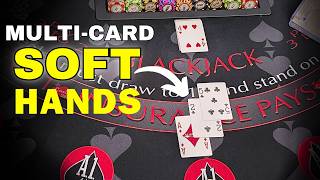
If a soft hand is composed of more than two cards, you cannot double down, even if the basic strategy chart would normally indicate doubling. For instance, a multi-card soft 18 vs. dealer 4 should be stood on.
Some soft hands require multiple hits. For example, soft 13 vs. dealer 10 is hit, becomes soft 18, which is hit again (since the chart says hit against a 10), then becomes soft 19, which is stood on.
Hitting a soft hand can turn it into a hard hand if the ace can no longer be counted as 11. For example, soft 17 vs. dealer 9 is hit, becomes hard 15, which is hit again, then becomes 20 and stands.
Another example: soft 13 vs. dealer 3 is hit, becomes hard 13, which against a dealer 4 is stood on.
Sometimes hitting a soft hand leads to a bust. For instance, soft 13 vs. dealer 9 is hit, becomes hard 13, hit again, and busts at 22. Similarly, soft 15 vs. dealer 3 can become hard 12, which is hit again and may bust.
The instructor promotes Blackjack Apprenticeship, a resource for learning card counting, with tools like betting software, casino locator (Casino 411), a forum, results tracker, and a video course.
The video ends with a quiz: soft 14 vs. dealer 5, multi-card soft 18 vs. dealer 2, and soft 17 vs. dealer 10. Viewers are asked to provide the correct basic strategy decisions.
Mastering soft hand decisions is crucial for blackjack success, and this video provides a thorough walkthrough of all possible scenarios. By understanding when to double, hit, or stand, players can improve their basic strategy play and avoid costly mistakes.
What is a soft hand in blackjack?
A hand that contains an ace that can be counted as either 1 or 11.
04:50
When you double down, how many more cards do you receive?
Only one more card.
01:00
What should you do with a multi-card soft 18 vs. dealer 4?
Stand, because you cannot double down on a multi-card hand.
03:16
What happens when a soft hand becomes a hard hand?
The ace can no longer be counted as 11, so it must be counted as 1.
04:50
What is the correct decision for a soft 13 vs. dealer 10?
Hit, then hit again if it becomes soft 18, then stand on soft 19.
03:41
What is the correct decision for a soft 17 vs. dealer 9?
Hit, which turns it into a hard 15, then hit again, and stand on 20.
04:36
What is the correct decision for a soft 15 vs. dealer 3?
Hit, which may turn it into a hard 12, then hit again, and possibly bust.
06:26
Multi-Card Soft Hands Cannot Double
This is a common mistake; players often try to double on multi-card soft hands, but it's not allowed.
03:16Soft vs. Hard Hand Definition
Understanding the definition is fundamental to making correct decisions.
04:50Soft Hands Can Bust
Many players assume soft hands are safe, but they can bust if hit incorrectly.
06:11[00:01] Today we're going to talk about all different types, kind of give you an exhaustive list of what to do when you have soft hands that stay soft after you hit them, soft hands that turn hard and then you have to hit again, and
[00:16] everything in between. All right, so for example, let's say we have a soft 18 here, but it's a multi-card soft 18 versus a dealer's four. What should you do? All right, you can't double anymore, but that's what the chart says to do.
[00:31] get to that in a second, but first off, let's go over some of the basic hands. I have a whole chunk of cards kind of listed out here for us that we're going to go through and kind of see what these different situations call
[00:45] for. All right, now the most basic is a soft hand that calls for a double down. All right, this is pretty easy. You double and you only get one more card. We give it to you face up here. In this case, our soft 13 became a hard 13, but
[01:00] because we doubled, that's all we can do. We only get one more card when we double down, and the dealer just plays out their hand as usual. They would take another card and that would be it. All right, let's do one more example of that
[01:13] kind. And that would be, let's say we have a soft 15 versus a dealer's four. basic strategy chart, this is a clear double down, and so we would double and and then the dealer would play out their hand and go from there. Okay, pretty
[01:29] the first type of soft hands that you can get. All right, throws off to the side. Now, the next type we'd like to call a soft hand that you stand on. Another very clear indicated
[01:43] here on the basic strategy chart. For example, a soft 20. what the dealer's up card is. We're going to stand on that and the dealer would play out their hand. They also have 20, and so therefore this one
[01:56] was a push. All right, another example of a soft hand that you would stand on would be a soft 18 versus a dealer's seven. This also calls for us to stand. The dealer play out their hand and that would be it. All right. So, a couple
[02:10] easy ones to start with. Those decisions are very clear, but as we get into this, right, this next category of soft hands are soft hands that you hit, but they are still soft hands and then you have to decide if you should hit or stand
[02:23] from there. All right, for example, let's say we were dealt a soft 13 versus a dealer's four. Well, this hand is not quite a double down yet, but the basic strategy chart says that we should hit on this hand. All right, so now we have
[02:36] a soft 20. And kind of like that previous soft 20, I have to revert back to our our chart where this would now be a stand and then the dealer would play out their hand or we're going to stand on our soft 20.
[02:48] Okay. Um another one like that is this one, a soft 15 versus a dealer's three. Again, not quite a double down yet, so we have to hit this and now we have a soft 18 versus a dealer's three.
[03:02] you at the beginning of the video where what happens when you have a soft hand that the basic strategy chart says you should double down, another card. And the answer is right here. This is
[03:16] different color because it says that this is normally a double down if it's your first two cards. If this was like an ace seven instead of an ace 4-3, so we would double if possible, but since it's no longer possible, it says
[03:29] that we should now stand on that against the dealer's normally doubled prior. All right, so then we're going to stand, the dealer can play out their hand from there and we're going to stay on our soft 18. This
[03:41] next category is soft hands where you hit and then you hit again to again make another decision. So, again, I'm trying to go through an exhaustive list here. And this one against a dealer's 10, no blackjack, a
[03:55] soft 13, this is going to hit, right? Now we have another soft 18, but instead of that last example where, you know, an ace seven would have normally doubled ace seven would have normally doubled against the dealer's two through six,
[04:09] here against the dealer's 10, the soft 18 row says that we should hit regardless of how that is comprised in our hand here. So again, we have to hit this one more time. All right. Now we have a soft 19, so we
[04:22] go up a row and what does this say now? Now it does say to stand and the dealer can play out their hand from there and we would end up pushing on our 19s. All right, this next category is going to be soft hands that call for a hit,
[04:36] hard. What I mean by that is here we have a soft 17 versus dealer's nine. Clearly on our basic strategy chart, this calls for us to hit, but when I do, this is no longer a soft hand. A soft hand indicates the ace can
[04:50] hand. A soft hand indicates the ace can be either a one or an 11. And because this cannot be an 11 anymore as that would put my total over 21, this has to only be kind of a firm one. It's the only possible thing that this could be,
[05:03] otherwise we'd bust, and so it's no longer soft. Doesn't have options anymore for this to be a one or an 11, it's only a one. Because of that, it's only a one. Because of that, uh 8 + 6 + 1 is a total of 15. Well, 15
[05:16] versus the dealer's nine still calls for a hit. And so now I would hit again. Now I have um 20, so I'm going to stand on that. Dealer could play out their hand. They had 19, and so we would win. All right,
[05:29] hand like that. And that's going to be a soft 13 versus a dealer's three. Here, again, it's not deviations if you're a card counter, but if you're just playing basic strategy,
[05:42] this is a hit, right? Now I have a hard 13. Well, a hard 13 versus a dealer's four, this is going to stand. All right, there's nothing left for me to do on this one um as 13 versus dealer's four
[05:56] to stand. The dealer would play out their hand from there. All right, this last category of soft hands is probably the least fun because this these are ones that if you have a soft total, it calls for a hit. We do that, all right,
[06:11] here. So, it was a soft 13 versus dealer's nine. Now, it's a hard 13 versus a dealer's nine, so it's still a hit. And unfortunately, this is 22. That is one too many, and so we bust. So, that is a real possibility, and that is
[06:26] let me show you one more, and then I'll have a little quiz for you after that. Here we have a soft 15 versus dealer's three. Again, not quite a double down, All right, now unfortunately, we have 12. This was one too many, and so this
[06:43] again has to act as a one. So, we're back to 12. 12 versus dealer's three is still a hit. And sometimes you pull a 10, and again, we do our little quiz, I want to talk to you about Blackjack Apprenticeship. This
[06:56] and where I learned all the decisions we're talking about in the first part of this video. They are the world leader when it comes to card counting and the link in the pinned comments, you will see that there's demo videos as to
[07:11] betting software, where you can learn kind of correct bet spreads to use, and kind of how to maximize your expected value at the Blackjack tables. Casino 411, which shows you kind of where the casinos are located, and not only that,
[07:25] but the number of tables that are at each casino, and the rules that they offer at each table. So, you can plan your Blackjack trips accordingly. There's also a forum where you can interact with other card counters, as
[07:37] well as the results tracker where you can keep track of your bank roll and all lastly, there's also a whole video course dedicated from taking you from absolute novice when it comes to the game of Blackjack to a professional card
[07:50] counter, and everything in between with all the practice and drills and things So, check them out down below in the pinned comment, All right, we're going to leave you guys with a little quiz here. You got three
[08:02] hands, one, two, and three. You guys tell me what is the correct decision according to basic strategy on these hands. We have a soft 14 versus the dealer's five for hand one. Hand two is going to be a soft 18, a multi-card soft
[08:15] 18 versus the dealer's two. And lastly, we have a soft 17 versus a dealer's below in the comments, and while you're down there, don't forget to check out blackjackapprenticeship. Woo!
[08:28] Woo! >> [music]
⚡ Saved you 0h 08m reading this? Transcribe any YouTube video for free — no signup needed.