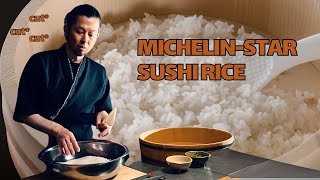

Never Wash Sushi Rice Like This!
38sReveals a critical mistake people make when washing rice that affects sushi quality.
▶ Play Clip"Title promises Michelin star sushi rice secrets—transcript delivers exact steps from a former Michelin chef."
A former Michelin star chef reveals the precise steps to make perfect sushi rice at home, from washing and soaking to seasoning and resting.
Measure rice with a scale. The first water is crucial—discard immediately as rice absorbs most water at the start.
Gently massage rice with five fingers (not palm) to polish without breaking grains. Rice is pre-polished, so light pressure is enough.
Rinse about five times until water is mostly clear. Over-rinsing can break grains and reduce flavor.
Soak for minimum 10–15 minutes, ideally one hour. Some restaurants soak up to six hours for different textures.
Drain rice and let it dry for about 10 minutes. For 450g dry rice, add 540ml water. Cook ~40 minutes in a rice cooker (or donabe).
Use a wooden (Hinoki) or metal bowl. Cover mixing spoon in vinegar to prevent sticking. Add 90g sushi vinegar to warm rice immediately.
Fold rice with a slicing motion (cut, not mix) to separate clumps without crushing grains. Keep rice fluffy and evenly seasoned.
Cover rice with a wet towel and let rest 5–10 minutes to cool. Store in a ceramic pot or oitsu, covered with a damp towel.
What is the first step after measuring sushi rice?
Discard the first water immediately because rice absorbs the most water at the beginning.
00:13
What is the correct technique for washing sushi rice?
Gently massage with five fingers (not palm) to polish without breaking grains.
00:26
How many times should you rinse sushi rice according to the chef?
About five times, until water is mostly clear.
01:04
What is the minimum and ideal soaking time for sushi rice?
Minimum 10–15 minutes; ideal is one hour.
01:17
What water-to-rice ratio does the chef use for cooking?
For 450g dry rice, add 540ml water.
02:47
How much sushi vinegar is added to the cooked rice?
90 grams.
03:26
What is the proper mixing technique for sushi rice and vinegar?
Use a slicing motion (cut) to fold the rice, not stir or press.
03:40
How long should sushi rice rest after seasoning before shaping?
5–10 minutes, covered with a wet towel.
04:21
Rice Polishing vs Washing
Clarifies that the process is polishing, not washing, and demonstrates the correct gentle finger technique.
00:26Optimal Rinsing Frequency
Provides a practical rule (5 rinses) to avoid over-rinsing that breaks grains and loses flavor.
01:04Soaking Time Flexibility
Explains that soaking time affects texture and that restaurants may soak up to 6 hours.
01:17Cutting the Rice
Introduces the key technique of slicing/folding to mix vinegar without crushing grains.
03:40Resting and Moisture Control
Emphasizes covering with a wet towel to prevent drying and achieve perfect temperature.
04:21[00:00] So, you want to learn how to make sushi rice? He will show you the exact steps on how to make the best sushi rice from scratch. The first step is to measure the rice using a food skill. And now for the second step. This is about 4 or 5 times.
[00:13] The first water is almost important. We have to slow water away immediately. This step is the most important because the rice absorbs the most water at the beginning. Don't wet rice or serve dirty water. So how to wash the rice?
[00:26] Well, first of all, chef told me it's not called washing the rice, but rice polishing. And the old school way to polish the rice was by pressing with the palm of the hand, but chef said it's efficient to gently stir and massage with your five fingers.
[00:39] Because what you need to know is that the rice is already pre-pollaged, so there's no need to apply as much force. You don't need to apply this. Be careful not to break the rice by applying too much pressure.
[00:51] The best and perfect sushi rice is made when the grains are still intact and uniform. And the next question is, how many times do you need to rinse it? Some methods suggest to keep rinsing and thus polishing the rice until the water becomes completely clear,
[01:04] but chef thinks rinsing the rice about five times is more than enough, because over rinsing can cause the rice to break and may result in a loss of flavor. I don't have to be completely clear. No, this is enough green.
[01:17] Some should do greener. Why do you not do it? I feel like the rice is forever. Now let's move over to the next step on how to make sushi rice, which is soaking the rice. Minimum 10-15 minutes. If you have enough time, do it one hour.
[01:30] Keep it in the fridge. Some of the times you have to rinse it in this case, you have to put it in the fridge. Yes, you need to soak the rice. The time rice spends soaking in the water before cooking affects its final quality flavor and texture.
[01:43] The optimal soaking time can vary depending on the type of rice, and chef soaks his rice for about an hour. Beyond that, the rice won't absorb any more water and won't give any more benefits in the rice he uses. However, chef said that some restaurants soak the rice for up to six hours,
[01:57] so feel free to experiment and find the best method for the rice you like to use. And after soaking, you can simply discard the water and move over to the next step. But before we do, if you want chef to teach you more about Japanese cooking and cutting skills,
[02:09] then make sure you subscribe to this new channel. And let's move on to the next step, and that is to get the rice as dry as possible. I have to waste a little bit. It's like leaving the 10 minutes or something.
[02:22] See? I have to be totally dry. And the next step is to cook the rice, and in this video, chef uses the Japanese rice cooker. But in his restaurant, he uses a classic Japanese cooking pot called Donabe.
[02:35] Oh, and if you want to know how to make sushi rice in a Japanese Donabe, or regular cooking pot, simply let us know in the comments. Doesn't matter what rice cooker you use, by the way.
[02:47] But can you make it with the European rice cooker as well? Yeah, you can, but I don't recommend that. This one, but don't stick. And now what you need to know is that for 450 grams of dry weight rice, chef adds 540 ml of water.
[03:00] Cooking the rice will take around 40 minutes, but this depends on the rice cooker you're using. Oh, and chef wanted to tell you that the best bowl for mixing sushi rice with sushi vinegar is made from Hinoki or Saladas Cypress wood. These woods don't affect the flavor of the rice.
[03:13] However, since most people don't have a Japanese Hinoki bowl at home, chef Yama will demonstrate how to do the next step, which is to mix the rice with sushi vinegar using a regular metal mixing bowl. And it's important to make sure that your mixing rice spoon,
[03:26] which officially is called a shamushi, is covered in vinegar to prevent the rice from sticking. So how much sushi vinegar to add for this recipe, chef, use 90 grams? Oh, and it's important to mix the rice with sushi vinegar immediately once the rice is cooked
[03:40] and thus still warm. So we don't say mix, we say cut, cut, cut, cut. So when you see some dismalcy with the cut, then you mean them, cut, cut, cut.
[03:54] So cutting the rice means gently folding the rice with a slicing motion and breaking up any lumps gently without crushing the grains. The slicing motion helps separate the clumps, ensuring the rice stays fluffy and evenly seasoned.
[04:08] So you cannot press, you have to gently mix. It's very important. Now that you know how to cut the rice, you need to cover it with a wet thick kitchen towel to keep your sushi rice from drying out.
[04:21] Now your sushi rice needs to rest about 10 minutes to cool down to a perfect temperature before shaping it. Now wait, let's say five to ten minutes,
[04:33] then we'll be right temperature. To store your sushi rice while shaping it, chef uses a Japanese ojitsu to keep perfect moisture and temperature, but you can also use a ceramic pot. And don't forget to cover it with a wet thick kitchen towel again.
[04:48] And your next step is to start shaping your sushi like a pro, so watch this video next.
⚡ Saved you 0h 04m reading this? Transcribe any YouTube video for free — no signup needed.