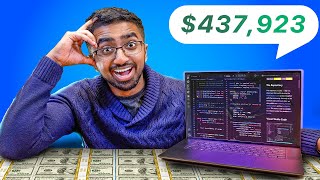

How RSUs Trap Software Engineers
55sReveals the downside of stock compensation that many engineers don't realize until they're stuck.
▶ Play Clip"The title accurately reflects the content, as the video provides a detailed breakdown of all 13 income sources."
A full-time software engineer and part-time content creator breaks down his 13 income sources with complete financial transparency. He details his compensation from a Silicon Valley job, content creation revenue, and investment strategies, aiming to provide actionable insights for viewers.
Compensation has three components: salary ($120k-$170k for Silicon Valley, boosted 10-15% with a master's), stock compensation (RSUs and ESPP), and bonuses (annual, relocation, performance). Total from job: $250k-$300k.
RSUs (restricted stock units) are granted over four years, e.g., $100k over four years. They can grow significantly (e.g., NVIDIA engineers becoming millionaires) but handcuff employees to the job. Amazon's vesting schedule is 5%, 15%, 40%, 40% over four years.
Allows employees to allocate 10-15% of salary to buy company stock at a 25% discount, creating instant profit. Example: $15k allocated buys $20k worth of stock.
Annual bonus is split: 5% based on company performance, 5% on individual performance. Exceeding targets can increase bonus (e.g., 10% target became 13-14%). Other bonuses include relocation ($5k) and spot awards ($1k-$2k).
Earns $700-$1,000 per month from YouTube ads. Took nine months to hit monetization thresholds (1k subscribers, 4k watch hours). First month earned $22.67.
Initially earned $2 per 1k views, but as audience grew internationally, RPM dropped to $0.50 per 1k views. One viral video (3.3M views) earned $1k, but revenue became unreliable.
Instagram bonuses (invite-only) earn $800-$1,200/month. Sponsorships are the real money: over six figures in 2024 from companies like AWS, ServiceNow, IBM.
Affiliate marketing with Codecademy (discount code 'sadge20'). A course on landing a first tech job generates revenue without active advertising.
Miscellaneous services (resume reviews, consultations). Speaking engagements at universities (Stanford, UC Berkeley, etc.). Investing in Sharia-compliant index funds (HLAL, SPUS) and angel investing via Hustle Fund's angel squad.
The creator's income is diversified across a high-paying software engineering job, content creation on multiple platforms, and strategic investments, emphasizing the importance of multiple revenue streams and financial transparency.
What are the three major components of a software engineer's compensation at a Silicon Valley company?
Salary, stock compensation (RSUs and ESPP), and bonuses.
00:28
What is the typical vesting schedule for RSUs at Amazon over four years?
5% first year, 15% second, 40% third, 40% fourth.
02:06
How does an Employee Stock Purchase Plan (ESPP) create instant profit?
Employees can buy company stock at a 25% discount using 10-15% of their salary.
02:36
What two factors determine the annual bonus payout?
Company performance (5%) and individual performance (5%).
03:24
What were the YouTube monetization thresholds the creator had to hit?
1,000 subscribers and 4,000 watch hours.
05:27
Why did the creator's TikTok revenue per 1,000 views decline from $2 to $0.50?
Because the audience expanded to countries with lower purchasing power.
07:08
What is the creator's primary source of 'real money' as a content creator?
Sponsorships.
08:11
Which two Sharia-compliant index funds does the creator invest in?
HLAL and SPUS.
11:51
What is angel investing, as described in the video?
Investing $1,000 to $5,000 in early-stage startups hoping for a large payout.
12:18
NVIDIA Engineers' Wealth from RSUs
Illustrates the massive potential upside of RSUs when a company's stock performs exceptionally well.
01:37Amazon's Back-Loaded RSU Vesting
Shows how companies use vesting schedules to retain talent, with most compensation coming in years 3 and 4.
02:06TikTok RPM Decline with Global Reach
Highlights the risk of relying on platform revenue when audience demographics shift.
07:08Sponsorships as Primary Creator Income
Demonstrates that for creators, direct brand deals far exceed ad revenue.
08:11Sharia-Compliant Index Fund Investing
Provides a real-world example of values-based investing within a standard portfolio strategy.
11:51[00:00] I'm a full time software engineer, part time content creator, but with everything under the hood, I effectively have 13 income sources. And so in this city, I'm going to be giving you a complete breakdown, financial transparency
[00:14] of how I make my money, what I do, and I hope that there's some value you can drive out of this video and that you appreciate this level of transparency. And with that being said, let's get started right away. In my 9-5 software engineering job, I work for a Silicon Valley based company, and my compensation
[00:28] is working up into three major components. First is salary. This is what gets deposited to my bank account every two weeks. The average base level salary for an entry level software engineer in the US is close to $118,000, but depending on the company you work for, and location, it can vary a lot.
[00:43] Like I said, I work for a Silicon Valley California based company, and so you'll see this number being a little bit higher in the range of $120,000 to $ 170,000. Plus, I got a little bit of a boost when I started working because I did complete my master's
[00:57] and computer science, which on average gives people a 10 to 15% pay-up. The second component or income source is stock compensation, and this is where things get pretty interesting. Let's say you're a brand new engineer, starting your job at Amazon.
[01:10] They may say we will grant you $100,000 over four years in RSUs or restricted stock units. So every year they'll give you $25,000 worth of their company stock up to four years.
[01:22] And I know that this sounds pretty amazing, but it's more like bittersweet. On one hand, RSUs are wonderful, because especially if you work for a company you like Amazon, and their stock does phenomenal, that initial $100,000 grant could end up becoming $200, $300,
[01:37] $400,000. In fact, 33% of NVIDIA engineers are millionaires today because their stock has been going up to the moon over the last year. But on the flip side, RSUs can be seen as being very evil or a way to handcuff software engineers
[01:52] to their jobs. Because it typically requires four years to get your full payout, you're pretty much stuck working there all four years, because otherwise you sacrifice a lot of compensation. In fact, with Amazon specifically, they don't pay you 25% every year.
[02:06] They pay you 5% first year, 15% second, 40% your third, 40% your fourth. So you pretty much have to stay till at least your third year before you get a serious chunk of compensation. So they can kind of afford to pay you a little less than market rate, which is by the way,
[02:21] but they can do that because they know that you want to stay there for that fat payout at the very end. Another part of stock compensation is ESPP or employee stock purchase plan. Now this is when companies allow you to take 10 to 15% of your base salary and dedicate
[02:36] that towards purchasing the company stock at a 25% discount. So imagine you make $100,000 every single year and you allocate 15,000 of those dollars to purchase your company stock. And if the stock price is at $100, for example, you'll get it at a discount of $75.
[02:53] And just like that, you own 200 shares of your company, which is worth $20,000, but you only spent $15,000. So it's almost like an instant $5,000 profit. Now, you can't sell immediately for obvious reasons, but generally if the company isn't
[03:08] doing horrendously, it's pretty much a guaranteed profit. My third income source or the third category in software engineering compensation is bonuses and there are many, many different types of bonuses. The common one people know about is the annual bonus and how this works is see you make $100,000
[03:24] and your target bonus is 10%. It's called a target because it's not guaranteed 10% bonus and you might ask why is it not guaranteed I thought we're supposed to get paid extra? Well, it's because of a couple of factors. 5% of this 10% is dedicated towards company performance and the other 5% is individual performance.
[03:42] So half of your bonus depends on how is the company doing? Are they turning profit? Are they acquiring new customers and general financial metrics for the company? If they're doing well, you'll probably get 5% of your 10% this whole category. But the other 5% is, are you a good engineer?
[03:56] Are you meeting your goals? Are you exceeding your goals? Are you ensuring quality product delivery? In fact, last year, my company was doing so well and I was ranked within the top 20% of engineers at my company. So my target 10% bonus actually ended up being closer to 13% or 14% because both categories
[04:12] exceeded their relative 5%. Other types of bonuses are things like relocation bonus. Like when I first started working, I got a $5,000 bonus to relocate from the East Coast to San Francisco, California.
[04:24] Other companies help you out in different ways. For example, one of my friends at Microsoft had a whole team of movers come to his place to help him move. One of my other friends at Google got a free real estate agent to help him find a property where he was moving.
[04:36] There are also other types of performance bonuses, like for example, a focalling does really good work. Just tell your manager or your director and they'll be eligible for a potential $1,000 $2,000 bonus as an award for the contributions.
[04:48] So overall from my software engineering job, I earned between $250 to $300,000 and I gave a range of this because the income can fluctuate depending on if the bonus is doing well, the stock is doing well and just general factors.
[05:01] Now let's get into an interesting discussion. So as you all know, I'm a content creator. I have a presence here on YouTube, TikTok and screen LinkedIn and Threads with the combined presence of about 700,000 followers and very gratefully, I do earn some pretty great
[05:15] money from this. So let's take a look. My fourth income source we got YouTube at sense. So you know those videos you see during high, do you feel stressed? The only way you can solve your problems is by investing into my $200 with cream.
[05:27] It's good. Goes well with pancakes. And I've been on this YouTube platform for about four years now and in order to start getting paid for these ads that would be put on my videos, hi, do you feel stressed? I had to hit 1000 subscribers and 4,000 watch hours, which took me nearly nine months
[05:43] to hit. Nine months of consistently posting three long form videos per week and once I did my first day, I made a grand total of $1.39 and that whole week, I made a few extra dollars and that whole month, I made $22.67 and I felt like a king.
[05:59] But that was back in 2021 when I just hit 1000 subscribers but over time, very gratefully, my platform started to grow and now I have around 40,000 subscribers averaging around 30 to 50,000 views per video, though I make a decent $700 to $1,000 per month on YouTube.
[06:14] So thank you for not skipping my ads. My fifth income source is the TikTok creator fund and at the time of filming, I have around 165,000 followers on that platform which probably won't exist by the time that this video goes live.
[06:26] But pretty much you need to hit 10,000 followers and have 100,000 views in order to qualify for this program. It's a little easier than the YouTube requirements and what's insane is you can go viral so much easier on a platform like TikTok and once I got monetized there, I was making $2 per 1000
[06:42] views, which is really insane considering the reach that you can have on TikTok. In fact, from this one video that I made, spending literally 20 minutes between two work meetings, I got 3.3 million views on that video and made over $1,000 and that month on TikTok, I made
[06:55] nearly $6,300. But I know it low-key sounds too good to be true and you're right, it was too good to be true because as I continued to post on TikTok and my views would go up, my follower
[07:08] account would go up, I was reaching a really wide audience, I was hitting countries outside the United States where they don't have that much purchasing power. So my revenue per 1000 views started to decline and like I said, it started off at $2 per
[07:20] 1000 views. But once I went more and more viral, it went all the way down to 50 cents per 1000 views and so instead of making thousands of dollars for millions of views, I would only make a few hundred dollars for millions of views.
[07:33] I have to say that that's bad and I'm very grateful for the situation I'm in but as a business owner and I treat this as a business, relying on that as a source of revenue from which I pay people to do services like editing videos or purchasing camera equipment, mic equipment,
[07:47] it's just not a reliable monetization strategy. So I decided to focus a little more on Instagram. My sixth source of income is Instagram bonuses and this one I honestly can't really tell you that much because the programs invite only.
[07:59] I don't know definitively why I got invited and why some people didn't get invited. I mean thankfully I do have over like 440,000 followers on that platform and very thankfully I make between $800 to $1200 per month.
[08:11] My seventh income source is sponsorships. If you're a creator, this is where the real money actually starts. Depending on how many followers you reach, your engagement, and your general likeability of course I'm good, right? Brands will offer you a certain amount of money to make videos promoting a product or service
[08:26] and I've worked with companies like AWS, ServiceNow, IBM and I've made just from sponsorships alone over six figures in revenue in 2024 which is really mind boggling since these sponsored videos are a little like 30 second clips of me just promoting a product but not just that
[08:41] as a result of this I've been flown out to tech conferences and campuses and had opportunities to interview sea level executive global AI leads and data scientists and I'm honestly just so excited to keep growing this and for opportunities in 2025.
[08:55] My eighth income source is affiliate marketing. Now this one is kind of like a sponsorship but not exactly. So I work with this platform called Cody Tech in which they teach people how to code from a very basic bite size level and I also think their platform is amazing and they have helped
[09:11] many many people which is why I love working with them. Your product by the way is free but if you do happen to want to use their premium features like their unlimited AI assistant for queries my code sadge20 can help you get a 20% discount
[09:25] plus you're supporting me and helping me run my business so I can continue providing you free value so it's like a win win win. My ninth source of income is one singular product to land your first tech job.
[09:37] I launched this course last year in which I offer free resume reviews advice, technical and behavioral interview prep and pretty much everything you need to land your first software engineering internship or entry level positions. Very interestingly I have not once even once advertised this because I didn't want to
[09:52] appear as a sell out but I did put it in my YouTube video descriptions and very surprisingly people have purchased it but not only that but like some people have actually come up to me in person and told me how useful it was for them which honestly didn't make my day.
[10:06] So if you are interested in landing your first software engineering internship or full time job link will be in the description below and you can check it out. By the way on the side if I made a course in which I taught you guys how to code like in Python or Java first of all what language would you be interested in and what like topics
[10:20] would you want to know. Let me know in the cons below. My tenth source of income is what I call miscellaneous services and this is actually why a lot of content creators actually get into the content space because they typically have a business at the back end and then they create content in which they get a lot of eyeballs
[10:36] on them so they can like funnel people in. For me I don't really have a full-fledged business but just out of sheer demand of resume reviews and consultations I have started doing those and earning money. My eleventh source of income is speaking engagements and very very grateful that I have spoken
[10:52] out many places over this last year including Stanford UC Berkeley, Georgia Tech and in many different cities including Dallas, Chicago, Boston, New York, Toronto, Los Angeles and San Francisco. And as my platforms continue to increase in size the goal is to continue to grow this and
[11:06] hopefully earn some money in the process. And if you're interested in having me speak out of local conference or university feel free to reach out I'll put a Google form down below. The next overall section in my income and this is something that I think everyone should be doing and that is investing.
[11:20] So my twelfth source of income is index fund investing and I know savvy investors so I don't like to track individual stocks so I systematically invest a portion of my paycheck every week into index funds which pretty much gives me a small portion of top performing company
[11:36] stocks. A little bit of Apple, a little bit of Amazon, a little bit of Google. And some of the traditional index funds you probably know of are the S&P 500 and the Dow Jones. Now I actually don't invest in those. In fact I'm not even allowed to because I'm a Muslim there are certain financial principles
[11:51] and rules that I need to follow meaning certain companies that deal with alcohol or just general prohibited things in the religion I'm not allowed to invest in. So I invest in HLAL and SPUS which are two index funds that track the S&P 500 and the
[12:05] Dow respectively but contain only the Muslim friendly stocks. And thankfully this has given me a pretty sizable return over the last couple years. My thirteenth income source and this is something I recently got into is angel investing.
[12:18] Angel investing is pretty much a way an average Joe like myself can invest a thousand to five thousand dollars into early stage startups in the hope of them going big so you get a fat payout. I recently joined HUSFUN's angel squad investing group and they have a group of VCs bench
[12:33] capitalists at the top of the company who received many proposals from startups looking to do investment. Then they do their due diligence listen to the pitches and once they decide that they actually want to invest they'll inform people in the group of the opportunity.
[12:46] It's super nice for me because I get to see what new innovative things people are working on invest my money plus I get to expand my network overall which is something I really need to do since I'm only 23 years old. And by the way if you're interested in angel investing they'll be a link down below in
[13:00] the description for you to join. Well that's about all I have in this video, I really hope that you guys enjoyed it and I hope that you got some value out of this video. Now if you want to land your first software engineering internship or job for the summer of 2025 you might be interested in this video right here.
⚡ Saved you 0h 13m reading this? Transcribe any YouTube video for free — no signup needed.
