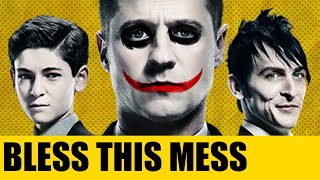

They cured the Penguin and nobody cared
50sThe absurdity of a perfect crime cure being ignored in a crime show is hilariously frustrating.
▶ Play Clip"The title accurately promises five specific complaints about *Gotham*, and the video delivers exactly that with detailed examples and humor."
This video humorously critiques the first five 'dumbest things' about the TV show *Gotham*, including a forgotten cure for crime, a missed opportunity with the Wayne murder, the mishandling of the Joker character, the show's aversion to consequences, and a convoluted villain backstory. The creator argues these issues undermine the show's potential and logic.
Dr. Strange successfully conditions Oswald Cobblepot (Penguin) to be harmless, but the show never revisits or uses this cure again, despite it being a near-perfect solution for violent criminals.
The show opens with the murder of Bruce Wayne's parents, missing the chance to develop them as characters and instead signaling a slow Batman movie, which turns off viewers.
Gotham introduces Jerome Valeska as a Joker-like character but cannot call him the Joker due to rights issues, leading to a convoluted twin brother plot and fan frustration.
The show frequently reverses serious injuries (e.g., Tabitha's severed hand) and uses fakeouts, making stakes feel meaningless. Arkham Asylum is a revolving door, removing tension from imprisonment.
Theo Galavan's vendetta against the Waynes is based on a centuries-old, unproven family feud, making him seem petty and spoiled rather than a compelling villain.
The video concludes that *Gotham* has significant logical flaws and missed opportunities, but promises to discuss both more criticisms and positive aspects in a future part.
What does Dr. Strange do to Oswald Cobblepot in season two?
He conditions him out of his violent impulses at Arkham Asylum.
0:43
What event does the show open with in the first episode?
The murder of Bruce Wayne's parents, Martha and Thomas Wayne.
3:25
Why can't Gotham officially call Jerome Valeska the Joker?
Because DC won't give them the rights to use the Joker character.
6:39
What happens to Tabitha's severed hand in the next episode?
It is bandaged up but she can still move her fingers, treating it as a minor inconvenience.
9:57
What is the basis of Theo Galavan's vendetta against the Wayne family?
A centuries-old accusation that a Wayne ancestor cut off the hands of a Dumas family member, with no proof.
13:11
Forgotten Cure for Crime
Highlights a major plot hole where a perfect solution to crime is introduced and then ignored.
0:43Insecure Premiere
Critiques the show's missed opportunity to build emotional depth by rushing the Wayne murder.
2:50Mishandling of the Joker
Explains the legal and creative mess around the Joker character, frustrating fans.
4:47Undermining Consequences
Points out how the show's fakeouts and reversals make stakes meaningless.
9:48Galavan's Weak Backstory
Exposes a poorly constructed villain motivation that lacks emotional weight.
12:30[00:00] “{Oswald:} Prepare for one massive tantrum!”
[00:04] Right now, I think Gotham is the most entertaining it’s ever been. That is a really weird thing to say about a television show that’s gotten dunked on as much as Gotham has.
[00:12] Gotham’s fanbase seems to be divided between loyal fans who are fed up with people acting like Gotham is the Glee of superhero shows, fans who hate-watch the show and only like two characters,
[00:21] and non-fans who are constantly showing up in comment sections like, “I always knew the Batman show without Batman was gonna be trash.”
[00:29] No matter what kind of viewer you are, I’d like to invite you to Part One of this series where we celebrate the dumbest things about Gotham.
[00:35] [Gotham title jingle]
[00:40] Number 1: oops, we cured crime.
[00:43] In season two, dangerous criminal Oswald Cobblepot, aka the Penguin, is sent to Arkham Asylum where he’s conditioned out of his violent impulses.
[00:52] After he is repeatedly tested to make sure the conditioning worked, he is released back into the city of Gotham. Oswald, now naive and harmless, goes to make amends with his enemies, and they tar and feather him. But still the conditioning holds up.
[01:05] Oswald goes to see his only real friend at this point in the story, Ed Nygma, aka the Riddler, and he turns him away. He has no interest in being Oswald’s friend now that he’s no longer a criminal.
[01:15] “{Ed:} Normally, I would love to share, but, to be honest, the new you is kind of freaking me out.”
[01:21] Soon after this, Oswald is reunited with his long-lost father. Overjoyed, Oswald moves into his dad’s big old mansion, but he is then abused by his new stepmother and step-siblings who don’t want him living with them.
[01:33] “{Stepmother:} We’ve been sheltering a killer.”
[01:36] Oswald’s father then dies, and Oswald is still fine; the conditioning has held up.
[01:44] “{Oswald:} *clingingly sad* He loved us all so much.”
[01:46] “{Stepmother:} *uncomfortably* Indeed.”
[01:47] It is only when Oswald discovers his father was poisoned by his stepmother to keep him out of his father’s will that the conditioning finally cracks. And yes, Oswald cooks his step-siblings and feeds them to his stepmother, but that’s not the point.
[02:00] The point is that this conditioning took a guy who once killed a man for a pair of shoes and turned him into a puddle of niceness, and this conditioning held up under very extreme circumstances before it broke.
[02:11] As far as I’m concerned, Dr. Strange, the mad scientist who did this to Oswald, has found a near perfect cure for violent repeat offenders in this crime show about homicidal criminals, and no one cares!
[02:23] It’s so weird! It’s like Dr. Strange just straight-up forgot he did this. He never tries to cure anyone else. Nobody who saw Oswald acting like this is at all curious about what happened.
[02:33] Oswald himself has no interest in harvesting this power for his own gain to clip the wings of his enemies.
[02:39] So throughout the rest of this video, keep in mind that there is a treatment that could make all of these people harmless, and the show is trying its hardest to make you forget it.
[02:48] Number 2: the first episode.
[02:50] Gotham, as a television show, especially in the beginning comes off as insecure.
[02:56] The show went through many identity problems with things like its tone and whether or not super villains were memes, but its biggest insecurity seems to be its very nature as a prequel and its obsession with referencing the Batman status quo.
[03:09] The fans know that when it comes to Bruce becoming Batman that there can’t be a real payoff until the show’s over. ‘Cause then, you know Bruce can go all,
[03:17] “{Batman:} I am vengeance. I am the night! I am Batman!”
[03:25] *excitedly* Yeah!
[03:25] But we can’t do that yet, so we gotta be patient. It’s a journey; don’t rush the journey. Which is why it was a super dumb decision to open the show on the murder of Bruce’s parents, Martha and Thomas Wayne.
[03:39] I am very, very salty about this. They could’ve spent a season or just half a season flushing Thomas and Martha out, making them real characters and invoking that dread because you know their ultimate fate.
[03:51] This could have been a really painful crime drama that led to them getting assassinated in an alleyway in front of their kid.
[03:57] In Gotham, Thomas and Martha getting shot is not really any deeper or more dramatic than when it happens in Starkid’s Holy Musical B@tman!, and that’s a comedy play where stuff like this happens:
[04:08] “{Robin:} Look Batman, a dog!”
[04:11] [peppy electronic music]
[04:13] Now I know it might sound really weird to criticize something for a lost opportunity, but this is a really big lost opportunity. First impressions are important, and I know a lot of people that gave up on this show really quickly.
[04:24] When you open up your show in this stereotypical way of Martha and Thomas getting shot, you are not sending the message that this is an opportunity to see Gotham in a whole new way.
[04:33] You are sending the message that this is the world’s slowest Batman movie, and that is a very toxic way to watch the show and will almost ensure that you have no fun with it.
[04:44] Number 3: the mistreatment of the Not-Joker.
[04:47] In season one, we are introduced to a character named Jerome Valeska who was the son of a snake dancer and a blind fortune teller and was raised in a traveling circus.
[04:56] The audience was almost universally delighted by Jerome as they assumed he was the Joker and really liked what his actor, Cameron Monaghan, was doing with the character.
[05:04] But then he died. Oops!
[05:07] Producer Danny Cannon explained in an interview that the Joker was more of a spirit of madness, and ideology, and not an actual dude, and then a lot of people who heard him say this groaned and rolled their eyes.
[05:19] Danny seems to have taken some inspiration from Heath Ledger’s Joker without really understanding what makes that character seem more like an idea than a dude.
[05:27] That Joker appears in his universe fully formed but without a real identity. He doesn’t have a name or a history.
[05:34] “{Police Officer:} No matches on prints, DNA, dental. Clothing is custom, no labels. Nothing in his pockets but knives and lint.”
[05:42] You can’t get the same effect when your version has a mommy and a daddy.
[05:46] “{Jerome:} Everybody has to start somewhere.”
[05:48] Jerome just feels more like a person than a spirit of madness or chaos, but that’s not bad. Heath Ledger’s Joker isn’t the only correct way of doing things, but if you want that kind of character, you have to commit to the idea.
[06:00] As the audience continued to grumble, Gotham decided to resurrect Jerome. And he was a lot of fun and real spooky for a while, until there was a twist. He turned out to have a twin brother no one had ever talked about before who was a genius and a good guy, mostly.
[06:15] This show has an obsession with secret twins and, surprisingly, this is not even the worst example. So Jerome was alive. He did Joker things, and then he died again.
[06:24] But this time, he used gas to turn his brother evil and live on in the darkness of his mind. So you might be wondering, “Uh, who’s the Joker? Is the twin brother Jeremiah now the Joker?”
[06:35] Well, thanks to Cameron Monaghan’s Twitter, we slowly found out the truth.
[06:39] Okay, so this entire time Gotham didn’t have the rights to use the Joker. DC won’t give it to them, so there isn’t going to be a Joker. They’re not allowed to use him.
[06:51] [many facepalms]
[06:53] {quote from Director, Writer, and Executive Producer John Stephens}
[07:01] Oh, so the Joker’s a fanboy. Jerome and Jeremiah already have tons of fanboys, (they have a literal cult following,) *sarcastically* but suuure. He sounds really cooool.
[07:11] I have some bad news for the writers and producers of Gotham: you have not protected the Joker; Gotham has a Joker in it. The second you got an actor with a big wide smile to laugh like this,
[07:24] “{Jerome:} Ahahaha!”
[07:28] “{Jerome:} [crazed laughter]”
[07:29] and talk about chaos and madness in society, it was all over. It was double over when you kept referencing other Jokers. It doesn’t matter if they don’t call Jerome and Jeremiah the Joker; everyone knows this is a Joker.
[07:45] Youtubers are including them in listicles about the best and worst Jokers. Cameron Monaghan talked in an interview about how he’s avoiding stuff from an upcoming Joker-centric movie so that it doesn’t affect his performance.
[07:58] He’s not allowed to call his character the Joker, but he’s operating as if he’s playing the Joker. Apparently the higher-ups didn’t realize it’s characterization and the overall aesthetic that makes a Joker a Joker and not one detail like green hair.
[08:13] So instead of just accepting this, they danced around it for years, leaving fans of the show in the dark. I’ve seen it suggested that the reason they won’t give them the rights is because they don’t want two live action Jokers out at the same time.
[08:25] That reasoning makes no sense to me. Modern audiences are aware of the concept of alternative universes, retellings, and remakes. It’s so funny to me that no one gets what they want in this situation.
[08:37] The fans don’t get Jerome cemented as a real Joker, and DC doesn’t get to protect the Joker. If I were one of these higher-ups, things would be getting very dark very quickly; like,
[08:47] “Mr. Bruno Heller, hi. You weren’t allowed to use the Joker, but somehow your show has two Jokers. Do you brush your teeth and eat ice cream at the same time? How did you even do this on accident, ya scrub?”
[09:00] It makes me so sad to read statements from the actor on how grateful he is to have been totally shafted.
[09:07] {quote from Cameron Monaghan}
[09:15] “I see no point in being resentful of that. You must understand how grateful I am to have been able to touch the character at all and in some way have a thumb print on the mythos.
[09:23] “Not just once, but two different interpretations over the course of [like] 16 one-hour episodes. That’s simply badass and a lifelong dream of mine. And I hope to continue to have a thumb print [with] this character and other comic book characters I love.”
[09:33] Look what a good boy he’s been, playing along with your nonsense! Why won’t you let him be the stupid murder clown!?
[09:39] “*screechy voice* When will you learn?! When will you learn?! That your actions have consequences!”
[09:45] Number 4: undermining consequences.
[09:48] In season three, Ed Nygma makes fellow criminal Tabitha choose between getting her hand cut off and saving her boyfriend, Butch. She chooses her boyfriend over her hand.
[09:57] But then in the next episode, Tabitha just has her hand. It’s bandaged up, but she’s still moving her fingers. Now of course people have gotten severed hands reattached, but the physical therapy for that is not easy.
[10:08] Gotham took a life-changing injury and turned it into a minor inconvenience that can get swept under the carpet in a couple o’ episodes.
[10:15] This example kinda illustrates why Gotham does not do consequences, and you should never take anything that happens on Gotham too seriously. The show also loves fakeouts.
[10:25] In this fakeout, Alfred carves his face, tries to kill Bruce, and then dies. Good thing it was a hallucination caused by Scarecrow. In this fakeout. Ed stabs Oswald in the middle of a room filled with people.
[10:39] This one doesn’t even have a justification; it was just a daydream. But Gotham’s aversion to consequences is only just beginning.
[10:45] This show relies on death and pointing guns at people for high stakes, but undermines the very concept of dying so early in the show’s run that dramatic standoffs and hostage situations become kind of meaningless.
[10:56] Occasionally characters do die, but what usually happens is characters temporarily become inferior versions of themselves that aren’t quite as fun. Death scenes can be extremely memorable.
[11:07] I don’t think anyone’s gonna remember the time Ed was temporarily stupid from freeze ray-induced brain damage. I understand that Batman can’t fight these villains if they don’t live to see Batman,
[11:19] but I don’t think stakes have to be life or death for a show to be good. Sometimes I think an audience is less likely to call a writer’s bluff if something small is at stake.
[11:28] Most of the time authors won’t actually blow up the planet, but they might destroy an object that means something to a character or make a character realize they were being misled.
[11:37] The trouble is to make an audience care about the well-being of a volleyball, you have a lot of work to do to set that up. So how are Gotham’s smaller stakes? What steps up to take the place of death?
[11:48] Well, it’s a crime show, and it’s a Batman show; so the two obvious ones are prison and Arkham Asylum. Characters in Gotham basically get out of having to go to prison by instead being sent to Arkham, and the big fandom meme is Arkham’s gate is a revolving door.
[12:02] [nighttime ambiance]
[12:03] “{Ed:} I’m sane.”
[12:08] [paper noises]
[12:09] “{Ed:} And the murder of Miss Kringle?”
[12:13] “{Ed:} Officer Pinkney?”
[12:15] [disappointed and reflective jazzy music]
[12:18] Basically all of the tension of the characters getting caught by the police just fizzles out because there is nowhere to put them where they will stay even for a little while.
[12:27] Number 5: Galavan’s backstory.
[12:30] Do you guys remember the episode where a family of circus clowns and a family of trapeze artists were arguing?
[12:35] This was a generation-spanning feud that originally started because someone from one family accused a person from the other family of stealing a horse. I just want you to tuck that little detail into your mind palace for right now.
[12:47] Okay, so Theo Galavan is an antagonist from season two, and he is generally considered to be a good villain. But he drives me insane because if you think about his character motivation for too long you realize Gotham turned a cool, cold villain into a snot-nosed brat,
[13:01] but then continued to act like he was cool and cold. Galavan never explains the full story to us. We get the full story from the super official source of a woman who runs an antique store in Gotham.
[13:11] Galavan is mad because his ancestors, the Dumas family, were once among the most powerful families in Gotham, just like the Waynes. But one night a young man named Caleb Dumas was caught in an “illicit embrace” with a woman named Celestine Wayne.
[13:25] Caleb swore that they were in love, but Celestine swore that he forced himself on her. Celestine’s brother didn’t believe Caleb, and he used a sword to cut his hands off. Caleb was then exiled overseas.
[13:36] His family changed their last name to Galavan, and now there is a cult among the Galavans, outfitted with actual unnamed revenge monks, who want to avenge the crime committed against Caleb and replace the Waynes as the most powerful family in Gotham.
[13:49] Okay. Problem One: Theo has not suffered because of his family’s name change.
[13:55] We’ve learned from his little sister, Silver, that their family grew up in the lap of luxury in a huge estate by the sea where they had puppies and ponies, and what happened to Caleb has perhaps made his family slightly less filthy rich and famous than they could potentially be,
[14:09] which is still rich enough for him to buy his way to be mayor and buy his way out of any legal problems he encounters. Now an antagonist that is motivated by how spoiled they are can still be a cool and compelling antagonist,
[14:20] but the story doesn’t acknowledge how dumb and spoiled this makes Theo look. Everyone acts like this is super cool and legit,
[14:26] but all I saw watching this was a grown-up Dudley Dursley, but like ten times worse; just this ham demon having a hissy-fit because there aren’t enough bridges named after him.
[14:35] “{Theo:} We carved the bedrock upon which it stands, but there is not bridge, an alley, a ditch that carries our name.”
[14:43] Problem Two: Galavan nor any of his family’s revenge monks have any proof of what happened between Caleb and Celestine.
[14:49] It’s not like Celestine wrote a deathbed confession that she lied about Caleb. In fact, they don't seem to have any proof Caleb's hands were cut off at all.
[14:56] All we have is the blade bearing the Wayne sigil that was allegedly used to Hammurabi his hands off-y in one side of a centuries-old accusation that might as well be an urban legend.
[15:06] Now, maybe it’s just me. Maybe I’m just cynical, and I’m just too suspicious of the accuracy of stories my family tries to pass down to me. But I would not take this very seriously. Personally, I would not join a cult to avenge my unspecified amount of greats great granddad.
[15:23] ‘Cause like, I don’t know what’s going on. Maybe Granddad was a grabby hotdog neck, and yeah, I will agree with you that even if he was a grabby hotdog neck, he didn’t deserve to get his dattles disconnected.
[15:33] Or maybe you’re totally right. Maybe Granny Celestine was a liar-liar-pants-on-fire with a dead coral reef for a heart. All I know is that I don’t know what happened. Everyone involved is dead.
[15:44] What do you want me to do? Call Long Island Medium? “*imitating gruff middle-age woman* Theresa, break out the lie detector for ghosts.” I’m not gonna do that. That’s just absurd.
[15:53] Because of the polygraph. They’re actually very unscientific.
[15:56] You know, if this was his dad or his grandfather, it would fix so many of my problems with this. It would make sense for him to just trust them, and he would have grown up seeing them struggling firsthand because of the Waynes’ snapshot judgement and vigilante justice,
[16:09] and that would be super relevant. These revenge monks are a lazy contrivance. Where do they come from? Why do they care so much? Why are you going to do this when you have everything to lose and nothing to gain?
[16:19] Problem Three: Bruce’s side of this is just non-existent. Bruce is related to Celestine, but he has no relation to her.
[16:25] It’s easy to see how they could’ve planted some remnant of Celestine at Wayne Manor: a diary, a letter confessing her crimes, a lovingly rendered handless man painting; but there’s just nothing.
[16:36] She’s not a real character. She’s a faceless shadow puppet. I don’t even know if Bruce knows she exists.
[16:42] For some reason they included the detail that Celestine never had children, so she’s actually one of Bruce’s great, great, grea-grea-grea-grea-great aunts and is not even related to Bruce in the same way Caleb is related to Galavan.
[16:53] Because of this it always feels like Galavan could be doing this blood sacrifice on one of Bruce’s twice-removed cousins who lives out in the country. It would probably be a lot easier than kidnapping one of the richest kids in the city.
[17:05] Let’s compare Galavan to another villain who has a blood feud with the Wayne family that makes them want to destroy Bruce’s life. Vague spoilers for the premise of Telltale’s Batman.
[17:15] So in this game, the Waynes ruined their colleagues lives and that ends up making life hell for those families’ respective children. So since it’s a game you get to roleplay this.
[17:25] Does Bruce find it believable that his parents were flawed, possibly awful people? Or does he live in denial and desperately try to cling to this idea that his parents were the loving, good people that he remembers them to be?
[17:38] The vendetta Lady Arkham and the children of Arkham have against Bruce’s family is skin-crawlingly personal. They grew up without their parents just like Bruce, but they didn’t have money and people like Alfred to catch them when everything fell apart.
[17:51] So when Bruce insists that it’s not his fault and he is not his dad, you can nod along with him. But there is something kind of awkward about the fact that Bruce, unknowingly yes, but absolutely profited off of his parents ruining other people’s lives.
[18:06] Lady Arkham has a point. She still needs to be stopped, but this conflict is a nice, clean, straight line, not some overcomplicated squiggle. The Wayne’s abused their power. She has hard evidence of this.
[18:18] There’s no wiggling out of it. And Lady Arkham has suffered because of this. Not someone from a hundred years ago, she suffered. People she loved suffered and died. And so, here she comes, your villain with a vendetta.
[18:31] But Galavan’s vendetta against the Waynes? It’s nonsense! He didn’t have to crawl his way out of poverty because of the Waynes! He’s lost nothing.
[18:39] This has absolutely nothing to do with anyone, not even him; and it carries as much weight as clowns and trapeze artists arguing over a literal dead horse.
[18:48] So that brings us to the end of Part One. Next time I’ll go over five more dumb things, including what I think is the worst, dumbest thing of all. And then I’ll talk about some stuff I actually like about the show, and why I think it’s overall improving.
[19:01] Below you can find a link to my Twitter, if you wanna see me post stupid things between uploads. See you soon.
⚡ Saved you 0h 19m reading this? Transcribe any YouTube video for free — no signup needed.