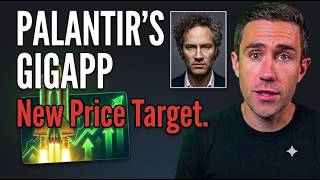

Palantir's 29% Surge: Overdone or Justified?
45sThe dramatic 29% stock move and the debate over whether it's overextended will spark immediate interest and debate among investors.
▶ Play Clip"Delivers a thorough analysis with updated price target and concerns, though some fluff and self-promotion."
Kevin from Meet Kevin analyzes Palantir's latest earnings report, highlighting the company's exceptional growth, pricing power, and unique business model. He discusses the divergence between slowing customer growth and skyrocketing net dollar retention, and provides an updated stock price target and valuation analysis.
Palantir stock surged 29% to $160, exceeding expectations. Kevin notes this might be overdone due to margin trading, but focuses on fundamentals.
Palantir reported 93% year-over-year revenue growth. Commercial growth accelerated to 110% from 103%, while government growth remained steady at 79%.
Palantir generates about $2 billion quarterly revenue, a fraction of Salesforce's $11.1 billion, but Palantir's growth rate is much higher (93% vs 13.2%).
Palantir's market cap is $390 billion, while Salesforce's is $156 billion. The market is pricing in Palantir's growth resilience and potential.
Palantir only engages with customers willing to spend at least $600,000 per month. They are taking on fewer new customers but selling more to existing ones.
Palantir's average commercial customer spends about $615,000 per month. Even excluding top 20 contracts, customers spend at least $250-300k monthly.
Quarter-over-quarter customer growth has slowed from 8-13% to 4-5.5%. Bears see this as negative, but Kevin argues it's part of Palantir's strategy.
NDR has jumped from 111-120% in 2024 to ~130% in 2025 and ~150% in 2026. This indicates existing customers are spending significantly more.
Palantir invests heavily upfront in customer onboarding (boot camp) but benefits from high lock-in and lower servicing costs over time.
Kevin argues Palantir uses government contracts (e.g., counter-terrorism) as marketing to attract commercial clients, leveraging trust and credibility.
Palantir's EBITDA margin plus growth rate is 155%, far exceeding the Rule of 40. They completed 73 deals over $10 million, showing strong pricing power.
Palantir is agnostic to which LLM is used, focusing on their ontology platform. They criticize token-based models for burning money without delivering value.
Palantir's work with law firm Kirkland & Ellis reduces tasks that took days to minutes, showcasing the value of ontology in legal workflows.
Kevin acknowledges Claude's capabilities but believes Palantir's moat is strong due to high demand and the network effect of prestigious clients.
Palantir's cash flow yield is ~1% ($4B annual cash flow / $400B market cap) vs Salesforce's 10.8% ($17B / $156B). This reflects market optimism for Palantir.
Palantir expects a significant increase in expenses in Q3 due to new hires and marketing initiatives, which could pressure margins temporarily.
Palantir has ~$9 billion in cash and generates $4 billion annual free cash flow. No buybacks yet, but Kevin expects them to start.
Revenue grew 93% while costs only rose 53%. Sales & marketing grew 39%, G&A 19.6%, R&D 42.6% – all below revenue growth, indicating strong pricing power.
Kevin's updated year-end price target is $202 (from $192). A 3x PEG at 50% growth justifies $235. Long-term, even with 25% growth, Palantir could 4x by 2030.
Kevin remains bullish, stating he would not bet against Palantir and is comfortable buying more at $160, despite potential overextension from margin traders.
Palantir's earnings reveal a company with exceptional growth, pricing power, and a unique business model that justifies a premium valuation. Despite a potential Q3 expense ramp, the long-term upside remains significant, with a possible 4x return by 2030.
What was Palantir's year-over-year revenue growth?
93%
01:09
What is Palantir's net dollar retention (NDR) in 2026?
Approximately 150%
09:38
What is the minimum monthly spend for Palantir to engage a new customer?
$600,000
04:36
What is Palantir's cash flow yield compared to Salesforce?
Palantir ~1%, Salesforce ~10.8%
20:41
What is Kevin's updated year-end price target for Palantir?
$202
27:27
What red flag did Kevin mention in Palantir's earnings?
Significant ramp in expenses in Q3 due to new hires and marketing initiatives.
22:43
NDR Skyrocketing
Net dollar retention jumped to 150%, showing existing customers are spending significantly more, a key driver of growth.
09:38Rule of 40 Exceeded
Palantir's EBITDA margin plus growth rate is 155%, far above the Rule of 40, indicating exceptional operational efficiency.
14:20Cash Flow Yield Gap
The 1% vs 10.8% cash flow yield highlights the market's extreme optimism for Palantir's growth potential.
20:41Updated Price Target
Kevin raises his price target to $202, reflecting confidence in Palantir's growth trajectory.
27:27[00:01] weeks ago, I made a video called four stocks that are likely to forex. And one stock that's not. And that one stock was SpaceX. And one of the four stocks was
[00:13] Pounder. And SpaceX has fallen substantially. And Palanteer has well, at least in the last 24 hours since I got back from vacation, done a holy moly that is impressive. I thought for sure we would, you know, be able to hold this
[00:27] 100 day moving average. I was not expecting we would get all the way up to expecting we would get all the way up to 160 today. A 29% move. Really insane. Part of me almost thinks a little overdone that people have taken on a
[00:39] little bit too much margin trading back into this market now that Kevin's back from vacation and Leo pulled has Leo folded. But let's actually stick to the fundamentals of this company. What is this company worth? Is it still a
[00:53] potential 4x and what is it going to take to get to that level? Well, let's find out and see if there are any red flags in this report. And spoiler alert, there is a red flag in the Palunteer earning set. We'll talk about that. Uh,
[01:09] but let's get right into some of the notes that I'm making. So, obviously, year-over-year growth, phenomenal at the company, 93% year-over-year growth. Uh, the commercial side of the business is actually growing faster than government.
[01:22] If you jump in over here, you can see government growth last year was 78%. And government growth last year was 78%. And this year it was uh 79%. Which means the delta here is 1%. We still grew at nearly 80%. Right? I mean just to like
[01:35] frame your mind about it, you still basically doubled. But the pace you were growing at last year, you really only exceeded by about a percent this year up is because I want to show you where you're growing on top of growing.
[01:52] Commercial. Commercial is growing at 110%. While last year it was growing at 103%. Which means there's been a 7 percentage point acceleration in growth. Now why that matters is because if you compare
[02:09] Palunteer which is generating about $2 billion worth of revenue in a quarter here which is great. You know that's up from you know a billion dollars. I think its first time it had a billion dollar quarter was uh this this quarter, same
[02:22] billion dollar quarter over here. Now we're almost double that, which is fantastic. It's still a fraction of the 11 billion of quarterly revenue that a company like Salesforce is bringing in. But the reason I bring in Salesforce
[02:37] isn't to show Salesforce. It's to show you the difference. Salesforce's revenue at 11.1 billion is only growing at 13.2%.
[02:51] is only growing at 13.2%. The 7% growth on the growth of their commercial contracts is almost half of that 13.2%. Right? So like the extra amount commercial grew is basically half of the growth all of Salesforce has. And
[03:05] that's on top of a double for Palanteer. Maybe that's excessively complicated the way I framed it, but I think when you look at these numbers, it's just really important to understand size-wise, Palunteer revenue-wise is still a
[03:19] fraction in terms of size compared to with Salesforce. Uh, but in terms of market cap, Palanteer is pretty dang well up there. Palanteer's market cap is sitting at $390 billion where when I look at a CRM stock
[03:36] billion where when I look at a CRM stock I'm at less than half at 156 and the difference is that growth rate people are doubtful about growth at Salesforce and is that 13% actually going to be robust and resilient whereas
[03:50] at Palunteer they are convinced that growth is going to be resilient and not only are they convinced growth is going to be resilient they think it's going to keep going and I have to say as an investor in Palunteer and Salesforce
[04:05] actually slightly different levels on each of these people are probably right people are probably right about Palanteer and this is sort of an easier way in my opinion to look at it is there are some companies that reach out to
[04:21] customers through sales teams and they're like, "Hey man, can we offer you a free demo? Hey yo, can we set you up with a Zoom call? We just need five 30 minute one after that and we'll send you through the salesunnel. Palunteer
[04:36] doesn't pick up the phone for their customers, like new potential customers, unless those customers have the potential of generating or spending like 600 grand on the platform every single month.
[04:51] month. So if a company like UiPath who's trying to you know put together robotic process automation uh basically let's incorporate LLMs into some form of automation system which is different but
[05:04] you know you could somewhat put it in a similar category for commercial contracts you know putting data together in an organized manner using LLMs to help great that's kind of kind of like the foundry model at Palanteer putting
[05:16] the foundry model at Palanteer putting data together and using uh you know NLP right? The keyword searching basically old school which is what Palanteer was founded on that has then turned into the ontology platform linking all of this
[05:30] data together which then now incorporates AI Palunteer the whole thing that whole stack they now call sovereign AI right that's the whole package so if at UiPath you've got robotic process automate process
[05:42] automation and you've got LLMs and then over uh at Palanteer you've got sovereign AI these are two different packages but their goal goal is data The difference between the companies
[05:54] though is UiPath is sending cold emails going, "Yo, you y'all want to give us a shot? How about a free trial?" Palunteer is like, "Uh, we have so many people signing up who want Palunteer that we're actually taking on fewer customers than
[06:10] ever before, but we're selling our existing customers more than ever Okay, I just set up a lot. I'm going to break this down for you. So, let me show
[06:22] you some data on how I I come up with this. And this is why it took me a day like as much as I wanted to be live and, you know, just go through the earnings live, I I actually kind of like really enjoy just brainstorming on this. And
[06:35] now I can give you these bottom lines. So, take a look at this. Uh, Palunteer So, take a look at this. Uh, Palunteer has a a total commercial contract value of about $1.9 billion per quarter. If you divide that by the commercial
[06:48] customers they have of,049 that works out to an average of uh their that works out to an average of uh their customers spending about $615,000 per month. Now their top 20 contracts are probably more heavily weighted, but
[07:03] even if you take out their top 20 contracts, you're probably still looking at customers who at bare minimum spend 250 to 300 grand a month for software. And unless you have the capacity or the willingness to pay that, Palanteer is
[07:19] not even going to talk to you. And the crazy thing about Palunteer is even if you had the willingness, they have so much demand for their product because of show you how they pulled that off in a moment. It includes terrorism. I know
[07:35] as marketing, but they use it as marketing. I'll show you in just a moment. uh and and it really uh helps us understand, wait a minute, okay, how do they do this? But watch this. These right here are their total customer
[07:51] numbers. And I want you to notice something. Their quarteronquarter something. Their quarteronquarter customer growth rate is plummeting. customer growth rate is plummeting. You literally went from a 13% customer
[08:04] growth rate, you know, eight over here, 10% fine. So you're between, you know, 8 10% fine. So you're between, you know, 8 to 13% over here to now between four and to 13% over here to now between four and five and a half%. Now a bear is going to
[08:16] five and a half%. Now a bear is going to look at that and go, bro, that is horrible. Like let's just exit stage right. Why are we even here? There's no point. The company must be overvalued. The
[08:31] company must be a scam. It's a ripoff. And then of course that's where Negan comes in and I hope you got your pants on. Um actually the real number that comes in is what's called NDR
[08:46] and this has to do with net dollar retention. This is how much money you're making compared to the sales you were making
[08:58] last year to your existing customers. So, for example, if last year my existing customers were paying me $100 and this year they're paying me $111,
[09:10] and this year they're paying me $111, my net dollar retention would be $111, which if you look at the first quarter of 2024 is exactly what the NDR was for Palanteer. Now, I want you to think about this. The customer growth rate is
[09:24] falling. What do you think is happening to NDR? Is it also falling? falling to NDR? Is it also falling? falling would be bad, right? No, it's actually would be bad, right? No, it's actually skyrocketing. In 2024, they were, you
[09:38] skyrocketing. In 2024, they were, you know, 111 to 120 over here on NDR. In 2025, they were sitting at maybe an average of about 130%. And in 2026 so far, they're sitting about 150%. So, this is an insane jump. And this is
[09:53] probably the most prominent W uh here from Palanteer. This is really, really impressive. They are being even more choosy than
[10:05] ever before with their clients. Yet, they are selling them more and more products and services because remember, you're going from uh the foundry level you're going from uh the foundry level to the ontology level to AI Palunteer
[10:20] and then all together we call all of that together sovereign AI. That's sort market it. So, when you see those words, that that's what you're going to see.
[10:33] that that's what you're going to see. The reason I bring this up is number decline, we have to ask ourselves, okay, like that seems bad, right? But you have to remember how Palanteer operates. What they're trying
[10:46] to do is make sure that when customers enter their boot camp, Palanteer is actually putting a massive investment upfront into sales and marketing basically on, hey, is this going to be a good fit for this company? Are we going
[10:59] to be able to make this company money? Is this going to be a win-win deal? And the hardest part is the beginning. It actually becomes a whole lot less costly for Palanteer to service a customer over time once they're locked in. The lock in
[11:13] effect is huge, but the upfront like teaching people how to use the ontology suite. It takes time. There's some effort that goes into this and actually connections. You know, they could actually data link into Salesforce. They
[11:27] could literally take your Salesforce data, link that in to the Palunteer sovereign AI platform. It's brilliant. Now obviously companies like Salesforce with their own processes to sort of build their own mode if they can but
[11:42] right now the one with the mode is Palanteer. So Palanteer doesn't in my opinion have a problem of finding new customers. There are a lot of businesses that do have that problem. Uh company like Service Now, Salesforce, UiPath,
[11:55] they're all looking for new customers. That is the normal way of things. It's totally normal. That's not a diss on them. It's just normal. Palanteer has the opposite problem. They actually prefer to just sell their existing
[12:07] customers more because they're making more money faster, but they do slowly customers who are willing to pay him big contract value because obviously that's going to contribute to growth as well. Now, when I talked about terrorism and
[12:20] marketing, take a look at this. They literally say the following Karp like we're supporting lots of institutions in Europe, but the growth sucks. I mean,
[12:32] clandestine institutions, but basically he's saying like, you know, hey, like how much money is MI6 really going to be able to pay us or, you know, a domestic three-letter organization like the CIA, like there's
[12:45] organizations have a budget compared to companies that, you know, if we could prove ROI, they'll spend more on our software. Well, Karp argues that their software. Well, Karp argues that their work for governments is because they
[12:59] want to prevent terrorism. He literally says without our products they would problems their migration problems and results would be 10 times worse. So he's basically saying look without Palunteer im like migration would be worse
[13:13] would be worse. Of course there can be no alternative to Palanteer. In my opinion, while some of this might be true, I actually think this is how true, I actually think this is how Palanteer markets, the government side,
[13:26] even though it's growing and making good money, is actually the best marketing they could ask for. It's brilliant because a cla like he's mentioning this strategically. If a clandestine institution with bad growth trusts
[13:41] Palunteer with their data, why shouldn't, I don't know, UPS with their shouldn't, I don't know, UPS with their routing or the Mayo Clinic or a law firm with their proprietary data, right? And the big money is businessto business. We
[13:55] know that that's where the big money is going to be. So, that's where Palunteer has this really unique advantage. They get to scoop off, and we talked about this in my video a month ago as well. They get to shave off from the cream of
[14:07] the crop and just pick the customers they want. Nobody else really has that. That's why I call it they get to scalp customers. You know, the rule of 40, Let me just explain this really quick. It's basically just taking your uh
[14:20] margin uh and and your growth rate. So, your ebida margin plus your growth rate, how much you're growing at per year, and then you add those two together. And then you get this ideally rule of 40 which is ideally you're growing at 20%
[14:35] and your margins 20%. Your eB margins 20%. And so rule of 40 is really just actually like a target percentage is what it should be. And anything above that is just considered good or great.
[14:48] Uh and you know they're sitting at 155% been growing. Uh and and you could see have here, 73 deals completed at $10
[15:00] million or more, they're fantastic. You know, it's really uh guardrailing know, it's really uh guardrailing the token uh self-pleasuring is really what I think a good way to describe Palunteer as doing. They don't really
[15:15] care about LLMs or which LLM you're using. they care about. Oh, well, instead of us using NLP, which they actually reference in here because that's those that's really where they came from, right? Uh here we had to work
[15:29] with NLP. That's natural language processing. Uh basically keywords, right? Those were the founding days. We did not have AI available. So having AI did not have AI available. So having AI available today is great, but you could
[15:43] interviews, we've talked about this on the channel before, where he's really anti- people just burning tokens and giving your intellectual properties over giving your intellectual properties over to like a claude or something else. And
[15:57] this is really fair, but you need to balance that. Karp is going to say funny things to bag on the token sellers like the claws or the opening eyes. That's why they want to be agnostic to this and basically tell you that they are um
[16:13] basically tell you that they are um agnostic to uh what model uh you use. Uh see for example enterprises that are not using Palanteer are seeing their token meters spinning endlessly just to get slop. The token model may be working for
[16:26] the labs but it's not working for anyone else. That's a really big claim and one of the reasons for this claim actually comes in the Kirkland example. So right
[16:39] here they give a Kirkland and Ellis a law firm example where they say that they're working with Palunteer and what used to take days for a lawyer happens in minutes. And it wouldn't be possible without ontology. All right.
[16:55] little bit realistic. Even though, you know, we're bulls, we're invested. and you know six figure investors not seven figure investors six figure investors um figure investors six figure investors um but um you know well when we look at
[17:10] this as a feel like reasonable person I think it's reasonable to say that Claude in fairness has a pretty good product now where in like a legal case you could upload project files and then you could start new chats with fresh memories
[17:26] citing those reference files in a project but resetting that sort of memory or hallucination risk, right? Uh while while still maintaining the context of those documents and that's really valuable and I think that's
[17:39] exactly what Karp is I don't want to say fearful of but more warning of. He's like ah these these AI models they're going to take your data. In theory, Claude can probably pretty quickly whip up something that looks and
[17:55] quickly whip up something that looks and resembles ontology inside of Claude, you know, because really, what's ontology going to be for a law firm? Well, it's going to be deal and case templates, letterheads, precedent structures that
[18:09] we like to use, experiences we have with local judges. This all gets sort of put together in a structured format in how we like to litigate our cases right now.
[18:22] While that is a risk over at Claude and it's understandable Karp is fighting it because if Claude does that it is a risk to Palunteer. I don't think Palanteer's to Palunteer. I don't think Palanteer's mode is going anywhere. In fact, because
[18:35] Palunteer has so many people who want to use Palunteer who can't because they because they can't spend enough or there are just so many people ahead of them in line. Honestly, the more companies like Kirkland and Ellis using Palanteer and
[18:48] the more other lawyers are getting excluded, the more Palanteer just markets itself for free because now it's like, "Oh man, you're up against that law firm. They use Palunteer, right?" And like then you're like, "Oh,
[19:02] I'm a law firm, too. I I want to use Palunteer." You can't. Palunteer." You can't. So massive moat, right? All right. And and that's where when we look on the cash flow statement, the moat is not the
[19:18] cash flow statement, the moat is not the cheapest. Okay. So just to compare, you know, there is a premium on what you're paying in terms of a cash flow yield. A cash flow yield is really when we take your cash flow, especially your free
[19:31] for Palunteer, and we divide it by your market cap. So, in this case, they're market cap. So, in this case, they're making, you know, $2 billion a quarter making, you know, $2 billion a quarter in uh in revenue and they're bringing
[19:45] about two billion or a billion of that to the bottom line. This is 6 months here, so two billion in six months. cash flow. They're bringing about a billion dollars of cash flow to the bottom line every single quarter, which is really,
[19:59] were at a billion dollars of revenue. Now they're bringing a billion dollars of cash flow in. You know, the capex here is 22 million. So, you have no risk of this like overspending on AI infrastructure.
[20:12] frankly, because they're spending 22 million. Their cash flow is 2 billion here in 6 months. So, in a 3-month period, they're spending $10 million on computers and infrastructure and GPUs or whatever. And uh you know, they're
[20:25] their cash flow line. But the problem with that is let's say you know they have $4 billion of annual cash flow and they're a $400 billion company. That's a cash flow yield of just 1%. Salesforce is probably going to do about
[20:41] $17 billion of cash flow, and they are a $156 billion company, which is a cash flow yield of 10.8%.
[20:53] Now, we're going to do a valuation on this uh in just a moment that that still flatters Palunteer, but let's be real, there is a massive difference between a 1% free cash flow yield and a 10.8% cash flow yield. And the reason for this is
[21:08] flow yield. And the reason for this is the market in my opinion is probably Palanteer a little bit. You know, this they got a little margin ran up here,
[21:20] price target we talked about in the last video was 192. I'll talk in just a moment about how that's changed. uh at Salesforce this is probably so
[21:32] uh at Salesforce this is probably so high because the market is downweighting uh Salesforce's growth because of artificial intelligence right so artificial intelligence actually potenti is is hurting Salesforce's valuation
[21:46] right so we'll get to that in just a through all the juice that I want to cover here so we talked about this we've about the video that I made talked about claw We talked about the law firm. Uh we
[22:02] talked about the decision logic. That's basically setting up uh you know your your structured data and your case precedence if you're an attorney. The models are a commodity but the American worker is not. This is marketing.
[22:14] regularly that hey we're here for the American worker. We stand for the Americans. You know whatever. It's really a way it's it's a logical fallacy. It's an appeal to patriotism. Uh it's marketing. I'm not trying to
[22:28] it is, okay? It's just like the whole terrorism thing. It's great marketing give them credit where credit's due. They actually made 3 cents of EPS from investing in SpaceX. Quite interesting. They are giving a red flag here about a
[22:43] significant ramp in expenses in the third quarter due to seasonality of new hire starts and new marketing initiatives, which are probably marketing initiatives to their existing customers, right? because that that's
[22:56] where a lot of their uh dollar retention is coming from. It's fantastic. Um have somebody on the system and you can sell them more products inside the same
[23:08] suite, you know, why not? They they're already in it. Uh okay, good. So, what talked about this. We talked about Oh, yeah. Here. So, uh a little bit about how um Oh, this is where they talk about how we could swap if we want the LLMs.
[23:24] We've talked about that already. Uh we've already known that. There was the not missing anything. Oh yeah, people aren't buying our product because we're swinging the golf club correctly or paying for the steak dinner. They don't
[23:39] little bit of a banger I wrote. They're basically saying people are paying for Palunteer because we make an ROI for people. They come to us because we make them money. Talk about great marketing. Oh, here it is. Switch out the models.
[23:54] about the LLMs a little earlier as well. Okay, good. So that uh that is the earnings call. Let's now go into the balance sheet and then a forecast valuation for this company. So on the balance sheet, they have almost $10
[24:08] balance sheet, they have almost $10 billion of cash. Technically 9.4. They have $500 million in bills and some lease obligations. And we we have what is this here? We have
[24:20] two billion. Oh, wait. This is uh this is the free cash flow, right? So, is the free cash flow, right? So, basically, I've got $9 billion of free cash. That's right here. Cash and cash equivalents, marketable securities, less
[24:35] uh $500 million in bills. Fine. Call it roughly $ 8.99 $9 billion in cash plus $2 billion of free cash flow every 6 months. 4 billion in a year. So really
[24:48] 6 months. 4 billion in a year. So really it's 9 billion plus 4 per year and that this year or something like that. This is a lot of money and I actually think is a lot of money and I actually think they'll probably start continuing some
[25:01] cash flow statement right now under the financing activities, we don't see any buybacks. And I think we're going to start seeing that come back, you know, either investing or uh financing, no stock issuance and uh no buybacks, but I
[25:17] think that'll come. Uh you can also see the stockbased compensation rose about 48% which if we go to the income statement is all just increasing pricing power. Their revenue nearly doubled at 93ish% rounded, but their costs were
[25:31] 93ish% rounded, but their costs were only up 53%. I wrote LOL, that's major pricing power. It is because if you're growing faster than your costs, that's pricing power in their operating expenses. Sales and marketing growing at
[25:45] 39%. That's like 1/3 of their growth rate. Uh we've got GNA 19.6% fraction of their growth rate. R&D 42.6% 6% fraction of their growth rate. So all
[25:58] of these right here suggest big pee pe very very big pricing power. very very big pricing power. Uh and last year their earnings per share were very very low. So for a period of time this company actually
[26:13] looked very expensive because their earnings were really low. Right? I mean, when they were making 4 cents a share, 5 cents a share, 7 cents a share, the valuation's going to look high for the company. Now, we're getting to half a
[26:29] buck per quarter per share. It's going to get to a dollar per, you know, it's going to get to $2, right, per quarter. That's pretty good. So now what we start
[26:41] seeing is the scaling out the scaling out the buttering out of all of the operating expenses. And how does this actually look in terms of a real valuation? So here are the numbers. They are forecast to have $157
[26:56] of earnings per share at the end of the year. Their growth rate is expected to be these numbers here which averages out to about 48% per year. Their current PE to about 48% per year. Their current PE ratio is 103. So obviously substantially
[27:12] above Salesforce. Uh they're that puts them at a price toearnings growth ratio, right? If I just divide these two into each other of 2.157. Now for a forecast at the end of the
[27:27] year, my prior forecast was 192. Using now the updated figures with all else being equal, I'm at 202 as a reasonable price for this company at the end of the year. Now, is it possible because they have so much annual recurring revenue
[27:43] justify a three peg at a 50% growth rate? Yes. In which case, then you could rate? Yes. In which case, then you could justify a $235 valuation. Now, can this justify a $235 valuation. Now, can this puppy still 4x in 4 years from now? Abso
[27:58] freakingutely. I mean, even if their growth in four years, let's just run it really quick. Uh, even if their growth declines to 25%. We'll do this live uh
[28:10] declines to 25%. We'll do this live uh by 2030, right? $748 by 2030, right? $748 of earnings times uh 25% growth and we'll give them a $2.69 peg. That's still a $53 price target. If I go with a
[28:25] three peg at 25% at 748 in earnings, I get a forecast value of $561. 561 divided by what I paid last week at 561 divided by what I paid last week at 118 is still a 4.7x. Now 561 divided by
[28:41] what you would have to pay today at 165 is still a 3.4x. So, and that's, you know, towards the end of the decade. So, tremendous upside here, tremendous mode, massive pricing power. their costs are going to go up in
[28:55] Q3. But when you really understand what's going on here, this is a very, very different company. And it's understandable why people are paying a premium for this company and their cash flow yield is as low as it is. This is a
[29:08] very rare beast. And honestly, I would not bet against them. I would not Michael Bur Palanteer and I have no qualms buying more in the 160. This is a great company. Although I do think margin buyers really ran this one up.
[29:22] fundamental analysis or my buy sell alerts anytime we uh uh send alerts or uh our courses on building your wealth or our daily alpha membership, make sure to join us over at meet kev.com and we look forward to seeing you in the next
[29:36] >> Why not advertise these things that you told us here? I feel like nobody else see how it goes. >> Congratulations, man. You have done so you. >> Kevin Praath there, financial analyst
[29:48] and YouTuber. Meet Kevin. Always great to get your take.




⚡ Saved you 0h 29m reading this? Transcribe any YouTube video for free — no signup needed.