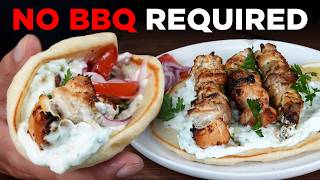

Foods you cook vs order: Souvlaki
45sOpens with a relatable, thought-provoking dichotomy that hooks viewers immediately.
▶ Play Clip"The title is accurate; the video delivers a unique, detailed method for making Greek souvlaki at home using a broiler."
This video teaches how to make authentic New York City-style Greek souvlaki at home using a broiler. It covers a yogurt-based marinade, homemade pita, tzatziki, and a basting technique called ladolemono.
The broiler is an underrated tool for achieving char and moisture without a grill.
Marinade includes Greek yogurt, lemon juice, red wine vinegar, garlic, olive oil, oregano, salt, and pepper. Must have a 'twang' (sharp acidity).
Use boneless, skinless chicken thighs cut into bite-sized pieces; breasts dry out.
Marinate for about 4 hours; longer will turn meat mushy due to acid.
Grate cucumber, salt it, and drain moisture before mixing with yogurt to control texture.
Pita dough: 250g flour, 5g salt, 5g sugar, instant yeast, 160g warm water, 15g olive oil. Knead, rise 1-2 hours, divide into 90g balls.
Ladolemono: olive oil, lemon juice, oregano, and garlic. Used for basting to add moisture and brightness.
Skewer chicken tightly, broil on a greased grate over a tray with water to prevent burning. Rotate every few minutes for even char.
Cook for about 15-20 minutes until charred and cooked through.
Assemble: pita, tzatziki, tomatoes, pickled onions, then chicken pulled off skewer.
What are the key ingredients in the souvlaki marinade?
Greek yogurt, lemon juice, red wine vinegar, garlic, olive oil, oregano, salt, and pepper.
00:54
How long should you marinate the chicken for optimal flavor without making it mushy?
About four hours.
02:48
Why is water added to the sheet tray under the broiler?
To prevent the yogurt from burning to the bottom of the pan.
09:48
What is the name of the olive oil and lemon juice mixture used for basting?
Ladolemono.
08:06
What cut of chicken is recommended for souvlaki to avoid dryness?
Boneless, skinless chicken thighs.
01:46
How do you prevent tzatziki from becoming watery?
Grate the cucumber, salt it, and let the moisture drain before mixing with yogurt.
03:27
How long does it take to broil the chicken skewers until done?
About 15–20 minutes.
13:29
What is the recommended weight for each pita dough ball?
90 grams.
05:50
What is the purpose of basting the chicken with ladolemono during broiling?
To add moisture and brightness (acidity) to the chicken while it cooks.
08:18
What type of pita is made in this recipe?
A flatbread without a pocket, perfect for wrapping souvlaki.
12:48
Foods You Cook vs. Foods You Order
Introduces a simple mental framework for deciding when to cook at home versus order out.
Broiler as the Key Tool
Highlights the broiler as an underrated kitchen tool for achieving char and moisture without a grill.
00:28The 'Twang' Test for Marinade
A practical sensory check to ensure the marinade has enough acidity to penetrate the meat.
01:33Controlling Tzatziki Texture
Demonstrates a pro technique of salting and draining cucumber to avoid watery sauce.
03:27Ladolemono Basting Trick
Reveals a restaurant trick for adding moisture and brightness to grilled meats.
08:06[00:00] I have a theory that every food that we eat falls into one of two buckets. Foods you cook, and foods you order. For example pasta you cook, but a bagel you order.
[00:13] And suvlaki, that's sitting deep in the order bucket. Today we're going to be changing that marinated chicken, a fresh and fast homemade pita, real tatsiki, along with a trick-of-the-trade, la dolemona.
[00:28] And we're doing it all using the most underrated tool in your kitchen, the broiler. This is New York City Greek suvlaki at home. Now the first step to our chicken suvlaki is the marinade.
[00:41] And the first step is a little bit of Greek yogurt. Now we need it for two parts, the marinade and the tatsiki. So I have two bowls here. Marinate is going to go in here, and we need about a cup for the marinade. Roughly need about the same amount in each.
[00:54] I'm just going to set the tatsiki off to the side. Now the marinade, I want it to be punchy. We've got yogurt, lemon juice, red wine vinegar, a little bit of garlic. And I want all of that punch and acidity to penetrate the chicken.
[01:08] So squeeze of about a lemon, about three tablespoons of red wine vinegar, about two cloves of grated garlic, olive oil, tablespoon or two, pinch of some oregano, Greek oregano if you got it.
[01:21] Good amount of salt actually, season our chicken. Black pepper. Then it out with a little bit of water. It's kind of the consistency you're looking for.
[01:33] You can use a little more vinegar. Again, at this point when you taste it, you're looking for a twang around your mouth. If you don't get that twang now, you're probably not going to get it on the chicken. Now I have the bowl off to the side.
[01:46] Here we've got skinless, boneless chicken thighs. Now breasts would dry out a little too easily. So what we're going to do is take our thighs, it's kind of like this thin piece of meat
[01:58] that separates the chicken thigh into like two pieces like this. Then we've got this nice chunk here. Now we've got three strips. Now we can go ahead and cut those strips into thirds. These pieces are a little smaller.
[02:11] If you can't get thirds out of them and cut it in half, it's roughly the same size. And then you're going to get basically a skewer like that. Take that into the marinade. See where that loose piece hangs?
[02:24] Slice it. See, using the chicken, mix it.
[02:36] Very similar to like a butter chicken at Tika Masala, something Indian skewered and broiled. We actually did something like that on the channel before. We're just kind of changing the flavors. Now there's a sweet spot for the marinade. There's a lot of acid in there.
[02:48] So you can't let this marinade forever. The acid will eventually turn the meat mush. But we want a little bit more than like two hours. So if we can let this go for like four hours in the fridge, I think that would be great.
[03:00] Now for the tatsiki, we've got that little bit of Greek yogurt to that, another graded clove of garlic. But just one, we don't want it to overpower it. We want it to be nice and smooth.
[03:13] A little lemon juice, a little salt, olive oil. That's got this nice twang to it. It's more balanced than the marinade. It's just missing cucumber. So I'm just going to cut a little knob off. Now if you don't care what the consistency of the tatsiki is,
[03:27] then you could simply grate this into our tatsiki. But I like control. So what I'm going to do, I'm going to grate this into a strainer over a bowl, salt the cucumber,
[03:40] and then work the salt in. You're going to start seeing all that moisture come out. Let me take a little parchment. Just put like an onion on top. After a while, all of the moisture will leach out. And then we can combine the cucumber
[03:53] grated into here. And if we need a little bit more moisture, a little calibration of the texture, we've got that moisture there to add. After a minute or so, we've gotten a lot of it out so we can add in the cucumber.
[04:05] There's going to be some inherent moisture in there. And then we can mix it in. A little thick so I can go ahead and add some. Now it tastes great to me. See how it just slides off?
[04:18] That's the texture you're looking for. And we can set this off to the side. Next up, I'm going to show you how incredibly easy it is. 250 grams of all-purpose flour into a bowl. You could do this in a food processor, too.
[04:30] I just don't want to get my arm hurts. I don't want to, it's above my fridge. I'm going to just get that. Five grams of salt, five grams of sugar, instant yeast. Got a package here. Need a few grams, basically like half the package.
[04:44] I'm going to stir it around. 160 grams of warm water, 15 grams of olive oil. Then I'm just going to gently start mixing. Just introducing the flour into the moisture.
[04:56] You might think it's dry, but when you feel it, it's super sticky. Just going to sort of cut it. And now it's starting to get shaggy. That's what shaggy means with my knuckles. Just going to start to knead. Using the knuckles kind of prevents stickiness
[05:10] until you can kind of get the ball going. And all the dust and the balls sort of picked up. Put it on our board. I'm going to do my one-handed knead. Work on my left-handed. And once it's dry, now it's even on the stickier side.
[05:24] Back into the bowl, a little oil on it. Cover it, leave that out about an hour, maybe two. We're going to allow this thing to rise. Roughly get about double inside, but we'll see.
[05:36] Play it by ear. Been about an hour. Turn it on to the board. For me, a 90 gram ball seems to be the sweet spot.
[05:50] Once you've got your ball, you're going to seal the bottom. That's your pita. 490 gram balls, and then a small pita. You could use that for any number of things. Like I'm going to create some nice tight balls.
[06:03] We're looking to create a little tension. Fold all that crimpy stuff on on itself. And you can use your palm to create a nice tight seal on the bottom.
[06:18] Cover it, and we're going to let that chill out at room temperature. Just until it starts to rise again a little bit. Save this guy for tomorrow. Like in my outdoor boys' tribute video, you can take extra dough
[06:30] and turn it into a fry bread, turn it into an English muffin. I almost intentionally don't have recipes that are the perfect amount. They are very opposed based on the size ball you need. And I like a little bit of extra because what we make on this channel is quite good.
[06:46] I'm going to leave these out. I'm going to stick this one in the fridge. Now, like I said earlier, the key to today's recipe is the broiler. And of course, we're going to be using the broiler in your oven today, but we're also going to cook it another way. Using the broiler function of the Suvi Kitchen Robot,
[07:01] our sponsor for today's video. But the Suvi isn't just the broiler, but not just an air fryer. Suvi is a smart countertop oven and meal delivery service designed to be a convenient time-saving cooking solution and not just a meal kit.
[07:15] And this thing's got 15 cooking modes on it. And while you can use your recipes like I do in it, you can also choose one of Suvi's over 50 chef-crafted meals. All you're going to do is load the meal into the Suvi machine
[07:29] and tap this recipe card to the appliance to cook. Then you're going to choose what time you want your food to be ready. And with it's cool to cook technology, Suvi will safely keep it cool in the machine all day
[07:41] and begin to cook it at your desired time automatically. You don't even need to be home. And the best part about Suvi is they offer a 100-day risk-free trial. That's a fair deal in my book.
[07:53] So you've got nothing to lose. Just click the link in my description and give Suvi a try. Now back into the recipe. Now we're going to make one of the tricks, the La Day Lomono. I'm probably saying that wrong.
[08:06] But it's basically like a base, right? If you're in the New York City food truck, they've got the chicken tsudaki on a grill skewering and they'll dip it in a liquid, which is this mixture of olive oil, lemon juice,
[08:18] and oregano and salt and stuff. And then put it back on the grill. And it's kind of just giving it that nice acidity, that freshness, live, and zip back up, moistens it while it cooks. And that's what we got here.
[08:30] We have a little bit of lemon juice to the lemon juice. So I'm going to add about two parts olive oil. To that, we have a little pinch of oregano, not too much, because it is overpowering.
[08:44] I'm going to add one trick to it, a little bit of grated garlic. It's my little touch. Now we can start skewering our chicken. Now here, I've got some metal rods.
[08:57] We've also got some wooden skewers soaking and some water. These will work as well. Now one thing I know is that we're going to pack them tightly. The one at the base, that's got a propensity to dry out.
[09:10] So I want a nice, decent sized piece, sort of at the bottom. Then we're just going to stack them up. Right there, that's a nice bundle.
[09:22] We don't need to go heavier than that. And then we keep going. Same thing with the wood skewers. Got longer, kind of square pieces.
[09:36] You kind of want to get them to drape over the other pieces. Almost like the way a swarm has built. Now here, I've got a sheet tray. And I got some water in it.
[09:48] Maybe it's a little too much water. Got a little water on the bottom. I'm going to hit the grate with some cooking spray so that the kebabs don't stick. We're going to put our kebabs onto the grate
[10:01] with a little space. Then I got the same set up with the roasting tray and the air fryer basket for our sous-vie machine. Hit that with a little spray. And those skewers go into the basket. Now I set up the bottom shelf in the sous-vie machine
[10:15] to broil function because it's essentially the same as roast. We're just going to start broiling it immediately. And again, we're going to go in and rotate and get nice browning around all sides of the chicken. By the time it's nice and browned and charred,
[10:29] they should be fully cooked and ready to go. If you want to, you can wrap the sticks. Try and protect them from burning a little too much. We can take this and pop it into the sous-vie machine. Then we can begin our cook. We're going to cook it for about 20 minutes.
[10:42] See where we're at. Now I've also got the broiler in the oven going. And that water's going to help that yogurt not burn to the bottom of the pan. And after a few minutes of broiling, we're just going to rotate. This is meant to prevent that underside of the chicken
[10:55] from sticking to the grate. It sort of sets the outside of the chicken. So we're just going to move them around, rotate them, and allow that broiler to char the outside of the chicken. While that cooks, we're going to prepare some garnishes.
[11:08] Cut the root and the top off. Position it so that the lines running across it are pointing at you, starting at the bottom. Take your knife slightly angled and cut as thin slices as you can.
[11:22] Straightening the knife as you start to get towards the center of the onion. Push your way, turn it. You've got this little nub nut left. Same thing. Into a bowl, we're going to kind of quickly pickle them
[11:37] in a way, get them with some salt. And then a little bit of that lo-mo, lo-mo. And then just work that in. Let that chill. Got a tomato. We're going to cut it in half. And again, and then into slices.
[11:49] To make alpita, little flour, grab a dough, place it down, and very similarly to how we did non-bread. With our friend, Akshay, who came on, I'm going to take my hand, and I'm going to press into it, and turn it, and then press.
[12:04] Turn it, and then press it out. One way I've learned to do this is I take my hands like this, and close it, and then sort of stretching it over your hand.
[12:22] Got a hot cast iron pan, about 400 degrees. Gonna spray the bottom with a little bit of oil. Spread it out. Pita goes right on. You just start to see some bubbling action
[12:34] occurring on the surface of the dough. Once we've got some nice color on the bottom, we're just going to give it a flip. Give it another minute, minute and a half on that second side, and we've got a pita. And this type of pita is specifically not the type that has a pocketed.
[12:48] More of a flat bread, perfect for a sandwich like a soup blockie. Now once our chicken is starting to develop a little bit of color, all around, this is when we're going to start basting it with that lot of limono. Get a nice coating on that chicken.
[13:02] Gonna go ahead and practice my slap technique here. It needs a little bit of work, but I show you since my non-training days, this has improved. Check on our oven broiled soup blockie.
[13:16] And it's looking good. We're starting to get some really nice color. We're going to continue to baste. And it looks like we're almost there. And after about 15 minutes, maybe 20 minutes of broiling, your chicken should be done.
[13:29] Checking on the stick in an oven. Checking soup blockie. Now we got our sous-vie ones. I think that looks awesome. Now as they come off the grill, I like to hit them with some more lemon.
[13:41] So to assemble this, we're going to put the pita down, followed by some tatsiki on the bottom. A little tomato, semi-pickled onions. Just dot it with some freshness.
[13:58] Or for more of the street food vibe, you just take a pita, slap some tatsiki on it, slap a skewer, and pull it out. That's a little bit more my style. It don't get much better than that.
[14:10] Let me tell you, broiled meat. I mean, what's better than that? Chicken's tender, but it's moist. The chicken thigh stood up to that cooking we gave it. Now, if you were ever scared to make a pita, let this be your warning.
[14:22] It is not hard. As always, the recipe's going to be down in the description. That's all that I have today. I'll see you next time until then take care of yourself and go feed yourself.



⚡ Saved you 0h 14m reading this? Transcribe any YouTube video for free — no signup needed.