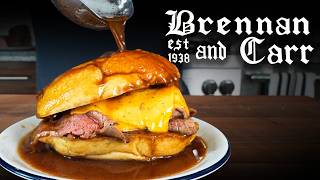

Brooklyn's Legendary Roast Beef Since 1938
41sHistoric food landmark with a unique dipping process sparks curiosity and food envy.
▶ Play Clip"The title promises a legendary sandwich and delivers a full recipe and technique breakdown, though the sponsor segment adds a slight detour."
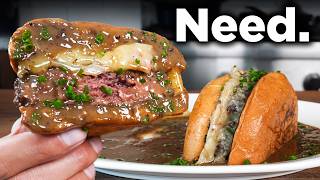
This video explores the legendary Brennan and Carr's roast beef sandwich in Brooklyn, New York, and provides a detailed recipe for recreating it at home. The host demonstrates a low-and-slow roasting technique to achieve a perfectly tender, medium-rare center, along with a flavorful broth for dipping.
Brennan and Carr's is a New York culinary landmark in Sheepshead Bay, Brooklyn, operating since 1938. They are famous for their roast beef sandwiches, which are dipped in a seasoned broth.
The sandwich can be ordered three ways: 'single dip' (meat dipped in broth), 'double dip' (both meat and bun dipped), and 'knife and fork' (sandwich drowned in broth).
Use a top round or bottom round roast (about 3.5 lbs). Pat it dry, truss it with string, and season with salt and pepper. Let it rest in the fridge for at least a day to allow the seasoning to penetrate.
Roast the beef at 250°F (low temperature) to avoid a gray band and ensure even cooking. Target an internal temperature of 130°F for a medium-rare to medium finish. Use a thermometer with an app to monitor progress.
At 250°F, carryover cooking is minimal (2-4°F). Pull the roast at 127°F to land at 130°F. This contrasts with high-heat cooking, where carryover can be 15°F or more.
The broth is made with beef stock, garlic, shallots, soy sauce, and dried minced garlic/onion. A 'perpetual stock' technique (adding leftover broth to new) adds depth of flavor.
After roasting, chill the beef overnight to firm it up, making it easier to slice thinly. The broth is also cooled and used as the dipping 'vat'.
Reheat the broth, slice the beef thinly against the grain, and assemble on a Portuguese roll with American cheese. Dip the meat (and optionally the bun) in the hot broth before serving.
The video successfully demystifies the iconic Brennan and Carr's sandwich, offering a practical, step-by-step recipe that emphasizes low-temperature roasting and a flavorful broth to replicate the experience at home.
What is the name of the legendary sandwich shop in Brooklyn featured in the video?
Brennan and Carr's
00:03
What are the three ways to order the roast beef sandwich?
Single dip, double dip, and knife and fork.
10:25
What cut of beef is recommended for this recipe?
Top round or bottom round roast.
00:59
What is the target internal temperature for the roast beef?
130°F for medium.
02:34
Why is the beef cooked at a low temperature (250°F)?
To avoid a gray band and ensure even cooking throughout.
03:18
At what temperature should the roast be pulled from the oven?
127°F, to account for carryover cooking.
05:48
What is the 'perpetual stock' technique?
Saving a bit of old broth and adding it to a new batch to deepen flavor.
06:55
Why is the roast beef chilled overnight before slicing?
It firms up, making it easier to slice thinly.
08:44
Low-Temperature Roasting
Explains the science behind avoiding a gray band and achieving even doneness.
02:34Carryover Cooking Prediction
Demonstrates a practical application of thermodynamics in cooking.
05:20Perpetual Stock
Reveals a professional trick for building deep flavor over time.
06:55Three Ordering Styles
Highlights the cultural specificity of the sandwich's serving methods.
10:25[00:03] >> That is phenomenal. Tucked away [music] deep in the magical lands of Sheepshead Bay, Brooklyn, lives a New York legend, Brennan and [music] Carr's. This place has been there since 1938, making it a bonafide culinary
[00:17] landmark in New York City. When you arrive, you're greeted by a jolly bald man wearing a white coat who mumbles your order into a microphone as old as >> Two cheese for you, double dip. >> Which then kicks off a process of thinly
[00:30] slicing their legendary roast beef, [music] topping it with American cheese, putting it inside a bun before aggressively dunking it into a vat of While it's its own thing, you could argue this is Brooklyn's take on a
[00:44] French dip sandwich, but they have three unique ways that you can order it, but more on that later. This is Brennan and Carr's iconic roast beef sandwich. meat a day or two in advance. And I've got a top round here, about 3 and 1/2
[00:59] lb. You really want a top round or a bottom round. It's just the right shape for roast beef. I'm just going to pat it dry out of its packaging. Keep everything nice and dry. And that's what you're looking for, a nice round piece
[01:12] I've got some string here, and this is how I do it. I To measure it, I pinch some string up here, and I'm just going to loosely wrap it around my arm. I'm [music] looking for like about eight strings. Then all you got to do, cut it.
[01:27] too much. Then we're just going to go ahead, take it underneath, going to the center, pull it tight, and then one more knot. Could have given myself a little bit more slack. [music] Here, I've got some roasted garlic oil.
[01:41] You can use regular oil, but we're basically just using this as a binder. lightly. Then we're going to generously season with salt. Get the bottom down first, and then a lot of fresh cracked black pepper. And I want to get that
[01:55] flat side with like a pepper grinder, I grind the board. Then you can [music] just take it, mop it up. Let me hit the top. this sit in the fridge, let that season penetrate for at least a day. You can
[02:08] swing 2 days, great. Now after a day in the fridge, your roast beef should look nice and dried out. That seasoning should sort of have been adhered to the meat, and it's ready to roast. Got a little thermometer here. This is what
[02:21] we're going to use to track this. Now most thermometers, you stick it right in the middle. This one though has different [music] probes, and it will running it through, I'm just going to run it down. We took this straight out
[02:34] of the fridge. It's about 48°. Now I like a nice medium, maybe touching medium rare. I find [music] closer to medium you get a more tender beef. So the target temp's going to be 130. And I have my oven preheated 250°.
[02:50] want to hit it with a little bit more of that garlic oil, to moisten it back up. oven. Then along with a kind of unit like this, all these thermometers nowadays come [music] with an app as well. And
[03:05] that's just going to cook low and slow. I would imagine for about 2 hours, but should tell us right on the app. Halfway through the cook, we're just going to rotate the beef and make sure that cooks nice and evenly. Got about 50 minutes
[03:18] left, and here's the thing about this low temp and why it's going to help us throughout the center of the beef. That thermometer will also check the surface [music] which is around 150. Now if a
[03:31] [music] which is around 150. Now if a nice medium is going to be 130, 135, you much higher than that. Otherwise you risk the dreaded gray band. And in roast beef, that gray band can get rather big, [music] often due to at some point in
[03:45] the cook blasting it at like 500°. That's why we sacrifice the crust noticeable once we thinly slice it. In order to get the perfect cook in the center, which is all roast beef is at the end of the day. 40 has hit me like a
[03:59] ton of bricks. And between me and my family, I've seen my share of doctors wondered like, how do you find a good doctor? Is it your mom's doctor? What if of the best ways I've found to find great doctors is our sponsor today,
[04:13] Zocdoc. I think a lot of reasons people put off going to see a doctor is cuz they don't know if their doctor is actually a great one. And in my experience, there really isn't a better way right now to find great doctors than
[04:25] Zocdoc. With Zocdoc, you can search and compare local in-network doctors with more than 150,000 providers within more than 200 specialties across all 50 states. And besides detailed doctor profiles, the
[04:39] best part for me is that I can read through reviews from real patients. And appointment available and instantly book a visit. And you don't have to wait weeks. Appointments happen fast, usually within 24 to 72 hours. Sometimes you can
[04:53] even find same-day appointments, which is almost impossible these days. Best part about it is Zocdoc is completely free. Now, as we've grown old together over these last 8 years, we all need to start looking after ourselves a little
[05:05] link in the description or visit and get started today. >> [music] and the internal temperature is 115. Now, if we were cooking this at a much
[05:20] Now, if we were cooking this at a much hotter temperature, let's say 500°, now would be the time at 115 that I would pull this out. And a piece like this at that temperature would carry over at least 15° pulling it out now.
[05:34] But we're cooking this at 250. Now, it's a big piece of meat, but a much lower inertia. And so, I'm going to predict this carryover cooks no more than 4°, this carryover cooks no more than 4°, maybe as low as 2°. So, I'm aiming to
[05:48] pull this out at 127. 127, time to take it out. Smells like through a little bit on the outside going to wrap it in some foil, try and
[06:01] insulate it a bit until we're at our final temp. There we go. While I don't suspect this will carry over much longer, I'm going to place this in the longer, I'm going to place this in the fridge and try and stop the momentum.
[06:13] jus. This is a vital part. They've got a vat of it. Every sandwich is dipped through it, depending on how you order it. And so now, we didn't get a lot of browning, a lot of fond on the pan, and so we're not going to get like crazy
[06:26] beef jus out of it. So, we're going to use a good beef stock or beef broth to get started. We're going to fortify that with various flavors. So, we're going to start with garlic and shallots. Just going to smash the cloves.
[06:39] >> I'm just going to slice up the shallots. Now, one of the tricks, I'm sure a place like this uses, we used it on the food truck when we braised our short ribs, is a version of like a perpetual stock or broth. When I tested this recipe, this
[06:55] is the residual of the broth that we used. While I'm going to make a new one, I'm going to add the old one back into it. And if you do a process of that where you save a little bit, add it back in, that adds that sort of deep flavor
[07:07] that only like a place like Brennan and Carr's kind of gives you just from age and quantity of what they're cooking. So, I'm going to get my little saute on medium-high heat, and I'm going to add a little bit of that garlic oil I have
[07:20] oil. Once we've got it hot, I'm going to add in the garlic and the shallots [music] and begin to brown them. Try to build some flavor on the bottom of the pan just to add [music] some depth to the stock. Hit them with a little salt.
[07:34] And all you're looking for is developing a little color, getting them nice and aromatic. You're basically just looking for that amazing smell you smell [music] when you caramelize garlic and onions. Once we got some nice color developing
[07:47] on the pan, I'm going to go ahead and add in the beef broth. Add in about two then a couple dashes of soy sauce. [music] And despite having added fresh garlic and fresh onion, I'm also going to add dried minced garlic and dried
[08:01] minced onion. They both add a different distinct flavor that's going to sort of strained out later. Then we're going to add the old stock. Now we're just going to bring that up to a boil, drop that down to a simmer, and just allow all of
[08:15] that flavor to marry roughly just until the beef fully cools down. is not bad. I told you I was off by a degree. I should have pulled it at 125
[08:30] if I wanted to land square at 130. Now we want to completely let this cool down the broth, and then we can make sandwiches the next day. Patience, I know it's cooked. You could eat this now, it's just harder to slice thin when
[08:44] it's still warm. Once it's firmed up overnight and chilled, you're going to see you can get a deli slice, albeit slightly thicker than [music] paper thin, once it's chilled, and then we're warm it back up in the broth. Cool to
[08:57] the touch, almost down, a little above room temp. Going to take my roast beef. I'm going to wrap it up. Place it in the fridge to firm up overnight. Now in our roasting pan, we've got some cooking juices. So I'm going to take some of the
[09:11] liquid, clean up the sheet tray, get it back into the pan. Then we're going to strain out our broth. Now this, for all intents and purposes, is going to be our vat. This is going to be what we dip and serve the sandwich [music] with. This we
[09:26] can place in the fridge to cool. Now imagine you did this over the weekend, you're set up to be making sandwiches all week. And that's what we're going to be doing tomorrow, so I'll see you then. So now is the fun part. First thing we
[09:39] got to do is set our vat up. So, I'm going to take our broth. I'm just going to bring that up to temperature. Just get that out of its plastic. Pat the get that out of its plastic. Pat the bottom dry.
[09:52] Juicy, nice medium, maybe a little medium rare. That's how you want it. Now, to cut it, I'm just going to remove the string, but you want to use your thinnest blade. This is how I'm going to do it. I'm going to cut it in half
[10:05] first. That's against the grain. Now, I've got a smaller piece of meat that I have more control of to shave thin. Moist, thin, easy to slice. it nice and thin? >> [music]
[10:25] cheese, our American cheese. I don't know the rolls that they use, but I've got this roll. It's actually a Portuguese roll. Now, there's three ways you could order. The first one's the dingle dingle, and that is just taking
[10:37] dipping it into the hot broth, then the double dip. So, the double dip takes the bottom bun, then we're going to take the meat, then we're going to dip it.
[10:50] >> [music] >> Dip the top bun, close it up. And that's your double dip. And then finally, the knife and fork job, which is essentially them drowning the sandwich in broth. [music]
[11:14] right bread, it holds up to all of that juice. And the roast beef is on point. again. And the broth [music] adds that final bouquet of flavor to the whole thing. It just gets all soaked up. You don't got to go down to Brooklyn
[11:29] cheese. Full recipe for this is going to be down in the description. That's all that I have today. I'll see you next time. Until then, take care of yourself time. Until then, take care of yourself and go feed yourself.
⚡ Saved you 0h 11m reading this? Transcribe any YouTube video for free — no signup needed.