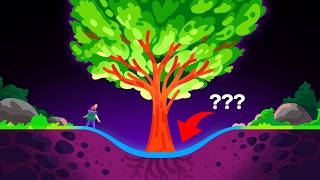

Trees Eat Thin Air?
45sThe surprising revelation that trees grow by consuming carbon from the air, not soil, challenges common assumptions and sparks curiosity.
▶ Play Clip"The title accurately reflects the video's content about trees growing from air and mining rocks."
Trees are the heaviest living things on Earth, growing from thin air and mining rocks with their roots. This video explains how trees harvest carbon from the atmosphere and extract nutrients from the ground.
The most massive tree weighs almost 2,000 tons, yet its roots are surprisingly shallow. Trees grow by eating thin air, not from ground material.
Carbon is essential for life. Plants harvest carbon from CO2 in the air, making up 80% of Earth's biomass. Trees process 6,000 tonnes of air to get one tonne of carbon.
Leaves are thin (10 cells thick) with a protective top layer, factory cells with chloroplasts, a spongy layer for gas exchange, and stomata that regulate water loss.
Trees pull dozens of liters of water daily from roots to leaves, sweating out 95% through stomata. This creates mist that can form clouds and rain.
Photosynthesis splits water, uses CO2 to make glucose, and releases oxygen. Trees also respire, using oxygen to burn sugar, especially at night.
Roots spread wide in top 25 cm of soil. They sense gravity, moisture, and chemicals, and use hydraulic pressure and acids to break rocks and extract nutrients.
Fungi form trade alliances with roots, exchanging sugars for nutrients and water. These networks can stretch kilometers and connect entire forests.
Trees are incredibly complex organisms that harvest carbon from the air and mine rocks for nutrients, supported by vast fungal networks. We are only beginning to understand their intricacies.
What percentage of Earth's biomass do plants make up?
80%
01:11
How many tonnes of air must a tree process to get one tonne of carbon?
6,000 tonnes
01:37
How many cells thick is a leaf typically?
10 cells
02:25
What percentage of water pulled up by roots is sweated out through stomata?
95%
03:25
What is the main source of free oxygen on Earth?
Algae and cyanobacteria in the oceans
04:59
What percentage of tree roots are in the top 25 cm of soil?
About 50%
05:26
What do root caps contain to sense gravity?
Gravity-sensing cells with tiny dense particles that sink
06:27
How do roots break solid rock?
They fill cracks with water and swell like hydraulic jacks, then release acids to dissolve bonds.
07:21
Trees weigh as much as 10 blue whales
Starts with a mind-blowing comparison that sets the scale of trees.
Trees are biological industrial megalopolises
Vivid metaphor describing tree crowns as industrial parks.
01:49Fungi form trade alliances with roots
Reveals the hidden symbiotic network that connects forests.
07:47[00:00] Trees are the heaviest and largest living things on Earth, with the most massive tree weighing almost 2,000 tons, as much as 10 blue whales. But instead of floating weightlessly in the ocean,
[00:13] it reaches 25 stories into the sky, held in place by surprisingly shallow roots. You'd think trees grow from the ground because, well, they're native stuff and they're stuff in the ground,
[00:25] but if something so massive and huge ate something down below, it would have to leave holes. Instead, trees are growing by literally eating thin air. But this is only half of the story, because down in the ground, roots are mining rocks in ways weirder than you can imagine.
[00:42] How does this work? How to eat air to grow huge. Carbon is the most valuable material for living things. A chemical multi-tool you can make almost everything from, and a good amount of it just floats around in the air and the oceans.
[00:57] What makes plants so incredibly successful is that over a billion years ago, their ancestors became better than any other living thing at harvesting carbon. They used it to grow and grow and grow.
[01:11] Today, plants make up 80% of the biomass on Earth and are the basis for all complex life. All animals eat either plants or animals that eat plants to get the carbon they need. Trees are an especially ingenious way
[01:25] plants found to harvest massive amounts of carbon Trees are big and heavy so they need a lot of material but the atmosphere is only about 0.04% CO2
[01:37] 425 CO2 molecules per million molecules in the air To get a single tonne of carbon a tree has to process 6,000 tonnes or 5 million cubic metres of air
[01:49] This is a lot So trees developed sophisticated biological industrial megalopolises, their crowns. A huge industrial park network made from dozens of branches, subbranches and hundreds of thousands of twigs that can sense the sun and take the tree to go toward it in slow motion.
[02:10] They're carrying up to a million leaves, the industrial plants where a tree eats and builds, consuming extreme amounts of resources from the air and steps by the roots down below while vomiting waste and changing the climate around them.
[02:25] Let's zoom in to a single leaf. It's made from hundreds of millions of factory cells and optimized to have as much surface area and be as thin as possible to harvest sunlight. While your skin is hundreds of cells thick, a leaf can be just 10 cells top to bottom.
[02:42] On their top leaves have only a single ultra layer of protective transparent skin cells that let light through and keep water in Below them are layers of factory cells filled to the brink with chloropat that do the actual work
[02:57] Beneath them, a spongy layer of loose cells enables gases to travel around. The whole leaf is traversed by a network of vein-like superhighways that carry sugars back down and bring water and minerals up from the roots.
[03:10] At the bottom is another protected layer of cells interrupted by hundreds of thousands of stomata tiny mouths opened and closed by two guard cells that look a bit like lit Each day an adult tree pulls up dozens of litres of water
[03:25] all the way from its roots in the ground to these veins where about 95% of it is sweated out through hundreds of billions of these tiny mouths This calls the leaf factories which need to stay in direct sunlight as long as possible
[03:37] and the air around the tree and it surrounds the tree with an invisible mist. The vapour from a forest of billions of trees can feed clouds and create rain.
[03:49] Rainforest is literal. Without the trees, the Amazon would be a sad, dry shrubland or desert. The other 5% of the water is used to keep the cells alive and to power the factories where the magic happens, photosynthesis.
[04:04] We're not going to explain the details here, but in a nutshell, with the energy from the sun, water molecules are split into hydrogen and oxygen. The oxygen is ejected while the leftover hydrogen and CO2
[04:16] are forged and reduced into glucose, a simple sugar that's both battery and building block, and the source of most carbon in the world for most animals. Oxygen is not just garbage to the tree, though.
[04:30] To actually use the energy stored in the glucose, the tree has to burn the sugar, just like we humans do, with cellular respiration. So all living cells in the tree suck in oxygen through the tiny leaf mouths, cracks in the bark,
[04:44] and even root tips tapping into tiny air pockets hidden in the soil. This respiration runs non-stop, and especially at night when the leaf factories stop production. Trees actually reabsorb some of the oxygen they produce,
[04:59] and almost all of the rest gets used up by microbes and everything else breathing nearby. Most of the world's free oxygen doesn't come from trees, but from algae and cyanobacteria in the oceans.
[05:11] But this is only half of the story, because the even more insane parts of trees are the second invisible crown, the underground empire of the roots. Most of the water a tree needs comes from rainfall, which soaks mainly into the upper layers of soil.
[05:26] Annoyingly for trees, their crowns are big umbrellas, so their roots need to spread out far and wide towards the side About 50 of their roots are packed into the top 25 cm of soil They not a mirror image of the crown but a dense tangled mat deeply intermingled with their neighbours Only if it very dry do roots grow straight down to tap hidden water reserves
[05:49] in extreme cases more than 20 storeys deep. But this is a rare exception. Most roots reach down 7 metres. But roots have a far more complex job than just catching water.
[06:01] Just like you can't build a city from only bricks and steel, trees also need some rare materials, phosphorus to build DNA, nitrogen for proteins, and many more. And all of these are stealthily buried underground.
[06:14] Rocks, dry patches, nutrients, and rival roots are all scattered unpredictably as chaos. To navigate the shifting maze, roots evolved a specialized sensor at their very tip, the root cap.
[06:27] Each cap is filled with gravity-sensing cells, in which tiny dense particles sink like pebbles settling in a jar of water. So the root always knows which way it's down. As it pushes forward,
[06:39] specialized cells detect moisture, temperature, chemical gradients, and the smallest vibrations from water. This raw data flows into the root's command center just behind the tip, where cells produce electrical pulses and move transmitter chemicals around.
[06:54] Signals from the soil are processed, interpreted, and turned into decisions about where to grow. A single tree has hundreds of thousands of these command centers and they seem to share information with each other.
[07:06] Once the root has chosen a path, slightly little drinking straws called root hairs loaded with enzymes and strontal protein begin soaking up water and dissolve minerals. But many essential nutrients are locked away in solid rock.
[07:21] So roots evolved to move into the finest cracks. Once in, they fill with water and swell like tiny hydraulic jacks, creating enough pressure to break even the hardest rock. Next, they release a mix of acids that seep into the fractures
[07:35] and dissolve the bonds that hold nutrients in place. Claw-like molecules wrap them and pull them in before they can slip away. This sophistication ready is stunning, but it gets even wilder.
[07:47] Even with all these tools, to ready thrive, the tree needs allies. and it found them, fungi. The underground network of fungi can stretch for kilometres.
[07:59] They're so small that they can go where roots can't, slipping between grains of soil to reach distant pockets of nutrients. But they need food. So hundreds of millions of years ago, roots and fungi formed a trade alliance.
[08:13] The trees provide a cut for the sugars they produce far up in the sky and fungi collect and give them nutrients and water in return. Some fungi grow directly into the root cells building tiny tray posts where spikers and minerals change hands Others wrap themselves around root tips weaving between their outer layers insulating delicate tissues and protecting them against microorganisms
[08:38] Today, there are thousands of fungal tree ally species, each with its own specialities. Some only partner with specific tree species, while others are happy to work with almost anyone. These connections often knit the roots of many trees together
[08:52] into vast underground networks. Their scale is gigantic. In just one cubic meter of healthy forest floor, fine tree roots can stretch for several kilometers, and for every kilometer of root,
[09:05] there can be hundreds of kilometers of fungal networks. It's one of the largest and most intricate living structures on Earth, and may even connect whole forests. We're only beginning to understand how complex and intricate
[09:20] the relationship between trees, their offspring, relatives and rivals, where probes and fungal networks are. But from what we've learned over the last few decades, the clearer one thing has become.
[09:32] Trees are just so incredibly wild. And we have so much more to learn. People once believed that all fungi, even those allied with trees,
[09:44] were just strange plants. But then some incredible minds discovered that they were actually an entirely different life form. This breakthrough in understanding was powered by a combination of technical knowledge and problem-solving skills.
[09:57] And you can start building both right now for free with Brilliant. Brilliant helps you excel in math, science and computer science through visual interactive learning that's personalized for you.
[10:10] And as you master new concepts, you'll also become a better thinker and problem solver and start seeing the world in a whole new way. Brilliant is designed to be highly effective. You learn by doing, a method shown to be formal, powerful than passive learning.
[10:25] It also tailors your experience, starting you at the right level, customizing your practice sets and reviews, and helping you advance at your ideal pace. Whether you're mastering fundamental math, algebra, or calculus, diving into algorithms,
[10:38] or exploring everyday physics, Brilliant will help you reach big learning goals, and give you the skills to make breakthroughs of your own. To explore everything Brilliant has to offer for free for a full 30 days, go to brilliant.org slash nutshell, scan the QR code on the screen, or click on the link in the description.
[10:56] Brilliant's also gives our viewers 20% off an annual premium subscription, which gives you unlimited daily access to everything on Brilliant.
[11:16] you



⚡ Saved you 0h 11m reading this? Transcribe any YouTube video for free — no signup needed.