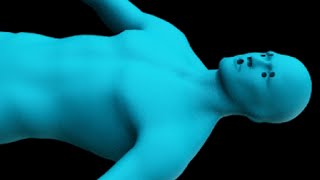

Is Your Body a Donut?
42sThe surprising analogy comparing the human body to a donut is shocking and immediately hooks viewers.
▶ Play Clip"The title promises a definitive answer and delivers a well-reasoned, surprising conclusion."
The video explores the question of how many holes a human body has, using topology and biology to argue that at a scale of 60 microns, the human body has seven through holes, not one. It distinguishes between blind holes (like pores) and topological through holes, and explains how the body's orifices interconnect.
The human body is often compared to a donut because of the GI tract, but this is an oversimplification.
Rubbing garlic on your foot leads to tasting it in your mouth an hour later, showing that molecules can penetrate skin.
60 billion neutrinos from the sun pass through your thumbnail every second, highlighting the body's porosity at small scales.
A good minimum hole size is 20-60 microns, about the width of a human hair, to meaningfully discuss holes.
The GI tract is a through hole; pores, urethras, ears, etc., are blind holes that dead-end.
The word 'hole' is imprecise; holes may not exist independently but are ontologically parasitic.
A bowl can be molded into a plate, removing the hole without closing anything, showing blind holes can be erased.
Through holes cannot be removed without cutting or gluing; they are topological invariants.
The nasal cavity connects to mouth, tear ducts, and sinuses; a string could go from nose to butt.
Four lacrimal puncta (tear ducts) lead from eyelids to nasal cavity, adding external openings.
A straw has one topological hole, not two, despite two openings.
Topology studies properties preserved under continuous deformation (homeomorphism). A donut and coffee cup are homeomorphic.
Blind holes can be removed via homeomorphism; topological holes cannot. The number of through holes is well-defined.
Demonstrates how to manipulate a two-hole donut with a rod to go through both holes via deformation.
A homeomorphism is a bijective, bicontinuous function; cuts are allowed if glued back perfectly.
A shape with unclear holes can be deformed into a known shape to count holes.
At 60 micron scale, the human body has seven through holes: GI tract, two nostrils, four tear ducts.
The body is topologically equivalent to a seven-hole torus, like four pairs of pants sewn together.
Each piercing adds one hole; if it goes through a through hole, it adds two.
Extra tear ducts or sinus openings can increase the hole count beyond seven.
The human body has millions of blind holes and, at birth, seven through holes, but individual variations like piercings or accessory ostia can change the count. The true number is personal and often unknown.
What is the minimum hole size used in the video to discuss holes in the human body?
20 to 60 microns, about the width of a human hair.
01:52
What is the difference between a through hole and a blind hole?
A through hole can be entered and exited (e.g., GI tract), while a blind hole dead-ends (e.g., pores).
02:18
How many through holes does a straw have topologically?
One.
16:42
What is a homeomorphism?
A bijective, bicontinuous function that allows continuous deformation without cutting or gluing (or with cuts that are perfectly mended).
13:39
How many external openings lead to through holes in the human body at 60 micron scale?
Eight: mouth, anus, two nostrils, and four lacrimal puncta.
17:25
How many topological through holes does the human body have at birth?
Seven.
17:39
What happens to a blind hole under a homeomorphism?
It can be removed without closing or pinching anything shut.
05:55
Why is a coffee cup topologically equivalent to a donut?
Because a coffee cup can be continuously deformed into a donut without cutting or gluing, so they have the same number of through holes (one).
10:37
What are the lacrimal puncta?
Tiny openings near each eyelid that drain tears into the nasal cavity via tear ducts.
08:35
How does a piercing affect the number of topological holes in the body?
Each piercing adds one hole; if it goes through a through hole, it adds two.
18:56
Human body as a donut
Opens with a surprising and memorable analogy that sets up the entire exploration.
00:13Molding a hole away
Demonstrates the philosophical puzzle of where a hole goes when a bowl is flattened into a plate.
04:34Body as a seven-hole donut
The climactic reveal that the human body is topologically a seven-hole torus, a mind-bending conclusion.
18:43[00:00] Hey, Geekha! Michael here. Come on in. If you keep going, you will eventually emerge out of our other end.
[00:13] And for this reason, it has been said that the human body is like a donut. Yeah, you are just a bunch of meat packed around a central hole.
[00:26] Or are you? Humans have more than one hole, right? I mean, we've got nostrils and ears, the holes we pee out of, the holes we're born from, nipples, our pores. Gosh, there are subatomic gaps between the molecules we're made out of.
[00:39] Where don't we have holes? Well, that is the rub. Literally. If you cut a clove of garlic in half and then rub that fresh, raw end on your foot,
[00:57] about an hour later you will start to taste garlic in your mouth that's because the molecules that give garlic its taste are small enough and have just the right properties to perniate skin cells in your foot
[01:11] enter your bloodstream and reach your mouth but you are even holier than that every second day and night about 60 billion neutrinos from the sun
[01:24] pass through just your thumbnail So clearly, at small enough scales, how many holes does a human have becomes a meaningless question. Ultimately, the human body isn't a solid thing that can even have holes.
[01:37] It's just a loose constellation of atoms and molecules. But if we accept a minimum hole size, the answer becomes pretty interesting. And a good choice for this minimum is about 20 to 60 millionths of a meter,
[01:52] about the width of a human hair, a magic spaceship 60 microns wide could fly into your pores like they were giant holes at craters. But it couldn't continue on through the vasculature at the other end
[02:05] or diffuse through cells or slit between molecules. And that is significant. It highlights the fact that not all holes are equal. A 60 micron wide ship or string
[02:18] could be threaded into your mouth and come out somewhere else. but it couldn't do that by entering a pore, or hair follicle. This makes the GI tract what engineers call a through hole.
[02:30] Whereas pores, urethras, nipples, ears, hair follicles, birth canals of the sinuses, are blind holes. They can be entered, but eventually dead end, usually at narrow capillaries,
[02:42] permeable only by things smaller than a single blood cell, and the determination to not be stopped. The eyeball can be squeezed under, but you'll eventually be stopped by the conjunctiva.
[02:54] The sinuses are nice big rooms in our skulls, but the only way out is the same ostea you came in through. As for the ear, well, the ear is a blast to go inside,
[03:06] but if you're 60 microns wide, the airtight eardrum will block further passage. It's a blind hole. Now, altogether, counting all of your pores and hair follicles, you've got millions of blind holes all over your body.
[03:20] But are they actually holes? That's a real humdinger, because you know what a hole is, what a hole really is? It's a word. A colloquial, fuzzy, imprecise lexeme that refers to a host of disparate, utterly unreconcilable things
[03:40] that eludes a single, precise, mathematical definition. In fact, holes might not even exist. I mean, think about it. If I eat a whole donut, have I eaten the whole?
[03:54] Like, is the hole inside me? Or could I eat a donut without eating its whole? Could I go to a store and buy Swiss cheese but leave the holes at the store?
[04:08] Clearly, holes are at best ontologically parasitic. Their existence depends upon the existence of something else that they can inhabit or be a disturbance in.
[04:21] Of course, the philosophy of holes rarely matters in your day-to-day life. You can call something a hole, and context will do its work, and people will know what you're talking about. But take a look at this. Does this have a hole in it?
[04:34] Well, yeah, right, obviously, right here, there's a hole. I can put my hand in it, it can store things, it's got a hole. But now imagine that I could mold it like it was made out of clay, and I molded it down into the shape of a drinking glass.
[04:48] You can see how that could happen, right? Well, does a drinking glass have a hole in it? If this does, then this should too, right? I mean, I didn't pinch the hole shut or glue anything together. Right? Sure, fine.
[05:00] I mean, I can accept that a drinking glass technically has a hole in it. But now, imagine that I took this glass, And I molded it out and I widened its opening until I had a shape like this.
[05:12] A bowl. Now, does a bowl have a hole in it? Now we really stretching the use of the word hole I mean if someone said their bowl had a hole in it I would think that it had a hole somewhere else and it was leaking But sure let call this a hole It not a very prototypical one but I think you see where I going with this
[05:30] If I then molded the bowl and flattened its sides all the way out until I had a plate, a shape like this, well, does a plate have a hole in it? Not really.
[05:42] So if a plate doesn't have a hole in it, but this shape did, and I continuously molded from here to the glass of the bowl to the plate and I never glued anything shut, where'd the hole go?
[05:55] Clearly, blind holes are pretty unique. They can be removed without closing or pinching anything shut. Compare that to the through hole of a donut.
[06:07] There is no way to remove a donut's through hole or add a new through hole without gluing stuff together, squishing things together that used to not be together, or ripping pieces apart, poking a hole through and breaking it.
[06:22] That is extremely significant. But let's go back to the body before we get ahead of ourselves. The mouth is an entrance to both blind and through holes.
[06:36] A 60 micron wide traveler could enter it, meander down the esophagus and keep going until they were, well, dumped out, but turn down the trachea and they would dead end in the lungs.
[06:49] Now, the area of the throat behind the mouth is called the pharynx. It's a pretty chill place, except not really. It's actually quite warm. It plays a role in warming and moistening and filtering the air that we breathe before it enters the lungs,
[07:03] including the air we inhale through our nostrils. Now, each nostril leads into a separate nasal vestibule. That's the tunnel that you can explore when you pick your nose. Eventually, those tunnels meet, and sniffed air enters the nasal cavity,
[07:19] a hollow, air-filled room in your face. Protruding from the walls of the nasal cavity are mucousy fins called the nasal conchi, or turbinates, that warm and moisten the air that passes around them.
[07:31] From there, the air flows via the pharynx down the trachea. So, your nostrils and your mouth are connected. A string could go into your mouth or nose and come out your butt.
[07:44] The nasal cavity is quite the hub. I mean, your ear holes would almost lead into it, but the eardrum blocks away. If it didn't, there would be clear passage from the outside into the middle ear
[07:57] and then down the eustachian tube into the nasal cavity via an opening about here. The eustachian tube controls air pressure in the middle ear behind the eardrum and is normally collapsed shut.
[08:09] But if the outside pressure is dramatically different than the air pressure in the middle ear, swallowing and yawning can tape it open, equalizing the pressure. That's what happens when you pop your ears.
[08:22] It's cool, but it's not a through hole, and that's what we're looking for. And as it turns out, there are four more. Four more orifices that lead from the outside into this place, your nasal cavity.
[08:35] And they are the lacrimal puncta. There is one near each of your eyelids. They're tiny openings about a third of a millimeter wide into which tears, the fluid constantly moistening and protecting your eyeball drain.
[08:49] Once inside the lacrimal puncta, tears flow through nasal lacrimal ducts, tear ducts, into your nasal cavity. Which is why when you're making a lot of tear fluid,
[09:02] you can get kind of sniffly and have to blow your nose. That's not snot. That's mainly tears. The point is, a 60 micron wide string could be pushed into any of your four lacrimal punta,
[09:17] threaded through your tear ducts into your nasal cavity, into the pharynx, and then pushed all the way out your butt. Pretty cool. That gives us eight external openings that don't dead end.
[09:29] But how many through holes is that? I mean, how many holes does a straw have? This clearly has two holes, but how many does this have?
[09:41] Is it one hole that forks? Is it two that combine? Gosh, maybe it's three. What about this? How many holes does this thing have? Or this? topology can help us answer every single one of those questions.
[09:57] Here, I have two essentially identical pieces of material.
[10:11] Now, they are no longer identical. Or are they? Geometrically, sure, their shapes are now different. But what didn't change about them?
[10:23] Well, that is what topology studies. Topology is concerned with the properties that persist so long as something isn't ripped apart. The famous joke that a topologist doesn't know the difference between a donut and a coffee cup
[10:37] is based on the fact that a coffee cup can be gently continuously molded into a donut by simply stretching and squashing No cutting gluing ripping or sewing required
[10:49] Topologists call these gentle, continuous transformations homeomorphisms, and the cutting and ripping and gluing that they disallow are exactly the kinds of actions required to make new holes or remove old ones.
[11:05] So since a coffee cup and a donut are homeomorphic, they must have the same number of through holes. And they do. One. We can now more precisely describe the difference we saw earlier between blind holes and through holes
[11:20] and understand why we are separately counting them. Now, blind holes can be erased through a homeomorphism. As such, topologists don't even really consider them. They're just geometric disturbances.
[11:33] Topological holes, on the other hand, cannot be massaged away. And unlike a blind hole, where what qualifies and what doesn't is a matter of opinion, the number of through holes a surface like your body in three dimensions has can be clearly defined.
[11:49] If we are having a hard time counting through holes, all we need to do is find something with an easy-to-count arrangement of through holes that it is homeomorphic with. But first, let's play around with some topological puzzles.
[12:04] Here is a two-hole donut with an infinitely long, unbreakable, unmovable rod through one of its holes. Without cutting or separating any part of the shape, can you figure out how to manipulate it such that the rod goes through both holes?
[12:19] Pause the video if you want to think about it. Remember this shape? It looks like it might have three holes, right? It's got a hole there, a second hole there, and a third hole here.
[12:32] But if I flatten it, you can see that it only has two holes. It has one there and one there. If the rod is threaded through the shape such that one wire is in front, and I choose one of the other wires to be the middle of the donut,
[12:45] for example, this one, then the rod passes through just one of the two holes. But if I choose the wire in the front to be the middle of the donut, well then the rod is seen to be passing through two holes.
[13:00] Likewise, if you continuously deform our original two-hole donut into the three-tube thing and pick this tube to be the new middle, ta-da, the rod is now going through two holes.
[13:13] No cutting or gluing required. One more puzzle. Without cutting or breaking, can you unlock this shape's intertwined loops? Well, pause if you want to figure it out yourself.
[13:25] Here's a solution. Simply inflate the bulb of the shape until you can skate a leg of each loop around until they're untangled and ta-da. Read them. Alright, let's define homeomorphism a little better.
[13:39] We said it was a rubber sheet or clay-like molding procedure with no cutting or breaking or gluing. And that's a good introduction, but honestly, you can cut all you want during a homeomorphism so long as you glue everything back together the way it was in the end.
[13:57] More precisely, a homeomorphism is a bijective and bicontinuous function. It's a function because it is a list of ordered pairs, where each point starts is paired with where it goes.
[14:11] Requiring that it be a bijection means that it must be a special kind of function, where there is a one-to-one correspondence between points in one object and in the other. No two points can map to the same location, and no point can get magically turned into multiple new points.
[14:27] Basically, material cannot be added or subtracted. Bicontinuous means that any cuts made must be later maided perfectly, with points going back amongst the same neighboring points they had before.
[14:42] In a homeomorphism, if parts are scooched over, everything else must flow with the scooch, as if all the points are kind of sticky. There is no smooth sliding along abrupt fissures.
[14:55] The precise test for whether a function is bicontinuous is pretty cool. First, I consider a point in one arrangement. Now, where the function takes that point is its image. Okay, now I choose some neighborhood around the image with a radius larger than zero,
[15:12] and I consider all of the points within it. If the function is continuous in this direction, I should be able to find a neighborhood around the pre-image, the input point, that only contains points that map inside the image's neighborhood.
[15:27] In this case, I can. But in this case, we've got an original point and where it went, but given a neighborhood around where it went, Every neighborhood around the original, no matter how small, will always contain some stuff that didn't make it over,
[15:43] which means points got separated but not put back, so the function is not continuous. Bicontinuity means that a function must be continuous in both directions.
[15:55] Okay, now that we can homeomorphize, let's start using it to count holes. Remember this shape It wasn immediately obvious earlier how to count its holes but it is easy if we can use a homeomorphism to turn it into something with an easy number of holes which we can
[16:12] Both of these shapes are homeomorphic. They both have two holes. To see why, simply drag and mold and flow the opening of one of this shape's holes into the tunnel of the other, and there we go.
[16:27] Since we didn't cut or glue, the number of holes hasn't changed. So this thing, just like this thing, always had two holes. Okay, what about a straw? Well, sure, informally, it can often make sense, depending on the context,
[16:42] to differentiate between two openings in a straw, the one you put in your drink and the one you put in your mouth. But that does not mean it has two holes. It only has one. A straw is homeomorphic to a torus.
[16:56] Both openings are part of the same single hole, but this process is a homeomorphism and thus does not create any new holes. You can also see that openings aren't holes by stretching one of the straw's openings
[17:09] until it becomes the outer part of a donut. There really was only ever just one hole. But enough about straws. Let's get back to the body. We found eight external openings, orifices, interconnected by tunnels.
[17:25] The openings aren't holes. They're parts of holes. And we can count those holes. As it turns out, at a scale of 60 microns, the human body has seven through holes.
[17:39] The human body is not a donut. It is a seven-hole donut. This shape can be molded and stretched into you. First, we choose a hole to be the GI tract, the mouth-anus tunnel.
[17:53] Now, into this, we roll half of the other orifices. Okay, now we've got something that looks pretty dang human. Seven holes with eight external orifices that meet in a common space, the nasal cavity.
[18:05] If we squish all the matter in towards the tunnels, we'll notice that our seven-hole torus is topologically equivalent to four pairs of pants sewn together at the waist. Your body isn't a donut.
[18:18] It's a bodysuit for a spider. Okay, now to finish, let's make two of the legs, the nostrils, and four of them, the tear ducts, one the mouth, and inflate the material into the form of a head.
[18:31] Now let's inflate the boundary of the final tube into the shape of a body, which is opening in the rear, and we've done it.
[18:43] The human body is a seven-hole donut. Or is it? For every piercing you have, that's one more hole in your body.
[18:56] Well, two more if the piercing goes through a through hole. Like, I don't know, if you had a thin piercing into your face that went through a tear duct and came back out, or if something like a bullet pierced into your chest, through your esophagus, and came out the other side.
[19:10] That would mathematically count as two new holes. And there's more. some people have supernumerary lacrimal puncta on their eyes.
[19:22] Each additional punctum they have over four total adds an additional hole to the standard seven. And remember the sinuses and the ostea connecting them into the nasal cavity?
[19:34] Well, they're just blind holes, depressions, but as many as half of us may have at least one accessory osteum, an extra hole connecting a sinus to the nasal cavity.
[19:46] Well, now we're talking about a through hole. You can enter one opening and exit via another. Now, these may not be external orifices, but for every excessia ostea you have, that's another topological hole you need to add to your body's total.
[20:01] The thing is, though, most of us have no idea how many accessory ostea we have, unless you've had serious sinus problems or have had extensive scans of your nasal region that have been studied from multiple angles.
[20:14] So, to answer this video's question, the human body has millions of blind holes, like at least five million, and at birth, seven through holes.
[20:26] It would be better if there was a clear answer that applied to all of us for our entire lives, or if finding out how many you had right now was easier. But you'll have to spelunk in your sinuses to know for sure.
[20:41] And that's beautiful, isn't it? We can rigorously define the properties of holes in all sorts of dimensions, and we can study the temperatures at the bottom of craters on Pluto, but few of us will ever truly know the whole truth of our own body.
[20:59] And as always, thanks for watching.
[21:12] you



⚡ Saved you 0h 21m reading this? Transcribe any YouTube video for free — no signup needed.