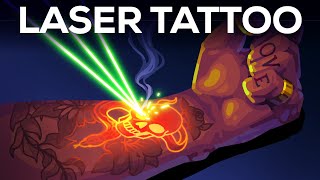

25 Million Regret Their Tattoos
45sHigh relatability and shock value about tattoo regret, sparking curiosity and debate.
▶ Play Clip"The title promises an explanation of how laser tattoo removal works, and the video delivers exactly that with detailed science and vivid description."
This video explains the science behind laser tattoo removal, detailing how high-energy laser pulses shatter ink particles without destroying the surrounding skin, and describes the painful process and healing aftermath.
One in four people with a tattoo regrets it, amounting to 25 million people in the US.
Tattoos have exploded in popularity, especially among millennials, but as people age they often stop identifying with their tattoos or they age badly.
Ink particles are too large for the body to remove; immune cells trap them in the dermis, keeping them in place permanently.
Removing a tattoo requires destroying ink particles without destroying the skin, achieved by using brief, high-energy laser pulses.
Different laser colors are needed for different ink colors: red ink absorbs green light, black ink absorbs all light and is easiest to remove.
Modern lasers use pulses lasting a few trillionths of a second to minimize skin damage.
Photons pass through skin but are absorbed by ink, heating particles to 600°C, causing them to expand and fracture.
Rapid expansion of ink and vaporized water creates shockwaves that damage surrounding cells and blood vessels.
Immune cells flood the area, engulf ink particles, and transport them to lymph nodes; some are excreted via urine.
Typically 5-12 sessions are needed because only a fraction of ink is removed each time; the rest is re-trapped by cells.
After treatment, skin is red, swollen, and itchy; blisters may form. Healing takes about two months with proper care.
Laser tattoo removal is a painful but effective process that uses ultra-short laser pulses to shatter ink particles, which are then cleared by the immune system over multiple sessions.
What percentage of people with tattoos regret them?
One in four (25%).
Why do tattoos remain permanent?
Ink particles are too large for the body to transport away, and immune cells trap them in the dermis.
01:11
What is the principle behind laser tattoo removal?
Destroy ink particles without destroying the skin using brief, high-energy laser pulses.
02:03
Why are different laser colors needed for different tattoo inks?
Each ink color absorbs specific light wavelengths; e.g., red ink absorbs green light, so a green laser is used.
02:44
How long do modern laser pulses last?
A few trillionths of a second.
03:19
What temperature do ink particles reach when hit by the laser?
600 degrees Celsius.
05:28
What causes the 'frosting' effect on the skin during laser removal?
Bubbles of hot gas expanding under the skin.
07:06
How does the immune system help remove tattoo ink after laser treatment?
Macrophages engulf ink particles and transport them to lymph nodes; some are excreted via urine.
08:01
How many laser sessions are typically needed for complete tattoo removal?
Between 5 and 12 sessions.
08:42
What is a potential risk of laser tattoo removal?
Scarring or permanent skin color changes, though rare with modern technology.
09:57
Tattoo regret statistic
Opens with a surprising fact that one in four people regret their tattoo, setting up the problem.
Ink heated to 600°C
Vivid description of ink particles burning to 600 degrees, making iron glow red hot.
05:28Pain described as electrocution
Relatable and visceral description of the pain: 'like being electrocuted' with a loud crack and burnt hair smell.
06:51[00:00] Very tasteful art. Oh, you hate it? You're not alone. One in four people with a tattoo regretted. 25 million people in the US.
[00:14] Getting ink carved into your body permanently has exploded in popularity in the last few decades, especially among millennials. Often their tattoos were about a current cultural thing, a moment in their life,
[00:26] following a trend, expressing individuality, or about feeling like being part of something greater. That's all fine and good, but as people age, they often stop identifying with what their younger versions wanted on their skin forever.
[00:40] Or sometimes their tattoos simply just look ugly or have aged badly. And so today, laser tattoo removal is booming, being as normalized as dentist appointments. Which is wild, since lasering a tattoo away
[00:54] is one of the most metal things you can do to your body. a high-tech procedure that's extremely painful and makes your skin explode from the inside. How does it work?
[01:11] We explained what a tattoo is in detail before, but in a nutshell, from the perspective of yourself, your tattoo is a mountain range of colourful boulders, from small to building
[01:23] Injected deep into your dermis by violently ripping huge wounds with gigantic needles. Your body is trying hard to destroy the tattoo, but the particles are way too large to be transported away, and your immune cells can't eat them.
[01:38] So they do the next best thing, keeping the ink trapped in a prison of flesh. This is why tattoos remain forever. Millions of your cells give their lives to keep the ink in place.
[01:50] When they die, new ones take their place. In principle, removing a tattoo is very easy. Just destroy the ink particles. The hard part is to do that without destroying you.
[02:03] Amazingly, the best way is still to blast you with a deadly laser. Lasers, using light, Wi-Fi or X-rays, are all the same thing.
[02:15] Electromagnetic radiation. Photons that travel through space at the speed of light in the form of a wave. The more energetic they are, the higher their frequency and the more punch they carry. Imagine your skin as jelly and your tattoo as crumbs of toast.
[02:31] If you shine a flashlight against it, most light passes right through the jelly, but the darker toast crumbs absorb more light and are clearly visible. Likewise, certain laser frequencies mostly pass through your skin without doing damage,
[02:44] while dark ink particles soak them up. Depending on the color of your tattoo, we need different lasers. Red ink reflects red light, but absorbs green light, so you need a green laser.
[02:56] Black ink easily absorbs all types of light and is the easiest to remove. But even with the right color, tattoo removal lasers are still pretty powerful and can still leave horrible injuries scars or change your skin color permanently So instead of shooting your skin with a continuous ray of death modern tattoo removal lasers shoot an extremely brief pulse
[03:19] a packet of electromagnetic energy that lasts about a few trillionths of a second, so sure that the beam ends before the first photon even hits the skin. OK, enough theory.
[03:31] Let's laser your mistake away and experience the fun of tattoo removal together. But laser removal is expensive, so let's start by taking care of your finances.
[03:44] With Rocket Money, the sponsor of this video, you can begin saving money today. Rocket Money is an app that helps you stay on top of your financial life. Build a budget, track your spending, and set saving goals, all with just a few taps.
[03:58] And because everything is in one place, managing your money instantly becomes much simpler. One feature we especially like is their subscription manager. It's easy to lose track of what you signed up for,
[04:10] but Rocket Money puts all your subscriptions in a single list and helps you keep track of payments. They can even cancel unwanted subscriptions for you. Rocket Money is free to download, and you can get a free premium trial when you sign up using our link.
[04:24] Go to rocketmoney.com slash CodsGazard, scan the QR code, or click the link in the description. And now... Let's laser a mistake away.
[04:36] Take a deep breath, this is going to hurt. Let's slow down time. Zap. The pulse of high energy photons hits your arm nearly at the speed of light,
[04:49] shooting through the dead layers of the skin, passing into the dermis. Most cells are like jelly to the laser and don't absorb much energy, escaping its deadly power unharmed. The flood of photons moves on and reaches the mountain range of ink
[05:03] embedded deep in the prison of your flesh themselves. Only a nanosecond, a billionth of a second, has passed, but now things escalate rapidly. As the photons hit the black ink on a molecular level,
[05:16] they smash into electrons and are absorbed and annihilated, transferring all of their energy into them. This sudden influx of energy almost instantly turns into a massive amount of heat that has nowhere to go.
[05:28] The ink particles burn up to a soothing hot 600 degrees, hot enough to make iron glow red hot. Overwhelmed by the sudden heat, the ink particles expand rapidly
[05:40] and are mechanically straightened to the max, violently ripping and fracturing, almost exploding. The mounting range cracks into millions of seething hot pieces and a bit of hot ink dust, which wouldn't be that bad
[05:53] if this was not going on inside your skin. Watering your tissue and inside your cells instantly vaporizes and expands quickly, ripping cells apart and growing into gigantic caves of hot steam bubbles inside your skin.
[06:07] This sudden expansion creates a shockwave that hits tissue nearby, causing more mayhem and damage. Your cells that were keeping the tattoo in place a moment ago are having a really bad time.
[06:19] If they had kept tattoo particles safely sewed inside of them they cooked or ripped apart The cells that surrounded the ink mountains are gravely wounded or burned alive by the sudden heat of things A few tiny blood vessels in the area are ripped apart violently
[06:36] Thousands of your cells are dead or hurt. And then the next laser pulse hits again and again, moving over the tapu like an orbital bombardment. From your perspective, all this is happening so fast that you only notice one thing.
[06:51] a sharp pain like being electrocuted, a smell like burnt hair, and most disturbingly, a loud crack. Where the laser hits, your tattoo instantly turns white, which is called frosting,
[07:06] and is the bubbles of hot gas expanding under your skin. To ease the pain, the area is often cooled with a stream of cold air for a moment before the laser moves on again. Inside your skin, the tattoo is now a crushed mountain range of carnage and death.
[07:21] The cooked and ripped remains of cells float in a mix of hot ink and water vapour who are cooling down. Many more cells are injured and are chemically screaming for help. It's like an internal burn wound.
[07:34] The Brutal Aftermath Hundreds of thousands of immune cells like macrophages stream into the wounds to clean up the mess. They order inflammation so your blood vessels open up and water rush again.
[07:47] Your wounded skin starts to swell up and turn red. As your cells begin cleaning up casualties and helping with wound heating, they also leak loads of hot ink particles. It's now that your tattoo is actually being removed.
[08:01] The same immune system that kept it in place is now helping to clean it up. Many of the smallest particles are simply rinsed away by the flood, while macrophages devour some of them and transport them to your lymph nodes.
[08:14] If possible, they'll be broken down further and ejected from your body via your urine. If not, they'll just collect inside your lymph nodes and stay there probably for the rest of your life. So, hopefully, you got the tattoo from a pro and the ink is not toxic.
[08:30] But the majority of ink particles are either still too large or there are just too many of them. So your immune and skin cells, in a brave effort to protect you, once again swallow and bind them in place.
[08:42] This is why a laser tattoo removal usually takes between 5 and 12 sessions. Each time a part of a tattoo is transported away and an even larger one is cemented in place again. You get to enjoy watching this process happening in real time.
[08:57] Within the first few hours, the frosting under your skin faint and the skin around the tattoo feels like a bad sunburn. Red, swollen and steam. Often it rises with fluid-filled burn blisters that you should leave alone.
[09:12] As the pain calms down, it's replaced by soreness. Over the next few days, the wound will remain red, swollen and tender and begin to itch. The itching is a direct consequence of your immune cells actively healing you,
[09:26] so maybe that gives you some comfort. After about a week, the wound may crust over as new healthy and pink skin replaces injured skin. Things slowly get back to normal Your tattoo will usually be noticeably lighter although not that much if this was your first session Over the next few weeks it will get a bit lighter still
[09:45] as your immune system keeps transporting parts of it away. Modern laser tattoo removal has gotten very good, so if you chose an experienced professional, you should be completely healed after two months.
[09:57] But if you didn't, or if you had the procedure done with older tech, sometimes there might be a slight scar, or the colour of your skin may change from the incases. Although this is pretty rare nowadays, please do your research when deciding who you're going to allow to shoot lasers at you.
[10:13] In the best case, after a number of sessions, your tattoo is no longer visible, or only very, very faintly. Whether it will disappear completely depends on the size of your tattoo, the colours that were used, how deep the ink was injected,
[10:27] and, to a degree, how good of a job your body does cleaning up the mess. New Year, New You We've created a health journal To set you up for success It's a science-based and easy-to-follow framework
[10:41] That helps you find out what actually works for your life Without pressure or guilt Want to focus on your diet? Start with the food and nutrition chapter Or drive into physical fitness or mental health
[10:54] Each chapter is packed with real science Lots of examples and inspiration to get you started so that you can make it completely your own to set your individual needs. We also made it as beautiful and fun as possible,
[11:07] as picking care of your health should always be. After the Gratitude Journal and the Habit Journal, this is the third part of our best-selling journal series. Set yourself up for success in the new year.
[11:19] Just give yourself one month. Try it. See where it takes you. I'm not the missing that.
[11:59] lambda Zie di di mi sea
[12:16] o S T T�
[12:41] The
[12:54] Subtitles



⚡ Saved you 0h 12m reading this? Transcribe any YouTube video for free — no signup needed.