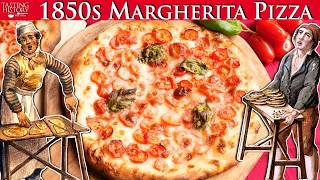

The Truth About Margherita Pizza
35sDebunks a beloved food origin myth, sparking curiosity and debate.
▶ Play Clip
[00:00] There is a story that says that the Margherita
[00:04] when Queen Margherita of Italy visited Naples in 1889. And he placed
[00:09] tomato, mozzarella, and basil on top of the pizza to represent the colors of the flag of the newly unified Italy.
[00:16] A charming tale with very little evidence to back it up. In fact,
[00:23] perhaps under a different name, already
[00:27] So using documents from the mid-19th century, I am endeavoring to uncover what the original Margherita pizza might have been like.
[00:35] So thank you to Babbel for sponsoring this video as we dive into the story of Neapolitan pizza,
[00:40] this time on Tasting History.
[00:48] Recreating the original Margherita pizza as it
[00:54] kind of an impossible task.
[00:56] See, today there is an association in Italy that has codified exactly what Neapolitan pizza must be.
[01:02] But 150 years ago, there was no such association. And the many, many pizza makers of Naples,
[01:08] had their own version of what they considered pizza.
[01:12] Mind you, at this time, most people, especially outside of Naples, considered pizza to be more of a dessert.
[01:17] It was kind of like a sweet cheesecake.
[01:20] And the pizza, the savory pizza, what we think of as pizza, was the food of the poorest people in Naples, the Lazzaroni.
[01:28] So without an actual recipe to follow, I'm going to have to rely on contemporary descriptions from the 19th century
[01:33] that at least describe what this savory pizza was like.
[01:37] And just like today, there are lots of ways that these pizzas were topped.
[01:41] Some of the more popular toppings were just olive oil, garlic, and anchovies.
[01:45] But in 1853, we do get a description of what might be the very first Margherita pizza.
[01:51] "Pizza... is a specialty of the Neapolitans - indeed of the city of Naples itself...
[01:56] [Some] are covered with grated cheese and seasoned
[02:01] Upon this, thin slices of mozzarella. At times slices of prosciutto, tomatoes, small clams, etc. are used."
[02:08] So he mentions grated cheese, slices of mozzarella, slices of tomato and basil.
[02:13] And if the pizzaiolo or pizza maker doesn't put any clams or prosciutto on it,
[02:19] then we got ourselves a Margherita pizza. So,
[02:24] what you'll need is 2 1/2 cups or 300 grams of
[02:33] a 1/2 teaspoon or 1 and 1/2 grams of dry yeast, and 1 and 1/2 teaspoon of salt.
[02:38] So start by mixing the yeast into the water and let
[02:42] And then add about 2 cups of the flour along with the salt and begin to work the ingredients together. And as you do,
[02:49] you can add more of the flour until you have enough that you get a shaggy dough.
[02:53] You may not need all of the flour to get to this point,
[02:58] and begin to work it until it is kneadable. And
[03:03] Then once it comes together, knead the dough for about 7 to 10 minutes until you have a nice smooth ball of dough.
[03:10] Then oil a bowl, set the dough in. Put a little more olive oil on top and cover with a wet towel
[03:15] and let it rise for at least 2 or 3 hours, but preferably more like 24 hours in the refrigerator.
[03:22] It'll really let the flavors in the dough develop.
[03:25] Now, this is just one version of pizza dough that might have been made,
[03:31] because we don't really know exactly what the dough was like. It's actually probably not like the dough that is used in Naples today.
[03:39] They would have probably mostly used sourdough but they did have compressed yeast as well. But the real question is
[03:46] exactly how leavened is this bread. Alexander Dumas said that
[03:51] "The pizza is... made from the same dough as bread."
[03:53] Which would imply that the dough is pretty well leavened. But in 1847 Gaetano Valeriani wrote
[03:59] "These pizzas are simple flattened breads and focacce, made from wheat dough without yeast and therefore indigestible."
[04:06] But then he goes on to say that the edges of the pizza are raised,
[04:09] which would imply that it is leavened. So maybe
[04:15] But the idea is that it probably varied from pizza maker to pizza maker.
[04:20] I mean, even in Italy today, pizza varies from city to
[04:26] And that's kind of what makes it exciting. You can have a bunch of different pizzas and they're all a little bit different.
[04:31] And that's one thing I really love about travel is the inconsistency,
[04:34] the variety of the different foods that you
[04:39] But it does help if you can actually read the menu
[04:44] And so, if you are traveling internationally, you might
[04:50] Babbel is one of the top language learning apps in the
[04:55] over 650 real life human language teachers and they gear the lessons to be very practical
[05:03] whether you're wanting to learn for business or to talk to relatives or to travel and that's what I use it for.
[05:08] I'm actually learning Spanish because I've gone to Spain and Mexico several times in the past couple of years
[05:13] and frankly I've been completely lost.
[05:15] So, while I would like to be fluent someday, even learning just a few key phrases like
[05:20] quiero un pan dulce por favor make travel all the more rewarding
[05:23] because when you go to Mexico especially, you got to order the pan dulce.
[05:27] Also, the lessons are nice and short. Just about 15 minutes so you can practice a little bit each day and it really does add up.
[05:35] Plus, that 15 minutes a day of learning a new skill
[05:39] So join me in learning a new skill and start speaking
[05:45] And right now, you can get up to 55% off of your
[05:51] or clicking this QR code. And Babbel offers
[05:58] And now, let us get back to our pizza.
[06:01] So, once the dough has risen, divide it into two pieces to make personal sized pizzas, or leave it whole if you want to make one large pizza.
[06:07] I will say the smaller size is going to be much easier to work with if you don't make pizzas all the time like I don't.
[06:13] I wish I did but I don't.
[06:14] So you want to form this dough into a thin disc, which can be a little tricky.
[06:18] And you're going to want to place it on a pizza peel that is ready with plenty of semolina flour on it
[06:24] because you're going to slide the pizza off into the oven. And even after you put the dough onto the peel,
[06:29] you should still be able to work it so you make it into a better circle.
[06:33] And then it is time for your toppings. and exactly what should those toppings be?
[06:37] Today, Margherita pizzas are usually made with tomato sauce. But in all of the old descriptions,
[06:44] I never saw tomato sauce for this type of
[06:50] which was made with tomato sauce and anchovies.
[06:54] All of the other pizzas that have tomatoes, it says they are sliced tomatoes.
[06:58] As Samuel Morse of Morse code fame described pizza in Naples in the 1830s,
[07:03] it's a "Species of the most nauseating cake... covered over with slices of pomodoro or tomatoes,
[07:09] and sprinkled with little fish and black pepper. And I know not what other ingredients,
[07:14] it altogether looks like a piece of bread that has been taken wreaking out of the sewer.
[07:19] Not a fan. All right, good to know.
[07:21] Hopefully mine does not look like it came out of the sewer. So, the tomatoes that I am using are called mini Marzano tomatoes,
[07:29] and they should have the same flavor as the traditional San Marzano, which I couldn't find at this time of year.
[07:34] But you can also use Roma tomatoes. Those are closer to the proper size, but the flavor is a little bit different.
[07:40] As for the cheese, I am using mozzarella, but two different kinds. And that's because of
[07:44] a description that is probably the most detailed description of the type of pizza we want to make that comes from the 1860s.
[07:51] But it was actually written by an Englishman who went to Naples,
[07:55] then came back to England and was trying to explain pizza to his countrymen.
[07:59] "What do you mean by the pizza? Well, the pizza is a favorite Neapolitan delicacy,
[08:04] which is only made and eaten between sunset and two or three in the morning and it must be baked in five minutes in the oven;
[08:11] at the very moment when it is ordered, it is pulled out
[08:17] The pizza baker takes a ball of dough, kneads it, and spreads it out with the palm of his hand,
[08:21] giving it about half the thickness of a muffin, then pours over it mozzarella,
[08:26] which is nothing more than rich cream, beaten almost like a cream cheese;
[08:30] he then adds grated cheese, herbs, and tomato, puts the cake - which made after this fashion, is termed the pizza -
[08:37] just for five minutes into the oven, and served it up
[08:41] The cheese and the cream are, of course, all melted, and united with the herbs and the tomato.
[08:46] The outside crust must, in the case of a perfect pizza, possess a certain orthodox crispness."
[08:52] So he talks about grated or sliced mozzarella for which you will need a firm mozzarella like buffalo mozzarella.
[08:58] But then for the portable mozzarella which he equates to like
[09:03] the stracciatella which is inside a ball of burrata.
[09:07] This you can actually, if not pour, then spread across the top of your pizza.
[09:11] Then you can cover that with the tomato slices and then a few pieces of the firmer mozzarella.
[09:17] And then you can put the basil on top. But really, you should only put the basil on top if you have a wood-fired pizza oven that is going to hit about 900° F.
[09:27] Because then you only need to bake this pizza for like 90 seconds, maybe 2 minutes.
[09:31] But if you don't have that, if you just have a regular oven like I do, then it's going to need to bake for more like 8 or 9 minutes.
[09:38] And so I would wait to put the basil on until about halfway through. Otherwise, it can burn.
[09:43] Also, if you are using a conventional oven, you're going to want to get yourself a pizza stone
[09:48] so that you can heat that up and make a really,
[09:55] Also, you note that when I did slide the pizza into the oven, the fan blew all the basil I had on there off,
[10:00] so I had to put it on later anyway.
[10:03] So, like I said, if you have a wood-fired oven and it's 900°, 90 seconds, maybe 2 minutes, you're going to be good.
[10:09] If you have a regular oven that's like 450° , 500° Fahrenheit, then you're going to need 8 or 9 minutes in the oven,
[10:16] which should give us plenty of time for me to take you back to 19th century Naples.
[10:25] Lately, I've had a lot of requests for signed
[10:28] This is actually the Italian version for the uh
[10:33] I'm putting a link in the description to where you
[10:36] Now, the history of pizza in Naples goes way, way, way back, probably to the Atruscans.
[10:42] They had flatbread, they had other things. They probably put it on there. You got yourself a pizza.
[10:46] But pizza, as we think of it as pizza, doesn't really get
[10:53] Before that, most pizza referred to kind of a sweet bread.
[10:57] I've actually made one version of that here on the channel. It was kind of like a brioche with a bunch of sugar on it.
[11:03] And that is actually what most people thought of pizza as being until like the early 20th century.
[11:10] In 1891, Pellegrino Artusi published a cookbook which was for many years the Bible of Italian cuisine.
[11:16] And in it, he included two pizza recipes. One was a crust stuffed with custard, raisins, and pine nuts.
[11:23] And the other, which he called Neapolitan style pizza,
[11:29] almonds, and sugar. Delicious, I have no doubt.
[11:35] Though, I would kind of love to see a restaurant
[11:39] historically authentic Italian cuisine. And when
[11:44] a cheese and pine nut stuffed crust, basically a cheesecake.
[11:48] And then they refuse to take it off the bill when people complain that that is not a pizza because technically,
[11:54] technically it is a pizza. And that's why I don't work in
[11:59] that's how I would run my restaurant. Anyway,
[12:02] just because Pellegrino Artusi considered dessert pizza,
[12:08] that doesn't mean that most people in Naples
[12:13] For the common people, pizza was pizza as we think of it or at least a version of it.
[12:20] And Alexandre Dumas when he visited, that's the author of 'The Three Musketeers', When he visited Naples,
[12:26] he talked about the fact that for most Neapolitans, they ate two foods, pizza and watermelon.
[12:33] "The lazzarone eats, as we've said, pizzas and watermelon; watermelon in the summer, pizzas in the winter.
[12:39] The pizza is a kind of flatbread... It comes in different widths depending on the price.
[12:44] A two centesimi pizza is enough for one man; a two soldi pizza should feed a whole family.
[12:49] At first glance, pizza seems a simple dish; upon closer examination, it's a complex one.
[12:55] There's pizza with oil, pizza with bacon, pizza with lard, pizza with cheese, pizza with tomatoes, pizza with small fish."
[13:02] And he says that the price isn't just determined by the size, but also by what toppings you're putting on it.
[13:08] Just like today, it can change the price. Unlike today, at least I hope.
[13:12] "Another thing that affects the price of pizza is its freshness; you can no longer sell yesterday's pizza at the same price as today's;
[13:19] there are week-old pizzas for those on a budget;
[13:22] these can, if not pleasantly, at least advantageously, replace the sea biscuit."
[13:27] So, Dumas is suggesting using weak old pizza as a replacement for hardtack.
[13:31] [clack clack]
[13:31] Now, I'm thinking that these week old pizzas were not usually sold in pizzerias, but rather out on the streets
[13:38] because a traditional pizza maker or pizzaiolo would have an establishment where they would actually make the pizza.
[13:45] Then "These pizzas, cut into many one-soldo slices,
[13:48] are entrusted to a young assistant who goes to sell them on the street corner at top a portable stand;
[13:53] and there he remains nearly the whole day with these slices of pizza,
[13:57] which freeze in the cold, turn yellow in the sun, and are eaten by flies...
[14:02] When the supply runs out, the pizzaiolo replenishes it even late into the night."
[14:07] This is the pizza sold to the poorest people of Naples, the lazzeroni.
[14:11] And to many people who are living outside of Italy or even outside of Naples,
[14:18] pizza is considered slightly above trash. As we
[14:25] And many other descriptions say that it is usually almost entirely burnt
[14:30] to the point of being inedible.
[14:33] But perhaps the most acerbic description of pizza that I could find actually comes
[14:38] from Carlo Collodi who wrote 'Pinocchio' because he not only talks about the pizza,
[14:44] but also the poor boy hawking it out on the street.
[14:47] "That blackness of the browned bread, that whiteness of the garlic and anchovy,
[14:51] that yellowish-green of the oil and the little fried herbs, and those bits of tomato here and there give the pizza an air of elaborate filth
[15:00] that harmonizes perfectly with the appearance of the
[15:04] But it is my belief that even the worst pizza, a weak old burnt pizza,
[15:10] is still better than no pizza at all. And it seems
[15:14] that the majority of the population of Naples, whether
[15:21] For "...there is no person, high or low, from the
[15:26] with whom it is not a primary article of faith
[15:30] The pizza cake is your only social leveller, for in the pizza shops, rich and poor harmoniously congregate;
[15:37] they are the only places where the members of the Neapolitan aristocracy - far haughtier than those of any other part of Italy -
[15:43] may be soon masticating their favorite delicacy
[15:49] The pizza shops are about the filthiest in Naples, and whoever knows Naples will admit that this is saying a good deal."
[15:56] A description of one of these pizza shops from 1853 says that between the hours of 11:00 a.m. and 3:00 p.m.,
[16:02] the shop is absolutely packed with young men who have no jobs to go to.
[16:07] And a boy from the next door tavern will come over and take a drink order
[16:12] because usually they couldn't sell wine in the pizza parlor or pizzeria.
[16:17] And then they would just all sit there and eat and
[16:24] Then he describes a scene which is just as
[16:31] A scene which is played out in restaurants all over the world whenever a group of friends gets together for a meal.
[16:39] He says that after the last slice of pizza is gone and the last drink of wine has been drunk,
[16:45] "Then follow painful notes of payment; often, at this point, some member of the merry company
[16:50] disappears under the pretext of urgent necessity;
[16:53] often they struggle to scrape together among themselves the price of what has been eaten and drunk.
[16:58] Often one who still retains a shred of modesty so as not to make a sad figure pays for all without hope of ever being repaid."
[17:08] That was literally every single meal that I ever
[17:12] nobody wanted to pay and then one of us would always end up paying. And since it was a time before Venmo,
[17:17] you were never getting that money back.
[17:19] Anyway, there were other pizzerias that were nicer. They catered to a more affluent clientele.
[17:26] And it is from one of these pizza makers that the story of the Margherita pizza origin comes from.
[17:34] Now, this is what is known as "accepted history",
[17:39] which typically just means it was made up.
[17:43] The story goes that in June of 1889, Queen Margherita and her husband Umberto I,
[17:48] King of Italy and chairman for the Society of Luxurious Mustaches,
[17:52] arrived in Naples to celebrate Risanamento.
[17:58] following a devastating cholera outbreak in 1884.
[18:04] at the Palace of Capodimonte, they decided that they wanted to try some of the local cuisine. So
[18:11] they summon the most well-renowned pizzaiolo of the region
[18:16] and that was Raffaele Esposito along with his wife Maria Giovanni Brandi.
[18:21] When they arrive they present the royal couple with three pizzas. One with olive oil, cheese and garlic,
[18:26] another with sardines and anchovies, and another with tomatoes, mozzarella, and basil.
[18:31] Those three ingredients strategically added to represent the colors of their royal highness's national flag.
[18:37] And while they enjoyed all three, Queen Margherita declared that it was that third pizza that was by far the best.
[18:44] And so Raffaele decided to name it in honor of her, the Margherita pizza.
[18:51] To top it off, then the King and Queen had a letter sent to the pizzeria a few days later.
[18:57] It said, "June 11th, 1889. Inspection Office of the Mouth. Most esteemed Signore Raffaele Esposito Brandi,
[19:04] I confirm to you that the three types of pizza that you prepared for Their Majesties the King and Queen were found to be excellent.
[19:11] Yours devotedly, Gali Camillo, Head of Services of the Royal Household."
[19:16] A charming tale which has been related countless times.
[19:19] But what if any truth is there to it?
[19:23] Well, right off the bat, we know it can't be exactly true because records show that the royal couple
[19:30] was never together at the palace Capodimonte during that visit.
[19:34] They were at a different palace, but that's pedantic. You know, some of the details got a little mixed up in the retellings.
[19:42] The rest could definitely be true. I mean, there's even a letter
[19:46] that talks about this. She doesn't call out the Margherita pizza specifically, but she says
[19:51] that all of the pizzas were wonderful. And this
[19:57] But here's the thing. That letter was not found until decades after the event.
[20:04] It wasn't found, conveniently, until the 1930s, shortly after Raffaele's wife's nephews, Giovanni and Pascuale Brandi
[20:13] took over the pizzeria and changed the name of the establishment to Pizzeria Brandi, which is what it is still called today.
[20:20] And it's not just the fact that they happened to find this letter at a time when they were kind of rebranding.
[20:25] It's the fact that on the letter it refers to Raffaele Esposito Brandi.
[20:31] Rather suspicious since it's unlikely he would
[20:38] Another issue is that as pointed out by historian Zachary Nowak, the signature of Gali Camillo is wildly different
[20:45] from that on any other government document. Add to that the fact that the seal on the document
[20:50] is one that was used decades after the supposed creation of the letter.
[20:55] One can with some confidence say that this is a forgery.
[20:59] Mamma mia!
[21:00] What is interesting I find is that while Raffaele Esposito did change the name
[21:07] of his pizzeria to Pizzeria della Regina de Italia
[21:16] 6 years before Margherita's trip to Naples.
[21:18] Turns out that at this time it was really common to request permission
[21:23] to have something named as the official establishment of either the king or the queen.
[21:29] It was kind of like today when a pizzeria might put up a sign that says world's best pizza.
[21:35] ¯\_(ツ)_/¯
[21:37] Who's- who's deciding that really?
[21:39] But what is clear is that long before the letter occurred and the rebranding to Pizzeria Brandi,
[21:46] this family was trying to associate their pizzeria with the queen.
[21:53] And it turns out that this had actually been
[21:59] In 1880, the Roman newspaper Il Bersagliere ran a story that tells of a pizziaolo summoned to the palace in Naples
[22:07] because the king and queen wished to try a pizza.
[22:10] When he arrives, Queen Margherita asks him what kind of pizzas that he has on offer. And he gives her a list of 35 different ways
[22:18] that he makes pizza. And she ordered one with fish
[22:23] And then the next day he comes back with all of the ingredients.
[22:27] "Finally, after frying and baking, fragrant and appetizing, the Queen tasted a little and was greatly pleased.
[22:33] Great joy and emotion came over the pizza maker who asked permission to place the royal coat of arms upon his pizzeria."
[22:41] The pizza maker in this story was actually Giovanni
[22:49] So, is it true?
[22:51] I don't know. But at least it is documented in a newspaper at the time that it was supposed to have happened.
[22:58] What's interesting is that the pizzas that she orders are not what would
[23:03] become known as the Margherita pizza. She orders
[23:10] like the one that I am about to try right now.
[23:12] So, after 5 minutes in the oven, toss the basil onto the pizza and let it bake for another 3 or 4 minutes and then serve straight away.
[23:19] And here we are, my version of the original Margherita pizza of 19th century Naples.
[23:25] So, the old descriptions do say that it needs to be served like right
[23:30] it's kind of lost some of its pizzazz.
[23:34] But, that's all right. I'm still going to eat it.
[23:36] [chomp]
[23:40] Hm!
[23:41] Hm!
[23:43] That's so good. Oh, but it's so different because
[23:49] without the tomato sauce, it's just a different- it you get actually more flavor of the tomatoes,
[23:56] which is very interesting. But I like that
[24:04] [chomp x2]
[24:05] Hm!
[24:07] Yeah so good. I do have to say the crust is-
[24:15] it is hard, but
[24:16] [chomp x3]
[24:19] it's not as crisp as I'd like.
[24:21] And I think that's really because I don't have a pizza oven. There is-
[24:26] you can get a certain level of crispness with the pizza stone,
[24:30] but it's just not going to be the same as if you have a wood-fired pizza
[24:35] because then I would just be making pizzas all
[24:41] Or more likely, I'd use it once and never use it again.
[24:45] Somebody in my family who has a pizza oven, which I'm pretty sure has only been used once.
[24:51] But that's okay!
[24:53] 'Cus there are so many places that you can go and actually
[24:58] there is no bad pizza. This is what I'm saying.
[25:00] Even week old black pizza that was being sold on the streets of 19th century Naples. It's probably pretty good pizza.
[25:10] Yeah. I mean, it's pizza. What can I say? It's delicious. It is-
[25:15] not like what you're going to find in Naples today,
[25:19] but according to all of the old descriptions, they are
[25:26] And that's okay.
[25:28] I really like these tomatoes, though. They're small, but they're very, very sweet, the San Marzano. These are the mini Marzano.
[25:35] And the the flavor of the tomato is just so strong and it's sweet.
[25:42] Really, really good.
[25:43] So, I am literally going to eat this entire pizza in one sitting um because it's that good.
[25:50] And so, you should go make some pizza of your own or go buy a pizza. Also
[25:55] link to the description or in the description of the signed copies of Tasting History if you want one.
[26:01] And I will see you next time on Tasting History.
[26:04] Back to the pizza.
[26:06] [chomp 4x]
⚡ Saved you 0h 26m reading this? Transcribe any YouTube video for free — no signup needed.