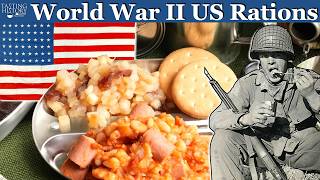

Cooking with WWII B-Ration: Vienna Sausage & Beans
45sThe unique premise of cooking a historical military ration sparks curiosity, and the step-by-step process is both educational and visually engaging.
▶ Play Clip"Delivers a detailed look at the B-ration with recipes and history, though the title is slightly broad as it focuses on one ration type."
This video from Tasting History explores the B-ration, a type of field ration used by American soldiers during World War II, consisting of canned and dehydrated foods. The host, Max Miller, prepares a full meal from the B-ration, including Vienna sausage and beans, pineapple milk, and apple cranberry sauce, while providing historical context about the various rations and their impact on troop morale.
The video begins with an introduction to the B-ration, a meal prepared from canned and dehydrated foods, as part of a series on WWII rations.
The host cooks from the 'US Army Technical Manual 10-412', specifically the B-ration section, which includes recipes for field kitchens using preserved foods.
Recipe number 880, Vienna sausage and beans, is scaled down from 100 servings to 10. Ingredients include white beans, dehydrated onions, bacon, canned tomatoes, tomato puree, sugar, dry mustard, salt, pepper, and Vienna sausage.
Beans are soaked overnight, then simmered in boiling water for 1 hour. Dehydrated onions are rehydrated in water for 20 minutes.
Bacon is diced and cooked with rehydrated onions, then tomatoes, tomato puree, sugar, salt, pepper, and mustard are added. The mixture is kept warm until beans are done.
Vienna sausage is chopped into inch-long pieces and added to the sauce, then simmered for another 20 minutes.
For a beverage, coffee was common, but the host chooses pineapple milk (recipe 803) as a more interesting option.
Pineapple milk is made with powdered milk, sugar, water, and pineapple juice. It is whisked together and chilled before serving.
Recipe 893, apple cranberry sauce, is made with dehydrated apple nuggets, dehydrated cranberries, and sugar. It is simmered and served as a compote.
The rations were called alphabet rations: A, B, C, D, and K, with quality decreasing from A to K. A-ration was fresh food, B-ration was canned/dehydrated, C-ration was canned meals, D-ration was emergency chocolate, and K-ration was for paratroopers.
American soldiers received 234 pounds of meat per year, nearly 100 pounds more than pre-war civilians, and up to 4,300 calories daily during training, with frontline troops receiving over 4,700 calories.
A fully stocked B-ration included 100 different ingredients, providing 5 pounds of food per man per day, including at least one dessert daily.
Field rations A and B made up 79% of calories eaten by men during the war, but the C-ration was the most representative of WWII rations, developed in 1938.
The C-ration's calorie count was miscalculated (only 2,000 instead of 3,700-4,000), so they doubled the amount and added D-ration. The claim that it was better than fresh meals was false; it was widely despised.
Each day's C-ration consisted of six cans: two per meal, with one M-unit (meat) and one B-unit (biscuits). Meat options were limited initially, with only three varieties, and were minced into 'meat particles'.
By the end of the war, there were 10 different meat options, but none were particularly beloved. Some soldiers heated cans on jeep manifolds or tank engines, but often ate cold or frozen.
The B-unit contained biscuits and optional items like candy, gum, cigarettes, chocolate, sugar, water purification tablets, soap, P38 can opener, and by mid-1944, toilet paper.
A full day's ration weighed up to 5 pounds and was bulky, so soldiers typically carried 3 days' worth, expecting backup with B-rations within 3 days.
Corporal EB Sledge described horrific conditions on Peleliu, with flies swarming over rations and corpses, making it revolting to eat.
Men landing in Morocco during Operation Torch survived solely on C-rations for up to 90 days, suffering from nausea and digestive disturbances.
During Anzio, soldiers ate only 400-1,800 calories per day, leading to an experiment at Monte Casino where fresh food was sent to the front, boosting morale.
Food had a significant impact on troop morale, with ice cream barges in the Pacific and access to Coca-Cola bringing comfort.
The 5-in-1 and 10-in-1 rations were repackaged B-rations for groups, and the K-ration was for paratroopers, which will be covered in a future video.
The dessert is made with dehydrated apple nuggets, cranberries, and sugar, simmered to a compote.
The host tastes the Vienna sausage and beans, noting the flavor is fine but the sausage texture is too soft. The apple cranberry sauce is good, especially with pork, and the pineapple milk is surprisingly good, not curdling.
The B-ration provided American soldiers with a relatively varied and abundant diet compared to other nations, but even so, troops often grew tired of canned and dehydrated foods. The video highlights the importance of food for morale and the logistical challenges of feeding millions of soldiers during WWII.
What is the B-ration?
A type of field ration used by American soldiers in WWII, consisting of canned and dehydrated foods, prepared in field kitchens.
01:14
What are the alphabet rations in order of quality?
A, B, C, D, and K, with quality decreasing from A to K.
07:12
How many calories did frontline troops receive per day?
Over 4,700 calories, 700 more than German combat ration and double that of Japanese.
08:08
What was the C-ration's initial calorie count miscalculation?
It was calculated to be 3,700-4,000 calories but actually only about 2,000.
10:37
What did the M-unit in the C-ration contain?
Meat, initially in three varieties: beef stew, pork and beans, and meat hash.
11:37
What was the most disliked C-ration meat option?
Ham and lima beans.
12:19
How many cans were in a full day's C-ration?
Six cans, two for each meal.
13:19
What was the purpose of the D-ration?
An emergency chocolate bar to supplement calories.
10:51
What was the 5-in-1 ration?
A repackaged B-ration for 5 men, providing an entire day's rations.
18:50
What was the K-ration originally meant for?
Paratroopers.
19:06
American Food Abundance
Highlights the stark contrast in food supply between American and other troops, with 4,300-4,700 calories daily.
08:08C-Ration Calorie Miscalculation
Reveals a significant error in the C-ration's calorie count, leading to adjustments.
10:24Peleliu Conditions
Provides a vivid, first-hand account of the revolting conditions soldiers endured with C-rations.
14:04Anzio Weight Loss
Shows the real-world impact of inadequate food intake on soldiers' health.
16:32Food and Morale
Emphasizes the psychological importance of food beyond mere nutrition.
18:03[00:00] Feeding the millions of American soldiers during World War II was a herculean task including the C-ration, the D-ration, and the K-ration. But today, I am cooking with the B-ration, an entire meal prepared from canned and dehydrated foods.
[00:17] So thank you to Trade Coffee for sponsoring this video as we make the kind of meal this time on Tasting History.
[00:32] As I mentioned in last month's video on the D-ration, this is the beginning of a whole series about So, let me know in the comments what army you would like to see next. But for today,
[00:44] I am cooking from the rather casually titled 'US Army Technical Manual 10-412'. Specifically, I'm cooking from the B-ration section. See, most of the recipes in this book are actually for the A-ration, which is like fresh meat, fresh vegetables, fresh milk, that kind of stuff.
[01:02] The things that you would be eating on an army base well behind the lines. But there is also a section on the B-ration, and these are the sort of meals that would be prepared in field kitchens
[01:14] This meant using the 100 or so items of the B-ration, which were all dehydrated, canned, or otherwise preserved foods. As the section says, "It will be necessary under conditions in the field to have only 'B' rations or a similar canned ration.
[01:32] At such times the cooks will find it convenient to have recipes to vary an otherwise monotonous menu." But even with these limitations, it wasalways the goal of the cook to provide each meal with at least one meat and two vegetables or fruits as well as some dessert and a beverage
[01:49] other than water. So, that is what I am going to endeavor to do starting with recipe number 880, Vienna sausage and beans. Now, you'll notice that this recipe is for 100 people. So you're using pounds of beans
[02:03] and measuring things in number 56 dippers, which is that big old dipper back there. I don't need that much. So, I'm going to cut this down to about 10 servings, for which you will need: 1 pound or 450 grams of white beans, 2 tablespoons or 14 grams of dehydrated onions,
[02:20] 2 slices or 70 grams of bacon, 2 and 1/2 cups or 500 grams canned tomatoes, 1 and a 1/3 cup or 375 grams of canned tomato puree, 2 tbsps of sugar, 1 tsp dry mustard,
[02:32] 1 tbsp of salt, 1/4 teaspoon of pepper, and 1.2 lb or 545 grams of Vienna sausage. So you want to start by soaking the beans overnight and then add them to a pot and cover them with 3.2 cups or 750 ml of boiling water.
[02:47] Then, set this over medium heat and simmer for 1 hour, adding more water if you need. You don't want them to burn or to get too mushy. While they cook, add 1/3 of a cup or 95 ml of water to the dehydrated onions and let them soak for 20 minutes.
[03:00] Then dice the bacon up and toss it into a hot pan along with the now rehydrated onions, and cook these for a few minutes or until they start to brown. Then you can add in the tomatoes and the tomato puree, the sugar, the salt, pepper, and mustard and stir everything together and let it stay warm until your beans are fully cooked.
[03:19] Here you might also need to add a little more liquid just to make sure nothing burns, but you're also not making a soup here. Then chop up your Vienna sausage into inch long pieces and toss them in and then simmer for another 20 minutes.
[03:37] And that is the meat and vegetable part of the meal. Now, for a beverage I wanted to make something other than water. And there are several different options. One of the most common, of course, was coffee. As one Army colonel put it,
[03:49] "Of all the drinks, meals, and other fuels I have experienced in my life as a soldier, it is coffee that stands out as the standalone drink of of choice and remembrance... Of all the necessary assets and material, a cup of hot coffee competes with ammunition as a crucial soldier commodity."
[04:06] Of course, many soldiers were reduced to drinking soluble coffee, instant coffee, which came in little containers like that. But in the B-ration, they would have had proper coffee that could be made for many, many men.
[04:18] the variance in the type of coffee be pretty monotonous. So, if you want light roast or dark Now roast, if you prefer a cold brew or a French press, then you're going to have to go with something Trade is a wonderful way to experience and explore coffee to have new coffees freshly roasted delivered right to your doorstep.
[04:39] And since they work with over 55 top roasters in the US, they've curated over 500 different coffees. Of course, if you find some coffees that you really enjoy, you can keep getting those, or you can explore and get a new coffee every single delivery. That's what I really like doing.
[04:55] Every time that little red bag shows up at my doorstep, I know that I'm going to get basically a present. And it is a present that I know that I am going to enjoy because Trade pairs you with different coffees. They don't use an algorithm. They personally curate coffees to your tastes.
[05:11] But just to be safe, they have a first bag guarantee. So if you don't like your first bag of coffee, And right now, Trade is offering a discovery trial. Three bags from three roasters with your first bag free at drinktrade.com/maxmiller.
[05:27] That's DrinkTrade.com/maxmiller to get started with your trial. I am Max Miller if that wasn't clear. Now, while the men could have had coffee, I decided to go with something a little more interesting in this book, a little different.
[05:43] So I'm going with recipe number 803, pineapple milk. And it is exactly what it sounds like. It's pineapple and milk. So for this what you'll need is 1 and 1/2 cups or 160 g of powdered milk,
[05:56] A 1/4 cup or 50 grams of sugar, 2 and 1/4 cups or 530 ml of water, and 3 cups or 710 ml of pineapple juice. And making this one is nice and simple. All you do is whisk together the powdered milk and the sugar and then add it to the water.
[06:11] Dissolve this by whisking it in and then add the pineapple juice. Mix it all up and then if possible, chill before serving. Now, we do have one more dish to make. It is an apple and cranberry "sauce".
[06:24] It's not really a sauce, but before we do that, make sure you are subscribed to the channel so you can keep watching the rest of this World War II series as I look into the other rations that would have been feeding US troops during World War II.
[06:44] The dining experience of an American GI was very different from that of pretty much everyone else fighting in this war. As one British officer put it, the food of the Americans was "Lavish to the point of extravagance."
[06:56] And that extravagance was actually referring to the B-ration, which wasn't even the highest quality ration that the Americans had available to them. See they were usually called alphabet rations because there was the A-ration, the B, the C, the D, and the K-ration.
[07:12] And generally, they they went down in quality the further down you went. And the A-ration was the top quality, though. That was essentially what the men would have been eating back at home.
[07:26] It was all fresh ingredients. In fact, sometimes it was better than what the men would have been eating back at home. There was a book in 1943 called 'When Your Son Goes to War' and it actually reassured mothers that they were getting the food that they were accustomed to having back at home,
[07:42] It said that the army was aware that "This generation of boys had been brought up on milk as a definite item of diet..." and that "...ample provision has been made for fresh milk for every man at every meal while in camp."
[07:56] And in addition to the freshness of the ingredients, it was the sheer quantity of the food that was so typically American. The amount of meat given to the average serviceman was 234 pounds per year,
[08:08] nearly 100 pounds more than the average pre-war civilian was eating. And the number of overall daily calories was a staggering 4,300 during training and when in base. Men at the front were meant to receive over 4700 calories, 700 more than the German combat ration and double that of the Japanese.
[08:26] However, the bulk of the calories out in the field were not coming from fresh ingredients, but canned and dehydrated ingredients of the B-ration. The B-ration was meant to be able to be transported without refrigeration and prepared on the M1937 field range and the M1942 field oven.
[08:44] It was canned meat, dehydrated fruits and vegetables, dried eggs, dried potatoes, powdered milk, and stuff like that. A fully stocked B-ration was made up of a hundred different ingredients and would provide 5 pounds of food per man per day,
[08:58] including at least one dessert in one of the meals each day. But despite the fact that it was more varied and more food in general than most of the other- all of the other powers were eating at the time,
[09:10] it didn't stop some Americans from grumbling about it, especially after they had been eating all these dehydrated foods for quite a while. One sailor in 1945 in the Pacific wrote home to his family,
[09:23] "Dear Mom - Dad and All, ...I sure wish we'd go in port., been a long time since we've been in. Longest time out since Saipan. We ate rice and spam for two weeks there, three meals a day. Isn't quite so bad this time. We got on some fresh eggs yesterday, so we'll have one good meal anyway.
[09:40] Everything is dehydrated or powdered, and you know how I hate potatoes at home? Now the field ration A and B actually made up 79% of the calories eaten by the men during the war,
[09:54] so it was the vast majority. But I would say that the C-ration or C-rat was the most representative of WWII rations. This was developed by the Subsistence Research Laboratory in Chicago in 1938.
[10:09] And the C-ration was designed to be fully edible without the need for cooking. They were full meals stored in cans that provided an alleged 3,700 to 4,000 calories a day. And the quartermaster at the beginning of the war said that the C-ration had
[10:24] "...all the vitamins, fuel, and regulating foods, and is far better in edibility and palatability than any meal that can be cooked in a peace time Army mess, let alone a rolling kitchen in gas and shell attack."
[10:37] The issue with this is that it's not exactly true. First of all, the calorie count turned out to be wrong. They had miscalculated and it turned out to only be about 2,000 calories. So, roughly half of what they were looking for.
[10:51] So, they essentially doubled the amount and added in the D-ration to get close to that 4,000 or even sometimes up to 4,500 calories per day. And the D-ration was an emergency chocolate bar that I covered last month, so I won't go into that,
[11:08] The other issue is that quartermaster claim that the C-ration "is far better in edibility and palatability than any meal that can be cooked in a peacetime Army mess."
[11:21] They were not as good palatability especially as a freshly made meal. That's just silly. Why would you even claim that? In fact, the C-ration was probably the most universally despised ration of the war.
[11:37] It was made up of six cans of food per day, two for each meal. One can was dubbed the M-unit because it contained meat. And at first, there were three options: beef stew, pork and beans, and meat hash.
[11:50] The meat inside all three varieties were minced so fine that they were actually referred to as meat particles. It wasn't until 1944 that they started adding in larger pieces of meat and still maintaining the calorie count.
[12:04] Now the lack of variation was also a major gripe amongst troops. And so in December of 1943 they added ground meat and spaghetti to the lineup. The following summer they added chicken and vegetables, ham, egg and potato, frankfurters and beans, and ham and lima beans.
[12:19] The last being the most disliked by troops through this and the Korean War. By the end of the war, they had 10 different meat options, none of which was particularly beloved, but they got the job done, Some soldiers had access to small Sternos that they could use to make little stoves to warm up the cans.
[12:37] Other stories include heating the cans on warm jeep manifolds or even tank engines. But more often than not, the canned meat was eaten cold or during the Battle of the Bulge, frozen solid. Now, the second can for each meal was called the B-unit because it contained biscuits.
[12:52] And along with the biscuits, there was an assortment of optional little goodies. Things like candy or chewing gum, cigarettes, chocolate, sugar, water purification tablets, soap, or a P38 can opener, among other things.
[13:06] By mid-1944, some even included the highly coveted item of toilet paper. Then they would also have something to make a beverage. Cocoa powder or soluble coffee was common, as was synthetic lemon powder to make lemonade.
[13:19] Now, a full day's ration would be six cans, and it could weigh up to five pounds, and it was rather bulky. So it was kind of hard to carry them around, especially because the soldiers often carried 3 days of them
[13:31] around with them. But that's the most that they would carry typically because you were expected to only have to live off of these rations for up to 3 days. By then, they figured that backup would arrive with B-rations so that more palatable meals could be made.
[13:48] And then after two to three months A-rations would come in. In practice, it was quite different. During his time on the isle of Peleliu in September of 1944, Corporal EB Sledge of the First Marine Division
[14:04] And he did so under horrific conditions. It was essentially during battle the entire time. And so there were flies everywhere, brought on by rotting rations and rotting corpses.
[14:22] "Those nasty insects were so large, so glutted, and so lazy that some could scarcely fly. They could not be waved away or frightened off a can of rations or a chocolate bar. Frequently, they tumbled off the side of my canteen cup into my coffee.
[14:37] We actually had to shake the food to dislodge the flies, and even then they sometimes refused to move. I usually had to balance my can of stew on my knee, spooning it up with my right hand while I picked the sluggish creatures off the stew with my left.
[14:51] They refused to move or to be intimidated. It was revolting, to say the least, to watch big fat blowflies leave a corpse and swarm into our C rations." Now, while not giving as vivid a description, many of the men who landed in Morocco
[15:07] during Operation Torch in November of 1942 had to survive solely on C-rations for up to 90 days. 90 days of canned food. And the canned food was often said, at least on the meat ones,
[15:20] to have this red-gray kind of sludge that was the fat floating on the top. And it would spill out and leave these stains on their uniforms that would then go rancid and smell horrible
[15:33] before the next time they could actually wash their uniforms. On top of that, the ration was said to wreak havoc on the stomach. One commander from that campaign said that after only 3 or 4 days,
[15:47] his men "...suffered spells of nausea and digestive disturbances." So before they went to Sicily in 1943, where he knew again they would have to go for possibly weeks or months just eating C-rations he had all the landing vehicles packed full of B-rations
[16:03] so that they could make some decent meals like the one that I'm making today once they got to Sicily. And it worked. Now another issue with the sea ration besides the fact that they made you sick
[16:17] was that the fact that they didn't taste good. And so very often between that and the fact that you know when you're in a combat situation your appetite goes down. Many of the rations were being thrown out half-eaten.
[16:32] During the Anzio campaign in Italy the rapid weight loss of many of the frontline soldiers revealed them to be eating between 400 and 1,800 calories per day, And so this prompted an experiment to be done by one of the quarter masters during the action at Monte Casino.
[16:51] And this experiment to me the conclusion is like well no. But you got to remember this is a time when the people in charge were saying that the C-ration was just as good, just as delicious and nutritious as a home-cooked meal. So with that in mind
[17:09] I'm going to get a bunch of the small field kitchens, the company field kitchens, together and make a big bakery. "Bakers made such pastries as fruit turnovers, donuts, cookies, cinnamon rolls, and chocolate cakes.
[17:25] At the same time, each company kitchen prepared sandwiches of hamburgers, ham, egg, cheese, and jam, and arranged for the packing and delivering sandwiches, pastries, and fruit juices to the unit's fighters."
[17:37] And they were sent via jeep and mule up to the men who were fighting. Again, no duh. You couldn't know that. I don't know. But it was a shock to many.
[17:51] And they took this knowledge and applied it to the D-Day landings later that year, knowing that a varied diet and more fresh food was necessary to keep morale up.
[18:03] It's really amazing the effect that food has on troop morale, on morale in general, but troop morale specifically. I actually did an entire video a few years back on the importance of ice cream in the Pacific. They had an ice cream barge actually bringing ice cream to all the men in the Pacific.
[18:22] And another thing that really brought morale was access to Coca-Cola. They could buy it in certain bases. And its importance was really well put by by one soldier who said,
[18:34] "To have this drink is just like having home brought nearer to you. It's things such as this that all of us are fighting for." Now, the other major rations from the war were the 5-in-1 and 10-in-1 rations.
[18:50] And those were essentially B-rations, but they were repackaged to be an entire day's rations for either 5 or 10 men that could be prepared. And then there was the K-ration. These were boxes of rations originally meant for paratroopers.
[19:06] And I'm not really going to go into detail on those because I'm actually going to do an entire video on them because I got several of them and they are actually filled with the foods that were in there during World War II.
[19:20] They are not from World War II, that is the realm of Steve MRE but they are made using all the recipes from the time. So I'm going to open those up and try those and discuss about the K-ration.
[19:35] But for now, I'm going to go back to the B-ration and make one last dish, and that is the dessert for our meal. It is called apple cranberry sauce, but it's really more of a compote.
[19:49] So to make recipe number 893, what you'll need is: 1 and 3/4 cup or 110 g of dehydrated apple nuggets, 1/4 cup or 25 grams dehydrated cranberries, and one heaping cup or 225 grams of sugar.
[20:03] So start by rehydrating the apples in 2 and 1/2 cups or 600 milliliters of water for a half hour. And then mix those with the dehydrated cranberries and another cup or 235 milll of water. Set this on the stove and bring it to a boil. Then reduce the heat and simmer for 15 minutes.
[20:18] And then stir in the sugar and let it continue to simmer for another 5 minutes. And here we are, a full meal of B-rations to feed the American troops of World War II.
[20:30] So I'm going to start with the Vienna sausages and beans. Kind of tomatoey sauce in there. Franks and beans. [chomp]
[20:52] Flavor's fine. Nothing amazing, but I don't think I've ever had a Vienna sausage.
[21:04] No meat should be that soft. you could eat it with your tongue. You don't even need teeth.
[21:20] Again, the flavor is fine. It actually tastes mostly of tomato, but I don't like- I don't like Vienna sausage. Yeah, I guess I've never had it.
[21:36] Anyway, moving on to the compote. Moving on to the compote- the sauce. I don't know why they call it a sauce 'cus it doesn't say to like mash it up or anything like that. And frankly, these apple nuggets, the dehydrated apple nuggets,
[21:54] they don't mash. They're not that soft. Let's give it a try. [chomp] A little bit of cranberry in there. You know what?
[22:10] This would be really good on like pork or something. Not Vienna sausages, but actual pork. Hm. It's weird. So, they also have a just applesauce recipe which is basically exactly this but without the cranberries and it adds
[22:30] nutmeg and cinnamon- or cinnamon. Nutmeg or cinnamon as well as a little bit of the synthetic lemon powder. Yeah, actually that's really good. I'm I'm going to actually eat- finish that one. Then we're going to go with the pineapple milk.
[22:45] I put it into a regular glass so you can see the the color, very milky. It also has this foam on top which is staying pretty well. 0_0
[23:00] It's actually really good. I'm going to try this.
[23:12] I would think that if you put pineapple juice in milk, it would curdle the milk. Maybe not. But since this isn't actually milk, since it's powdered milk, it definitely doesn't curdle
[23:25] 'cus it's actually quite nice. You really get the flavor of the pineapple juice, but none of the astringency from it. It's like smooth and creamy pineapple juice.
[23:40] That's actually really good. You want to make sure it's well dissolved. Yeah, make that. That's pretty good. Anyway, that's it. That's the B- ration.
[23:55] These are what the C-rations look like. These kind of cans. The D-ration we covered, that's the little chocolate. And then the K-ration, which I will cover maybe as soon as next week. If I can get my-
[24:09] get myself together, it'll be next week. Otherwise, it'll be very soon. of the other countries. So, let me know in the comments what other country you would like to see.
[24:22] I'm going to cover a bunch, but let me know what you'd like to see next, and I will see you next time on Tasting History.

⚡ Saved you 0h 24m reading this? Transcribe any YouTube video for free — no signup needed.