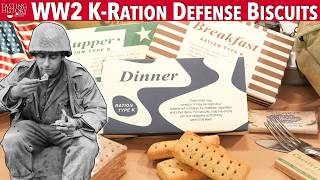

Surviving on WWII K-Rations
54sThe hook introduces a fascinating historical topic with a personal challenge, appealing to history buffs and food enthusiasts.
▶ Play Clip"Delivers exactly what the title promises: a detailed, historical, and hands-on exploration of the K-ration."
The video explores the K-ration of World War II, a no-cook meal kit designed for paratroopers, by unboxing replica boxes and recreating the K-1 defense biscuit from original 1942 specifications. The host, Max Miller, tastes the components, shares historical context, and discusses soldier feedback.
The K-ration was a no-cook, three-box meal system (breakfast, dinner, supper) providing 2,800-3,200 calories daily, developed for paratroopers before invasions.
The host discovered the original 1942 US Army Quartermaster Corps specifications for the biscuits, which led to recreating the K-1 defense biscuit instead of just unboxing.
The pemmican biscuit was reviled and replaced by the K-1 defense biscuit and K-2 Graham biscuit. The K-1 stuck around to the end of the war.
The recipe includes whole wheat flour (73g), wheat flour (103g), soybean flour (100g), fine cut oatmeal (70g), whole eggs (112g), dried skim milk (70g), sugar (24g), molasses (12g), shortening (114g), and ammonium bicarbonate (3g).
The finished biscuit must have a moisture content not exceeding 7%, which is extremely low compared to typical cookies at ~40%. This made the dough very difficult to mix.
Biscuits had to be rectangular, approximately 3 3/16 inches long and 1 3/16 inches wide, to fit tightly in the ration boxes.
Bake at 350°F (175°C) for 20 minutes, after poking holes in the top to prevent puffing.
Most K-ration boxes were cardboard double-dipped in wax, with 'Breakfast Unit', 'Dinner Unit', or 'Supper Unit' printed on the front and a letter (B, D, S) on the side. No details were given on contents initially.
Cans were painted dark for camouflage after reports from North Africa that shiny tins littering roadsides guided enemy aircraft to American convoys.
Cigarettes were a key component of all three boxes. Soldiers preferred Camels, Chesterfield, Lucky Strike, and Philip Morris, but complained about off-brands like Fleetwoods or Chelsea.
The host tried Nescafe instant coffee, mixed with 8 ounces of water and a sugar cube. He found it tasted like coffee and was 'not bad at all'.
The fruit bar could be eaten as is or stewed with water to make jam. The host found it similar to something from Whole Foods.
The host tasted a Nabisco-made K-1 biscuit from a replica ration, describing it as 'super bland' and 'tastes very healthy'.
Dinner boxes included a notice added in February 1944: 'Mosquito bites cause malaria. If you are in a malaria zone, keep your shirt on and your sleeves rolled down.'
The host found a War Department malaria map with a character drawn by Theodore Geisel (Dr. Seuss): 'This is Ann... she drinks blood! Her full name is Anopheles Mosquito.'
Dinner included K5 square biscuits, a confection (often malted milk dextrose tablets or caramels from Kroger), lemon juice powder, processed American cheese, chewing gum, cigarettes, and matches.
The lemon powder was heavily complained about; it was synthetic, very sour, and tasted like 'battery acid'. Soldiers even used it to scrub floors.
The host tried the lemon drink and found it extremely sour, comparing it to bathroom cleaner. He couldn't drink a second sip.
In 1943, the packaging was deemed 'not very inviting', so colorful 'morale boxes' were designed and went into production in May 1944, just before D-Day. The designs were described as 'bold, masculine, and impersonal'.
Supper included beef and pork loaf, more K5 biscuits, bouillon powder, cigarettes, chewing gum, and a chocolate bar (Rockwood's sweet chocolate).
During the Battle of Okinawa, soldiers used composition C2 explosive putty to heat their canned food, shaping it under the can.
The chocolate bar was a smaller version of the D-ration, but with a modified recipe to be more palatable. The host found it 'much closer to something a person would want to eat'.
Toilet paper was a coveted item but was not included until near the end of the war. Soldiers complained it wasn't waterproofed.
The host's homemade K-1 biscuits were too big and puffed up too much, but he acknowledged hand-cutting couldn't match industrial molds. He tasted them and found them bland, comparing them to dense, flavorless health bread.
K-rations were meant for no more than 3 days but were often eaten for weeks or months. Soldiers would pick out the chocolate, coffee, and salted crackers, and eat the cheese for about a week before getting tired of it.
Psychologist Gustave Gilbert observed Rudolf Hess at Nuremberg, who complained that the 10-in-1 ration crackers gave him headaches. Hess offered some to Gilbert to test.
The host concludes the US rations series and announces he will move on to another country's rations next time.
The K-ration was a practical but widely disliked food solution, with bland biscuits and sour lemon powder being major complaints. Despite its shortcomings, it was a crucial part of the soldier's experience, and the host's recreation highlights the challenges of meeting military specifications.
What was the calorie range provided by a full day of K-rations?
2,800 to 3,200 calories per day.
00:54
What was the maximum moisture content allowed in the finished K-1 defense biscuit?
7%.
04:37
What were the required dimensions of the K-1 defense biscuit?
Approximately 3 3/16 inches long and 1 3/16 inches wide.
05:10
Why were the cans in K-rations painted a dark color?
To camouflage them, as shiny tins littering roadsides guided enemy aircraft to American convoys.
07:28
Which cigarettes did soldiers prefer in their K-rations?
Camels, Chesterfield, Lucky Strike, and Philip Morris.
08:30
What was the purpose of the 'morale boxes' introduced in 1944?
To make the packaging more colorful and inviting, to stimulate interest in the food and make it appear more attractive to the soldier.
17:18
How did soldiers at Okinawa heat their canned food?
Using composition C2 explosive putty, shaped and placed under the can.
19:22
What was the intended maximum duration for eating K-rations?
No more than 3 days.
24:20
What did Rudolf Hess complain about regarding the ration crackers?
He claimed they gave him headaches.
25:49
Extremely Low Moisture Content
The 7% moisture requirement explains why the biscuits were so hard and dry, a key factor in their poor taste.
04:37Camouflage for Safety
The decision to paint cans dark was a direct response to a military report, showing how logistics adapted to battlefield lessons.
07:28Lemon Powder as Cleaner
Soldiers repurposed the sour lemon powder for scrubbing floors, illustrating the resourcefulness and dissatisfaction with the ration.
14:35Morale Boxes
The introduction of colorful packaging shows an attempt to improve soldier morale through design, even if the food remained unchanged.
17:18Soldier Feedback on K-Rations
Direct quotes from soldiers reveal the practical shortcomings of the ration, providing a human perspective on military logistics.
24:20[00:00] they knew that it might be some time before they would have a freshly cooked meal. Instead, they were handed boxes of Krations, three boxes a day containing full meals,
[00:12] which included biscuits like these K-1 defense biscuits, which I'm going to make using the specifications from 1942. So thank you to Hungryroot for sponsoring this video as I feast or at least survive on the K-ration of World War II,
[00:25] this time on Tasting History. which was something that American soldiers could cook or at least heat up when they were near the front lines.
[00:41] But today, I am going to be discussing a ration, the K-ration, which needs no cooking, no heating, no nothing. It was developed for paratroopers landing before an invasion and it was three individual boxed meals,
[00:54] breakfast, dinner, and supper, which provided between 2,800 and 3200 calories a day. Now originally, this video was going to be a little bit different cuz I wasn't going to have any actual cooking. I was just going to kind of go through the different components of the K-ration, kind of an unboxing.
[01:08] But during my research, I actually came across the original 1942 specifications that were given out by the US Army Quartermaster Corps, two companies making the biscuits inside the K-ration, or at least the two types of biscuits being made at the time.
[01:24] See before 1942, the ration included a pemmican biscuit, which in addition to wheat and oats, Reviled by the people who actually had to eat these pemmican biscuits they were quickly replaced by the K-1 defense biscuit and the K-2 Graham biscuit,
[01:39] [clack clack] And by the end of the war, they had actually introduced some more biscuits and had replaced the K-2 biscuit, but the K-1 defense biscuit stuck around to the very end. So, that is the one that I'm going to make.
[01:53] Now the recipe is very specific. So, I'm going to use grams to do this recipe. So, I can be very specific in the amounts, but I'm also going to reduce the amount because the original recipe calls for like 73 pounds of flour.
[02:09] I'm going to simply call for 73 grams of whole wheat flour, 103 grams of wheat flour, all purpose, 100 grams of soybean flour, 70 grams fine cut oatmeal, 112 grams whole eggs, 70 grams dried skim milk,
[02:24] 24 grams sugar, 12 grams molasses, 114 grams of shortening, 3 grams of ammonium bicarbonate or baking soda works, So that is a lot of ingredients for a biscuit. And actually, in hindsight, this turned out to be the most difficult biscuit or cookie of any kind
[02:42] that I think I have ever made. Takes a lot of kneading, we'll we'll get to that. And so, after a full day of filming and cooking in the kitchen and kneading until my arms hurt, I really rely on the easy and delicious meals that I get from today's sponsor, Hungryroot.
[03:01] So, Hungryroot has done this really cool thing where you can essentially make a cookbook within the website of different recipes that you like to get from them I have made a cookbook on there and it's called Off The Clock quick recipes to make after work.
[03:16] I cook all day, so often at the end of the day, the last thing I want to do is cook more. And so, these are some wonderful recipes that you can make in a jiff. Like the honey garlic beef with cilantro lime rice. Tender beef with a sweet and tangy glaze over rice in about 10 minutes.
[03:29] One of my favorites because it's fast, filling, and I just love the sauce. In fact, I like the sauce so much that I included it as a single grocery item that you can get and pretty much put on anything.
[03:41] There are also some of my favorite snacks from Hungryroot, like the Himalayan pink salt popcorn from Lesser Evil So check out my Hungryroot digital cookbook and find some recipes that are right for you.
[03:53] Just click the link in the description or scan this QR code and it'll take you right to the cookbook Of course, right now I am on the clock, so I need to get back to making them biscuits.
[04:05] So start by adding together all of the dry ingredients in a big bowl. All three flours, the oatmeal, dry milk, sugar, salt, cinnamon, and bicarbonate. Whisk these all up and then add in the eggs. 112 grams turned out to be about two large eggs.
[04:19] Then add the molasses. And finally, the shortening. Now, I decided to melt my shortening because it does make it easier to mix the dough. Though, I'm not really sure if that was the right move because this dough was very difficult to mix together. continued to work it, but it just kept crumbling to pieces. And it's probably because it is so dry.
[04:37] The requirements state that moisture content of the finished product shall not exceed 7%. That is wicked low. Like, most cookies are like 40% or something like that. But I didn't feel so bad that I was having trouble with this because I found a quote from the manager of a biscuit making company
[04:55] who was tasked with making these biscuits. And he said that "This is the most difficult mix I have ever tried to put together." But eventually the dough did come together and it smoothed out nicely. But I do think that that's because it's humid and I kept washing my hands
[05:10] which added more moisture to the dough. But there it is. It ended up working out. At this point, I was ready to roll out my biscuits. Here, the instructions say, "Biscuits shall be rectangular in shape with dimensions approximately and not exceeding 3 and 3/16 inches long, 1 and 3/16 in wide,
[05:28] Not going to lie, I was not as precise as all that, but I think I came pretty close. The actual biscuits were made with industrial molds, and that's just a standard I can't meet. At this point, you put them on a baking sheet and poke some holes in the top so they don't puff up too much.
[05:44] And then transfer to the oven and bake at 350°Fahrenheit, 175° C for 20 minutes. So, at first I questioned why these biscuits had to be so precise in their size. I mean, I think this is the only recipe that I've ever seen that uses 16th of inches.
[05:59] But then once you see the box that they need to be packaged in, and how tightly packed they need to be you get a better idea of why they had to be a specific size. So,
[06:11] I'm going to start unpacking these K-ration boxes as I tell you a bit about the history of the K-ration. if you want a super deep dive, then check out the website kration.info,
[06:31] they cover every component of the K-ration, and they really did their homework. So the K-ration boxes that I have here are, of course, reproductions. And specifically, they're reproductions of the boxes that came out near the end of the war.
[06:44] For most of the life of the K-ration, they were simply cardboard boxes double dipped in wax that had either breakfast unit, dinner unit, or supper unit printed on the front with the letter B, D, or S on the side.
[06:56] And there were no details on exactly what was inside the box. "Opening a K ration was similar to opening a package of Cracker Jacks and that you never knew what was inside..." The only issue was that often, even after you opened the pack, you had trouble figuring out exactly what you were eating.
[07:12] So eventually they did start writing on the back what was inside of the box. Like this breakfast says that it includes "meat and eggs: eat cold, or after heating by boiling can in water." And here we find that can. Now the can itself is indicative of the latter part of the war
[07:28] because it is painted a dark color to make it camouflage. The reason for that was made clear in a report by the quartermaster corps after the action in North Africa. "Littering the roadsides with empty, shiny tins guided enemy aircraft along the routes and bivouacs of American convoys."
[07:44] So not only did they camouflage the cans, but they added some writing on the box. "For security, do not discard the empty can, paper, or refuse where it can be seen from the air. If possible, cover with dirt, foliage, sand, etc."
[07:58] And it makes you wonder how many of these empty cans are still buried just slightly beneath the soil throughout Europe and the South Pacific. The writing on the box also suggested that soldiers "Open inner bag carefully. It may be used as a waterproof container for matches, cigarettes, etc."
[08:13] And that is because one of the key components of all three K-ration boxes throughout the day was cigarettes. But most people at the time, they smoked their cigarettes. These are Chesterfield cigarettes. Milder, cooler, better taste.
[08:30] And these were one of the ones that the soldiers seemed to like. They liked Camels, Chesterfield, Lucky Strike, and Philip Morris. But soldiers would complain when they'd open their ration and it would have Fleetwoods or Chelsea cigarettes, off-brand cigarettes, I guess.
[08:44] I don't know. I don't smoke, but I guess those were the lesser cigarette of the time. a packet of soluble coffee, that is instant coffee, a fruit bar, and assorted biscuits.
[08:56] I'm going to start with this soluble coffee. This is Nescafe, and it just says to mix it into a third canteen cup, which is 8 ounces of hot or cold water. And then add some sugar if you want.
[09:19] See how this tastes. Comes with four sugar cubes from Jack Frost tablet sugar. And so I'm going to toss one of those in as well. I like sugar in my coffee.
[09:34] That works better if it's really hot water. This is like lukewarm water. We'll give it a try. Actually, that's not bad. That's not bad at all. Tastes like coffee.
[09:47] and I'll try that. But it also says that you can make into jam by stewing 3 to 5 minutes in about four spoonfuls of water. [chomp]
[10:02] Feel like that's something I get at Whole Foods. Then I'm going to take the rest and I'm going to kind of break it up here, I guess, and put it into some some warm water, hot water, I guess, in a little cup.
[10:18] So, while it stews I'll talk about the two biscuits. This one is three biscuits and this one is four. Which the- the size of the biscuit being so specific, one of those things is the width.
[10:34] So that three and four of two different types of biscuits can be the same. Anyway, again with the very specific sizes. Okay, I'm going to open thi
[10:47] Nabisco. So this would have been made by the Nabisco Company. [chomp] Super bland.
[10:59] Hm. So I think that this is actually the K-1 biscuit, the one that I'm making today.
[11:11] Tastes very healthy. Let's try the second biscuit. [chomp] Crispier, still flavorless.
[11:26] All right, so after 5 minutes, it did not turn to jam. Maybe I used too much water, but I don't think less water would have made a difference. It just kind of like crumbled up, which I guess then at least you can put it on something. So that's what I'm going to do. I'm going to put it on this flavorless biscuit.
[11:41] [chomp] Now I'm not shocked that the biscuits don't taste good because they were one of the most complained about aspects of these boxes,
[11:56] even though they're kind of the the main component of all of them- there were a lot of complaints. It was basically that off-brand cigarettes and another component which we'll have to find in the dinner box.
[12:09] So this is the dinner K-ration and it also has plenty of writing on the box, including something that was added in February of 1944. It said, "Notice: mosquito bites cause malaria. If you are in a malaria zone, keep your shirt on and your sleeves rolled down.
[12:25] Use mosquito repellent when out of doors between sunset and sunrise." Now, I would guess that that warning is for those who are fighting in the Pacific and not the people in France and Italy. But then I questioned, did they have malaria in Italy? And so I did a quick Google search and I found this really cool map
[12:43] from World War II which showed where malaria could occur and Italy was actually high on the list. It was put out by the War Department and it's not simply a map but rather a map with a character drawn by Theodore Geisel,
[12:56] "This is Ann... she drinks blood! Her full name is Anopheles Mosquito and she's dying to meet you." I just love stuff like that. I would love to get a full-size version of that poster and put it on my wall.
[13:10] Warning against malaria. Anyway, back to the dinner K-ration. The first item that comes out of this includes yet more biscuits, though these are known as the K5 square, so at least we're getting some variation.
[13:22] Also, you'll note that there is a box inside of the outer box. It can either be just plain or some of them said breakfast unit, dinner unit, but they all had the letter on the bottom and they were all waxed.
[13:34] The outer box not waxed so they wouldn't stick together if they melted, but the inner box was waxed and sealed shut so that no liquid could theoretically get in. Anyway, after the biscuit, you've got a confection which sometimes was maltted milk dextrose tablets,
[13:50] The caramels in this case were produced by the Kroger Grocery and Baking Company which is still around. Go to Kroger's. And they taste like caramels, Then the last thing packed with the biscuits was lemon juice powder. And this
[14:08] people really complained about actually probably more than any other component because it was meant to be dissolved in water with sugar to make lemonade. But I guess the the amount of sugar that was given
[14:20] was the ratio was totally off. So it ended up just really being very sour. And it didn't help that it is synthetic lemon powder. It's not even real. So people said it doesn't actually taste like lemons. It tasted more like just battery acid- like it bit you.
[14:35] One soldier recalled, "We used K ration and lemon powder dissolved in buckets of water for scrubbing the floor when we were living in buildings, and it worked out exceptionally well, cutting dirt spots and more or less bleaching the wooden floors."
[14:48] Eventually, it was phased out in favor of orange-aid or a synthetic grape drink, and I've got the granulated sugar that was meant to be mixed with it, I should give it a shot.
[15:01] So some cold water and just add that synthetic powder. And then, like I said, we know how much sugar to add 'cus they boxed it up.
[15:13] I feel like that's a lot of sugar, but you know what? Maybe not. Bottoms up.
[15:25] Oh god. x_X I can't even drink a second drink of that. That's really sour. I don't like sour things.
[15:37] It doesn't taste- It tastes like- lemon. It tastes like if you took like, you know, the stuff that they clean a bathroom with, which is, I guess, why they used it as a cleaner. That is what it tastes like.
[15:53] Now, in addition to this horrible drink, dinner included the obligatory biscuits, camouflage can, this time filled with processed American cheese, chewing gum, cigarettes, and matches.
[16:06] And you'll note I'm not tasting what is in these cans, and that is because they are powdered. They're dehydrated. They're not actually the way that they were made during the war. And so,
[16:20] I'm just not going to eat them. You could fill them or add water and then reconstitute them, but again they're not really indicative of the original. And you can't really find exactly what the original was. You can go watch Steve 1989 MRE
[16:35] That's what he does on his YouTube channel. But even then, when he gets to the K-rations, they're so old that usually these cans have deteriorated and there's nothing in there.
[16:47] And you know, he's not willing to completely poison himself. But wonderful channel to watch anyway. What I am going to try are these K5 biscuits, which supposedly tasted better than the K1 and K2. Definitely softer.
[17:02] Now, before we move on to supper, you'll note that these boxes have nice designs and and colors on them. And that was not always the case. For the majority of the war, they were just plain, you know, plain cardboard.
[17:18] But it was determined in 1943 that the packaging wasn't very inviting. So they decided to design the outer boxes more colorfully with designs. They were called morale boxes. And they went into production in May of 1944, just before the D-Day landings.
[17:34] was adopted in order to stimulate interest in the food and make it appear more attractive to the soldier... The designs are bold, masculine, and impersonal."
[17:47] Bold, masculine, and impersonal, that's husband material right there. But while they did look better and they were easier to distinguish from a distance which meal was which,
[18:00] they didn't actually change the food. And so, yes, the box was more appealing, but the inside was not. So, it didn't really change the way the soldiers felt about the food inside.
[18:14] There's only so much lipstick you can put on to gussy up a pig. And this turned out to not be enough. And now for our last gussied up pig, it is time for supper.
[18:26] Also, I feel like we don't use that word supper anymore very often. And I think it's interesting because my grandparents used it all the time. They actually did breakfast, then dinner was the main meal of the day, and then supper was in the evening.
[18:39] Whereas now, I think most people say breakfast, lunch, dinner. So, I'm curious if maybe it's a regional thing or if if you know of anyone who still uses the word supper. Leave me a note in the comments and where you're from 'cus that's what I'm actually curious about.
[18:55] So supper starts off with yet another can. This being beef and pork loaf. And this one says, "Eat cold or after heating by boiling can in water or after frying in its own fat with added biscuit crumbs."
[19:08] But there was another way to heat up your cans of food, and that was with explosives. During the Battle of Okinawa, Kenneth Long recalled that "Most of the guys had some knowledge of demolition and explosives as we were using blocks of TNT and composition C2 to seal caves.
[19:22] It wasn't long though, and we learned that these explosives served us well to heat our food, especially composition C2. This was a putty-like material that one could shape into any design and place under the can to be heated;
[19:34] Along with the canned meat, there were more biscuits, again, the K5 in this case. Then some bouillon powder, more cigarettes, more chewing gum, and then drumroll please
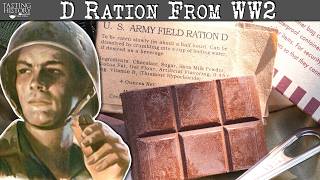
[19:46] So, last month I actually kicked off this World War II ration series with the D-ration. And that was an emergency chocolate bar made with chocolate and oat flour to keep it from melting.
[20:00] It was 4 ounces, and they had a smaller one, half the size that was put into the K-ration. Now, by the time these are around late 44, early 45, they had changed the recipe a bit. So, they were supposed to be more palatable than the actual D-ration.
[20:16] And like this one is Rockwood's sweet chocolate. So, they don't even call it the D-ration but I do want to try it. It's still the same shape as the D-ration, but you'll notice it has melted a bit, and that was part of the problem. They would- they would melt,
[20:31] because they didn't have as much oat flour in them. Let's give it a try. [chomp] Much closer to something that a person would want to eat. It's not as grainy.
[20:47] It's still very hard like the D-ration, but it's not as grainy as the D-ration. Pretty good. Now, the only other item that I won't be trying out for you here on camera is
[21:02] Now, this was actually one of the most coveted items along with the cigarettes and and the chocolate for the K-ration, but it was not included for the first several years, not until pretty close to the end of the war. So just
[21:16] think about that or actually maybe don't think too much about that but even the highly coveted toilet paper was not above scrutiny. "If there was one improvement that should have been made to the K-rations, it was that the toilet paper should have been waterproofed.
[21:30] Although this shortcoming was not life threatening, wet toilet paper did cause some irritating situations." And speaking of irritating situations, I think it's time I check in on my K1 defense biscuits.
[21:42] And here we are, the K1 defense biscuit, the backbone of the K-ration of World War II. So they're not perfect. They're definitely a little too big. And they definitely puffed up too much. I just made them too thick, but I was cutting them by hand, so I didn't expect them to be perfect,
[22:00] but the US Army absolutely would have. In the instructions that they gave to the manufacturers, they say "The product shall be uniformly well baked, of reasonably uniform size and thickness, with reasonably clean-cut edges."
[22:16] And I'm going to guess that these would not have been acceptable to the US Army. Especially when they stack up. Just not not working, but let's see how I did on the other prerequisite,
[22:31] which was to have a characteristically appetizing flavor. Here we go. [chomp] Nuh-uh.
[22:44] UNHhhh. I mean, are they terrible? No, they don't taste like bad. They just don't taste good.
[22:58] There ain't enough sugar in there for them to taste good. It tastes so- They actually taste- my mom used to when I was a little kid, my mom was on this kick and she would get this bread that was like super dense and super
[23:15] flavorless, but it was really healthy. It was child abuse, frankly. It was terrible. But this is what that reminds me of. Kind of like if you made a-
[23:28] a graham cracker or something like that, but softer. slightly softer and added absolutely no sugar. There is sugar in here, but so little it doesn't really matter.
[23:41] The thing is they say that this had a characteristically appealing flavor. No, it didn't. Or appetizing flavor. There are so many stories about how they did not soldiers did not like these.
[23:54] Especially because if you have one, maybe two, okay, that's fine. Dip it in some coffee or whatever. It's fine. But they were eating like 20 of these a day. This was the main component. This is
[24:06] where many if not most of their calories are coming from. So after a day or two or three, that's rough. And really the K-ration was meant to be eaten for no more than 3 days, but very often
[24:20] they were eaten for weeks, sometimes months at a time. And it was very often commented on that "In general, the men will not eat K rations after a few days.
[24:33] They will pick out the chocolate bar, drink the coffee, and eat the soda crackers if they are the salted type. They will usually eat the cheese for about a week, after which they get tired of it." But that's how actual soldiers felt about these biscuits. And frankly, that's how I feel about these biscuits.
[24:49] But if you watch the war propaganda from early on in the war, they thought much more highly of their biscuits. I found this great video about producing the K-ration, "The object of the K-ration is provide the soldier with food under emergency.
[25:07] Several recipes, for instance, were tried in picking a soybean biscuit. This biscuit seems to meet specifications. Pretty tasty biscuit. It's good eating." There's one more interesting little story I have about these biscuits or rather they call them crackers
[25:22] and it's probably more like this or the soda crackers that they would put in the boxes later on in the war which were slightly more palatable. But what's interesting is that the person eating these was not an American soldier
[25:37] but a German prisoner of war waiting to stand trial in Nuremberg. The story was told by the psychologist Gustave Gilbert as he observed war criminals like Rudolf Hess
[25:49] who claimed, " 'I got a headache from eating crackers again yesterday.' Here he pulled out a little cellophane wrapping of 10-in 1 ration crackers, and offered me one. 'Would you be good enough to eat this and tell me if it gives you a headache? And this too.'
[26:02] He then picked up a K-ration package of crackers and handed me one. 'Of course, it may be just accidental on account of my continuous stomach cramps.
[26:14] I wouldn't have given it any thought, but it happened twice.' " Absolutely not. You can just to see what it's like, but you can also get these replica K-rations online at a place called Hero Rations.
[26:31] I think that that wraps up the US rations. um At least for now, so I'll be moving on to another country.
[26:43] and I will see you next time on Tasting History.

⚡ Saved you 0h 26m reading this? Transcribe any YouTube video for free — no signup needed.