
How to Read a Call Sheet Like a Pro
45sEducational hook for aspiring filmmakers and crew members, offering a quick, practical guide.
▶ Play Clip"Delivers a clear, practical guide as promised, though it's brief and lacks depth."
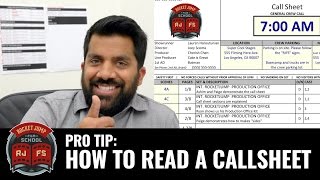
This video from RocketJump Film School explains how to read a film production call sheet, covering its key sections and their purposes. The presenter, Ashton, walks through the document from top to bottom, highlighting critical details like call times, locations, and cast information.
Call sheets are essential for on-set communication, informing crew of location, schedule, and preparation needs.
The call sheet lists the show title and general crew call time, but crew should check the back page for their specific call time.
Crew parking and location address are provided; always follow the attached map, as the address may not lead to basecamp.
Weather, sunrise/sunset times, and nearest hospital are listed; ensure the hospital has an ER.
Directors, producers, and ADs are listed with contact info; having the AD's number is crucial.
Scene numbers, page counts, descriptions, cast involved, and shooting locations are detailed, including any location moves.
Cast members are numbered; 'S' indicates a start date. Special notes like 'Big Budget's first day' are included.
Special instructions for props, makeup, costume, and other departments (e.g., 'pimp chalice', 'grill pour') are listed per department.
The bottom of page one shows upcoming schedule info for the week or next week, helping crew prepare.
Page two is a full crew list organized by department, with names and contact info.
Reading call sheets thoroughly is vital for smooth production; it saves time and avoids confusion. Always check maps and specific call times to stay informed and prepared.
Follow the map, not the address
A practical tip that prevents common on-set confusion and saves time.
00:39Always know the nearest ER
Safety-critical information that is often overlooked.
01:05Start dates are marked with 'S'
A simple system to track cast availability and first days.
01:47Advanced schedule keeps everyone prepared
Proactive communication helps crew anticipate changes.
02:32[00:00] Hey guys, I'm Ashton, producer over here at RocketJump. Today we're going to be going through how to read a call sheet. Call sheets are a very useful and effective way of communication on set. Where you are, what's happening, and what you need to be prepared for the day.
[00:12] So here we go. First up on the call sheet, the title of the show. Today it's RocketJump Film School How To. Right below that you'll see the call time. That is the general crew call. But then also you go back to the back page and look for your call time.
[00:26] but it's good to look at your specific call time because it is that for a reason. You'll look at crew parking. You'll know where you are parking. It's always important. Also, you'll have the address to the location. It'll almost always be a map attached to the email.
[00:39] As nice as this address is, always look at the map and follow the map. Every location manager and producer will tell you that because it's a pain. You'll get calls from people asking where the hell Basecamp is when they look at the location address, but Basecamp's actually a mile away, so just do that and save everyone a hassle.
[00:53] And then over here is also a bunch of weather information, shooting outside, sunrise and sunset are very important as well as weather. Nearest hospital, unfortunately that is always a good thing to know.
[01:05] And when picking a hospital, always make sure it's an ER and not just a random hospital because that's the most important part. Going down on the farther side you'll see directors, producers, your AD, our AD here is Batman.
[01:17] So it's always good to have Batman's number just in general. The next box is your scene breakdowns for the day. So it's going to be your scene number, your page count, and then a small description of what scene it is and what happens in the scene, as well as who from the cast will be in that
[01:32] scene and of course where you are shooting that. Sometimes you will be jumping around locations in a day, so if there is a move in the middle, you'll see this is shot there and this is shot somewhere else. Below that is your cast list, so every cast member gets a number, one through however
[01:47] many you have. So we have everyone from Osham to Big Budget Tenengo showing up today Big Budget is his first day on set so he has an S indicating that he is starting work today We really excited to have got Big Budget His agent is a pain in the ass Below that is information about
[02:04] stand-ins and background and then of course all special instruction by department. So there you'll see the number of people showing up to set to be background as well as information for props. If you need for instance a pimp
[02:16] chalice for Asim it will be noted there. For makeup if you need a grill pour For Oshum again, it'll be noted there, as well as costume information like bling bling, and other departments, special effects, weapons, camera, sound, grip electric, stunts location
[02:32] and transportation. All information that is different, pertinent and interesting will be there, laid out per department. And then at the bottom of the first page will be an advanced schedule, this is for everyone to know what's going on later in the week, or the next week if it's Friday, we all love
[02:47] Fridays, just to see what else you'll need to know, who all is going to be there, things are changing every day. So this is just the best way to communicate what's happening next, what people need to be ready for, and what things are coming.
[03:00] Going on to page two. This is very simple. It's basically everyone, it's a crew list. This has everyone's name and information separated by departments. And on the bottom we have
[03:12] the number of the Waukee channel. But yeah, that's kind of how you go through a call sheet really quickly. So it's always nice if people actually read the call sheet because our poor second ADs spend all day working on it. So it's nice that it's noticed. So read your call sheets, guys. When they go out, look at your maps. Look at your call sheets. Know
[03:27] what's going on. Stay informed. Stay in school. Don't smoke.
[03:48] you

⚡ Saved you 0h 03m reading this? Transcribe any YouTube video for free — no signup needed.