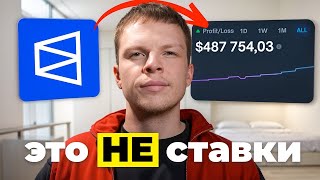

30-50% Daily Profit? Polymarket Strategy
38sPromises extremely high daily returns, which is controversial and attention-grabbing for viewers seeking quick profits.
▶ Play Clip"The title promises 100% daily profit, but the video shows realistic small gains (10-20% on a $25 deposit), not guaranteed 100%."
This video presents a strategy for profiting from spread trading on Polymarket, a prediction market platform. The creator demonstrates how to use limit orders to capture small spreads (4-7 cents) on high-liquidity events, particularly live sports, aiming for 30-50% daily returns on small deposits. The tutorial includes real trade examples, both successful and unsuccessful, and emphasizes risk management through stop-losses.
The strategy targets small deposits ($30-$100) and aims for 30-50% daily returns using limit orders on spreads.
Polymarket has categories: politics, sports, and crypto. Sports are best for fast flips due to live events.
The order book shows buy and sell orders with a spread. The strategy involves buying at the bid and selling at the ask to capture the spread.
Look for spreads of at least 4 cents, preferably 6-7 cents for low-volume markets. High liquidity and volume are essential.
The Sports tab, especially Live section, offers tight spreads and high volatility, ideal for quick trades.
Bought at 62 cents, sold at 64 cents (or 66) for a quick profit. Limit orders executed rapidly.
In volatile markets, you can wait for the spread to widen. Set virtual stop-losses to manage risk.
Entered a match with a 1-2 cent spread and 62% probability. The outcome moved against, leading to a stop-loss exit.
Checked the match status: first map won by M80, second map in progress. Decided to cut loss and switch to a better opportunity.
Exited at 50 cents (loss), then used remaining deposit to bet on the second map winner with a 5-cent spread.
On outcomes with large spreads but low volume, arbitrage bots may eat the spread, making it hard for manual traders.
With additional deposit, placed a limit order at 63 cents to average position, then sold at 66 for a 3-cent profit.
Bought at 77 cents, sold at 81 cents for a fast profit. Demonstrates high volatility opportunities.
Multiple flips on a single match: bought at 84, sold at 97; bought at 91, sold at 94; bought at 85, sold at 90. Overall profit on small deposit.
Strategy works with small deposits ($25) for 10-20% daily returns. Larger sums possible but easier to grow small accounts. Emphasizes clear take-profits and stop-losses.
The strategy of capturing spreads on Polymarket using limit orders on live sports events can yield consistent small profits, but requires discipline, risk management, and understanding of order book dynamics. It is best suited for small deposits and active monitoring.
What is the recommended minimum spread for low-volume markets on Polymarket?
6-7 cents or more.
03:46
What are the three main categories on Polymarket?
Politics, sports, and crypto.
00:27
What is the strategy's target daily return on small deposits?
30-50% per day.
00:14
Why is the Sports tab preferred for fast flips?
Because live events have high volatility and tight spreads, allowing quick trades.
03:59
What is a 'stop-loss' in the context of this strategy?
A predetermined price at which you exit a trade to limit losses, e.g., selling at 60 cents if bought at 70.
06:45
What three factors did the creator consider when entering a trade with a small spread?
1) Price already at 70% probability, 2) high liquidity in the order book, 3) ability to exit at stop-loss of 60 cents.
08:25
What happened in the 'bad decision' example?
The creator entered a match with a 1-2 cent spread and 62% probability; the outcome moved against, leading to a stop-loss exit.
08:56
How did the creator recover from the loss?
He exited at 50 cents, then used the remaining deposit to bet on the second map winner with a 5-cent spread.
11:25
What are arbitrage bots and how do they affect low-liquidity markets?
Arbitrage bots monitor large spreads and automatically place orders to capture them, making it hard for manual traders to profit.
13:34
What was the final profit percentage on a $25 deposit according to the video?
10-20% on the deposit.
22:02
30-50% Daily Target
Sets an ambitious but realistic goal for small deposits, framing the strategy's potential.
00:14Spread Requirement
Key technical criterion: at least 4 cents spread, preferably 6-7 cents for low-volume markets.
02:35Learning from Losses
Honest inclusion of a losing trade demonstrates risk management and the importance of stop-losses.
08:56Arbitrage Bots
Reveals the presence of automated competitors, highlighting the need for speed and liquidity.
13:34Scalability with Small Deposits
Shows that even $25 can yield 10-20% daily returns, making the strategy accessible.
22:02[00:02] Polymarket that works best with small deposits, 30, 50-100 bucks a day, and allows you to [music] pump it up, using not a gambler's story, like, let's set the odds here to such-and-such and so on
[00:14] thought-out strategic model, so to speak. Here, according to my calculations, there is an speak. Here, according to my calculations, there is an opportunity to make 30-50% per day. I will show you everything using examples, and then you can draw your own conclusions. But most
[00:27] importantly, in addition to this video strategy, you'll also find a comprehensive text guide covering all the basics of Polymarket, completely free. But first things first. At PolyMarket, we have a completely different categories. This is connected with politics, sports,
[00:44] and crypto. That is, will Bitcoin reach a certain price there in 250,000 dollars, or, for example, will Lightner do an airdrop before
[00:56] number of bets. And look, we have the Markets Person of the Year 2025 according to Time magazine. Every year, Time magazine publishes a person of the year, editorial policy, and it is a certain person or
[01:11] something else, for example. Why anything else ? Because this year, ah, the greatest probability is that we have artificial intelligence, which would be, it seems to me, interesting and quite in line with the spirit of the times, yes. And
[01:23] here, having opened artificial intelligence, we see that we have an order book, that is, a glass of exchange orders, just like we have in P2P arbitration, for example, or, in general, like a glass
[01:39] on the exchange. We have purchase orders, sale orders, and right here, the polymarket displays the spread, that is, the difference between purchase orders and sale orders. And what does this mean? What we can do right now
[01:52] [music] is stand in the glass at 66 cents, that is, make a limit order here to that is, make a limit order here to buy at 66 cents. We will find ourselves in this glass. And, accordingly, when someone sells, our
[02:07] sale will occur at the price of this order in the purchase order book. This request will be fulfilled order in the purchase order book. This request will be fulfilled , and we will be able to use these same we buy something at Polymarket, we
[02:21] become the owners, so to speak, of shares, yes, of this given outcome. And then we can stand in the same glass at a price of 68, that is, buy at 66 cents, sell at 68 cents. And this is the basis for our strategy. We will look for
[02:35] various outcomes where our spread will be, well, at least 4 cents, where we will have high liquidity, high volumes at the moment, that is, right now trading is taking place, and we will buy with limit orders the outcome that is
[02:51] more likely, so that even if our spread has narrowed, with a higher profit, and if not, then we exit at a stop-loss. If at this point you suddenly thought: "Damn, that sounds interesting, but I don't understand the basics of what shares are,
[03:05] how to display them in the order book, or what a polymark is in general." I've created a comprehensive guide covering the very basics of Polymarket from A to Z just for you. It includes basic information on how to deposit funds on the platform and how to
[03:21] create a limit order. This is also very useful information for professionals. How can I verify the information's accuracy, or when exactly is Orderbook cleared? This is a full-fledged website, everything in a very convenient, structured
[03:34] format, with text and graphic explanations. And yes, everything is absolutely free. The link for receiving is in the description. There, as I mentioned, you can go to the break tab, look at each of these outcomes
[03:46] and look for spreads of 6 cents, 4 [music] cents, 5 cents. But in reality, for low-volume markets, that is, where there is not much action right now, it is better to look for a spread of 6-7 cents or more. But for farming
[03:59] money throughout the day and doing fastflips, the Sports tab is best suited for us, because here we can go to the Live section and find sporting events that are happening right here and now. In
[04:11] this case, we have a spread of 4 cents. In general, we can already work with this. And here general, we can already work with this. And here we have a spread of 1.8. Here we have a spread of 2 cents. Well, not really, but still 3 cents give or take, if, uh, the glass changes super quickly
[04:24] changes quite quickly. We [music] had 5 cents there at one point, and I saw 6 cents for a second. But you can already work with glasses like these. And in order not to try to make a video out of nothing now, I have
[04:39] actually already recorded several examples of how I simply recorded everything I did at the Polymarket throughout the day. And so, in 2 hours, and now there will be several examples of what you can work with, what you cannot
[04:53] work with, what actions I took correctly, and what actions I took incorrectly. That is, I actions I took incorrectly. That is, I spent 2 hours recording and will now comment on all my recordings that I have. Let's go. Here we have a CS match
[05:06] where we can see the spray is a whopping 5 cents. Accordingly, we can buy for 5 cents cheaper and sell for 5% more if we enter at limit prices. I placed a limit bet of 62 cents to be the first bid in the order book.
[05:20] Our request was fulfilled immediately. And then we can sell at 66 or, let’s say, at 65 in order for the order to be instantly. Again, to be not within the framework of someone else’s application, but within the framework of the very first application. [music] Here at Polimarketeet we don't load
[05:36] Accordingly, we refresh the page there and go back to selling. And so we see that we can [music] put the maximum number of shares that we have, and then put it up for [music] at a price of 64. And so
[05:50] our request is executed very quickly. All. Accordingly, we immediately sold with a spread, created a limit order at the bottom of the order book, a limit order at the top of the order book, and received a very quick profit. Let 's go to the portfolio and see that
[06:04] here we have 51 [music] purchases, 527 sales. In this example, our spread is [music] only 2 cents, but I'll now show you on fast forward that our spread here in this order book is constantly jumping.
[06:18] here in this order book is constantly jumping. It is 5 4 3 2 and so on. So here we'll try to somehow get all of this out with a quick flip. Our order was executed at 70 cents. And then we simply begin to wait for the glass to start
[06:31] moving in our direction. This is a riskier method. It is suitable for markets [music] The game is going on right now and we see the spread changing constantly. But even in this case, you should always set yourself
[06:45] some kind of virtual, at least stop-losses, in case Here, you still need to understand that 70 cents is a conditional 70% why we here always go towards the bet that is more than 65, and preferably
[07:00] more than 70 cents, so that even if our spread is not sufficient, then at least there is a higher probability that our bet will play. Here
[07:12] we begin to wait, the price fluctuates between 65, 70 and so on. We are not satisfied with these values set any value, then, let’s say, it will be 60 cents. For now, from there, well, [music] for another five, let's say , bets, we will immediately place a
[07:28] limit order at 73 prices so that, as we remember, we buy at 70, in case our glass goes up very quickly. Our request profit. We place a limit order and wait. Little by little, everything is starting to move
[07:43] in our direction. We don't change the limit order in any way, we just start waiting until the wall gradually starts to be eaten away towards our 73 . In general, already at this stage it would be possible [music] to move
[07:59] the rate higher than 73 cents. Let's say I remove this limit, put it there at 75, at 76, but in this particular case I decide to wait and take 3 cents of the spread. Okay, the application has been eaten. Now we can go back to our portfolio and
[08:13] look at the profit. 528 bought, 5.50 sold. Again, in this example because the spread was quite small to begin with . But I made this
[08:25] decision based on three factors. First, the price is already 70 cents, meaning the market estimates the probability of success of this outcome at 70% . [music] The second argument is that we have quite a lot of liquidity in the order book. We had
[08:39] this match going on right now, and it was clear that there was enough liquidity for the direction, and for the opposite outcome, so that we could calmly exit at a stop-loss of 60 cents when I just started placing limit orders, I saw that
[08:56] our spread was constantly changing and at its peak it reached 7 [music] cents. Here's an example of a bad decision. Look, I decide to go to the same match. decide to go to the same match. Our spread is 1 dash 2 cents.
[09:10] Our probability is now 62%. I set the limit at 62 cents. It fills up instantly for me. And then we begin to see how the outcome is going completely against us. But I specifically included this example in
[09:24] this video so that you could see not only positive outcomes, but also negative ones, because this also happens and everything is okay. The price in our glass is now 58. I decide to look at other matches and go through them. I see here
[09:37] that the match is not going in our favor. We have less and less time left. Our winner is shifting, since in total the 62 cents for which we bought our initial outcome are approximately the same situations that happen at the very beginning of the
[09:51] same situations that happen at the very beginning of the match. And since we have a constant shift in time and the winner of our match is not going in our direction, then, accordingly, its outcome, the probability of its outcome, is
[10:04] decided to take a closer look at the match itself. Look, we have a Counter-Strike match here. We have already completed the first map, where the winner of the first map has been determined map, where the winner of the first map has been determined . It was Team M80, on
[10:18] whose victory in the entire match we made our initial prediction at a price of 62 cents, if my memory serves me right. But since we are now in the process of the second
[10:30] card, we play the first card first, then the second. Right now the second card is happening, as we can see from the glass. Firstly, it has a super small, but still a spread. It jumps from two to six. Six is
[10:43] jumps from two to six. Six is already an interesting story overall. Oh, and 86% probability means that we have the team we bet against, that is, we bet that M80 will win against us overall
[10:56] In the second map, the first team, PSNUA, takes the lead. And most likely she takes the second card. Because of this, I immediately understand that since we were betting on the outcome of the entire match, we will have a third map. And
[11:13] based on this third card we will make the final decision. And since there will make the final decision. And since there will be more Gamble here, I be more Gamble here, I decide to take the money from
[11:25] our first position as quickly as possible and transfer it to the second one for a win on the second map. Because, firstly, overall 86 is already a very high probability, and secondly, we have a spread of 6 cents there, which is really very good. I decide to go out on the
[11:39] market at a price of [music] 50 cents. I fix the loss, take the money back into my portfolio, and then I load the rest of the deposit with a spread of 5 cents into a
[11:52] bet on the winner in the second map. And, accordingly, here you can just sit and wait [music] for the end of the match, since in fact with a spread like there 90 dash95 it seems like you don’t have to sell, but just wait until
[12:08] run out of the map. Naturally, it's worth keeping an eye on the outcome of the match, but the 5- cent sprite gives us some gap to, uh, close at breakeven if something happens. And at the same time, I'm deciding to make an additional deposit to the PoleMarket itself, since it's still
[12:22] quite inconvenient to do something here with a minimum balance of $5, from because one way or another I'd like to place at least a few bets of $5, to have the opportunity to add one position, two positions,
[12:35] and so on. While we're making a deposit on Polemarket, I'm keeping an eye on how the stack is moving overall at the end of the second map of our PSNUA match. This is Passion UA, by the way, against M80. Well, everything is going more than in our favor. Here it is already
[12:51] clear that since 98 cents 99 cents, most likely the match itself has already ended, likely the match itself has already ended, and it is just that the glasses are running out. Look here, this is an interesting example. We have an outcome. Who will be in the top two
[13:04] free apps in UST on December 5th, which is two days after this video was recorded. Since the video was recorded on December 2nd, we have a good spread of cents. But since the event doesn't have any news happening
[13:20] at the moment, unlike, for example, the matches we watched in the we don't have much volatility here. So we bid 58 cents to And here, you see, some 59 cents was automatically set. That is,
[13:34] monitors such situations [music] and which, if a person is higher than him, moves the order higher. So we place an order at 59 cents, and on top of that we get an automatic limit order of 60
[13:49] cents, and the spread [music] is eaten up. That is, it was 8 cents, now it is already five. But I think these arbitrage bots also have, [music] allow them, well, there, to get up with a minimum spread. And, accordingly,
[14:01] since there is not much liquidity here in the order book , or rather, it is there in general, but we do not have bets taking place here and now for limit orders on both sides to be filled, then it is pointless to stand here. Here you either need to
[14:16] arbitrage bots, or just skip this whole thing. In this video, I decide to skip this story. But this is an interesting example of how, this is an interesting example of how, on many outcomes with initially
[14:29] large spreads and [music] a small number of transactions, here and now we have these arbitrage bots that monitor these situations so that they are constantly filled with these guys who
[14:43] sell. But since we're here within the [music] of this video without software, I decide to move on . And so I return to our already favorite match M80 vs. Passion. Uua. And even though it's a small spread of 63 cents, I decide to place a linite order
[14:57] because we've reached our deposit, and I can thus average my position and have the opportunity to simultaneously place an order in two orders at once. What will you we have an order at 63 cents, the very first one in the order book. Spread 3 cents. Okay,
[15:14] they decide to work with it. And [music] the limit application is filled. We now have a certain number of shers for sale, which we can list at 66 right now. And we also have an additional deposit in case
[15:27] the price goes down, we have the opportunity to buy more at 60 cents, at 55 cents, and so on, so that we can [music] manipulate this position while maintaining the spread. Right
[15:41] now the spread there is 4 cents, 6 cents, it is gradually fluctuating. For us, pay attention to this for now, because since we have a spread and, in general, the price is still in our price range, we have the opportunity to
[15:56] have variability of 3-4 cents in both directions, and so on. I place a limit order at 66 cents in order to sell our [music] first limit order with a spread of 3 cents. And I also place a limit
[16:09] order to buy at 61 cents. Our first position was 63, a sale at 66 and another fill at 61 in order to have some kind of spread. We have two simultaneous positions in our glass : sell at 66, buy at 61
[16:27] cents. We sit and wait. [music] And so the glass is eaten very quickly, down to 69 cents. Our limit sell order has been filled. with a 3 cents spray. We sold at 61. It flew too far down into the glass. We are
[16:40] canceling it. Here, due to the very high volatility [music] during this match, I decide to go with some quick flips. I'm placing an order for 64 cents. We are fulfilling it. I immediately try to set it at 66 cents in
[16:54] order to, well, sell very quickly with a spread in our glass. Even if it’s 2 cents, it’s still a profit. And since we have additional cash, if something happens, we can go down, buy more positions and have the opportunity, [music]
[17:08] so to speak, to average out. And if something happens , even if I exit at the stop-loss, I placed a sell order at 66 cents. We wait for it to come true. Here our to 69. [music] That is, in the previous case, in this case we could have
[17:22] bid not at 66, but quite at 68. And they were fulfilled without any problem. That's said, do some flips super-fast , [music] experiment with on. I see a sprite of 34 cents,
[17:36] some fast flip. I am placing an order at 77 cents. We fulfill it quite quickly . And I immediately refresh the page so that our shers are loaded and we can set the limit for sale. I'm making a limit of 81
[17:50] cents. I'm exhibiting. I am in the very first glass. Moreover, as you can see, 81, then 83 comes right away. [music] That’s it, our limited edition is being fulfilled very quickly. And again they took some quick profit. Let's go to the portfolio.
[18:02] As we can see, our last four outcomes played out quite well. 4.52 deposited, 4.86 withdrawn, 1260 deposited, 13.20 withdrawn, 6.40 deposited, 6.60
[18:14] 13.20 withdrawn, 6.40 deposited, 6.60 withdrawn, 1540 deposited, 1620 withdrawn. And immediately saw a completely new event for which stands at 7.9. 6.9 cents. We're trying to get to
[18:30] 84 cents in the glass. Still manageable is 6.9. [music] We're waiting. Our price is shifting. Since we have a fairly large sprite, we first one in the glass so that our goal will be fulfilled sooner. We cancel this
[18:48] limit order and place it again at [music] 84.2 in order to be the first in the order book, since the spread allows us to do this. 4.8 is a really previous match, which we looked at, for example, and which we
[19:01] still flipped. Excellent, our request has been fulfilled. Sprite is 6.8 cents. And here we just start waiting. Here I am exhibiting at 95 cents. Our glass is quite thin, it doesn’t reach our limit. And I'm listing
[19:17] doesn’t reach our limit. And I'm listing at 94 prices, more or less the same story. And then, in general, I just waited, more or less, until the end of the match. But when our score started to be tied closer to the end, I still decided not to wait until the
[19:31] end, because that’s more Gumble. In order to pick up another 5 cents of spread, I still decided to take the outcome that was being given right now, and closed, I think, at 94 cents, because my
[19:45] laptop ran out of battery. I'll show you this now in the final profile. So, let's final profile. So, let's look at the bet: we took it for 84, sold it for 97. Then I re-entered it, again , because of the spread. [music] Bought it
[19:57] , because of the spread. [music] Bought it for 91, sold it for 94. At the moment it was about 97 cents, but my limit order was not executed. Then the outcome started to go a little against us. I sold
[20:10] it at 94 to avoid gambling. And the last time I bought it at 85 and sold it with limit orders at 90. So, we had a constantly fluctuating spread on this market , which in our order book reached 8 cents, plus or minus, but in
[20:26] fact, I always closed it at four or five cents. This happened three [music] If we analyze all the outcomes from beginning to end, Kendrick, unfortunately, didn’t make it at all for me. I didn't
[20:39] turn on the video then, but this is not the match that was happening right now. There wasn't much liquidity in it at the moment, but I managed to get a super small sprite on it . And then there was a Counter-Strike match. [music]
[20:53] Actually, the first example. I took it well. The second example is exactly the same. And with the third example we had an error. Again, I want to say, well, at least in my head, to say it again to myself, that,
[21:07] firstly, 62 cents with no spread and low volatility and, uh , a match that is already moving towards completion, these are bad factors. And there is also no additional deposit to average out the position if necessary. The
[21:22] combination of these things ultimately gave us an exit at stop-loss, which, in fact, also happens. Errors have been taken into account. And then we have an outcome that was approaching completion with a spread. He took it and pulled it out at the end of the
[21:37] match. Then again, again, within this match, Then again, again, within this match, I saw a spread, took a spread of 3 cents, I saw a spread, took a spread of 3 cents, then a spread of 2 cents, and a spread of 4 cents
[21:49] then a spread of 2 cents, and a spread of 4 cents with a deposit there three times larger than we had before. Of course, these are ridiculous numbers, but that's why I was interested in showing that even with a deposit of $25 overall, you can
[22:02] deposit of $25 overall, you can make a plus 10-20% on your deposit, and for small volumes, so that orders in our order book are constantly executed. But, as you saw throughout the video, there were periodically
[22:18] orders in the applications that could contain three, four, or even 5,000 dollars. Again, you can reconsider. Here are some examples from this video, showing how much is actually inside each order in the order book. You can enter there with larger sums
[22:31] , but it’s just easier to increase a small deposit here, and your limit orders are executed very quickly. And then there was a really great match, in which, as I already said, there was a constant 6-7 cents squeeze. And in the end, we
[22:44] was a constant 6-7 cents squeeze. And in the end, we took it all in all. I consider this strategy for Polymarket to be quite interesting. First, to understand prediction markets. And in order to boost a small
[22:56] deposit, in order to have the opportunity, well, this is generally super secondary for me, but if Polymarket is going to give away something, then why not have well-pumped accounts. But first and foremost, I perceive this
[23:09] activity and talk about it from the perspective that here you can make cash here and now, have quite clear take-profits, clear stop-losses, and minimize the story with Gamble inside the Polymarket and
[23:24] maximize some mathematical strategies. I hope this thing with Polik will be useful to you. And write about your results in the Telegram channel, in the chat, [music] I have everything there, info, or in the comments on YouTube. I would be
[23:39] info, or in the comments on YouTube. I would be glad to see that. I'm waiting for your results. So.
⚡ Saved you 0h 23m reading this? Transcribe any YouTube video for free — no signup needed.