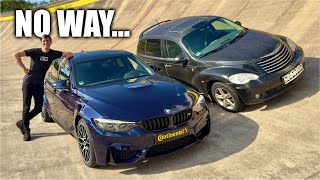

PT Cruiser Beats BMW M3 in Wet Race?!
45sShocking underdog story where an old PT Cruiser on good tires outperforms a powerful BMW on cheap tires in wet handling.
▶ Play Clip"Delivers a compelling demonstration of tire importance, though the title oversells the Cruiser's dominance which only applies in wet conditions."
In a controlled experiment, a PT Cruiser on premium all-season tires outperformed a BMW M3 on budget summer tires in wet handling and wet braking, demonstrating that tire quality can overcome significant power and technology disadvantages. The tables turned when the M3 was fitted with proper performance tires, highlighting the critical role of tires in vehicle performance and safety.
A PT Cruiser on good tires is pitted against a BMW M3 on bad tires to prove tires matter more than power.
The video aims to demonstrate that tires are the most important factor for vehicle performance and safety.
PT Cruiser uses Continental True Contact Tour 54, an all-season touring tire with an 80,000-mile warranty. It prioritizes longevity over grip.
BMW M3 is fitted with a budget summer tire, traction rating A, temperature rating A, but half the treadwear of the Continental.
The Continental tire costs about double the budget tire, but has double the treadwear rating.
Pacific Coast Highway Edition diesel, manual transmission, 150 metric horsepower, initially broken ABS.
F80 M3 Competition, twin-turbo inline-six, 450 metric horsepower, 7-speed dual-clutch, advanced ABS.
PT Cruiser: 89.67 seconds, BMW M3: 93.6 seconds. The PT Cruiser was nearly 4 seconds faster.
The driver clocked 94.27s in PT Cruiser and 97s in BMW, confirming a ~3 second gap for a less experienced driver.
PT Cruiser average: 30.79m, BMW M3 average: 32.69m. PT Cruiser stopped nearly 2 meters shorter despite worse ABS.
PT Cruiser averaged 0.818g, M3 averaged 0.77g – over 6% more grip from the PT Cruiser's tires.
Budget tire BMW: 38.72m, PT Cruiser: 41.73m. BMW wins by 3 meters in dry conditions.
Fitted with Continental Sport Contact 7. Dry braking: 33.14m (1.187g). Wet braking: over 5m shorter than budget tires. Wet handling: 79.1 seconds (14 seconds faster).
1) Performance cars need proper tires. 2) Slow cars with good tires can keep up. 3) Traction rating doesn't fully represent real-world wet grip.
You get what you pay for with tires. They are the most important safety component and not a place to cheap out.
Tires are the single most influential factor in vehicle performance and safety, capable of making a slow car competitive or a fast car dangerous. Investing in quality tires pays dividends in grip, braking, and accident avoidance.
What was the time difference in wet handling between PT Cruiser and BMW M3?
PT Cruiser was nearly 4 seconds faster (89.67s vs 93.6s).
04:48
What is the treadwear warranty of Continental True Contact Tour 54?
Up to 80,000 miles.
01:00
What was the average wet braking distance from 80 km/h for the PT Cruiser?
30.79 meters.
08:27
What is the traction rating of the budget tire used on the BMW?
A.
01:22
Why doesn't the traction rating accurately reflect wet performance in modern cars?
It measures locked-wheel braking, but ABS prevents locking in most cars.
13:28
How much more wet grip did premium Continental tires provide over budget tires on the M3?
Almost 20% more (0.921g vs 0.77g).
11:50
What was the dry braking distance from 100 km/h for the M3 on premium tires?
33.14 meters.
11:22
What issue did the PT Cruiser have initially that affected braking?
Its anti-lock braking system (ABS) was broken.
02:49
What is the horsepower of the PT Cruiser?
150 metric horsepower.
02:33
What is the horsepower of the BMW M3?
450 metric horsepower.
03:08
PT Cruiser beats M3 in wet handling
Demonstrates that tire quality can overcome a 3x power disadvantage in wet conditions.
04:486% more wet grip from PT Cruiser's tires
Despite worse ABS, the PT Cruiser achieved higher deceleration due to tire grip.
08:46Premium tires transform M3 performance
With proper tires, the M3 gained 20% more wet grip and a 14-second lap time improvement.
11:50Traction rating limitations explained
Clarifies that the same traction rating doesn't guarantee equal wet performance due to testing methodology.
13:14You get what you pay for with tires
Emphasizes the value of investing in quality tires for safety and performance.
14:10[00:04] Woo! I lost it. Can a crusty old barnfind PT Cruiser it. Can a crusty old barnfind PT Cruiser dominate a BMW M3 with tires alone? Of course it can. That's too easy. So, in this video sponsored by Continental,
[00:17] we're going to make this hilarious challenge even more difficult. I have been on an endless quest to inform all drivers that tires matter more than anything else. And this is quite possibly my most powerful demonstration
[00:31] of that to date. So, if we were to put the BMW on the worst tires out there and then put the PT Cruiser on some of Continental's stickiest tires, like these Extreme Contact Sport02s, well, there'd be no competition. Good tires
[00:45] win every time. So, how can we make this even more difficult for the PT Cruiser? It's not going to be on an ultra high-performance summer tire. It's not even going to be on an ultra high-performance allseason tire. In
[00:58] fact, it's going to go on an allseason touring tire. This is the True Contact Tour 54, and it is Continental's longest lasting tire they sell today with up to lasting tire they sell today with up to an 80,000mi warranty. This is not made
[01:13] for the ultimate amount of grip. This is made for longevity. The BMW, on the other hand, will actually get a self-proclaimed ultra high performance tire, and retailers label it as a summer tire. It has a traction rating of A, the
[01:28] second highest you can get, and it has a temperature rating of A, the highest you can get. However, since it's a high performance tire, it has about half the tread wear rating of the Continental tire. By all means, it should be faster,
[01:40] but it just has one factor working against it. It's cheap. Now, it's not the cheapest, and I've looked at thirdparty testing results, and it's far from the worst tire out there. It's very midpack for a budget tire, but let's
[01:54] talk about price for a second. If I'm to match the size of the PT Cruisers tire, Continental's True Contact Tour 54 was about double the price of the budget tire. The Continental has the same traction rating, the same temperature
[02:08] rating, but again, double the treadware rating, so it should last quite a bit longer. So, before we dive into the driving comparison, I want to make sure we're abundantly clear on how different the performance is between these two
[02:21] vehicles. This isn't just any PT Cruiser. It's a Pacific Coast Highway Edition diesel engine, manual transmission, and it's part of the
[02:33] highly coveted street cruiser series. The diesel engine is packing a potent 150 metric horsepower, or at least it was when it was new. And when it arrived, it had a broken anti-lock braking system. So, to summarize, it's
[02:49] braking system. So, to summarize, it's complete. Oh, I can't say that. It's complete. Oh, I can't say that. It's um very slow. Though, to be honest, I did have a lot of fun driving it. Uh-oh. The BMW is an F80 M3
[03:04] Competition with a twinturbo inline six-cylinder producing 450 metric horsepower. Yes, three times the power of the PT Cruiser. And instead of a manual like the Cruiser, it has a lightning fast seven-speed dualclutch
[03:20] transmission. On top of the performance specs, the M3 has about a 15-year technology gap advantage. One of the key points here being a much more advanced points here being a much more advanced anti-lock braking system or ABS. So,
[03:33] we've paired the ultimate driving machine against the aspires to be mediocre driving machine. I mean, technically, it does move. All right. PT Cruiser with premium all seasonasons versus BMW M3 with budget
[03:48] highperformance tires. What wins? To find out, we'll first run three initial tests. First, a wet handling course. Second, a wet braking test to verify the grip differences. And third, a dry braking test to see if there's any
[04:03] scenario the budget tire can win. After all, it is a summer tire. Now, because this is engineering explained and apples to oranges comparisons make no sense, at the end, we will put the BMW M3 on a proper set of Continental high
[04:17] performance tires and rerun all the tests and show that the car is indeed extremely fast with the right equipment. Okay, so first up is wet handling. This is a 1.8 8 km twisty track with a continuously fed consistent layer of
[04:32] water completely covering its surface. Continental's test driver, who's done probably drive it blindfolded, took the BMW M3 out for several laps and managed BMW M3 out for several laps and managed a best time of 93.6 seconds. So, how did
[04:48] the PT Cruiser fare? Well, again, after several laps, the best time held was several laps, the best time held was 89.67 seconds. nearly four full seconds 89.67 seconds. nearly four full seconds faster. Okay, this is ridiculous. A car
[05:01] with three times the power is nearly 4 seconds slower than a car with tires seconds slower than a car with tires that are simply twice the price. Unreal. Now, maybe you don't trust these numbers because it's Continental's test driver
[05:15] shouldn't stress about this. I was there. I watched everything. He's an exceptional driver and he gave it his best in both cars. However, to help prove a point, I too went out and gave it my best in both cars. After several
[05:30] laps with each car, my best time in the BMW was 97 seconds flat. In the PT Cruiser, my best time was 94.27 seconds. So, nearly a 3second gap.
[05:43] this is that means Continental's driver in the BMW was actually faster than me in the PT Cruiser when I was on the better tires. Sad. Though to be fair, it was my first time driving this track. Never show up to a track day without
[05:58] plenty of excuses ready. But back to this time gap on the wet handling course. This doesn't remotely tell the full story of what the cars were like to drive. The PT Cruiser was easy to confidently drive hard. It's surprising
[06:11] confidently drive hard. It's surprising that driving this versus the M3 is so much less intimidating despite the fact that the check engine lights on. It that the check engine lights on. It doesn't have ABS. It's ancient. It's a
[06:25] doesn't have ABS. It's ancient. It's a manual diesel. It's a PT Cruiser, but you know, it's ready to make this happen. Of course, there was under steer at the limit, but the tires behavior was very predictable.
[06:40] Alternatively, the BMW was a complete handful and was very difficult to drive at the limit, always wanting to over steer and spin around. The tires were anything but predictable. Continental's driver and I did an exercise where we
[06:54] chased each other in these vehicles. And giving it everything I had in the BMW to stay with the PT Cruiser, I was at a complete loss. And as you're now witnessing, wasn't even able to keep the car on the track. These tires required
[07:08] complete constant focus. And even then, I couldn't keep it together or stay remotely close to the PT Cruiser. And I have three times the power. Okay, so to prove there is a grip difference in the wet between the tires, let's move on to
[07:23] our wet braking test. This takes place on the same straight section of road with a consistent layer of water and with the vehicles alternating between each run to ensure similar surface conditions for both cars. Worth
[07:37] mentioning, the first several times we tried braking in the PT Cruiser, ABS wasn't working, so the tire locked up, slid, and of course that means a terrible stopping distance. After some time in the shop, Continental managed to
[07:49] get the anti-lock braking system working again. So, we headed back out to the braking course. We ran four braking tests in each vehicle from 80 kmh down to zero and again alternating vehicles after each run. Worth reiterating,
[08:03] there's about a 15-year difference between anti-lock braking systems. You could hear and feel the slow, chaotic pumping of the PT Cruiser's dated ABS, while the M3 had a much faster and more frequent actuation, which does a
[08:19] significantly better job of holding the tire at peak grip for the best stopping distance. Even still, the Cruiser pulled out the win here with an average out the win here with an average stopping distance of 30.79 m over four
[08:32] stopping distance of 30.79 m over four runs versus 32.69 m on average for the runs versus 32.69 m on average for the M3. nearly two full meters longer. This is just wild. In terms of G-forces, the PT Cruiser was averaging. 818 gs in the
[08:46] wet, while the M3 only managed.77gs. That is a very meaningful managed.77gs. That is a very meaningful difference. Over 6% more grip in the wet. And that is with a significantly worse anti-lock braking system. Now,
[09:01] let's address some common misconceptions in case anyone is unconvinced. You might think, "Okay, maybe all season tires are better than summer tires in the rain." But actually, and of course, while not always the case, summer tires can and
[09:15] often do perform better, as will be demonstrated once we fit the M3 with quality summer tires. You might also think the BMW is losing in the wet because it has much wider tires. A wider
[09:28] tire could have worse hydroplaning characteristics, but in this case, we're staying below hydroplaning speeds. And again, we're going to fit the M3 with the same width summer tires, but of a performance variety, and you will see a
[09:41] stark contrast. But for now, let's move on to dry braking. This will be conducted at higher speeds from 100 km/h down to zero, and we'll take the average of three runs. So, very quickly, let's list all the advantages the M3 has.
[09:56] First, summer tires, which have better dry stopping distance than all seasons. Second, it has much wider tires, even better for dry performance. Third, it has a 15-year advantage in terms of ABS technology. Fourth, the M3 also has a
[10:12] much better weight distribution. And fifth, almost certainly the M3 has a should result in better braking distances. I simply refuse to believe that the PT Cruiser could possibly win this comparison, but here's the thing.
[10:30] Nah, it didn't. The budget tire managed to take the win here with an average to take the win here with an average stopping distance of 38.72 m versus the stopping distance of 38.72 m versus the Cruiser's 41.73 m. About 3 full meters
[10:42] of a gap. You can feel so much movement in the pedal. Based on how terrible the PT Cruiser's ABS felt, I really think it could significantly close that gap with modern ABS alone. Comparing G-forces, the Cruiser was at N43 GS on average
[10:59] the Cruiser was at N43 GS on average versus the BMW's 1.016 GS. All right. Now, obviously, we've been pretty unfair on the M3 thus far, so let's give it a tire that allows it to show its true potential. We threw on a set of
[11:12] Continental Sport Contact 7s, very similar to these Extreme Contact Sport O2s, and sent it back out to retry all three tests. In the dry braking we were just discussing, it managed to stop from 100 km/h to zero on average in
[11:28] 100 km/h to zero on average in 33.14 m, averaging 1.187gs while stopping. Very impressive and of course dominating both the PT Cruiser and the budget tires. As for wet braking, it averaged over 5 m shorter
[11:44] from 80 to 0 km/h than the budget tires with an impressive 921gs in the wet. with an impressive 921gs in the wet. That's almost 20% more wet grip than the budget tire. The lap time implications are ridiculous. So, at last, we get to
[12:00] the wet handling course, and the M3 finally has tires that can put down some serious power. Even with a wet surface, the M3 managed a best time of the M3 managed a best time of 79.1 seconds. Over 14 seconds faster
[12:16] than the budget tires. Holy smokes. Okay, so I think there's three key facts we've learned here. Number one, if you've got BMW M3 money, Number one, if you've got BMW M3 money, please, please put up the cash for some
[12:31] proper tires. Nothing pains me more than walking through a parking lot and seeing these kinds of machines on budget tires that can't let them shine. And yeah, I just compared my Corolla to an M3. Number two, even if your ride isn't all
[12:46] that fast, not calling out names, but I'm just saying um PT Cruiser ain't uh ain't much going on underneath that hood, you can still hang with the big guys with the proper set of tires. And joking aside, even if tracking your car
[13:01] isn't your thing, good tires are your first line of defense in avoiding an accident. Rain, shine, or snow. Personally, I don't believe there is any important. It's really not where you want to cheap out on. And third, which
[13:14] might be surprising to some, is that two tires can have the same traction rating as both of the tires we tested had A ratings, yet may have differences in performance, just as we've shown. That's because this traction test measures wet
[13:28] grip with the tire locked. But basically, all modern cars have ABS, meaning braking doesn't require locking up the tire. So again, two tires can have the same rating and yet perform differently in the rain. Now, regarding
[13:42] the budget tire on the M3, you might wonder what specific tire we chose. I have intentionally not disclosed what tire it is because the purpose of this video was not to call out one singular tire as being bad. We picked a tire that
[13:57] actually does fine against its equivalently priced competitors. For a cheap tire, it's far from the worst. So, it's actually very representative of many budget tires out there. So, this very clearly illustrates the point that
[14:10] with tires, more often than not, you really do get what you pay for. And to be fair about what specific tire it is, I mean, I have dropped quite a few hints in this video. Y'all got the internet. There's a lot of ways to save money when
[14:24] it comes to cars, but tires are not the place to cheap out. You pay a bit more, sure, but that means a safer ride, and that could easily mean the difference in avoiding a car crash, especially when it comes to more control when road
[14:37] conditions aren't great. A huge thank you to all of the folks at Continental that helped support this video. It was simultaneously hilarious to make and yet highly educational. Hard to beat that. If you have any questions or comments,
[14:50] feel free to leave them below. Thanks for watching.


⚡ Saved you 0h 14m reading this? Transcribe any YouTube video for free — no signup needed.