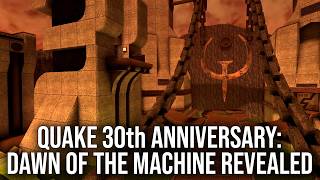

MachineGames Returns with FREE Quake Episode!
60sReveals a surprise free DLC from a AAA studio, sparking excitement and nostalgia.
▶ Play Clip"The title accurately promises a reveal and review of the new episode, and the video delivers a thorough breakdown with genuine enthusiasm."
The video celebrates Quake's 30th anniversary by reviewing the new free episode 'Dawn of the Machine' from MachineGames, released for the Nightdive version of Quake. The episode features 19 levels, a new deathmatch map, and a new soundtrack, and is the most ambitious of the three episodes MachineGames has produced. The host discusses the design philosophy that makes Quake timeless, including its pixel-art textures, lightmaps, and simple geometry that allows for clear navigation and secrets. The new episode uses modern tools like TrenchBroom and introduces colored lighting, seamless teleportation, and creative level design that blends ancient ruins with futuristic military bases. The hub world cleverly hides difficulty selection, including a secret nightmare mode. The episode is structured as a continuous sequence rather than a hub-based selection, and includes secret exits. The video also highlights the Quake Brutalist Jam 3 pack as another example of community creativity. Overall, the host praises the love and effort put into the episode and reflects on Quake's lasting impact.
Quake is 30 years old and remains one of the most important games ever developed, changing the industry in many key areas.
MachineGames released a free new episode called 'Dawn of the Machine' for owners of the Nightdive version of Quake, featuring 19 levels, a new deathmatch map, and a new soundtrack.
The episode captures the classic Quake feeling while showcasing modern engines and tools, created with TrenchBroom, with maps that are massive in scope.
Quake's visual design relies on 3D polygonal environments, lightmaps, and pixel-art textures, creating an evocative and atmospheric experience that still holds up.
MachineGames' dedication to creating new content for the original Quake, not for a new product, speaks volumes about their passion.
The new hub features a clever difficulty selection, including a hidden nightmare mode accessed by swimming through sludge and finding a secret entrance.
The episode uses seamless teleportation to create the illusion of the map changing, used to simulate time travel and blend different themes.
The episode introduces colored lightmaps, a feature from Quake II, which works well and adds dramatic scenes while staying conservative to the original aesthetic.
The episode features a completely new soundtrack that makes it feel unique and not just an extension of the original Quake.
Unlike previous mission packs, 'Dawn of the Machine' is a continuous episode with sequential maps and secret exits, similar to the original Quake.
The Quake Brutalist Jam 3 pack showcases a staggering number of new maps, highlighting the ongoing creativity and importance of Quake to the community.
Quake's 30th anniversary is celebrated with a heartfelt review of 'Dawn of the Machine,' which demonstrates the enduring appeal and design brilliance of the original game. The episode, along with community creations, proves that Quake remains a vital and beloved part of gaming history.
How many levels does the new 'Dawn of the Machine' episode feature?
19 levels
01:18
What tool was used to create the maps for 'Dawn of the Machine'?
TrenchBroom
01:47
What feature from Quake II was introduced in the new episode?
Colored lightmaps
09:39
How is the nightmare difficulty selected in the new hub?
By jumping into a pipe, launching onto the Quake symbol, grabbing a suit, and swimming through sludge to a secret entrance.
07:01
What is the structure of 'Dawn of the Machine' compared to previous mission packs?
It is a continuous episode with sequential maps and secret exits, unlike the hub-based selection of previous packs.
12:45
Timeless Visual Design
Explains why Quake's pixel-art textures and lightmaps still evoke atmosphere decades later.
03:26AAA Studio Passion
Highlights MachineGames' dedication to creating free content for a 30-year-old game, showing genuine love for the medium.
05:25Seamless Teleportation Technique
Demonstrates a creative use of engine features to simulate time travel and blend themes.
07:31Conservative Upgrades
Shows how adding Quake II features like colored lighting can enhance without breaking the original aesthetic.
09:39Community Creativity
References the Brutalist Jam 3 pack as evidence of Quake's enduring community and creative output.
13:27[00:07] textures, and twisting designs of the original Quake still manage to stir emotions deep within. This year marks 30 years of Quake, a game which single-handedly changed the gaming industry in many key areas,
[00:23] forever altering how we play. It is among the most important games ever developed, I might argue. It's a game I've discussed many times, but given that it's 30 years old, it feels natural to discuss the game once
[00:36] again here on Digital Foundry. But, there's an additional catalyst for it. Revealed at QuakeCon this year, MachineGames has returned with a massive new episode known as Dawn of the Machine, being made available for free
[00:51] to owners of the Nightdive version of Quake. MachineGames has already crafted two new episodes for both Quake and Quake II, thanks to what they call Quake Club, a group of MachineGames employees making Quake maps in their spare time.
[01:06] And this new episode is a celebration of everything Quake, and easily the most ambitious of the three episodes they've produced to date, which is why I wanted to talk about it. You see, this new episode features 19 levels, a new
[01:18] deathmatch map, and even a new soundtrack, along with some twists on familiar enemies and weapons that will surprise and delight. this episode is how it's designed to really capture the essence of that
[01:32] classic Quake feeling, while also showcasing the power and flexibility of modern Quake engines and tools. This one was created using TrenchBroom, my favorite editor for Quake. Each of these maps are just massive in scope,
[01:47] showcasing design elements that would never have been possible on '90s-era never have been possible on '90s-era Pentium systems.
[02:00] Displate makes premium metal posters offering a sleek display ready alternative to traditional paper prints with over 2 million designs to choose from. With so many options, it's easy to keep the studio walls looking fresh. And
[02:13] because displates are so easy to swap around, we've just added some classic PC gaming artwork to the mix including this excellent Aperture Science print alongside the heavy-hitting classic logos of Quake and Doom. And for those
[02:27] legendary id Software pieces, we opted for the text for finish, which uses a 3D enhanced print for an impressive level of detail. That flexibility to swap things out is [music] all thanks to how straightforward the mounting process is.
[02:40] Every displate comes with a tool-free magnet system that installs in seconds. There's no drilling or holes required. Displate features over 200 officially licensed brand collections [music] and original artwork from over 40,000
[02:54] independent artists. [music] This means you can easily find other incredible collection. Whether it's for your own setup or a great gift idea, use code foundry at the link below to get 22% off one displate, 27% off two, and 33% off
[03:11] three or more displates. Please note that this isn't valid on limited edition [music] prints. Click the link in the video description below to find out video description below to find out more.
[03:26] through this new episode got me really thinking about the beauty of Quake 1, both in its original form and what's now possible 30 years later. Quake's visual design in '96 stems from a combination of its 3D polygonal
[03:41] environments, its heavy reliance on light maps, and crucially the almost pixel art-like texture work painted across every surface. This is from an era before the concept of a material or even multi-pass
[03:54] textures were a thing, where the art of a surface was entirely driven by the hand of an artist, someone who meticulously placed every pixel to create the desired effect. I love the way this is used to create
[04:09] these fluids, things like water, slime, and the like. The swirling texture trick, it's not realistic, but it's evocative, and that's what mattered most. Same goes for the skies, the gorgeous purple clouds scrolling quickly
[04:23] above the player in dual parallax, it's beautiful. I'm honestly amazed that it still feels this dark and atmospheric all these years later, despite the relatively simple shapes and repeating textures.
[04:38] It allows the designers to create these complex spaces without the fear of the player becoming overly confused. It's from a time when polygon structures being this simple allowed you to just run into a room and instantly parse
[04:53] where you could or could not go. This in turn gave the developers additional trust in the players, allowing the designers to include some devious secrets. The lack of scene clutter kept things manageable and
[05:08] rewarding, even when combing over a previously explored space. So, Quake 30 years from launch is still beautiful to my eye, it's evocative, it's wonderful, and it plays like a dream. I still love plundering its dark hallways.
[05:25] And the fact that the staff of a AAA game studio like MachineGames was ready to dedicate time and effort to creating something new for the original Quake, and not even for a new product, mind you, speaks volumes. You can feel the
[05:40] love in every corner of Dawn of the Machine, and I wanted to share some of it. So, the original Quake was of course known for its in-world difficulty selection. You know, you walk through
[05:52] one of these slip gates to select either easy, normal, or hard mode. In fact, if you wanted a hidden fourth difficulty, nightmare, you had to swim into this water here, drop down onto this beam, and find a secret gate nestled over here
[06:05] to the side. I've always loved this. With Dawn of the Machine, they've toyed with this concept in fun ways that really sets up what's to come. For starters, it's beautiful. This new hub features towering architecture beckoning
[06:19] you forth, the Quake symbol floating in the sky above you. It pulls you into this world. Like the original though, easy and normal are selectable by simply walking through the appropriate doors. But, if you want to select a harder
[06:33] mode, things get a little trickier. If you jump in the center here, you'll actually die before reaching it due to the toxic waste. But, you can see that logo. Poke around the level, and you might
[06:46] discover a blue card key, right in the selection map of all places. That card key opens a door on the other side, which is also accessible from walking up the chain link. That door represents hard mode. But, if you keep
[07:01] poking around, you'll notice you can jump into this pipe, launch out on top of the Quake symbol, grab the suit, then swim all the way down through the sludge to reach the nightmare entrance. I'm lingering on this hub here because I
[07:16] feel it sets the tone of what's to come, the types of puzzles, navigations, and And, one of those tricks you'll encounter in this very first level, seamless teleportation. At any point, the game can instantly transport you to
[07:31] another area of the map without breaking the illusion of movement, making it seem as if the map itself is changing around you, rather than your position changing. walls, you'll see that this is just an area down here below the original room.
[07:46] It just warps you there so seamlessly that it feels like the same room. And they use this throughout this DLC episode to create the illusion of moving back and forth through time. It's so interesting and creative.
[08:01] They do a lot with this as well. At the end of the first level, for instance, we get another hint of this. The exit portal is surrounded by castle ruins spilling out into the military base. A couple levels later, though, they toy
[08:15] with the futuristic military complexes and ancient structures within the same level, but at a larger scale. They tell a story purely through map design. In fact, this map is one of my favorites for this. You begin by exploring what
[08:29] seems to be an abandoned military complex, slowly peeling back the layers, dead guards all around you. Then, the otherworldly beasts begin to attack. As you make your way through the level, you eventually uncover an area where these
[08:44] ancient ruins are being studied. Descending the stairways, it leads to a completely different aesthetic and eventually a portal that ties to a different realm. These contrasting themes were a big part of the original
[08:56] Quake's design, but they were always disparate levels. Here, they really mess around with the idea of combining the two into individual missions. These maps are also massive in size. Architecture is towering with so many
[09:11] complex and interesting structures carved out of vintage BSP material. They've created that satisfying loop you get from the best Quake and even Doom maps, where by the time you reach the end of the map, you kind of realize that
[09:26] seamlessly and you're maybe back close to the start or way above some other place where you started. taken advantage of upgraded features that have been added into the engine,
[09:39] such as colored lighting. The light maps in the original Quake were completely monochromatic, but here you get Quake II like colored light maps, which I think actually works very well, creating some dramatic scenes. The key though is that
[09:51] these upgrades are very conservative. Colored light maps were directly introduced in Quake II, so they don't feel out of place in a Quake I map. There's also a lot of variety on display. Just the first few levels
[10:06] showcase so many different location types. The atmosphere varies wildly, but I love the new skies created for this episode as well. Sure, it lacks the cool moving clouds, but it allows these open vistas without the awkward wrap-around
[10:21] effect we had in the original. The way the water and sky meet in this level for instance, actually looks pretty good. It's not as easy of a trick Ultimately though, this is just a reminder of what can be achieved through
[10:34] decades of experience and a love of the medium. While the tool set has been expanded and new features brought over, plus they've introduced things like new enemies such as ogres sporting rocket launchers or rabid dogs with explosives
[10:49] strapped on their backs, it's still fundamentally Quake at its core. Understanding what Quake is has allowed them to focus on just making the best them to focus on just making the best possible use of the available design,
[11:03] creating a very pure, beautiful experience in the process. Sure, the level of detail is higher than the original Quake, but it's still ultimately limited by the Quake design ethos, making the structures and
[11:16] achievement all the more impressive in my book. Now, another great feature here is the music. Unlike the last episodes that actually features a completely new soundtrack.
[11:28] It's amazing how just altering the audio can make it feel much more unique, not can make it feel much more unique, not just an extension of regular Quake. just an extension of regular Quake. Take a listen.
[12:45] of this episode is different compared to the previous two episodes. In the other mission packs, the player was presented with a hub and you'd complete each level in isolation before returning to that hub to select the next
[12:58] map. With Dawn of the Machine, however, it's a continuous episode, much like the original Quake, where you move from one map to the next in a sequence. They've even introduced secret exits to the mix. It's honestly been a pretty awesome year
[13:13] for Quake's 30th in general. This new episode was the catalyst for talking about Quake again, but the beauty of Quake is that there's a near endless supply of creativity being released every single year. For instance, over
[13:27] the last year, we saw the Quake Brutalist Jam 3 pack featuring a staggering number of new maps built in this Brutalist style. While Dawn of the Machine sticks close to Quake's roots, Brutalist Jam goes crazy with new
[13:40] weapons, enemies, visual design, and concepts taking the player on a wild ride through a cement nightmare. Not every level was great, but the experience is absolutely worth having. And it really highlights how important
[13:53] Quake remains to this community, to this industry, and to gaming as a whole all these years later. And that's to say, looking back over my decades of playing games, I still marvel at what Quake has achieved and what it has become. Knowing
[14:08] more about the difficult development that id Software originally faced back in the mid-90s makes it even crazier. So, let me just say thank you to the original creators of Quake and everyone that has kept Quake alive for the last
[14:22] that has kept Quake alive for the last 30 years. Here's to many more.




⚡ Saved you 0h 14m reading this? Transcribe any YouTube video for free — no signup needed.