
Quantum Mechanics: Weird but Practical
45sOpens with a provocative quote from Feynman and promises to turn quantum weirdness into practical tech, hooking viewers who are curious about quantum computing.
▶ Play Clip"The title promises a visual explanation and delivers exactly that, with clear diagrams and step-by-step quantum concepts."
Quantum mechanics underpins quantum computing, and this video explores three key quantum systems—electron spin, hydrogen atoms, and superconducting circuits—to explain how superposition and entanglement work. It demonstrates how quantum weirdness is harnessed for practical technologies like quantum computers.
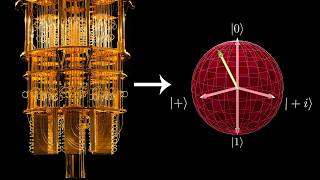
Electron spin is binary (up or down) but can exist in superposition, forming a qubit. The Bloch sphere visualizes superposition states.
Atoms have discrete energy levels; lasers with specific colors induce transitions. A pi/2 pulse creates superposition between two levels.
Bell states are entangled superpositions where measuring one atom determines the other. Entanglement requires interaction between atoms.
Superconducting circuits act as artificial atoms. A capacitor and Josephson junction create quantized energy levels, controlled by radio waves.
Placing qubits close together on a chip enables interactions needed for entanglement, similar to atoms.
Superposition and entanglement are the core principles behind quantum computing, demonstrated through electron spin, atoms, and superconducting circuits. These systems allow controlled quantum states that form the basis of quantum computers.
What are the two possible states of electron spin?
Spin up and spin down.
01:08
What is a superposition in quantum mechanics?
A combination of two eigenstates, e.g., spin up and spin down simultaneously.
02:04
What does the Bloch sphere represent?
A three-dimensional visual representation of a qubit's superposition state.
03:15
What is a pi pulse?
The time required to promote an electron from one energy level to another (180° rotation on Bloch sphere).
06:29
What is a Bell state?
An entangled state with 50% probability for |00⟩ and |11⟩, and 0% for |01⟩ and |10⟩.
08:08
How are Cooper pairs formed?
Two electrons pair via attraction through a crystal lattice, forming a boson.
10:03
What are the two circuit elements in a superconducting qubit?
A capacitor and a Josephson junction.
10:47
Defying Feynman
The video directly challenges Feynman's famous quote, setting a bold tone for practical quantum mechanics.
00:27Superposition Explained
Clear explanation of superposition using electron spin, a key 'aha' moment for understanding qubits.
02:04Bell State Revelation
The moment entanglement is introduced, showing how measuring one atom determines the other.
08:08[00:00] Quantum mechanics is the foundation of our understanding of the universe. To truly grasp quantum computing, we need to confront this strangeness head-on. In this video, we'll explore three key examples of quantum systems,
[00:13] each one peeling back the layers of quantum mechanics, and in doing so, bringing us closer to understanding quantum computing. As Richard Feynman once said, if you think you understand quantum mechanics, you don't understand quantum mechanics.
[00:27] But there's a problem with this. Today's cutting-edge technologies, atomic clocks, quantum sensors, and quantum computers, aren't just built on quantum mechanics, they actively control and harness quantum states.
[00:39] In this video, we'll defy Feynman's warning, and see how we turn quantum weirdness into something practical. First, let's take a look at a single electron. Associated with subatomic particles like electrons is a quantity known as spin.
[00:55] Spin is just a form of angular momentum, and it gets its name from the fact that it makes the electron behave almost like it's spinning like a top. Since when charged particles spin, they get magnetized, spin effectively makes electrons
[01:08] tiny little magnets. The spin of an electron can be in two possible states, either spin up or spin down. The direction of spin tells you about the direction of the magnetic field from the electron.
[01:20] Importantly, though, when we measure the spin of the electron, it can only be either up or down. In other words, the spin of the electron is binary. If this electron spin were like a normal system that we studied in classical physics, that would be the end of the story.
[01:35] However, quantum mechanics lets us do something interesting. When we find the allowed states of a quantum system, we do it by solving a differential equation known as the Schrodinger equation. Any physical state that we get from solving the Schrodinger equation is known
[01:49] is an eigenstate, and is an allowed state for our particle to be in. In this case, spin up and spin down are the eigenstates. But this is where it gets interesting. The eigenstates aren't the only allowed states. You can take two eigenstates and combine them together
[02:04] to make a new state, which is some bit eigenstate A and some bit eigenstate B. This new state is called a superposition. So there's another option that we didn't have access to in the classical setting. Our electron can either be spin up, spin down, or in a superposition of both
[02:20] spin up and spin down at the same time. This is one of the fundamental characteristics of a quantum bit or qubit. A switch, on the other hand, is a good classical representation of a scenario like
[02:32] this. A classical switch can be open or closed, but it can't be in a superposition of both. In general, it's possible for a classical system to be put into a state between two extremes. For example, a door can be opened, closed, or somewhere in between. But the difference is that when you
[02:47] look at the door, i.e. when you measure it, you measure the door to be in that intermediate state. It doesn't collapse to be open or closed. In other words, the state of the door is definite the whole time. In contrast, if you have an electron in a superposition of spin up and spin down, when you
[03:03] measure that electron spin you will measure either spin up or spin down not the combination of both We can represent the state of any spin quantum system meaning a system with two allowed states
[03:15] using something known as the Bloch sphere. The Bloch sphere is a three-dimensional visual representation of the superposition. Physically, the Bloch sphere represents a lot of ideas in a very compact notation.
[03:28] The radius of the Bloch sphere is the easiest thing. Every superposition state of our electron that combines spin up and spin down lies on the surface of this sphere. Spin up is along the plus z direction, and spin down is along the minus z direction.
[03:43] If you plot a state on the block sphere, you'll notice a couple of important angles. The first of these angles is called beta, which is the angle that the point on the sphere makes at the z-axis. This angle basically tells us how much of a superposition we're in.
[03:57] For a theta angle of zero, the state is 100% spin up. For a theta angle of pi, or 180 degrees, the state is 100% spin down. For anywhere in between, for example theta equals pi over 2, or 90 degrees, there are
[04:11] a bunch of different possible states that make a circle all the way around the sphere. This is where the second angle, phi, comes in. Phi is known as the phase. While it doesn't control the probability that you'll measure spin up or spin down in a
[04:23] single qubit, it allows for different qubits to interfere with one another in quantum algorithms. This is something that I'll talk about more in another video. Next, let's take a look at another physical system, atoms. If we zoom in to a single hydrogen atom, we find more discrete states.
[04:40] In the case of the single electron, the states are spin. In the hydrogen atom, however, the states that we're going to look at are the orbital states of the single electron living around the nucleus. There are some other differences as well.
[04:53] When we solve the Schrodinger equation for an atom, instead of getting two allowed states like we do for an electron, we get an infinite power of space. If we have an atom in one of these states, we can transition to another by shining in a laser with a very specific color.
[05:07] Since the color of a laser is related to the energy of the photons of light in that laser beam, if we shine a laser on the atom, which has a color that corresponds to the energy difference between two states, the electron in our atom has a chance to absorb that photon
[05:21] and transition up to that state. For example, if we shine in a red laser, this corresponds to the transition between the n equals 2, or second, and n equals 3, third energy levels. If we shine in a blue laser, however, this corresponds to the n equals 2 to n equals 5
[05:37] transition, raising our electron from n equals 2 to n equals 5. If we keep shining in these lasers, we can also do the reverse process called stimulated emission, where the incoming photon kicks the electron back down.
[05:49] Since shining a single laser color lets us focus on two specific states and ignore the others, we can draw a block sphere just like we did for the electron spin. This time, instead of the states being spin up or spin down, they'll be the 2 and 5 electron
[06:02] states. Thus, in this case, our theoretical atom-based qubit states are the n equals 2 and n equals 5 states. Again just like before with the electron spin we can generate superpositions of multiple states To do this we shine in the laser for a shorter period of time Specifically if we want to make an even superposition of the n equals 2 and n equals 5 states we first record the amount of time that it takes to promote the electron from n equals 2 to n equals 5
[06:29] This time is known as a pi pulse duration, because it changes the angle theta on the block sphere by the value pi, or 180 degrees. To put our qubit into an even superposition of 2 and 5, we apply a pi over 2 pulse.
[06:42] This is a laser pulse at the same frequency or color of the pi pulse, but for half the time. Not only can we create superpositions of two states in a single atom though, we can create
[06:54] superpositions of two atoms together as well. Imagine we have two atoms, which we'll label A and B, each of which we apply a pi over 2 pulse to. Then, the total state of our system can be described by the following four scenarios.
[07:08] 2, 2, 2, 5, 5, 2, or 5, 5. Or if we relabel our states to call 2, 0, and 5, 1, because it doesn't really matter what we call them, then we get 0, 0, 0, 1, 1, 0, and 1, 1.
[07:24] Our total quantum system now is in an equal superposition of all four states, 0, 0, 0, 1, 1, 0, and 1, 1. And this superposition works exactly the same way mathematically as our other one did.
[07:38] Changing the coefficients of each state changes the probability that each state gets measured. However, if we play around with different states, we find something interesting. If we just set up a normal superposition state with equal probabilities of all four states,
[07:53] measuring one atom doesn't tell us anything about the other atom. However, there are some states where this is very much not the case. For example, this is known as a bell state. In the bell state, there is a 50% weight for the 00 and 11 terms,
[08:08] but a 0% weight for the 1,0 and 0,1 terms. Now, if we prepare a Bell state and measure atom A to be 0, then we already know without measurement that atom B will also be 0.
[08:20] If we measure atom A to be 1, then we also know that atom B must be 1. This special superposition state that we've created is known as an entangled state, because the results of measuring one of our atoms tell us information about the other.
[08:33] If we want to generate this entangled state in the lab, however, it's not so easy. Regular superposition states that are not entangled don't require any interaction to generate, meaning that I can generate the states of atoms A and B separately, however
[08:48] if I want to entangle atoms A and B, they must also be able to interact in some way. While electron spins and hydrogen atoms are great quantum systems to look at to understand the basics, the type of quantum computer that most people picture in their minds is made
[09:03] a bit differently. This is a superconducting quantum computer. These are the current front runners in the field of quantum computing. To understand how these work, we'll need to see how to apply the concepts of superposition
[09:16] and entanglement to electrical circuits rather than to atoms or electrons. First though we need some background information out of the way Superconductors are a special class of metals which allow electrical current to flow with zero electrical resistance The current can literally flow forever No you cannot use this for infinite energy or perpetual motion and yes I am sure While I won
[09:37] explain superconductivity in depth in this video, there is a quick visual explanation. Electrons are particles known as fermions. This means that they are a type of particle that likes to organize in a tower of states with one electron in each available state.
[09:51] However, if two fermions pair up, they can form a boson, and bosons can all occupy the same quantum state. When an electron moves through a crystal lattice, it can attract positively charged nuclei towards
[10:03] it, which then attracts another electron. This interaction pairs up the electrons, forming a boson that we call a Cooper pair, named after Leon Cooper, one of the scientists who first discovered how superconductivity works.
[10:17] Since bosons can all occupy the same state, these paired electrons move down to occupy the lowest energy ground state together, which allows them to flow with no electrical resistance. Since superconductivity is fundamentally a quantum property of materials
[10:31] due to this Cooper pairing mechanism and the discrete spectrum of energy levels that the electrons inhabit, it turns out that the circuits that we make from them have very similar energy levels to atoms and molecules. Often, for this reason, people call superconducting circuits artificial atoms.
[10:47] To make a superconducting qubit, we can take two circuit elements, a capacitor and a Josephson junction, which is a special type of inductor, and put them in parallel. Doing this gives us a circuit with an energy spectrum, meaning a bunch of quantized energy
[11:02] levels which look very similar to the atomic states in hydrogen. Just like hydrogen then, we can send in a bit of energy to flip the qubit from the ground state to the first excited state, and we can send in the same pulse of energy again to
[11:14] go back to the ground state. This is still a pi-pulse. Now, however, the only difference is that instead of the signal being generated by a laser, the signal is generated by control electronics which turn radio waves down into the chip.
[11:27] This works basically the same way as an old radio, where the qubit functions like an antenna. When we output a radio wave signal that has the right frequency, analogous to the color in our atom example, the qubit can absorb that radio wave just as the atom would absorb the
[11:41] photon of visible light. To put a superconducting qubit into superposition then, we just have to do the same thing as before. Apply a pi over 2 pulse of this time radio waves rather than visible light. Just like atoms, we can also generate entanglement. In fact, the method to do this is very similar.
[11:58] In the case of atoms, to make them interact, we bring them close together in space, which causes the electrons to interact with one another, repelling each other. This lets us generate entanglement. For superconducting circuits, same principle holds.
[12:11] By putting two superconducting qubits next to one another physically on a chip, you can generate the interactions required for entanglement. Once you have a system which can controllably be put into a superposition or into a desired
[12:24] entangled state, you have the base needed to make a quantum computer. If you found this video interesting, check out this video on an algorithm for quantum computers but has the potential to revolutionize medicine as we know it.
⚡ Saved you 0h 12m reading this? Transcribe any YouTube video for free — no signup needed.