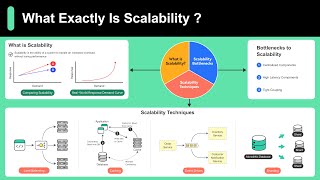

What is Scalability?
45sClear, foundational definition that hooks viewers interested in system design.
▶ Play Clip"Delivers a solid, structured overview of scalability concepts, though it's more of a primer than a deep dive."
This video provides a comprehensive overview of scalability in system design, covering fundamental concepts, key principles, and practical techniques for building systems that can handle increased loads efficiently. It emphasizes the importance of comparing systems using response versus demand curves, identifying bottlenecks, and applying strategies like statelessness, loose coupling, and asynchronous processing.
A system is scalable if it can handle increased loads by adding resources without compromising performance. Scalability also involves doing so efficiently and cost-effectively.
Scalability is better understood by comparing systems using response versus demand curves. A more scalable system has a curve that rises less steeply as demand increases.
No system is infinitely scalable. There is a 'knee' in the response versus demand curve where performance degrades rapidly. The goal is to push this knee as far to the right as possible.
Two main culprits cause scaling bottlenecks: centralized components (e.g., a single database server) and high-latency operations (e.g., time-consuming data processing tasks).
Keeping servers stateless (not holding client-specific data between requests) enables horizontal scaling and improves fault tolerance. State can be externalized to a distributed cache or database if needed.
Designing components with minimal dependencies and well-defined interfaces allows for independent scaling and modification without ripple effects across the system.
Using event-driven architecture with non-blocking operations helps mitigate tight coupling and reduces cascading failures, but introduces complexity in error handling and data consistency.
Vertical scaling (scaling up) increases a single machine's capacity but has physical and economic limits. Horizontal scaling (scaling out) adds more machines, offering better fault tolerance and cost-effectiveness for large-scale systems.
Load balancers distribute incoming requests across servers using algorithms like round-robin, least connections, or performance-based methods to prevent overload.
Caching stores frequently accessed data close to where it's needed (client, server, or distributed cache) to reduce latency and backend load. CDNs also help offload traffic.
Sharding splits large datasets into smaller pieces stored on different servers, enabling parallel processing. Choosing the right shard key is crucial to avoid hotspots.
Centralized components become bottlenecks. Use distributed queues, break long-running tasks into smaller parallel tasks, and apply patterns like fan-out, pipes, and filters.
Creating loosely coupled, independent modules with well-defined interfaces enhances scalability and maintainability, avoiding monolithic architecture pitfalls.
Scalability is an ongoing process. Monitor key metrics like CPU, memory, network bandwidth, response times, and throughput to identify bottlenecks and make informed scaling decisions.
Building scalable systems requires a combination of architectural principles, techniques, and continuous monitoring. By understanding the trade-offs and applying these strategies, developers can create applications that remain robust under pressure.
What is the definition of scalability in system design?
A system is scalable if it can handle increased loads by adding resources without compromising performance, and doing so efficiently and cost-effectively.
00:13
What are the two main culprits that cause scaling bottlenecks?
Centralized components (e.g., a single database server) and high-latency operations (e.g., time-consuming data processing tasks).
02:02
What does statelessness mean in the context of scalable systems?
Servers do not hold client-specific data between requests, enabling horizontal scaling and improving fault tolerance.
02:59
How can state be preserved when using stateless web servers?
State can be externalized to a distributed cache or database, allowing the web server to remain stateless while the state is preserved.
03:25
What is the difference between vertical and horizontal scaling?
Vertical scaling increases the capacity of a single machine, while horizontal scaling adds more machines to share the workload.
04:50
What are the limitations of vertical scaling?
Physical and economic limitations: a machine can only be made so powerful, and costs skyrocket as hardware limits are approached.
05:20
What is the purpose of load balancing?
To distribute incoming requests across servers using algorithms like round-robin, least connections, or performance-based methods to prevent overload.
06:03
What is sharding and why is choosing the right shard key important?
Sharding splits large datasets into smaller pieces stored on different servers. Choosing the right shard key ensures even distribution and avoids hotspots.
06:51
What is the golden rule in scalability?
Avoid centralized resources whenever possible, as they become bottlenecks under heavy load. Think distributed.
07:21
What metrics should be monitored to identify bottlenecks?
CPU usage, memory consumption, network bandwidth, response times, and throughput.
08:21
Response vs. Demand Curves
Provides a visual and objective method to compare scalability across systems.
01:06The Knee of the Curve
Introduces the concept of a performance degradation point, crucial for planning capacity.
01:45Statelessness as a Scalability Enabler
Highlights a fundamental principle that simplifies horizontal scaling and improves fault tolerance.
02:59Vertical vs. Horizontal Trade-offs
Clearly contrasts the two scaling strategies, helping architects choose based on constraints.
04:50Avoid Centralized Resources
A golden rule that directly addresses the most common cause of bottlenecks.
07:21[00:00] Today, we're diving deep into the cornerstone of system design, scalability. In a world where any app can go viral overnight, it's great that our systems can handle sudden traffic surges without breaking a sweat.
[00:13] So how do we build applications that stay rock solid under pressure? Let's find out. First thing first, what exactly is scalability? At its core, a system is scalable if it can handle increased loads by adding resources
[00:26] without compromising performance. But there's another layer to this. Scalability isn't just about handling more work, it's about doing so efficiently. It's about applying a cost-effective strategy to extend a system's scalability.
[00:40] This gives a focus from merely surviving increased demand to optimizing how we scale. This raises some critical questions. If we add more processors or servers, how do we coordinate the work between them?
[00:53] Will the overhead of coordination eat into the performance gains we're aiming for? It's essential to consider these factors to ensure that adding resources actually delivers the benefits we expect. When we talk about scalability,
[01:06] it's more meaningful to compare systems rather than labeling them as simply scalable or not scalable. One effective way to do this is by analyzing response versus demand curves.
[01:18] Imagine a graph where the x-axis represents demand and the y-axis represents response time. A more scalable system will have a curve that rises less steeply as demand increases.
[01:30] This visual comparison helps us objectively assess the scalability of different systems. Now, it's important to acknowledge that no system is infinitely scalable. Every system has its limits, and eventually, demand will outstrip resource availability.
[01:45] This tipping point often appears as a knee in the response versus demand curve, where performance starts to degrade rapidly. Our goal in system design is to push this need as far to the right as possible, delaying that performance drop-off for as long as we can.
[02:02] So, what typically causes scaling bottlenecks? There are two main culprits, centralized components and high latency operations. A centralized component like a single database server handling all transactions creates a hard parliament on how many requests our system can handle simultaneously High operations such as time data processing tasks
[02:26] can drag down the overall response time, no matter how many resources we throw at the problem. However, sometimes centralized components are necessary due to business or technical constraints. In such cases, we need to find ways to mitigate the impact,
[02:41] such as optimizing the performance, implementing caching strategies, or using replication to distribute the load. Alright, so how do we build systems that scale well? Let's focus on three key principles, statelessness, loose coupling, and asynchronous processing.
[02:59] First up, statelessness. This means that servers don't hold on to client-specific data between requests. By keeping servers stateless, we make it easy to scale horizontally because any server can handle any request.
[03:11] Plus, it enhances fault tolerance, since there is no crucial state that could be lost if a server goes down. However, it is important to note that some applications require maintaining state, such as user sessions in web applications.
[03:25] In these cases, we can externalize the state to a distributed cache or database. This allows the web server to remain stateless while the state is preserved. Next, loose coupling. These are about designing system components that can operate independently, with minimal dependencies on each other.
[03:44] By using well-defined interfaces or APIs for communication, we can modify or replace individual components without causing ripple effects throughout the system. This modularity is important for scalability, because it allows us to scale specific parts of the system based on their unique demands.
[04:01] For example, if one microservice becomes a bottleneck, we can scale out just that service without affecting the rest of the system. Lastly, asynchronous processing. Instead of having services call each other directly and wait for a response, we can create bottlenecks.
[04:17] We can use event-driven architecture. Services communicate by meeting and listening for events, allowing for non-blocking operations and more flexible interactions. This approach helps mitigate tight coupling and reduces the risk of cascading failures
[04:32] in complex systems. However asynchronous processing can introduce complexity in error handling debugging and maintaining data consistency so it is crucial to design these systems carefully When it comes to scaling strategies we have two main options vertical scaling and horizontal
[04:50] scaling. Vertical scaling, or scaling up, involves increasing the capacity of a single machine. This could mean upgrading to a larger server with more CPU, RAM, or storage. is straightforward and can be effective for applications with specific requirements
[05:05] or when simplicity is a priority. For example, vertical scaling might be preferable for database systems that are challenging to distribute horizontally due to consistency constraints. However, vertical scaling has physical and economic limitations.
[05:20] It can only make a machine so powerful and cause him to skyrocket as we approach the upper limits of hardware capabilities. Horizontal scaling, or scaling out, involves adding more machines to share the workload.
[05:32] Instead of one super-powerful server, we have multiple servers working in parallel. This approach is particularly effective for cloud-native applications and offers better fault tolerance. It's even more cost-effective for large-scale systems, as we can add or remove resources based on current demand.
[05:49] However, horizontal scaling introduces challenges like data consistency, increased network overhead, and the complexity of managing distributed systems. Now, let's get into some concrete techniques for building scalable systems.
[06:03] First, load balancing. Think of load balancers as the traffic hub of a system, directing incoming requests to the servers best equipped to handle them. Without load balancing, we might have one server overwhelm a request, while others sit idle.
[06:17] Low-balances can use various algorithms like round-robin, least connections, or performance-based methods to distribute traffic efficiently. Next up, caching. Caching is like giving our system short-term memory boost by storing frequently accessed data closest to where it's needed.
[06:35] Whether that's on the client side, server side, or in a distributed cache, we can significantly reduce latency and decrease the load on our backend systems. Implementing a content delivery network can also outflow traffic and improve response times for users globally.
[06:51] As our data grows, charting becomes essential. Charting involves braiding large datasets into smaller more manageable pieces each stored on different servers This allows for parallel data processing and distributing workload across multiple machines
[07:06] The key is to choose the right starting strategy and keys based on the data access patterns to ensure even distribution and minimal crawlshot queries. Carefully selecting short keys helps avoid hotspots where some shots become overloaded
[07:21] while others are underutilized. A golden rule in scalability, avoid centralized resources whenever possible. Centralized components become bottlenecks under heavy load. Instead, think distributed.
[07:33] If we need a queue, consider using multiple queues to spread the processing load. For long-running tasks, break them into smaller, independent tasks that can be processed in parallel. Design patterns like fan-out, pipes, and filters can help distribute workloads effectively across our system.
[07:51] Finally, embrace modularity in system design. By creating loosely coupled, independent modules that communicate through well-defined interfaces or APIs, we enhance both scalability and maintainability.
[08:04] This modular approach helps us avoid the pitfall of monolithic architectures, where changes in one area can have unintended consequences elsewhere. In a modular system, we can scale, modify, or replace individual components without impacting the entire application.
[08:21] Building a scalable system isn't a set-it-and-forget-it task. It's an ongoing process of monitoring, analyzing, and optimizing. Keep a close eye on key metrics like CPU usage, memory consumption, network bandwidth, response times, and throughput.
[08:37] These metrics are invaluable for identifying bottlenecks and making informed decisions about when and how to scale. As our applications grow and evolve, so too will our scalability requirements.
[08:49] We need to stay flexible and be prepared to adapt our architecture as needed. What works today might not be sufficient tomorrow. We should continually reassess our design decisions and be ready to implement new scalability techniques as our needs change.
[09:05] If you like our videos, you might like our system design newsletter as well. It covers topics and trends in large-scale system design trusted by 1 million readers.
[09:19] you

⚡ Saved you 0h 09m reading this? Transcribe any YouTube video for free — no signup needed.