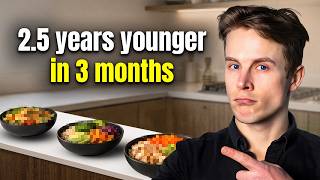

Reverse Aging by 2.5 Years in 3 Months?
45sThe surprising scientific finding that a simple diet can reverse biological age by 2.5 years challenges common beliefs and sparks curiosity.
▶ Play Clip"Delivers exactly what the title promises — a well-supported analysis of a real study with practical protocol details."
A 2024 study in Nature Communications found that three cycles of the fasting mimicking diet (FMD) reduced biological age by about 2.5 years in just 3 months, independent of weight loss. The diet involves 5 days per month of low-calorie, low-protein, plant-based eating that mimics fasting effects, improving metabolic health and immune function.
Three cycles of the fasting mimicking diet reduced biological age by approximately 2.5 years, measured by PhenoAge (based on 10 blood markers).
The 2024 Nature Communications study analyzed blood work from prior RCTs and found improved insulin, inflammatory markers, immune function, and reduced liver fat.
Calorie restriction in monkeys (30% for 8-10 years) gave 7-year age reduction, but FMD achieved 2.5 years in 3 months, making it more sustainable.
Day 1: ~1,100 calories; Days 2-5: 700-800 calories. Low protein (10%), low carbs (30-40%), high unsaturated fat (40-60%). Plant-based, no animal protein.
FMD transiently suppresses white blood cells, then stimulates hematopoietic stem cells during refeeding, regenerating the immune system.
Short-term nutrient shortage activates autophagy, AMPK, FoxO, and suppresses mTOR/IGF-1, leading to cellular cleanup and resilience.
FMD is safe with no muscle loss from human trials; best for overweight middle-aged individuals with poor metabolic health.
The fasting mimicking diet offers a practical, short-term dietary intervention that can significantly reduce biological age and improve metabolic health, making it a promising tool for longevity without long-term calorie restriction.
What is the fasting mimicking diet (FMD)?
A short-term dietary intervention that mimics fasting while allowing food intake, consisting of 5 days per month of low-calorie, low-protein, plant-based eating.
00:28
How much did biological age decrease in the 2024 FMD study?
2.5 years after three cycles of FMD.
00:10
What is PhenoAge?
An estimation of biological age based on 10 common blood markers, validated to predict survival.
01:07
What are the calorie targets for FMD days 1 and days 2-5?
Day 1: 1,100 calories (40-50% of normal); Days 2-5: 700-800 calories (30-40% of normal).
03:44
Why is protein restriction key in FMD?
It lowers IGF-1 and mTOR signaling, which are linked to aging and disease risk.
04:17
What immune system effect does FMD have?
It transiently suppresses white blood cells and then stimulates hematopoietic stem cells during refeeding, regenerating the immune system.
04:45
2.5 year age reduction
Demonstrates a significant and rapid biological age decrease from a simple dietary intervention.
00:10PhenoAge validation
Explains the scientific basis for measuring biological age using blood markers.
01:20FMD protocol details
Provides a clear, actionable dietary protocol for mimicking fasting without full fasting.
02:52Longevity pathways activation
Connects FMD to fundamental cellular mechanisms like autophagy and mTOR suppression.
05:54[00:01] initially completely overlooked. They fasting mimicking diet, and the results were surprising. Participants reduced their biological age by about 2.5 years in just a few months. If that finding
[00:15] holds up, that's a pretty meaningful shift from a relatively simple dietary quite skeptical of the fasting mimicking diet, but over the last few years, should take more seriously. So, in this video, I'm going to share with you the
[00:28] relatively simple and straightforward diet protocol that could lower your biological age by 2.5 years. I'm going to analyze this particular study and the other relevant studies about the fasting mimicking diet. A 2024 study in the
[00:40] journal Nature Communications analyzed blood work data from previous randomized mimicking diet, and they discovered that three cycles of the diet reduced insulin improved markers of immune system functioning. If they used that data to
[00:54] calculate the participants' biological age, the three fasting mimicking diet cycles were associated with 2.5 year decrease in biological age independent of weight loss. First of all, they used phenotypic age to assess the biological
[01:07] age. PhenoAge is an estimation of biological age based on 10 common blood markers, and it's been scientifically validated to have a pretty strong greater survival. There's no 100% perfect way to measure someone's
[01:20] biological age, although it exists as a concept. But, what we can do is look at people's blood markers and other biomarkers, and based on that, predict what their future risk of diseases and mortality is. That's exactly what this
[01:32] fasting mimicking diet study did with PhenoAge. Yes, the headline is that the associated with a 2.5 year lower biological age, but the practical result is that people improved their metabolic risk factors, such as insulin, blood
[01:45] inflammation, and immune cells. They also saw a reduction in liver fat, and most interestingly, these results weren't explained by weight loss. Now, just doing three cycles of this within 3 months, reducing biological age by 2.5
[01:59] years. Now, that's quite an impressive result. However, in 2017, good old calorie restriction of 30% in rhesus monkeys resulted in 7 years younger difference between this is that the monkey study used epigenetic DNA
[02:12] methylation age clocks, whereas the new fasting mimicking study used blood they're measuring different things. I'm personally a bigger fan of the blood blood markers are more clinically relevant and we have a lot more
[02:26] mean. The other huge difference is the were calorie restricted for 8 to 10 years, which is a massive amount, whereas people doing the fasting mimicking diet saw 2.5 year reduction in
[02:39] their biological age scores within only 3 months. That sounds a lot easier and more sustainable than 8 to 10 years of calorie restriction, even if the effects main idea behind the fasting mimicking diet. You're supposed to be able to get
[02:52] similar health benefits, similar metabolic benefits as you get from calorie restriction without actually doing it for long term. So, what does then? The fasting mimicking diet, FMD, is a short-term dietary intervention
[03:06] effects of fasting while still allowing food intake. Basically, you eat a very small amount of calories, specifically lower protein, lower carb, plant-based foods for 5 days of the month. The goal is to not stimulate insulin or mTOR
[03:19] signaling, and this essentially can make the body think that it's still fasting. The FMD was primarily developed by Valter Longo's research group, and it's been tested in both animals and human clinical trials. In both of them, it's
[03:31] been shown to reduce IGF-1, which is a key marker of fasting and feeding. In the randomized controlled trial, people were told to follow 5 days of the 3 months. Their risk factors for cardiovascular disease improved.
[03:44] circumference, body fat, blood pressure, as well as IGF-1, which in high levels what the diet looks like. Once a month for 5 consecutive days, you follow this. Day 1, 1,000 to 1,100 calories, which is around 40 to 50% of your normal intake.
[04:01] Day 2 to 5, 700 to 800 calories, around 30 to 40% of normal intake. The diet is intentionally skewed to suppress growth pathways. It's low protein, around 10% of calories, low carbohydrates, around 30 to 40%, and high fat, 40 to 60%,
[04:17] mostly unsaturated fats. Protein restriction is key because it lowers aging and disease risk. It's also entirely plant-based because plant proteins stimulate IGF-1 less. The foods typically include vegetable soups, nuts,
[04:31] olives, olive oil, herbal teas, and small energy bars or crackers. No animal protein and minimal carbs. After the 5 days, you return to a normal diet with no strict calorie restriction or no food restrictions. Besides the regular weight
[04:45] of the more interesting effects is that the FMD can also improve the immune system. In 2014, Walter Longo and colleagues published a study that showed that prolonged fasting for 2 to 5 days can regenerate the immune system. Mice
[04:59] and chemotherapy patients who didn't eat for several days saw a significant reduction in white blood cell count. This also turned on signaling pathways for hematopoietic stem cells, which are responsible for the generation of blood
[05:11] and immune cells. During the fast, their white blood cell count dropped, which system was slightly weaker. However, after they started eating again, their baseline, and the long-term hematopoietic stem cells rose several
[05:25] times above baseline. 1 year later in 2015, the fasting mimicking diet in mice transiently [snorts] suppressed parts of the immune system and then promoted regeneration-like changes during refeeding, largely
[05:39] through IGF-1, PKA, mTOR pathway suppression. In old mice, they also saw growth of new brain cells, and their median lifespan was 11% longer. This is short-term calorie restriction, whether that be from actual calorie restriction,
[05:54] fasting-mimicking diet. The body does best when you periodically experience nutrient shortage and nutrient stress. It ramps up all these different longevity pathways related to life extension, such as autophagy, AMPK, FoxO
[06:07] proteins, suppression of mTOR and IGF-1, cell senescence clearance, sirtuins, and many others. The short-term nutrient shortage can clear out the junk, ramps up antioxidant pathways, ramps up cellular resilience pathways, and also
[06:20] desensitizes the body towards recovery. Because the benefits are worthwhile if is what regenerates the immune system, as shown by the stem cell study. The key idea is to not experience it long-term, and maybe you don't have to. Maybe just
[06:33] whether that be through the fasting-mimicking diet or through an actual prolonged fast, maybe those can be enough. Overall, I think that the new diet over the last few years have been quite impressive. Many years ago, in
[06:46] 2019 or so, I was a lot more critical of the fasting-mimicking diet because we biggest worry about the fasting-mimicking diet was that it would result in muscle loss. But the new human clinical trials suggest that it doesn't
[06:58] be beneficial for muscle preservation through increased autophagy signaling. would need to do the fasting-mimicking can also be downsides, and it might be just unnecessary. And I think that the
[07:11] best target for the fasting-mimicking diet is like a middle-aged person who overweight, and with slightly poor metabolic health. These individuals can diet. If you want to learn more about how to
[07:24] improve your biological age and overall healthspan without spending hours at the supplements, and get yourself to top 1% of health without obsessing about it, then check out my online community, Youth Longevity It's where you can learn
[07:37] more detailed programs and protocols from me. Link in the description.




⚡ Saved you 0h 07m reading this? Transcribe any YouTube video for free — no signup needed.