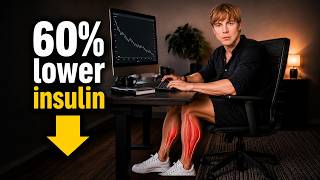

Activate this muscle to slash blood sugar by 52%
39sThe surprising 52% reduction in blood sugar and 60% in insulin response is highly shareable.
▶ Play Clip"Title exaggerates 'destroying your metabolism' but content delivers actionable science-backed exercise to improve metabolism – solid information."
This video explores the soleus muscle, often called the 'second heart' due to its role in circulation and glucose metabolism. A 2022 study found that activating the soleus while sitting reduces post-meal blood sugar by 52% and insulin response by 60%. The video explains how to perform the soleus push-up and its benefits for metabolic health.
The soleus sits under the calf muscle, invisible in a mirror, but recently discovered to significantly reduce blood sugar spikes when activated while sitting.
Sitting for long periods reduces muscle activity, leading to higher insulin needs and blood sugar issues. Gravity impairs blood return from legs, increasing risk of clots and varicose veins.
The soleus pumps blood back to the heart via one-way veins. Its high proportion of slow-twitch fibers allows continuous contraction without fatigue, aiding circulation and glucose uptake.
Researchers at University of Houston published in iScience: participants doing repetitive heel raises while seated after meals saw 52% reduction in blood sugar and 60% reduction in insulin response.
Soleus contractions activate GLUT4 transporters that pull glucose into muscle cells. Because the soleus can contract almost indefinitely, it can sustain glucose disposal for long periods.
Sit with feet flat, toes planted. Lift heels while pressing front of foot down, then lower. Aim for about 100 contractions per minute. Hold the contraction briefly for optimal effect.
The soleus push-up may be more effective than walking for immediate post-meal glucose reduction because walking is energy-efficient, while the push-up creates continuous metabolic demand.
A 2023 meta-analysis showed increasing daily steps from 2,000 to 8,700 is linked to 60% lower all-cause mortality. Walking also activates the soleus, so both exercises are beneficial.
The soleus push-up is a simple, effective way to improve circulation and blood sugar regulation while sitting, making it a valuable addition to anyone's daily routine, especially for those with sedentary lifestyles.
What is the name of the muscle that sits underneath the calf and is called the 'second heart'?
Soleus
02:16
By what percentage did the 2022 study show that activating the soleus reduces post-meal blood sugar?
52%
03:33
By what percentage did insulin response decrease in the same study?
60%
03:33
What protein molecule is activated by muscle contractions to pull glucose into muscle cells?
GLUT4
04:14
What type of muscle fibers does the soleus contain in high proportion, allowing it to contract continuously?
Slow-twitch oxidative fibers
03:08
How many contractions per minute did the researchers identify as optimal for the soleus push-up?
Approximately 100 contractions per minute
05:36
What is the main risk associated with poor leg circulation due to prolonged sitting?
Blood clots, thrombosis, or varicose veins
01:48
According to a 2023 meta-analysis, how many steps per day were associated with a 60% reduction in all-cause mortality?
About 8,700 steps
07:09
52% Blood Sugar Reduction
Demonstrates a dramatic metabolic improvement from a simple seated exercise without diet or walking.
03:33Soleus as a Second Heart
Highlights the critical circulatory function of the soleus, often overlooked in health discussions.
02:39Soleus Push-up vs. Walking
Controversial but evidence-backed claim that a seated exercise may outperform walking for post-meal glucose disposal.
06:28Almost Infatigable Muscle
Describes the soleus's unique fatigue resistance, enabling prolonged contraction for sustained metabolic benefit.
03:20[00:01] most people have never heard of. You can't see it in a mirror because it sits underneath your calf muscle. Most people don't even know its name. However, in 2022, researchers discovered that activating this one muscle while sitting
[00:13] reduced blood sugar spikes after meals by 52% and incident by 60%. The interesting thing is that you don't have to stand up. You can activate it while television, or reading a book. Researchers even called it your second
[00:28] heart because it performs one of the most important in your circulation. In this video, I'll explain what this muscle is, how it works, and exactly how to use it based on both the research and my own personal experience. Also, if you
[00:40] percentile to know what level of health you're at with various different types body composition, and blood work, what are your bottlenecks and biggest assessment in our top 1% health community. Link in the description.
[00:55] sitting for long periods of time is bad specific than people realize. It's not just about gaining more weight. When you eat, glucose enters your bloodstream and your pancreas releases insulin to move
[01:08] that glucose into your muscles and other tissues. Under normal conditions, skeletal muscle is responsible for disposing most of the glucose after a several hours, your muscles become almost completely inactive. As a result,
[01:22] significantly more insulin to keep your blood sugar under control. That's one of the reasons why people experience brain fog and energy dips after eating. And it's also going to increase the risk of diabetes and insulin resistance when you
[01:35] time, there's another problem that almost never gets talked about, and that's gravity. Blood naturally flows down into your legs due to gravity. However, it can't get back up again because of the gravity of the situation,
[01:48] pun intended. Getting blood back to your heart requires help from your muscles. the blood back up again, the blood circulation becomes less efficient. This is where some people will eventually
[02:01] start to get blood clots, thrombosis, or varicose veins because of this poor these problems can be solved by activating one specific muscle. And this had two great uncles who died with thrombosis, so it does run in my family.
[02:16] So, I'm especially invested into this topic as a way to protect my own health and longevity. All right, the muscle is called the soleus. It sits underneath calf muscle you can see in the mirror.
[02:29] The soleus itself is flatter, deeper, and much more resistant to fatigue. second heart because it helps to pump blood back up to your heart. Your heart can pump the blood easily down into your legs, but to get the blood back up
[02:42] again, it needs a pump. And soleus is the pump. Your veins contain one-way valves that prevent blood from flowing backwards. However, those veins still need pressure to push the blood upward. Every time your soleus contracts, it
[02:55] squeezes those veins and pumps blood back towards the heart. When the soleus cycle repeats continuously whenever you're walking or activating the soleus in some other way. However, the circulatory function is only one half of
[03:08] the story. What makes the soleus unique is its metabolism. Unlike many other muscles in the body, the soleus contains an extremely high percentage of slow-twitch oxidative muscle fibers. These fibers are designed to contract
[03:20] continuously for very long periods without fatiguing. Researchers even describe the soleus as almost infatigable, which means the soleus characteristic makes it especially effective for glucose metabolism. All
[03:33] right, this brings us to the study. In 2022, researchers from the University of Houston published a study in the journal I Science to examine what happens when people repeatedly activate the soleus muscle while sitting after a meal. The
[03:46] Participants sat in a chair with both feet on the floor, and they repeatedly lifted their heels while keeping the front of the foot planted on the ground. The participants weren't endurance athletes, they were ordinary adults, and
[04:00] Post-meal blood sugar was reduced by 52%, and insulin response decreased by 60%. That's a substantial reduction considering the participants weren't changing their diet, and they weren't going for a walk after eating. The
[04:14] glucose uptake. Whenever skeletal muscle contracts, it activates a transporter called GLUT4. GLUT4 pulls glucose directly out of the bloodstream and into muscle cells. Every muscle can do this.
[04:26] However, because the soleus can continue contracting almost indefinitely, it can longer than many other muscles. For me personally, I have started to I'm sitting for long periods of time. For example, when I'm flying on an
[04:41] when I'm driving a car, or if I'm just sitting behind a computer. It obviously doesn't replace structured exercise and regular walking, but if you're sitting going to do? The best thing you can make of the situation when you are stuck
[04:55] to do the soleus push-up to help with your circulation and blood sugar The technique is actually very important, but simple. Most people should start by sitting with both feet flat on the floor. Your toes should
[05:10] point straight ahead underneath your knees. Now, press the front of your foot into the floor and keep your toes planted. Think about only lifting the heel, and then lower it back down again. Basically, a seated calf raise. You
[05:22] lower part of your calf rather than the upper calf. The movement should be isometric hold. This is important because Mark Hamilton, the lead researcher, found that holding the contraction produces only about 1/3 of
[05:36] repeatedly contracting and relaxing the soleus. The researchers identified approximately 100 contractions per minute as the optimal speed. Basically, a little bit faster than one push-up per second. If that feels uncomfortable, you
[05:50] per minute and gradually increase over time. The original study had the participants repeat the soleus push-up for many hours because they wanted to see what would be the maximum metabolic effect. Now, realistically, you're
[06:03] probably not going to be able to do the soleus push-up for 5 6 7 hours a day. Maybe you can, but probably not. A much more realistic scenario is to just do sitting for long periods of time. Let's say you're traveling by train, airplane,
[06:16] bus, car, whatever it is. You have 1 hour, 2 hours, 3 hours, just do the soleus push-up for at least half of that time. One interesting point Mark Hamilton brought up is that the soleus push-up might be more effective than
[06:28] sugar. That sounds a little bit counterintuitive because walking is a more strenuous form of exercise than soleus push-ups. But the explanation does make sense. Walking has become an extremely energy-efficient movement
[06:41] evolution. The soleus push-up on the other hand creates a continuous metabolic demand without requiring your body to become more efficient at the movement. It's basically opening up the valve for glucose disposal. Whereas with
[06:54] blood sugar becomes lower as the longer you walk. Now, this doesn't mean that definitely keep walking. The soleus push-up is just a small exercise you can walk when you sit, but you can do the soleus push-up. Speaking of walking, I
[07:09] still think it's one of the best forms of physical activity you can do. A 2023 meta-analysis involving over 111,000 participants found that increasing daily step count from approximately 2,000 steps to around 8,700 steps was
[07:22] associated with roughly a 60% reduction in all-cause mortality risk. Interestingly, most of the benefits occurred before around 9,000 steps. Beyond that point, the benefits continued, but at a slower rate. Walking
[07:35] activates the soleus muscle. So, that's why I think you should aim for at least 8,700 steps a day and up to 10,000 steps. Overall, the soleus muscle is one of the most underrated muscles and the soleus push-up is one of the most
[07:48] a traditional exercise. You don't need to go to the gym, you don't need to change your diet, you don't even need to sit up, and you should especially do it sitting, your blood sugar regulation goes down, your metabolic rate goes
[08:00] down, your circulation declines, and the soleus push-up is the most effective way for watching. If you want to discover your health percentage and get your road community using the link in the description. I'll see you there.

⚡ Saved you 0h 08m reading this? Transcribe any YouTube video for free — no signup needed.