
Waymo is 10x Safer Than Humans
45sThe shocking safety statistic (10.4 times safer) contrasts with the tiny number of robotaxis, sparking curiosity and debate about why they aren't everywhere.
▶ Play Clip"The title is exaggerated clickbait; the video explains Waymo's challenges but does not conclude self-driving cars are doomed—it highlights progress and remaining hurdles."
Waymo's self-driving cars are statistically far safer than human drivers—10.4 times fewer injuries, 80% fewer cyclist incidents, and 92% fewer serious crashes. Yet by late 2025, only 2,500 robotaxis roamed US roads versus 297 million human-driven cars. The technology works, but the real bottleneck isn't the software; it's the messy, unpredictable world the cars must navigate.
Waymo robotaxis cause 10.4 times fewer injuries than human drivers, 80% fewer cyclist/motorcyclist incidents, and 92% fewer serious injury crashes.
Waymo uses lidar, cameras, and hyper-detailed pre-built maps (like Google Street View) to navigate from a bird's-eye view.
The system relies on fixed, pre-mapped routes; any change (construction, detours) can cause catastrophic failure if maps aren't updated.
Rare, unpredictable 'edge cases' (e.g., chicken spill, Halloween costume) stump AI because they can't be pre-programmed.
In emergencies, control is handed to a remote human operator in the Philippines, who guides the AI—a hidden fallback that undermines claims of full autonomy.
Scaling to 10 million robotaxis would require 250,000 remote operators, raising security and logistical concerns.
How much safer are Waymo robotaxis compared to human drivers?
10.4 times safer than human drivers.
What three main technologies do Waymo cars use to navigate?
Lidar (light detection and ranging), cameras, and detailed pre-built maps.
00:51
What percentage reduction in serious injury crashes does Waymo claim?
92% fewer crashes involving suspected serious injuries.
02:08
What is the main weakness of Waymo's mapping-dependent system?
They rely on pre-built maps that must be constantly updated; unexpected changes (construction, detours) can cause failures.
03:28
What are 'edge cases' in the context of self-driving cars?
Rare, unpredictable scenarios that are impossible to pre-program, such as a truck spilling chickens or a Halloween costume confusing sensors.
05:45
What happens when a Waymo car encounters an emergency it cannot handle?
Control is handed to a remote human operator (often in the Philippines) who provides guidance to the AI.
09:27
What security risk did Senator Ed Markey highlight about Waymo's remote assistance system?
Senator Ed Markey warned that overseas remote assistance could be taken over by hostile actors, turning cars into weapons.
10:22
Waymo is 10.4 times safer than humans
Provides a concrete safety benchmark that challenges common fears about autonomous vehicles.
Map dependency is a critical weakness
Explains why even advanced AI struggles with dynamic urban environments, a key barrier to scaling.
03:28Edge cases and the long tail problem
Highlights the fundamental challenge of programming for every rare scenario, a core AI limitation.
05:45Remote human operators as a hidden fallback
Reveals that true autonomy is not yet achieved; humans are still in the loop, contradicting marketing claims.
09:27[00:00] Humans are terrifying drivers, and Waymo proves it. The company's robotaxies have driven millions of miles and caused far fewer injuries than humans. In fact, they're almost 10.4 times safer.
[00:13] Yet by late 2025, there were only 2,500 robotaxies on US roads compared to 297 million human driven cars. The software works. Waymo has the brains, the money, and the data,
[00:26] but one question remains. I'm Josh and on today's episode of the Infographics Show, we're asking if self-driving cars work. Where are they? Chapter one, the invisible tracks. The Waymo system is actually more complicated
[00:39] than you think, which makes sense considering its parent company is alphabet. The Waymo autonomous vehicles engage with the road in fundamentally different ways than human drivers do. The greatest strength and the greatest weakness
[00:51] of Waymo autonomous vehicles is that they think like a machine. They don't reinvent driving. They take the tech that we already use every day, cruise control, collision warnings, lane assist, and they combine it with cameras, lidar sensors,
[01:05] that slight detection and ranging, and incredibly detailed maps of the cities they operate in, collected in a way that is surprisingly similar to Google Street View. While we can only look in one direction at a time, checking mirrors and blind spots,
[01:18] Waymo sees everything from above. It's like a car is tracing its finger across a map, navigating the streets from a bird's eye view rather than from inside of the driver's seat. You're sitting in a remote controlled car,
[01:31] being piloted by an AI system, which has plotted a fixed path. Once the route is mapped out and its 3D model of the world, the AI takes over. It controls the actuators, the systems that handle the steering, acceleration, and braking.
[01:43] It's less like driving, and it's more like the car is being puppeteered in real time. This is all pretty cutting-edge stuff, tech that would seem exclusive to the world of science fiction like 20 years ago.
[01:55] But how does that account for those insanely impressive safety statistics? Because what it's doing is really on another level. In addition to all of those other stats, Waymo cars cause around 80% fewer incidents
[02:08] involving injured cyclists and motorcyclists. At intersections, injury crashes drop by over 90%. Overall, crashes involved suspected serious injuries are down by about 92%.
[02:20] By June 2025, Waymo is claiming to have logged over 96 million miles. And its accident rate was far lower than human driven ride-sharing services like Uber and Lyft. That's all because of human error.
[02:33] People bend the rules when we think nobody's looking. Our minds wander off when we should be focusing. We drive tired, upset, sick, or in extreme cases, drunk and high. Self-driving cars don't have that issue.
[02:47] They've got hard-coded rules, obstacle avoidance algorithms, predictive modeling, and object detection to keep them on the straight and narrow, where people are sloppy, self-driving cars are disciplined. That can be a problem.
[03:01] The exact rigidity and following the plan that makes a Waymo ride so safe is also one of its Achilles heels. The real test for Waymo isn't in the highways. It's the cities. Proving the system works there means it's not just viable,
[03:14] but it is potentially the next step toward a world where no one needs to drive. Because cities aren't static, they're constantly changing, unpredictable, almost like living organisms. When your entire system depends on a highly detailed pre-built map,
[03:28] that map has to evolve just as fast. If it doesn't, everything starts to break down. Maybe a water main bursts. A traffic light fails. A new lane suddenly appears or construction takes over the street.
[03:40] Orange cones, temporary signs, detours, workers and high viz moving everywhere. For a human, it's an inconvenience, something that is stopping you from getting home sooner. But for a Waymo car, it's a different story.
[03:52] If Alphabet hasn't updated the maps, this kind of thing is catastrophic. When you break the invisible track that all these cars operate on, they can't improvise the way a human could. The only question is, can Alphabet actually keep up with constantly remapping every inch of a city
[04:06] to make their driverless cars run smoothly? Chapter two, the long tail of terror. This might be a disadvantage for Waymo and account for some of the barriers facing mass adoption of robot taxis. But remember what we said earlier?
[04:19] This isn't some small Silicon Valley startup. It is Alphabet, Waymo's parent company and the owner of Google and YouTube, which has a market cap of over $2 trillion. It also has access to the finest programming
[04:31] and engineering minds on the planet. Everything they touch seems to turn to gold. Well, except Google Gemini. And they've clearly put their money where their mouth is, adapting the tech and upgrading their mapping game.
[04:43] Every year, they add more cities to their roster with half a dozen at the time of this video's production. In February, 2026, they also began the rollout of their sixth generation vehicles. By this point, they'd clocked over 200 million miles
[04:55] and they have a vision system that their official press release describes as, quote, far beyond the capabilities of human sight or standard automotive cameras. And the cars have ears now, too.
[05:07] It's short for external audio receivers. These devices mainly detect the sounds of emergency vehicle sirens to make sure the Waymo doesn't get in the way of ambulances, fire trucks, or the police. Alphabet has the money and the resources to scale
[05:20] what had once been their pet project. They're getting better and better at mapping and remapping cities. So it's clear that the fluid nature of city structure isn't going to be a barrier for long. But building new technology in the real world
[05:32] comes with a whack-a-mole effect. Fix one problem and another one will pop up before Alphabet could even react. Even if driverless cars can get the sense of location, they're never going to understand people. That is a genuine problem.
[05:45] People in the zone call them edge cases. These are bizarre, highly specific scenarios that are impossible to predict in advance or program a universal response for. It is the horrors of the long tail as statisticians put it.
[05:59] These are the rare but critical anomalies that humans can understand and react to instantly. But they would leave a computer completely stumped. If a truck with a bed full of chicken crates took a turn to sharply and filled the road
[06:11] with screeching poultry, a person would know to slam the brakes. Would a whammo? What if a car's driving down Main Street on a boozy Halloween night and someone in an inflatable dinosaur costume drops a mirror that then confuses the vehicle's digital sensors?
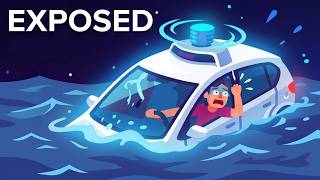
[06:25] Sure, they are hypotheticals, but even more to range things have actually happened. Self-driving cars have driven straight into flood waters because they were never specifically programmed not to. They also didn't know how to avoid an active crime scene
[06:39] where police have their guns drawn. Something a human driver would have the good sense to avoid, most of the time. And in one of the most horrifying incidents we found, a non-whammo self-driving car in San Francisco in 2023
[06:51] ran over a pedestrian and dragged them 20 feet causing multiple serious injuries. That is, well, that's not a very human choice. That said, it's not like Whammo hasn't been involved
[07:03] in some high-profile cases that might have made the public a little bit nervous about getting into a driverless car. Whammo vehicles have consistently been criticized for speeding past stop school buses at dangerous speeds. In 2023, a Whammo ran over a dock.
[07:17] In the same year, two cars crashed into the same truck in quick succession. In 2024, they hit a cyclist and ran into a telephone pole. In one of the most bizarre long-tail scenarios of all, Whammo attracted massive controversy in San Francisco
[07:31] when one of their cars hit and killed KitKat, an internet-famous bodega cat. It caused such an uproar that a local supervisor campaign for legislation that would allow local governments to make self-driving cars illegal.
[07:44] And that feels pretty mild compared to a 2026 incident where a Whammo taxi blocked an ambulance heading to the scene of a mass shooting. Humans are the victims of human error. Driverless vehicles can fall victim to machine error.
[07:57] That's something we've all become a little more familiar with in the age of generative AI. These situations are the kinds of things that only humans can understand because, well, we have lived as humans. We can actually understand what's happening from within.
[08:11] Sometimes, actual truth and reality can be lost in the reams of raw data that driverless cars are trained on. And critics have brought up that it's harder than ever to train computers on these scenarios. That's because actually exposing cars
[08:24] to niche dangerous situations would be both dangerous and extremely costly, given the risk exposed to the hardware. And even then, the problem with long-tail scenarios is simple, no matter how many you train for,
[08:36] the world is chaotic and new ones will always pop up. One proposed solution is using virtual AI proving grounds where the computers that run Waymo vehicles can explore as many scenarios as possible. It improves their batting average,
[08:48] but the same problem remains. They still can't predict everything or react in real time. If a Waymo car freezes up during an unexpected scenario, it might have a death toll. That is the worst case,
[09:00] but it's still an extremely possible scenario. However, in a dire situation, Waymo does have a hidden contingency plan in place. One that reveals a secret that some would argue goes against the entire point of true self-driving cars.
[09:15] One advantage of self-driving cars, you've got more time to watch videos like this, so make sure to like, share, and subscribe. Don't worry, the car won't judge if you binge watch. Chapter three, the ghost in the machine. Self-driving or autonomous vehicles
[09:28] can sometimes be as much a case of marketing spin as they can be a technical term for an emerging science. That's because if an emergency disables the self-driving features, control of the car will likely be handed over
[09:41] to an overworks technician in the Philippines. That is right. For all of Waymo's talk about these autonomous cars being better than human drivers. In a true emergency, it is a human, thousands of miles away who's expected to save you.
[09:55] Waymo has been squirrely about this, saying that the remote workers who are often assigned to as many as 40 different vehicles don't drive the car, so they just provide guidance to the AI system. But at a point, isn't that really just all semantics?
[10:10] And relying on third-party emergency drivers isn't nearly as exciting as the idea of a car that does everything the hype claims. It's also a major security risk, as it opens the system up to potential hacking
[10:22] by a malicious actor. In the words of Senator Ed Markey, who voiced the opposition to the system, overseas remote assistance operations may be more susceptible to physical takeover by hostile actors, granting them driver-like control
[10:36] of thousands of vehicles. They could quickly become the weapons of foreign actors seeking to harm innocent Americans. And when you put it in terms of your cool driverless taxi might suddenly become a giant RC car for a terrorist,
[10:48] 10,000 miles away, you could see why this leaves some people feeling a little concerned. Chapter four, the Capitol Nightmare. When you pull back the curtain at the processes that make Waymo's impressive safety stats possible,
[11:01] it becomes clear that getting this system online is far from a walk in the park. If the autonomous taxi industry eventually reaches a global fleet of, say, 10 million driverless vehicles, we're looking at an emergency remote assistance agent
[11:15] to every 40 or so cars. That means at least a quarter of a million of these technicians need to be active and ready at all times. Think about the logistics. A huge number of employees that need to be hired, trained, paid, and given offices and equipment
[11:30] to do a job that is literally life or death. That kind of upfront development cost would hurt even for alphabet. It makes you wonder, doesn't just having a driver in the car seem a lot less complicated? Even if the risk of getting into an accident
[11:42] is superficially higher. But the truth is, Waymo never really got rid of the driver. They just moved them. Ultimately, if you want to experience being taken from one place to another at affordable prices without needing
[11:55] to drive yourself, we recommend you look into getting a bus pass. Now, check out how Jaguar destroyed its 102-year legacy in 30 seconds, or watch this instead.
⚡ Saved you 0h 12m reading this? Transcribe any YouTube video for free — no signup needed.