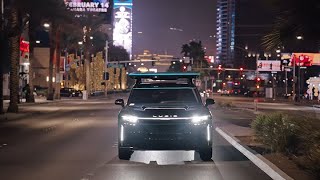

Future of mobility: Human vs AI drivers
38sExplains the realistic mix of human and autonomous vehicles, a common debate.
▶ Play Clip"The title 'The Future of AI-Defined Vehicles' is fairly accurate; the video covers AI transformation in vehicles, but it focuses more on autonomy and specific partnerships rather than a broad future definition."
The future of mobility is multimodal, with a mix of human-driven and self-driving vehicles for years to come. Autonomy requires additional technology, sensors, and high-performance compute platforms like NVIDIA Thor to provide superhuman intelligence.
The future of mobility and autonomy is multimodal, with a mix of human-driven and self-driving vehicles.
Higher autonomy requires additional technology, sensors, and high-performance compute platforms like NVIDIA Thor.
Neuro, Lucid, and Uber are excited about bringing a production version of their Robo Taxi to communities in 2026.
AI is changing the engagement from hardware-centric to software-defined vehicle development.
A true AI-powered cockpit uses natural language to adjust settings based on commands like 'I'm cold'.
Autonomous trucks are the biggest innovation since the diesel engine, using NVIDIA Drive Hyperion and Cosmos for testing and validation.
AI is transforming vehicles from hardware-centric to software-defined, with autonomous trucks expected to revolutionize freight transportation by improving safety and efficiency.
What is the future of mobility described in the video?
Multimodal, with a mix of human-driven and self-driving vehicles.
What technology is needed for higher autonomy in vehicles?
Additional technology, sensors, and high-performance compute platforms like NVIDIA Thor.
00:24
When is the production version of the Robo Taxi expected?
In 2026.
01:04
How does an AI-powered cockpit respond to 'I'm cold'?
It adjusts the settings in the car to the passenger's comfort level.
01:31
What is considered the biggest innovation in transportation since the diesel engine?
Autonomous trucks.
02:08
Which platform is used to enable autonomous trucks to operate at highway speed?
NVIDIA Drive Hyperion.
02:08
What does Cosmos allow for autonomous truck development?
Testing, training, and validating against scenarios not yet experienced in the real world.
02:21
Multimodal Future
Sets the core premise that the transition to autonomy will be gradual and mixed.
Robo Taxi Production in 2026
Provides a concrete timeline for a major autonomous vehicle deployment.
01:04Natural Language Cockpit
Illustrates a practical application of AI in enhancing driver experience.
01:31Autonomous Trucks as Biggest Innovation
Makes a bold claim about the impact of autonomous trucks on the transportation sector.
02:08Cosmos for Validation
Highlights a novel approach to testing autonomous systems with synthetic scenarios.
02:21[00:00] What is the future of mobility and autonomy? It's multimodal. For many years to come, there will be a mix of human-driven vehicles
[00:12] and self-driving vehicles on the road. When we think about increasing levels of autonomy, we have asked ourselves, what does it actually mean for the car design? And what do we potentially have to change?
[00:24] The answer is, of course, we have to add additional technology, additional sensors to increase our model of the environment, but also the underlying high-performance compute platform. The entire NVIDIA development kit,
[00:38] including NVIDIA Thor, that allows us to bring higher levels of high-performance compute into the vehicles as well. It's been incredibly useful for us to have the powerful compute
[00:51] that NVIDIA has been building over the entire history of Neuro and for us to leverage that to provide superhuman intelligence by Neuro on top of that compute in this vehicle. And we are all Neuro, Lucid, and Uber.
[01:04] It's incredibly excited about bringing this production version of our Robo Taxi 2 Communities in 2026. Our goal as a company is to bring autonomy to all roads and all rise.
[01:17] The AI is really changing everything. It's changing the whole engagement between driver and vehicle. Truly shifting from a formerly more hardware-centric development to a software first, which is key for a true SDV development.
[01:31] A true AI-powered cockpit is an assistant with natural language, where you can give general commands or more statements. For example, I'm cold, but a vehicle will change the settings in the car
[01:43] to adjust the surrounding to your comfort level. Where we come in with our long-standing automotive experience, that's cockpit, if that's A does, if that's driving, parking, to bring all that knowledge and combine it
[01:55] with NVIDIA's powerful solutions to really create a great experience for that customer. Autonomous trucks will be the biggest innovation
[02:08] in a transportation sector, since the invention of the diesel engine. Josei and our OEM partners like Trayton are building on the NVIDIA Drive Hyperion platform to enable our autonomous trucks to operate at highway speed.
[02:21] With Cosmos, we can now be testing, training, and validating against scenarios that we never experienced in the real world yet. It's going to be truly transformational across the freight transportation sector, improving both the safety and efficiency of trucks on the road.
⚡ Saved you 0h 02m reading this? Transcribe any YouTube video for free — no signup needed.