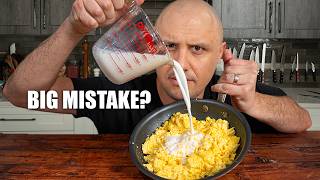

Is milk in scrambled eggs a myth?
44sImmediately challenges a common kitchen habit and promises a definitive answer from testing 10 methods.
▶ Play Clip"Title promises to answer the milk question, and the video delivers a thorough test with clear verdict—though the answer is unsurprising."
In this video, a chef tests 11 methods of making scrambled eggs, including the common practice of adding milk, to determine which technique yields the best results. The experiment covers heat levels, ingredient additions, and timing, with taste tests and commentary throughout.
The host announces a test of 11 scrambled egg methods, including the milk method, to find the best one.
Whisk two eggs for 15-20 seconds, cook on medium-low heat with butter, add salt halfway, and remove while still slightly undercooked for residual heat to finish.
Cook on very low heat for about 2 minutes 10 seconds, resulting in wetter, more broken-up curds but still good.
Cook on medium-high heat, stirring quickly. Eggs lose creaminess and become dry; not recommended.
Add a tablespoon of water to whisked eggs. Eggs become lighter and fluffier but drier and less luscious.
Crack eggs directly into pan, stir with spatula without pre-whisking. Results in uneven texture with visible white streaks.
Add salt to eggs before whisking. Minimal difference from adding during cooking.
No salt during cooking, only flaky sea salt on top. Eggs feel looser in pan; texture excellent but salt distribution different.
Add creme fraiche after removing from heat. Adds slight sourness, but butter-only eggs are preferred.
Add cream to eggs. Results in very soft, jiggly, rich eggs that resist overcooking.
Add a splash of milk. Eggs become watery, cottage-cheesy; host attributes this practice to stretching eggs during the Great Depression.
Best scrambled eggs use only butter, eggs, and salt. Focus on proper heat and doneness rather than additives.
What is the recommended heat level for the chef's go-to scrambled egg method?
Medium-low, even closer to low.
00:36
When should salt be added in the standard scrambled egg method?
Halfway through cooking, when curds start forming.
00:54
How does adding water affect scrambled eggs?
Makes them lighter and fluffier but drier and less luscious.
06:28
Why does the host dislike the lazy man's method?
It leaves streaks of uncooked white, creating a 'snotty' texture.
09:04
What is the origin of adding milk to scrambled eggs, according to the host?
A holdover from the Great Depression to stretch limited eggs.
16:12
What three ingredients does the host recommend for perfect scrambled eggs?
Butter, eggs, and salt.
16:25
Low Heat Sacrifices Texture
Low heat yields wetter eggs but smaller, broken curds, showing trade-off between creaminess and structure.
02:19High Heat Destroys Creaminess
High heat quickly overcooks eggs, losing the velvety texture that makes good scrambled eggs special.
05:20Salt After Cooking Changes Texture
Adding salt only at the end makes eggs feel looser during cooking and produces excellent texture, suggesting salt timing matters.
10:38Milk Method Is a Depression Relic
The common practice of adding milk is traced back to stretching ingredients during the Great Depression, not culinary improvement.
16:12[00:01] a little milk in her scrambled eggs and now you do it, too. But, is it actually the move? Today, I'll be putting the milk method to the test and trying 10 other techniques to see which one makes the best scrambled eggs. Now, let's go.
[00:14] The first method I'm going to show you is the way I've personally been making scrambled eggs for years now. It's my go-to. So, I always do two eggs, you know, guys, you always pop the yolk first. So, I whisk them for about
[00:28] probably 15-20 seconds. Just until I see that it's all together and I don't have any of those streaks of like white in here. And I don't season now. I just leave like this. And then what I do is get my heat on medium-low, even closer
[00:40] to low. I don't want to cook these over really aggressive heat. And I'll add my about right. And then when that butter is about half melted, I put my eggs in right away. And I like to stir like this, sort of pulling the edges around
[00:54] middle. We need to let it cook a little bit first. I don't stir like crazy, you smaller curds, but I like getting these sort of bigger strands. And then when about here, I'm going to put my salt in right now. That's just [music] when I
[01:10] why, but that's just what I do. And we'll just continue cooking. Now, about this stage here, [music] when I start to see these wider sort of pieces that are off. There's enough residual heat in that pan that these eggs will keep
[01:24] personal preference, [music] but for me, I don't want them any more cooked than to get them out immediately. And as you can see, these clearly have a nice people would even like it way wetter than this. Like, you would be surprised.
[01:39] and see what we all think. All right, here we go, Marcus. I don't really know. How do you usually cook your eggs? Worse. Good butter, the right amount of eggs and you think, "Man, are these getting overcooked?" They were
[01:51] overcooked like 2 minutes before that. Have a chef cook you eggs, cuz I ate eggs the same way my whole life and they were so much worse than this. Every time are just scrambled eggs, with butter, salt, and egg, it can be so good."
[02:05] it's it's velvety. I don't know, it's just like fun to eat. So, eggs are down, Marcus, too. We have like 22 more eggs to eat. So, as it stands right now, the only one we've made, so I can't
[02:19] >> I wasn't supposed to eat it all. >> Next up, we are going to be experimenting with cooking scrambled eggs over really low heat. Now, for follow the exact same process as [music] the ones before it for whisking and all
[02:32] that. Now, for the low heat eggs, I'm starting with the heat, well, on low. Very low, though. And again, we'll add our butter right away. And again, when in. And I'm just going to keep [music] that heat low and just give it gentle
[02:45] stirs as we go here. I'll give you a time on how long it takes when it's done. We'll add salt halfway through, just like before. There we are, my friends. That took about 2 minutes and 10 seconds. And I like the way they're
[02:58] So, out they go. And as you can see, these ones are nice and jiggly as well, curds. It's like a little bit more broken up. Let's give it a taste with Marcus. See how it weighs up to mine. All right, Marcus, here we go. So, low
[03:11] Also very good, just a little bit more broken up. Maybe they've got a little >> [music] >> but this one is just kind of more one-sided, but still quite good scrambled eggs. Are they better than the
[03:25] ones before? I somehow still prefer the first one, I guess cuz it's maybe going on, I don't know. Honestly, it's a toss-up. I don't I wouldn't be mad at >> Yeah. I think I like maybe a little more texture. These are a little bit more
[03:38] soupy, and you definitely would >> soupy, but like a little wetter. They're a little wetter because of that low heat. So, it didn't form like a crust like you would see on the outside of a French omelet, where
[03:50] you have that more wider looking egg. Like this is all just kind of yellow. We don't care, but if you always cook your eggs bad, definitely try sunny's first >> Next, to follow up on the low heat eggs, we're going to cook our scrambled eggs
[04:03] on high heat very aggressively. >> So just like before my friend, same deal when it comes to the whisking, except this time we're going over high heat. Like medium high the whole time. I would usually never ever cook eggs this hot,
[04:15] so let's see what this does. In with the butter. All right, here we go. Eggs in, and I'm going to keep that heat high the whole time. And I'm going to stir, not And right here I'm just going to turn the heat off. Those look done to me. And
[04:28] out they go. These ones look much more like some sort of mutant French omelet, yellow. Well, I don't know about white previous ones, you know what I mean. And definitely it has less jiggle to it,
[04:41] what Marcus thinks. Oh hell yeah, more eggs. High heat eggs, honestly, before even trying these, I don't advise you really do this. And this here is kind of like super hurry, which can happen. It's not that they're bad, it's just
[04:55] that they lost that creamy, velvety, silky, luscious thing that I love about good eggs, you know what I mean? No one's going to be upset. >> The creaminess is lost. Like whatever the moisture is that makes it like nice
[05:07] [music] is just gone cuz you fried it. Also, the methods we've done take two set like the sunny's eggs barely longer. So what's your hurry? You need 30 extra >> That's the thing, right? I mean as you can see, eggs overcook so quickly and
[05:20] heat, it's just so much easier to overcook them. And he's a chef. You're Moving on, believe it or not, a lot of people cook scrambled eggs with just a splash of water mixed in beforehand. Let's try it out and see if there's a
[05:34] difference. Here we go. So again, just two eggs, and I've never actually done this, so I'm super curious. Adding about a tablespoon of water. Pop, pop, and we going to follow my standard method, right? Medium low, in with the eggies,
[05:47] and away we go. And you know, one thing you can experiment with when making stir it, you know? Do you want to follow like the same motion like this? You test, or do you want to do like these folds like this? Or do you want to drag
[06:01] [music] something you can really just kind of experiment with and see how you bigger curds or smaller curds, and that's just personal preference. Let me go over salt. Scrambled eggs with water? What the hell, dude? There we have it.
[06:15] always want to kill the heat about like 10, 20 seconds before you think they're done, and out they go. Eggy, watery, eggy eggs. And as you can see, they look pretty standard, got a nice little jiggle to them. Water eggs. Let's see,
[06:28] difference here? [music] They're lighter, right? Just cuz you put water in there, it takes away from the richness a little bit. To me, they feel a little bit more fluffy, but also like a little drier. Like they're not quite
[06:40] as like luscious and velvety as just butter. I think I'm trying real hard to >> something, but I I don't really know why you would do this. I guess to volumize >> If you have like kids or something and you want to spread the eggs. Spread the
[06:53] >> It doesn't make them bad. >> I noticed the texture. To me, it's not just my observation. >> Yeah. But let's move it on. Now, before moving on, if you've been looking for the most convenient way to get the best
[07:06] our sponsor Trade is a coffee coffee based on your actual taste. The beauty of Trade is that every bag is roasted to order by local roasters across the country and delivered right
[07:20] for 2 years now, and I've genuinely They just don't miss. And it's not just random picks, because their team of experts have 500 options to choose from, so you're always discovering something
[07:33] then Trade handles the rest. And if your first bag isn't a perfect match, they will replace it for free until they nail it. I personally love espresso and dark roast and Trade always surprises me with
[07:45] this new Temple Brazil roast and let me tell you this stuff is absolutely amazing, full of flavor. And right now Trade is offering 40% off your first order. Just go to drinktrade.com/thatdudecancook
[07:58] description to check it out. Now back to the recipe. [music] Next up we're going to try out the lazy man's scrambled eggs. You'll see what I mean. Now for this method we're just cracking two eggs. Oh, if you ever get shell in, the
[08:10] best way to get it out is with the shell. I don't know why, it just kind of works. So two eggs going in and we'll add our butter right away as well. And medium low and right away I'll pop those yolks. And I'm just going to use a
[08:23] spatula for this the whole time. I'm just going to stir as they cook. So is this like a way to cheat without dirtying a bowl, right? Is there going pre-whisking? Let's see. They look pretty well mixed even at this stage
[08:36] whites are still there. I don't know if I'm quite going to get that with this spatula, but let's see. I hate when I'm eating scrambled eggs and I have like a >> [music] >> Just get out of here. I don't I do not
[08:48] want snot as a texture in my food. Right there, boom, heat already off and out they come. There's our final product. And as you can see, you know, [music] but let's give this a taste with Marcus and see what's up. Bro scramble. See I
[09:04] white in there. It becomes like multi-textural. I can feel like the white and the difference and I don't I just don't like it looks. I don't like seeing any kind of like little slimy pieces. I would
[09:18] just pre-do it, you know. I don't know. That's just me. Oh, it's got hard boiled dirty move that only someone like Gordon Ramsay would probably do. So we're not yet. Moving on we're going to be experimenting with salt because we're
[09:32] going to add it to the eggs before cooking and and if there's a difference. Now for these here eggs, we're going to add our salt immediately. Pop, pop, and whisk it up. Medium-low heat. Some butter. And again, you guys know how I
[09:44] like to do it. Same process as before. You guys know that I probably spent like, let's see, I've probably done like 4 years of breakfast cooking in something, it's a nightmare, man. Imagine just cooking like hundreds of
[09:57] eggs every single day, poaching them every single different method. It really is like fast and hectic. Okay, there we are. Almost ready. This point, kill the little jiggle. Let's uh give these a taste with Marcus. We're really going to
[10:11] have to try these side by side with like the salt after. Next. Um really trying to be egg detective. Scrambled eggs have never faced this much scrutiny. Honestly, putting the salt in before, during,
[10:24] we're going to find out about after, but like I don't think there's a big is. Although, there might be with just putting salt on like after completely. there's not much of a difference between this and like the first way that I did
[10:38] >> Might be a myth. Following up on our last method, we're going to put the salt difference. And here we go, for these ones, we're literally going to put no salt in during the cooking process. So, first we whisk, in with the butter, and
[10:51] going to keep repeating it. I'm just going to cook these the same way as I've difference now is we're just going to salt them with a little bit of flaky sea salt just on top. No salt mixed in with the egg. Let's see how these measure up.
[11:04] Now, I will say before even tasting these, as I cooked them in the pan, they felt like less seized up, I guess. I don't know, they just felt looser to me. So, that's just an observation from cooking them. Let's see.
[11:17] Dang. I actually like these maybe the most. They're different. I don't like the different, personally. Like, I like the other ones better. But, they are but difference. >> I I I like these. The salt isn't as
[11:29] different, but the texture of the eggs is excellent. That's that's my we're going to be testing out some of our creamy methods here leading up to fraiche and put it in towards the end of the cooking process to see if it makes a
[11:44] seen made popular by Gordon Ramsay. Let's put it to the test. All right, let's try these Gordon Ramsay eggs. So, to start, it's the same exact process. We're going to just whisk and use the butter. Eggs in. And right about this
[11:57] stage, I'm going to kill the heat and we're going to add creme fraiche and the cooking cuz it's cold right out of the fridge. Away we go. There's our creme fraiche eggs. They do look a little bit more shiny. I don't know.
[12:09] fat in them. So, let's give these a taste. See how they measure up. I don't point. It may be starting to cloud my one should eat this many eggs, dude. I'm doing this for you guys, you know?
[12:23] forgot to add the salt. So, we're just going to add it now. I meant to do it able to get the idea. You know, I'm so much more down with just butter and eggs than throwing in the creme fraiche because it adds like a
[12:36] slight sourness. It's not bad, right? I don't know. It's not bad, but like I at all. It's worse than the eggs with just butter. Butter tastes better than hell as an ingredient.
[12:48] it's still not that good. If you want to pretend to be British, then make eggs ingredient you're not even going to have. Picture me with Gordon Ramsay here. Olive oil. Olive oil in. Olive oil Olive oil in. Olive oil in. FRESH. MHM.
[13:00] aren't that good. >> Next, before moving on to our milk cream first to see if there's a difference. So, two eggs going in, it's going to be interesting to try it with cream as well as milk cuz as we
[13:16] know, cream has a much higher fat content than just regular milk. Melt up the butter, in with the creamy eggs. These two already kind of look good with the the I don't know. They just seem rich. Let's get our salt in here this
[13:28] about there, you see? Just turn off the heat. You really just don't need it on. off earlier than that. You can see the way that this look. Look how it slides just feels different. Like it doesn't want to overcook as easily [music]
[13:44] more French to me. A little bit more jiggly, as well. All right, creamy eggs. These are like really soft. Usually, when you turn off the pan, it cooks just kept kind of being wet. Kind of bomb, you know? And if you like wetter
[13:59] eggs, which I do, that's good. I mean, for me, that's like these are good eggs. loose. They're a little wetter than what you would typically cook. I think you'll You'll have to go down the levels of looseness before you enjoy this. And
[14:13] that's what I wanted to say. Quick story time. One of the first restaurants I I made this dude scrambled eggs. He's French, and he sends it back, and he "Dude, this guy is out of his mind, right? Crazy freaky European, right?" A
[14:27] little bit more loose. Send them out. He sends them back again. He says, "I want He sends them back again. I'm like, "This guy is out of his mind." Probably eggs, he was like, "Well, they're still a little overcooked, but I'm going to
[14:40] to you today is to next time you cook your eggs, you don't have to make them like this. Just cook them a little less. See if you like it. If you like that, just keep bringing down how long you cook them until you find something
[14:54] you will be happy you did. >> They're not snotty at all. No. There's no whiteness. There's no uncooked white. It's nice. They're beautiful. Luscious. And last, but certainly not least, grandma's favorite method, your mom's
[15:08] favorite method, adding a little bit of milk to the scrambled eggs. Let's test against the rest of them. And here we go, our final eggs. And I'll tell you just speak volumes about how many eggs
[15:21] splash of milk, just same as the cream. Pop, pop, you know the deal. Milky eggs, here we come. In they go. Does mama know best, you know? I feel like so much cooking information online just gets handed down as common knowledge and
[15:35] nobody ever really tests it and a lot of it is just absolutely false. And we've seen that time [music] and time again. Salt. Just feeling these, they feel kind of like volumized. Nice little jiggle. All right, let's give them a taste.
[15:48] And here we go, final milky eggs. Looks like the most eggs we've had so far. bad. >> Not only are they loose, but like it gives it like this wateriness. Like I
[16:00] way that I'm I don't really love. >> Cottage cheesy. There's like a little little bit similar to the water ones. bleed out a little bit. >> the reason moms do this is cuz their grandmas did this cuz it was the Great
[16:12] Depression. That's it, man. Stretching it out. Water down the ketchup, water down the eggs, water down the vodka after you steal it from your parents. >> So, I think this is more of a survival thing than it is a actual side-by-side
[16:25] goodness thing. Less is more. >> Yeah. Butter, eggs, salt, [music] experiment with how much you cook them and the temperatures you use to cook them. But like once you find your just perfect little balance of everything If
[16:37] you do anything, just buy nicer butter, nicer eggs. [music] Make it easy. Takes >> And that's it, my friends. If you like these kind of experimental videos, here's two more of our favorites from this channel. Otherwise, we will see you
[16:49] know I love you. I'm out. >> Yeah.
⚡ Saved you 0h 16m reading this? Transcribe any YouTube video for free — no signup needed.