
Dry Brine vs Wet Brine Fried Chicken
48sReveals a shocking cooking myth that buttermilk brine ruins crust adhesion, sparking debate among home cooks.
▶ Play Clip"Title accurately reflects the comprehensive, experiment-driven approach to frying chicken."
In this episode, Andrew Rea (Babish) conducts a series of controlled experiments to determine the ultimate fried chicken technique. He tests brining methods, starches, flours, resting times, frying temperatures, and cooking vessels, culminating in a hybrid tempura batter and double-fry method that produces exceptionally crispy and flavorful chicken.
Dry brining with kosher salt creates a tacky exterior that helps breading adhere, while wet brining (buttermilk, salt, egg) introduces excess moisture that causes steam gaps and poor crust adhesion.
Dry-brined chicken showed significantly better crust adhesion compared to wet-brined chicken, which had large gaps and 'dirty' fried chicken appearance.
A custom spice blend includes kosher salt, garlic powder, onion powder, white pepper, celery salt, sweet paprika, ground mustard, cayenne, and MSG.
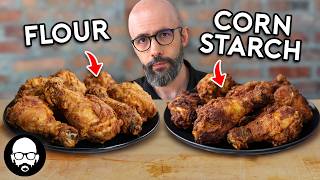
Tested plain flour, semolina, cornmeal, chickpea flour, potato flakes, cornstarch, rice flour, potato starch, and tapioca starch. Rice flour and potato starch performed best for crispness and browning.
Resting breaded chicken for 30 minutes before frying resulted in larger gaps and poorer adhesion compared to immediate frying.
Double frying (first at 315°F, then at 400°F) produced a crispier crust with better adhesion and more craggly texture than single frying at 375°F.
Deep frying yielded better crust adhesion and more even craggles, while shallow frying caused flat spots and gaps from skin contraction.
A tempura-style batter using potato starch, flour, buttermilk, egg whites, vodka, and cold seltzer created an ultra-crispy, well-adhered crust.
Final recipe: dry brine with spice blend, dip in tempura batter, dredge in flour/rice flour mix, double fry (low then high temp). Uses 50/50 lard and peanut oil.
Through systematic testing, Babish debunks common fried chicken myths and develops a superior technique: dry brining, a tempura hybrid batter, and double frying. The result is exceptionally crispy, flavorful chicken that redefines homemade fried chicken.
What is the main advantage of dry brining over wet brining for fried chicken?
Dry brining creates a tacky exterior that helps breading adhere better, while wet brining introduces excess moisture that causes steam gaps and poor crust adhesion.
02:36
What is the recommended ratio of lard to peanut oil for frying chicken?
A 50/50 mix of refined lard and refined peanut oil.
25:01
What are the key ingredients in Babish's tempura hybrid batter?
75g all-purpose flour, 50g potato starch, 100g buttermilk, 30g egg whites, 25g vodka, 120g cold seltzer, and a pinch of salt.
25:27
Why does Babish use egg whites instead of whole eggs in the tempura batter?
Egg yolks contain fat that can soften the breading, so egg whites provide structure without the fat.
25:56
What is the purpose of adding vodka to the tempura batter?
Vodka evaporates quickly during frying, contributing to a crispier crust.
26:09
What temperatures are used for the double fry method?
First fry at 315°F, second fry at 375°F (or 400°F as mentioned earlier).
15:23
What is the effect of resting breaded chicken before frying?
Resting causes larger gaps and poorer crust adhesion compared to immediate frying.
13:12
Which starch provided the best binding properties and structural integrity?
Tapioca starch created a flexible, well-adhered layer that held the crust together.
12:02
What is the recommended cooking vessel for deep frying?
A Dutch oven or high-walled, heavy pot to retain heat and protect from splatters.
30:26
What spice is considered essential by Babish for fried chicken flavor?
MSG (monosodium glutamate).
06:58
Dry Brine Wins
Debunks the common belief that wet brining is superior for fried chicken.
02:36Double Fry Technique
Demonstrates a clear improvement in crispness and crust adhesion over single frying.
15:08Tempura Hybrid Batter
Innovative combination of tempura batter with traditional dredging yields exceptional crunch.
20:28Deep Fry vs. Shallow Fry
Contradicts popular belief that shallow frying improves crust adhesion.
17:52Embrace Failure
Highlights the value of systematic experimentation and learning from mistakes.
33:47[00:02] The subject of today's episode has many faces and many names. Pyofrito, Karag, Milan, Yamyong, Lazi. A universal language to describe a single idea, a dream, a fantasy. Fried
[00:19] chicken. [Music]
[00:40] Unity. As someone who's obviously passionate about at home dining, Cook Unity has brought a new solution to my table. Unlike conventional food delivery services, Cook Unity operates as a chef to you platform, delivering exceptional
[00:53] restaurant quality meals directly to your doorstep. They're so good that our crew eats them on shoot days instead of ordering in. Today, I'm trying the chana masala by Chef Lena Elkusi. Other favorites of mine are the jam-own jerk
[01:05] chicken thighs by Chef Arati Zath and pennet with spicy pink sauce by Chef John Deluchcci. Real chefs, real flavors. That's what I love about Cookity. Upgrade your dining game at cookunity.com/babish50
[01:17] or click the link below using my code babish50 supports this channel and also gets you an exclusive 50% off your first order. Fried chicken. I've made a lot of fried chicken on this channel. Practically every food YouTuber has. So,
[01:31] techniques that I've tried out, some secrets that I've learned along the way, but there's still a lot I want to figure out. So, this episode I'm going to be doing a little bit of science and gathering empirical data for perhaps the
[01:44] first time in my life. I'm going to test out several of the most essential aspects of fried chicken. The brining, the dredging, wet dredge versus dry dredge, different starches, different flowers, different breading components,
[01:57] and tricks thrown in there. And what should result at the end of today is the should result at the end of today is the be all and end all absolute perfect fried chicken technique. That sounds a little lofty, but it's
[02:11] going to be really good. We're we're going to make a really good one. So, let's get testing. Brining is basically the process of Brining is basically the process of introducing meats to acids or salts or
[02:23] both in a liquid or dry format. But then there's the question, do you do it wet or you do it dry? Come on. Everybody likes it wet, right? >> I guess that depends on what we're talking about. Do we like funerals wet?
[02:36] chicken. >> Yeah, but you were trying to make a sex thing. In the case of brining, I think dry brining is going to work better because with wet brine, you're introducing all this moisture to the
[02:49] chicken and moisture evaporating, creating steam is what causes a gap to form often between the meat and the breading. So, I'm going to use chicken like flopping them around, but also because there's no skin, there's no fat,
[03:03] there's no place for a gap to hide. First, for the dry, simply enough, I'm just going to sprinkle it with kosher salt. This is going to at first draw moisture out of the meat, and then that moisture is going to get reabsorbed
[03:16] after about 45 minutes to an hour, creating a tacky, sticky exterior, perfect for hanging on to and clinging to batter. Now, for the wet mixture, I'm going to do a very common combination of buttermilk, salt, and egg. This isn't
[03:29] about flavor. We're trying to figure out what is going to cause the biggest moisture buildup and gap inside the chicken. And now, both these guys are hours, up to 24 if you really want to go crazy. Okay, these guys have been
[03:44] brining for about 6 hours. So, now I'm going to simply bread and fry them at 375° F. Grab these guys straight out of their marinade and just plop.
[03:57] something fry. You feel so much concern for it and like you need to manipulate and check on it, but there's really nothing you can do. It's just got to do nothing you can do. It's just got to do its job. Okay, that's 5 minutes. They
[04:09] It's something's interesting. They have a bunch of dark spots on them. Looks like moisture building up and needing to escape and then burning when it hits the oil. It's kind of gross looking. So now I'm just going to use this same
[04:23] buttermilk egg mixture to dip these guys in cuz it's effectively just the normal fried chicken dip. This dry brine chicken has a nice tacky texture on the outside which is exactly what we want to grab onto the liquid. Wow, that is
[04:38] crazy. I can't wait to show you guys this up close. Like this is fascinating. And it's answering so many questions for me I didn't even know I had. Look at what happened in the buttermilk Bryant one. I think the chicken becomes so
[04:51] moist that all this extra liquid is evaporating and needing to escape the breading and it ends up pushing its way out and you end up with this dirty fried chicken. That's happened to me so many times and I never knew why. Wow. That is
[05:06] just gap city right there. Look at that. just gap city right there. Look at that. There is zero adhesion to the chicken. All that to be said, it's quite tasty. Um, it's very moist from the buttermilk
[05:19] Entire life I've always been like buttermilk brine. Only way to go. Fried buttermilk brine. Only way to go. Fried chicken 100% America. No, dude. I've made it more tender, made it more juicy, but at the expense of a crust that even
[05:34] thinks that it's part of the the production here. It's off somewhere smoking weed in its Trans Am tooling around town looking cool as being kind of an Okay, that's 5 minutes on this batch. Let's see what happens when
[05:48] I slice inside. Some slight separation, but you can see the crust is significantly more adhered to the meat. I got to say, I think it's just as delicious. Like, you're still, I think,
[06:02] getting some buttermilk flavor from the dip. And this is perfectly juicy and tender. It's because it was dry brined. I really think this is the better way to go. Come on, everybody likes it spicy,
[06:14] right? What? All right, so we've determined that dry brine is best. So, now we need to introduce some more flavor. Some of those 11 secret herbs and spices, or in my case, seven or eight or so. So, we're
[06:29] starting with a/2 cup of kosher salt, to which I'm going to add pretty much an equal amount of each of these spices except for the cayenne pepper. Half a teaspoon of garlic powder, onion powder, white pepper, celery, salt, sweet
[06:43] paprika, ground mustard, maybe like half, depending on how how much kick you a whole/ teaspoon, it's not going to be spicy. It's just going to have more between a/4 to a/ teaspoon of cayenne pepper, depending on how you like your
[06:58] pepper, depending on how you like your business. And lastly, we have MSG, essential. I'm not even going to measure this. I'm just going to throw in about a tablespoon's worth. It's a salt substitute, so like it's fine. We're
[07:12] just going to mix these guys together. And you know, it's salt, but I'm still And you know, it's salt, but I'm still going to taste it for seasoning.
[07:24] hitting me hard. But the MSG brings this whole other dimension to it that like that amount, but it's going to make a difference. So, this is what we're going difference. So, this is what we're going to coat our chicken with.
[07:40] >> I don't know. Have you ever been dredged? >> And why are you asking me such a question? I can tell you that I don't think anybody likes getting dredged. Chicken, however, loves it. Next up,
[07:55] flowers and starches. Unless you're making batter fried chicken, you need a dry dredge to finish the breading with. Usually that means flour. But adding different starches, different combinations of flowers can give you
[08:08] more crispness, lightness, aireriness, sometimes at the cost of color, sometimes at the cost of flavor. So I want to try each and every one of these starches. I'm going to do a 50/50 mix of flour plus one of these and see what
[08:21] attributes it ends up giving to the chicken so we can make a master blend of sorts. For the wet element, I'm just going to make something super basic. a going to make something super basic. a beaten egg and uh some buttermilk. This
[08:33] should create plenty of adhesion. I'm going to go dry, wet, dry for each one of these. And then I'm going to fry at 350° F. So that way we can really focus on what each starch or flour is doing to the crust. There is our plain ass flour,
[08:50] and it's crisp, but it's definitely starting to soften. Um, still nice and hot. So, it's good. It's just a normal homemade In fact, there's many things right with that. You can see some of the breading
[09:06] is indeed quite flabby. Got to hit the gym. Not ideal. It's definitely not as crispy as it could be. Next up, we have the semolina flour. This already feels a lot more crisp.
[09:22] it works with seafood. I don't see why flour. This one smelled kind of like McDonald's when I was frying it. N. Nope. Not nearly as crisp as any as either of
[09:38] the first two entrance. Now we have chickpea flour. This one feels pretty these bubbles all over it. I have no idea what could be causing that. Some idea what could be causing that. Some kind of science, I imagine.
[09:58] The potato flake one looks dank. I really wanted to see what would happen if you made fried chicken with dehydrated potato flakes. Basically, instant mashed potatoes. It definitely feels too flexible. There's lots of big
[10:10] crispy craggly bits on the outside, but the base layer of breading is very soft. know, adding potato flakes, not unlike corn flakes or uh potato chips or
[10:27] you like to throw into your breading, this might be a viable option. It adds a definite flavor, too. Not like French fries, but more like handicap bagged chips, but they're fries. That kind of flavor. It's good. I have so much fried
[10:43] chicken to eat, but it's good. Cornstarch smells kind of funny. And it's not as crisp as I expected. I was expecting this to be quite crisp. imagined it was going to be. Maybe I added it in too high a ratio. As a major
[10:59] to go. Definitely having an effect in terms of the crispness, but this needs a better base layer. It might be because I used it as the base layer. I shouldn't have done that. Let's try out this rice flour. Already
[11:13] it feels good. It's a light, airy crunch. There's might be from frying so many things in the oil and it's starting to pick up nicely and quickly. So, I think this is going to end up in our final mixture cuz
[11:28] it's definitely bringing new attributes to the table and it browns well. Let's try the potato starch. It feels good. It feels nice and crisp. This one has a really good rigidity to it. Like it's doesn't have much play as
[11:44] one. I'm going to I'm going to hang on to that one up here in my brain hole. to that one up here in my brain hole. Okay, we have not terribly good rigidity. I can bend that as though it were a child's toy.
[12:02] It's probably the strongest layer of breading. Like, it's flexible. I can bend it around and I won't break the breading. And it's glued to the chicken. It's not going anywhere. I can't I can I can barely peel it off. Some really
[12:17] interesting experiments here. I think there's definitely stuff I want to toy with or maybe make a master blend of flour. Obviously, we need that. Uh semolina, it added a really great crunch. This is still crunchy, too. Like
[12:31] crunch. This is still crunchy, too. Like this is still good. And rice flour did quite well. browned a little better than starches and it added great uh flavor and and it gave it this really light, airy crunch. I think rice
[12:44] flour is a keeper. The tapioca starch I definitely think has some unexpected binding properties. Like it's just made this a very structurally sound piece of chicken, so that could play a role as well.
[12:57] and starches and try to come up with a master blend for our final fried master blend for our final fried chicken.
[13:12] Babish cookware. The decision is clearcut. Come on. Everybody likes not resting, right?
[13:26] on the fried chicken battlefield is, do you let the chicken rest after breading it before frying it? People swear that one method or another will cause breading to stick better. So, easy way to test this out. I have a couple
[13:40] chicken tenders here that have been sitting in the breading for 30 minutes. It's hydrated a lot. It's soaked up a lot of the egg. We'll see if it makes it stick better. So, let's find out what happens when you believe what you read
[13:52] on the internet. All right, there's our rested chicken tenders. Now just going to do a super standard immediate bread and fry. And here's our fresh breaded boys. Let's see what the
[14:09] fresh breaded boys. Let's see what the gap situation is looking like. And there is one. It's adhered to it relatively well. No, it's well adhered. sticking to it quite well. Let's see what happens with the fresh bread.
[14:29] assuredly has a bigger gap. You can see the stark difference. This breading is really well adhered. You have to really push at it to peel it off. This it's adhered, but it is ready to pop off. I'm not a scientist. I cannot tell you
[14:43] definitively which one of these uh works better, but in my personal experience just now, letting it rest does not work better. Personally, for my ultimate fried chicken, I'm going to fresh bread. I'm not going to let it sit around for
[14:55] too long. It's good tendy. >> Come on. Everybody likes getting double fried, right? >> You know, man, I think this bit's getting old. It's the rule of threes,
[15:08] >> Five. >> Fives. That doesn't even sound right. Single fry versus double fry. This one kind of speaks for itself. In one case, you fry once at a high temperature. With a double fry, you fry once at a lower
[15:23] temperature, like 315° Fahrenheit, and then you crank it up to 400 and fry a second time. This basically allows all the moisture that the breading is soaked up to evaporate in the hot oil, so it ends up being way, way crispier. My
[15:36] other hope is it will reduce the gap that forms between the meat and the breading. Because one of the many reasons why that occurs is because you've got muscle fibers contracting very quickly. And by cooking at a lower
[15:50] temperature, in theory, those muscle fibers should contract more slowly. I'm hoping that will result in better crust adhesion. Wow, that looks good. Very light in color. We're going to let this rest for maybe 5 minutes before plunging
[16:04] it into a much hotter oil bath. For the normie chicken, we're just frying right at 375 F. Standard procedure. Things are browning up much more quickly, as is to be expected given the
[16:20] I'm actually not sure if that's what the laws of thermodynamics are. All right, there's our classic fried chicken. Very interestingly, it did not form as many craggles and as rough a surface as the
[16:34] episode, I'm going to have a lot of findings without many explanations. I hope that's okay. So, now I'm cranking the oil all the way up to 400° fast. It's going to sputter because there is moisture accumulating.
[16:51] there is moisture accumulating. Just watch your eyes and your groin. All right, so here is our classic fried chicken single fry 375.
[17:06] It's fried chicken. It's good. Let's see if this guy fares any better. crispier because we've driven so much moisture out of it, but also for some
[17:22] reason in the initial low tempmp fry, all these extra big flaky craggles formed. I've never seen that before cuz I've never a beat this before. A better product in every metric. This is just like way better. So,
[17:39] one big secret to making great fried chicken is double frying. First at a low temperature. >> So, deep fry versus shallow frying.
[17:52] >> Come on, man. Doesn't everybody like it deep? Now, on to the cooking vessel itself. Should you deep fry fried chicken or shallow fry it? But I've seen people on the internet swear by shallow frying because the direct heat with the
[18:07] bottom of the pan can apparently help the crust adhere to the meat and will keep it crispier. It's much more romantic to look at frying in a cast iron pan like that. I'm going to try to flip this nice and early to establish
[18:20] version is definitely going to take longer because we can only really cook it one half at a time. It's got great color on it. It definitely got darker color faster than the deep fried version, but this is looking great. I'm
[18:35] going to pull it. Oh, this stove is going to need a top to bottom kind of going to need a top to bottom kind of cleaning. Ouch. That hurt. And it's because there's huge holes in this. That's insane. Hole
[18:48] number one. Is that the skin that's doing that? It might have been the skin contracting and pulling the breading apart, but no such thing happened here. It's the exact opposite thing that I was led to believe. Not only does putting it
[19:02] on the bottom of the pan compress all the craggles. You can see these craggles resting on the pan. Look, it's completely flat on the on the the sides that were resting on the pan. So, you got no light craggly crisp like this
[19:17] guy. All this stuff gets to float freely. Kind of average everything. Decent crust adhesion. There's definitely a gap, but it's it's so sturdy that it hangs on just fine. All right. Now, we have the
[19:31] pan fried version. Just want to see if this must be the skin. Yes, that is the skin. So, this crack was caused by the skin retracting.
[19:44] There is a definite gap. That takes some effort for me to pull off. Like, it is bonded to the chicken to some degree. This is hardly. I will say slightly better crunch, a little bit more flavor, probably from the direct heat contact,
[20:00] but worse crust adhesion. It doesn't stick to the meat as well. Gaps opened up that didn't on this one. So, I'm inclined to think that this is down home and beautiful and something that's worth taking pictures of and taking video of,
[20:14] the way I'm going to go. I'm going to go deep fried. So far, every tip and trick I've been taught over the years is being upended. Tempura fried chicken. Uh, is this cultural appropriation?
[20:28] >> No, but it could be a very effective way to adhere our dry dredge to the chicken while making every layer super crispy. Tempura, while frying up a lot lighter
[20:40] in color, is really light and airy and crisp and it requires no powder coating. It requires no flour coating before application. So, it's got me wondering if we were to make a sort of hybrid tempura batter. I like the potato
[20:53] It gave great crisp and good flavor, too. 50 grams of potato starch. One egg, too. 50 grams of potato starch. One egg, about 100 grams of buttermilk, 80 g of introduce more water into this situation, but most tempura batters are
[21:10] water-based, so this one will be too. I'm going to add about 120 g of ice cold water. And why not? Let's throw some MSG in there. It's going to make things taste better. We're looking for a consistency of like heavy cream. Looks
[21:24] like a very very light batter. I might need to thicken that up further. Maybe with flour. About Let's do 25 g of flour. Let's try that. We can always thicken it up. I really like the tapioca uh flour for the sort of barrier that it
[21:38] created. It created this like flexible layer that that held the crunches on top. So, I'm thinking we start by coating the chicken in tapioca flour, dip it in our tempura batter, and then roll it in flour. See what that does.
[21:58] in the flour, I think, because it was too thin to be able to support them. So, I had added 25 g of flour. I'm going to add another 25. There we go. We're in double cream territory. How's this guy looking? Got some cracks, I think,
[22:13] forming. All right, knock off the excess starch. Let's see how this stuff behaves. Oh, way better. Way better. I like the look of that. So much better. I think I wouldn't mind it even thicker. But this
[22:26] does feel a lot more robust. Like it's got more body to it. So, let's pull this got more body to it. So, let's pull this guy. He's looking done. Let's try out this guy for a change. I am going to try adding 25 more g of
[22:40] am going to try adding 25 more g of flour. Maybe like 20 g just to keep it science, but then again, I never said it would be. So, let's see. This guy looking good.
[22:53] Let's try the one more test. Thickest yet. I'm going to try the first one. This is the thinnest batter. It looks really intact. Like there's no major cracks where I can see through the meat. Even over this big exposed patch, it's
[23:07] Even over this big exposed patch, it's also like really crispy. Like, wait till also like really crispy. Like, wait till you hear this. That works. Let's try the medium thickness one. Wo! Feels really crispy.
[23:29] crust is. The shatters are in these definite shapes. Okay, here is our thickest tempura batter version. It feels insultingly crisp. Like it is Wow, it's strong. If I press on the crust, there's no give whatsoever. It just
[23:44] cracks. Look at that. This piece is flying off. say it lightly. That's fabtacular. the parts where the meat is exposed, it's
[24:00] parts where the meat is exposed, it's just glued to it and it's so crispy. Wow. So, I think we've definitely landed on something special here. A tempura breaded hybrid. Onward to the master fried chicken recipe.
[24:16] >> Come on. Master fried chicken recipe. This one's probably pretty difficult, >> Well, mastery askketh not for your time. It askketh only for your patience and >> What? >> All right. So, we've had a lot of fun.
[24:32] We've done a lot of experimenting and we've learned a thing or two. Just like these experiments, I've done a lot of little experiments of my own. Also, with Rachel. So, we've tried a whole bunch of different iterations of this and we've
[24:46] landed on a formula that I think might just goddamn work. There's only one way to find out. It's time to make the ultimate fried chicken. obviously is fat. And I've experimented over the years and over the past few
[25:01] different flavors. And my favorite continues to be a 50/50 mix of lard and peanut oil. Now, there's a couple things to look out for here. You want to make sure that you've got refined lard and refined peanut oil. Highly refined,
[25:15] processed, and it's got a higher smoke point closer to 400° Frenheit, which is exactly where we want to go. So, I'm going to mix these together. We've got our chicken brining and our fat melting. What about our breading? First up, the
[25:27] wet stage. And I'm going with this sort of hybrid tempura batter. Now, this is going to create an adhesive layer that itself cooks up crispy. So, it should make the whole thing hilariously crispy. First, for our dry ingredients, I have
[25:40] 75 g of allpurpose flour. And I have 50 g of potato starch. Pinch of salt. Give that a little whisking just to get any potato starch lumps out of there. Now for the liquid elements, we have 100 g of buttermilk and we have 30 gram of
[25:56] liquid egg whites. Egg yolks have a lot of fat in them and that can cause the breading to soften. So this should give the same kind of structure without any the same kind of structure without any of the fat. 25 g of vodka and then 120 g
[26:09] of cold seltzer. It is important to fold tempura batter if there's lumps in it. It's kind of overdo it. Otherwise, you're going to
[26:22] have a gummy sort of texture to everything. There we go. And you should end up with something that has the consistency of like a lumpy thin paint or like a very, very thick cream. Somewhere between paint and cream.
[26:36] right back after these unimportant right back after these unimportant messages from non-sponsors.
[26:56] [Music] Babish cookware. Checkmate. Atheists. that I'm using two very different bowls here. I have a wide shallower bowl for bowl for the wet. That's going to help me submerge chicken pieces more easily.
[27:13] And then in the wider, shallower bowl, this is going to help me toss and press and really, you know, manipulate them more easily. So, we've got 300 g of Now, I really like the way that this
[27:26] white rice flour behaved, and it should uh slow down the rate of browning a starting to use big whole chicken pieces, which need longer time to cook. It's 300 g of flour. I'm going to add like 50 g of white rice flour. Now, as
[27:40] per always, even with this tempura batter, we're going to grab a little spoonful of the wet, add it to the dry. Makes these little craggles. Makes these little pieces of of breading that make the chicken extra super crispy. All
[27:53] right, let's get our hands dirty, so to speak. So, let's start with these breast Now, of course, you could do wet hand, dry hand technique, but I've been making chicken all day, and I'm kind of beyond caring. So, that's uh what I'm gonna do
[28:09] here. You can see that it's adhering to the chicken extraordinarily well. Like, this has no dry flour coating to try and help with that. It's just on there for sure for serious for all ways. Want to make sure that these guys get powdered
[28:25] immediately as soon as they get in there. Like, cover them up because if you just start tossing them around while they're only half covered in flour, the uh wet is going to start to smudge off as you manipulate them. And this is
[28:37] going to get you more craggles. See how many craggles attached to it now? All many craggles attached to it now? All those little bits. There they are. bring it down to 300. Oh man, that
[28:52] never tried this particular technique with a double fry. And I'm not joking when I tell you this. It might be too crispy. It might be too crispy. Oh man, look at how freaking crackly they are. They have
[29:06] the most beautiful texture of any fried chicken I've ever seen. I just want a there yet. The great thing about the slow and low is that it's going to pretty much cook the chicken through. Any dark meat pieces might be
[29:19] undercooked in that they should be up around 185 and they're at 160 or something. But it's ready to be either, you know, just hang out at room temperature for like 30 minutes or go in the fridge wrapped up overnight to be
[29:31] fried hot and fast the next day. You're going to have the best fried chicken in the world. I can't believe this. These are only par fried. They should be soggy as right now, but they're already a little crunchy. Wow.
[29:43] right, I'm going to start pulling them out cuz they're starting to look pretty blonde. I'm going to kill the heat because I need to strain this oil now. because I need to strain this oil now. Spectacular.
[29:59] always do like I'm wearing right now. Wear leather shoes when you're deep from everything, but they will give you a little little protection. There's our let those sit for about 30 minutes. And in that time, I'm going to strain the
[30:14] particulate that's going to burn when we get up to 400. Let's get this oil carefully back into its now clean vessel. You'll notice that I'm using a
[30:26] highwalled sauté pan. I would not recommend you doing this. Um, I'm doing it so you can still see what's going on. I would recommend using a Dutch oven, something highwalled and heavy that's going to retain heat and protect you
[30:39] from splatters. So now I'm going to crank this guy back up to like 375. Uh don't want to smoke that lard. So I think 375 is going to be plenty hot. there. It's going to spit and spatter. It's going to be a little scary, but
[30:54] it's all the moisture that's been absorbed by the crust cooking off. For this final fry, I want you to join me in a guided meditation. Please close me in a guided meditation. Please close your eyes. Take a deep breath
[31:14] and imagine chicken so craggly it defies crag expectation. Crust so glassy crisp you mistake it Crust so glassy crisp you mistake it with the bone dry sands of the Kalahari.
[31:27] Meat so moist and tender you'll wonder if it's your own. visuals so divine you'll forget entirely that I forgot to hit record on the stove cam. So, we
[31:39] don't have any footage of this final fry coming out of the oil. Take yourself there and forgive me me unconditionally.
[31:54] breakthrough here today. >> Yeah. my god. There you have it, folks. My ultimate fried chicken. This is probably
[32:09] ever had. This chicken is crispy.
[32:25] Those subtle spices from the dry brine are bringing that classic fried chicken flavor. Lard smells like death. Makes fried chicken taste like life. Like fried chicken taste like life. Like unreal. And the crust is just so
[32:38] powerfully both crispy and crunchy. It has crunchy bits on the outside and it's crispy on the inside. No part of this is not crispy. That is so special. I'm so thrilled to have not only been able to figure this
[32:53] out, but to now get to share it with you guys. It's way fussier than most fried chicken recipes. It requires a couple specialty ingredients, some vodka, some potato starch, stuff like that. But it all comes together to make something
[33:06] you've had fried chicken like this before. It's crunchy in a new kind of way. No part of it isn't crispy or crunchy. The chicken is so juicy and flavorful from the dry brine, from the different fats we're frying in. There's
[33:20] so much going on here. It's utterly classic fried chicken, but everything about it is amplified. Everything about it is louder and and stronger and crunchier and more flavorful. And I'm so thrilled that now you guys get to try
[33:32] this if you want. I think I might have learned more making this episode than I have in any other. And all it took was trying things and seeing what happens. Part of this show, part of this channel has always been embracing failure
[33:47] because it leads to new successes. And that's exactly what this episode was about. Controlled, observed failure in pursuit of the greatest success of all,
[33:59] very, very crispy fried chicken. Please let me know in the comments what recipe or dish you want to see me workshop the hell out of next to create the ultimate version. Thank you so much for watching. Keep it crispy out there from all of us
[34:13] Keep it crispy out there from all of us here at Babish International Studios Pictures Incorporated Logistics and Suns.
[34:26] Thank you. And go fry some chicken before I love you to death. Thanks so much again to Cook Unity for sponsoring this episode. With dishes meticulously crafted by esteemed chefs like Food Network
[34:39] recipients, it feels as though you have the masters personally catering to your meal time with a flexible schedule. With Cook Unity, you can set your preferences like. Then pick a plan and get menus tailored to your taste 2 weeks in
[34:53] advance. The Cookity menu offers over 10 dietary preferences, and there are 300 meals nationwide to choose from every week. Go to cookunity.com/babish50 or click the link in the description and use my code babish50 to get 50% off your
[35:07] first order of Cook Unity meals to try them out for yourself. Come on. Everyone likes it wet, right? >> Huh? right? >> What

⚡ Saved you 0h 35m reading this? Transcribe any YouTube video for free — no signup needed.