
Starship Launch Aborts at T-0!
60sThe dramatic last-second abort of a massive rocket launch is inherently suspenseful and visually striking, making it perfect for hooking viewers immediately.
▶ Play Clip"Delivers a thorough analysis of the abort, but the title overpromises 'major problem' when the video is more of a detailed breakdown."
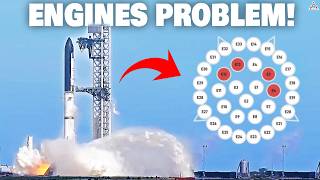
SpaceX's Starship Flight 13 launch attempt on July 16th was aborted at T-0 due to four Raptor engines failing to ignite, prompting a detailed analysis of the cause and implications. The video explains the systemic nature of the failure, the differences between static fire and launch conditions, and the strategic decisions made by SpaceX, including engine replacement and the broader context of the space race with Blue Origin.
Starship Flight 13 was halted at T-0 because four Raptor engines failed to ignite, triggering an automatic abort. The launch was scrubbed, and SpaceX began investigating.
SpaceX posted a brief statement about standing down, while Elon Musk explained on X that some engines didn't start, causing the abort, and that two Raptors would be replaced.
Sharp-eyed viewers counted four engines that never lit (E5, E6, E12, E13), all in the middle ring, suggesting a systemic issue rather than random failures.
Just six days before, booster 20 had successfully static fired all 33 engines, indicating the engines were not inherently broken. The change was in the ignition sequence, rewritten after Flight 12 issues.
The Raptor is a full flow stage combustion engine, requiring precise methane-oxygen mixing. If an engine drifts out of the startup window, it risks catastrophic failure, so the computer aborts rather than gamble.
Data showed two engines had genuine hardware anomalies, while the other two were shut down by the computer before their turn. The failed engines cannot be trusted and must be replaced.
Losing an engine mid-flight is manageable because the rocket has speed and can compensate, but at T-0, all 33 engines are needed to lift the 5,000-ton rocket, and losing four could cause a catastrophic tilt.
NASA experienced similar aborts, like STS-41D in 1984, where computers caught an anomaly seconds before SRB ignition, proving the safety system's value.
Maritime warnings suggest July 20th as the primary date for Flight 13, with alternates through July 25th. The booster and ship were rolled back for engine replacement.
Blue Origin introduced a more generous equity package with golden handcuffs to retain employees, as SpaceX's IPO made many employees paper millionaires, intensifying the talent war.
The abort caused SpaceX stock to drop over 3% in after-hours trading, highlighting that every launch attempt is now scrutinized by investors.
The abort was a demonstration of the safety system's reliability, not a failure of Starship. SpaceX is moving quickly to replace engines and likely launch within days, while the broader space industry faces talent and financial pressures.
What triggered the automatic launch abort on July 16th?
Four Raptor engines failed to ignite, triggering an automatic launch abort.
00:08
How many engines failed to ignite, and what was the pattern?
Four engines (E5, E6, E12, E13) failed, all in the middle ring, in pairs, suggesting a systemic issue.
02:18
Why did the static fire succeed but the launch attempt fail?
The ignition sequence was rewritten after Flight 12, and the static fire used different propellant loads and pressures, so the new sequence was first tested under real launch conditions on July 16th.
03:37
What is the Raptor engine cycle?
The Raptor is a full flow stage combustion engine, the most complex engine cycle ever flown.
04:49
Why is losing an engine at ignition more dangerous than losing one in flight?
At T-0, all 33 engines are needed to lift the rocket; losing four could cause lopsided thrust and a catastrophic tilt, whereas in flight the rocket has speed and can compensate.
06:11
What did SpaceX do with the two engines that showed hardware anomalies?
They removed and replaced them, as a Raptor that misses its startup window cannot be trusted without a full teardown.
05:29
What was the primary date for the next launch attempt according to maritime warnings?
July 20th, with alternates through July 25th.
08:03
How did Blue Origin respond to SpaceX's IPO?
Blue Origin introduced a more generous equity package with a catch: leaving for a competitor within 18 months forfeits all shares, known as golden handcuffs.
09:16
Systemic Failure Pattern
The clustering of failed engines points to a systemic issue, not random failures, which is crucial for diagnosis.
02:18Raptor Engine Complexity
Explains why the computer aborts rather than risk igniting an engine on bad terms, highlighting the engineering trade-offs.
04:49Survivability of Engine Loss
Clarifies the counterintuitive difference between losing an engine at ignition vs in flight, a key principle in rocket design.
06:11Talent War Intensifies
Shows how SpaceX's IPO and Blue Origin's response are reshaping the space industry's competitive landscape.
09:16[00:08] halted. Not the outcome any of us were hoping for, but this wasn't without reason. The cause is a major problem with the new generation Raptor engine, one that's holding up this historic launch. So, what have SpaceX and Elon
[00:21] Musk explained about it? What's the fix? Let's analyze with Alpha in today's episode. Let's go back to July 16th at Starbase, Texas. Ship 40 sits stacked on top of booster 20 carrying 20 Starlink V3 satellites, and everything runs
[00:37] almost suspiciously smooth. The launch window opens at 6:45 p.m. The team is go, and over 5,000 tons of liquid methane and oxygen, roughly the weight of a dozen fully loaded Boeing 747s, flow into the rocket. Weather looks
[00:53] good, systems look good. The crowd holds its breath. Then the countdown hits its final 5 seconds. In the final second, the ignition sequence begins. From the drone camera high above the pad, you see smoke and steam billowing beneath the
[01:08] booster. A few engines flare to life, but not all of them. And instantly, everything stops. All of it. The giant rocket just stands there on the pad as if someone had pulled the plug. On the live stream, the voice of SpaceX's Dan
[01:22] Hwitt comes through, calm, but unable to hide the disappointment. >> No Starship launch today. Uh, we'll dig in with the teams, figure out what happened, and figure out when our next attempt is going to be.
[01:34] >> Minutes later, SpaceX's official account posts exactly one line. Standing down from today's flight test attempt. Short, cold, classic SpaceX. But Elon Musk isn't so cold. About 10 minutes later, he posts on X. Some of the engines
[01:50] didn't start, triggering an automatic launch abort. Now offloading propellant next launch attempt hopefully in a few days. Presumably after the first report landed from the engineering team, he's back on X with the followup. To be
[02:03] confident of a good flight, two Raptors will be removed and replaced. Just a few feeling as hyped about this as I am, drop a comment go 13 to cheer SpaceX on. Now, this is where the puzzle begins.
[02:18] two engines to be replaced, but sharpeyed viewers rewinding the stream's telemetry counted four engines that never lit. The analysis community on X went even further. According to a widely shared diagram, the four positions that
[02:32] shared diagram, the four positions that failed to ignite were E5, E6, E12, and E13. And they failed in pairs, sitting right next to each other, all in the middle ring of the engine cluster, not scattered randomly around the outer
[02:45] ring. That detail changes how you look at the whole problem. Think of it this way. You come home, flip the light switch, and four bulbs in the same corner of your living room all stay dark at once. What do you think? Certainly
[02:58] not. What a coincidence. All four bulbs burned out at the same time. You suspect the fuse, the wiring, the thing all four bulbs share. Four engines clustered in one zone, refusing to start together, points very strongly at a systemic
[03:12] issue. Maybe the propellant feed to the inner ring, pressure not hitting its thermal conditions in the central section. But wait, if it's a systemic problem, why did booster 20 sail through
[03:24] its static fire flawlessly? Before we dive deeper, could you take 2 seconds and hit the subscribe button? Just to check if it still works, because nobody's touched it all week, and I'm starting to think it's broken. Now, back
[03:37] to the mystery. This is the piece that makes the story so much better. On July 10th, just 6 days before the launch attempt, booster 20 test fired all 33 engines right on the pad. Every one of them lit. Every one of them roared. If
[03:53] those four engines were truly broken, they should have shown their faces that day. So, look at what actually changed in those six days. Not the engines, not the booster, the sequence. After flight 12, the flight where the booster flipped
[04:07] a full 90° off course and five engines refused to relight, SpaceX rewrote the ignition sequence from the ground up. New timing, new startup conditions, new multi-engine environment. And here's the
[04:22] thing about a static fire. It is never a perfect copy of launch day. Different propellant load, different tank pressures, different software configuration. July 16th was the first time the new sequence ever ran with a
[04:35] fully fueled stack under real launch conditions. The old rules gave those four engines a pass. The new rules did not. The software didn't create the fault. It exposed it. And there's a reason those new rules are so ruthless.
[04:49] The Raptor is a full flow stage combustion engine. The most complex engine cycle ever flown. During startup, methane and oxygen must meet at exactly the right ratio, at exactly the right millisecond. If an engine drifts outside
[05:03] that window, and you light it anyway, the flame doesn't just sputter, an oxygen-rich fire at those temperatures cuts through turbine blades like a torch through wax. This is why the computer would rather kill the entire launch than
[05:15] ignite one engine on bad terms. It's not being cautious. It's refusing to gamble, which finally explains the two versus four mystery. Four engines went dark, but the data tells two different stories. Two of them show genuine
[05:29] hardware anomalies. The kind of readings that mean an igniter, a valve, or a turbo pump can no longer be trusted. The other two never got the chance to fail. The computer shut down the whole group before their turn came. And once a
[05:44] Raptor has missed its startup window, you don't repair it on the pad. You can't fully trust it again without tearing it apart. So SpaceX did the SpaceX thing. Pull both out, drop new ones in, fly on the ground. A heart
[05:58] transplant is far cheaper than open heart surgery in the sky. Which brings us to the best question of this entire event. Why is losing an engine in flight survivable? But losing an engine at ignition potentially catastrophic.
[06:11] Sounds backwards, right? But think back to October 2012. A Falcon 9 on the CRS1 mission lost an entire Merlin engine mid ascent and still completed its mission
[06:23] delivering cargo to the ISS. In the sky, the rocket already has speed. It's already lighter from burning propellant and the remaining engines just burn a little longer to compensate. It's like your car losing a bit of power while
[06:36] cruising on the highway. Annoying, but you still make it home. But at T0, a 5,000 ton rocket needs all 33 engines straining at full power just to lift itself off the ground. Losing four engines at that moment is like an
[06:50] overloaded truck stalling halfway up a steep hill. And it gets worse. Those four dead engines sat on one side of the cluster. The thrust would be lopsided. If the computer had forced the liftoff anyway, the rocket could have tilted,
[07:04] slid, and turned the entire launch pad, hundreds of millions of dollars of infrastructure, into a fireball. History has seen moments just like this. NASA's multiple times after its main engines had already ignited. The first in 1984
[07:20] on STS41D when the computers caught an anomaly and shut everything down just seconds before the solid rocket boosters were due to light. And once those things ignite, nothing on Earth can turn them off. The
[07:33] astronauts that day sat on top of a bomb that a computer had just diffused. So the abort on July 16th was not a Starship failure. It was the moment the safety system proved exactly how much it can be trusted. The only question left
[07:47] is how long until it flies again. Can you guess? Drop your prediction in the comments. Let's see who gets it right. I'll go first. Wednesday afternoon, July 22nd. Your turn. One hint before you answer. Maritime authorities have just
[08:03] updated the Indian Ocean navigational warning for flight 13. July 20th as the primary date with alternates through the 25th. And the forecast at Starbase looks good for those days. So don't expect a weather delay. If anything pushes this
[08:18] launch again, it won't be the sky and it won't be transport logistics either. Ship 40 and booster 20 were both rolled back to the production site on the morning of July 17th, one after the other, which means rolling back out on
[08:32] the night of the 19th or the morning of the 20th is entirely on the table, just in time for the earliest launch date. The pieces are moving fast. Still, there's a little sting of regret in all this, isn't there? Whether by design or
[08:46] by chance, SpaceX picked July 16th, the day when 57 years earlier, the whole world held its breath as a Saturn 5 carried Apollo 11 away from Earth. If flight 13 had flown that day, it would have been one of the most beautiful
[09:01] mirror images in spaceflight history. The generation of rockets that first generation of rockets that will take us back. History didn't give us that gift, another day. And while Starbase swaps
[09:16] engines, the space race is heating up on a very different front. Not on the launchpad, but inside employment contracts. On that same July 16th, news broke that Jeff Bezos's Blue Origin is rolling out a far more generous equity
[09:30] package for its employees. Why? Because ever since SpaceX went public on June 12th in the largest IPO in history, roughly 4,400 of its current and former
[09:42] employees have become paper millionaires. From executives all the way down to welders. About 400 of them are now worth over $100 million. Blue Origin had to respond or watch its talent walk out the door. But the new
[09:56] package comes with a controversial catch. leave for a competitor within 18 months and you forfeit every share. Financial advisers have a name for it, golden handcuffs. The war for talent between these two giants is now every
[10:10] bit as brutal as the race to orbit. And in a bitter twist, the very abort on the afternoon of July 16th send SpaceX stock down more than 3% in after hours trading. A reminder that from now on, every second on the Starbase launchpad
[10:25] is being watched by Wall Street. Back to the rocket lying in the mega bay. Two new engines will go in. Data from thousands of sensors will be dissected down to the millisecond. And somewhere in that mountain of data lies the final
[10:38] answer to why four musicians in a 33piece orchestra went silent at the exact moment the conductor raised the baton. On July 16th, 1969, humanity left Earth to touch the moon. On July 16th, 20026, a computer decided that humanity
[10:54] should wait a few more days. And maybe that's the most astonishing part of all. three astronauts to building machines wise enough to say on their own. Not today. Once again, a huge thank you to everyone still here at the end of the
[11:09] video. You're the best part of this channel. Have a great day and don't forget to subscribe because flight 13 is about to fly and you'll want to be here when it does. Teams are working through Starship system activations, performing
[11:22] initial tower chopstick motion tests, confirming the operation of the hold downs on the launch mount, and performing multiple integrated tests of diverter, and launch mount. With Starship coming to 39A, the launch
[11:35] complex will soon have two operational pads for two very different rockets with Starship and Falcon Heavy. It has been awesome to see the 39A Starship program it's going to be exciting to soon see a Starship launch from this historic pad.
[11:51] >> Yeah, we're super excited. But 39A isn't SpaceX's only pad in Florida. Just a few miles down the coast at Space Launch Complex 37, the first of two Starship launch pads at that site is quickly taking shape. Pad 37A is targeted to be
[12:07] ready for flight operations early next year, which is very fast considering we only started construction on the pad in November.




⚡ Saved you 0h 12m reading this? Transcribe any YouTube video for free — no signup needed.