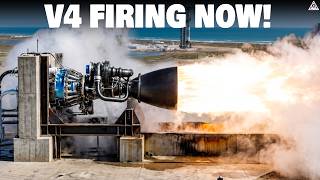

Raptor 4: Mars or Bust?
55sThe bold claim about Mars colonization timing sparks curiosity and debate.
▶ Play Clip"Delivers solid technical details on Raptor 4, but the title's '4X Upgrade' is exaggerated and the intro includes a lengthy subscribe plug."
The video discusses SpaceX's Raptor 4 engine, the successor to Raptor 3, which is expected to power the Starship V4. It covers the engine's development history, technical innovations like the full flow staged combustion cycle, and its implications for Mars colonization, including cost reductions and the potential for nuclear propulsion.
Raptor 4 is the successor to Raptor 3, building on its power, reusability, and production cost improvements. It is confirmed by Elon Musk and planned for Starship V4.
Fully stacked Starship V4 could reach 142 meters tall, nearly as tall as the launch tower at 144.5 meters.
Raptor 1 was a test version, Raptor 2 was refined, Raptor 3 was a major leap, and Raptor 4 is expected to mature and mass-produce the breakthroughs.
Raptor 4 won't match F-1's brute thrust (680 tons) but uses higher chamber pressure (350 bar vs 70 bar) for efficiency.
Expected chamber pressure beyond 350 bar and thrust between 300-330 tons per engine.
Raptor uses two preburners (fuel-rich and oxygen-rich) feeding all exhaust into the main chamber, achieving ~99% combustion efficiency.
Extreme temperatures require proprietary superalloy SX500 and regenerative cooling channels 3D printed into the walls.
SpaceX has destroyed over 30 engines and melted over 50 combustion chambers during testing.
Raptor 3 costs under $1 million each; Raptor 4 target is under $250,000, making 480 Raptors cost about the same as one RS-25.
Starship requires 12-18 tanker launches for lunar missions; Raptor 4 could reduce this to five or fewer.
Best Raptor ISP is ~380 seconds, limiting Mars transit to 6-9 months, prompting consideration of nuclear propulsion.
Nuclear thermal engines could provide 900+ seconds ISP, cutting Mars transit to 3-4 months, but DRACO was canceled due to SpaceX's low costs.
NASA plans a fission reactor on the lunar surface before 2030 and a rover using radioisotope thermoelectric generator.
Nuclear starships have decay heat issues, making turnaround times a month, but become economically viable for large-scale Mars colonization by 2038-2042.
Raptor 4 represents a significant step in rocket engine technology, enabling cheaper and more frequent launches, but chemical engines have limits. Nuclear propulsion may become necessary for large-scale Mars colonization, with a likely window in the late 2030s.
What is the expected thrust range for Raptor 4?
300-330 tons per engine.
03:41
What is the full flow staged combustion cycle?
Two preburners (fuel-rich and oxygen-rich) power turbines, and all exhaust is fed into the main combustion chamber for a second burn, achieving ~99% efficiency.
04:10
What is the target cost for Raptor 4?
Under $250,000 per engine.
07:10
How many tanker launches are estimated to refuel a Starship for a lunar mission?
NASA estimates around 16, Elon Musk believes as low as 8, reality likely 12-18.
08:45
What is the specific impulse of the best vacuum-optimized Raptor?
Around 380 seconds.
09:55
Why was the DRACO nuclear propulsion program canceled?
SpaceX's launch costs dropped so dramatically that nuclear propulsion could no longer justify its development expense.
10:37
What is the expected Mars transit time with nuclear thermal engines?
3-4 months.
10:37
What is the proprietary superalloy developed by SpaceX for Raptor?
SX500.
05:36
How many engines has SpaceX destroyed during testing?
Over 30 engines and melted more than 50 combustion chambers.
06:18
What is the estimated window for nuclear propulsion to become economically viable for Mars colonization?
Between 2038 and 2042.
12:12
Raptor 4 Specs
Provides concrete performance targets for the engine.
03:41Full Flow Staged Combustion
Explains the key innovation that makes Raptor efficient.
04:10Cost Reduction
Highlights the dramatic cost savings that enable mass production.
07:10Nuclear Propulsion Trade-off
Shows the economic reasoning behind canceling DRACO.
10:37[00:01] redefine how humanity escapes the earth. Nope, it's not the Raptor 3. This is its successor, the Raptor 4. It builds directly on everything SpaceX pushed to the limit with Raptor 3, then goes further. Raw power, reusability,
[00:16] production cost. All of it taken to a level that wasn't considered possible even a few years ago. And if Elon Musk gets this right, the question of humans on Mars stops being if and becomes when.
[00:29] But before we dive into the Raptor 4, let's take a moment to celebrate the 250th anniversary of the great United States of America. Our channel is also about to turn 5 years old. So, hitting that subscribe button would be an
[00:42] amazing gift for us. Thank you. All right, let's get into it. For many people, the Raptor 4 is still just a rumor, something that doesn't actually exist yet. After all, we've only seen three official versions fly so far. But
[00:56] that's not the case. The Raptor 4 is very real. Elon Musk has confirmed it multiple times on X. This is the engine SpaceX plans to use on their massive Starship version 4. When fully stacked, Super Heavy Booster plus Starship, the
[01:10] whole vehicle could reach up to 142 m tall. Just for perspective, the current launch tower at [music] pad 2 is about 144.5 m high. The rocket and its own launch tower are nearly the same height. Let
[01:23] that sink in. Because of that massive size and weight, the Raptor 3 simply won't cut it. Elon has already confirmed that Starship V4 is targeted for the end which means we'll very likely see the Raptor 4 sometime next year. So, the big
[01:39] question is, what makes the Raptor 4 so much more powerful that the Raptor 3 can't handle it? Before we get into the technical details, let's look at the development history of the Raptor line, because there's a very clear pattern
[01:52] here that most people miss. Raptor 1 was the initial test version. Raptor 2 was the stabilized, refined version of that foundation, mature enough that SpaceX pulled off three successful tower catches with the Super Heavy booster.
[02:06] Then came Raptor 3, a major architectural leap built on everything Raptor 2 taught them. And because it's brand new, it's still in that phase every cutting edge engine goes through, high performance but reliability still
[02:18] being dialed in. Following that exact pattern, Raptor 4 should be the version that takes all the breakthroughs from Raptor 3 and turns them into something mature, mass producible, and cheap enough to build at industrial scale.
[02:31] This isn't speculation, it's the same playbook SpaceX has run with every single generation of Raptor so far. So, what does that actually look like? A more powerful, more compact, cleaner engine. And while the Raptor 4 won't
[02:46] dethrone the Saturn 5's F-1 in pure brute force, that engine produced a brute force, that engine produced a staggering 680 tons of thrust per engine with a nozzle large enough to drive a small car through. Raw thrust was never
[02:58] really the point. The F-1 used an open cycle design, a small portion of propellant was burned just to drive the turbopumps, and that exhaust was dumped overboard, energy lost forever. Its chamber pressure sat around 70 bar. For
[03:13] the 1960s, that was remarkable. By today's standards, it's the baseline. The Raptor 3 already operates at 350 bar, five times higher than the F-1. combustion chamber were a pressure cooker, the Raptor would be something
[03:29] closer to a controlled explosion in a steel vault. That extreme pressure is more energy from the same amount of fuel, and why it delivers 280 tons of
[03:41] thrust from an engine a fraction of the size. The Raptor 4 is expected to push both numbers even further, chamber pressure beyond 350 bar, thrust targeting between 300 and 330 tons per engine. The real strength though, isn't
[03:56] just the numbers. It's what makes those numbers possible. A technology that existed only on paper for decades. The full flow stage combustion cycle. Here's how it works. In most traditional rocket engines, the turbo pumps that feed
[04:10] propellant into the combustion chamber are driven by burning a small amount of fuel in a preburner, spinning the turbines, then dumping that exhaust turbines, then dumping that exhaust overboard. Simple, but wasteful. Raptor
[04:22] does something fundamentally different. It has two separate preburners. One running fuel rich, the other oxygen rich. Both power their own turbines. And after doing that job, every molecule of exhaust from both preburners gets fed
[04:36] directly into the main combustion chamber for a second burn. Nothing leaves the engine unused. The result is around 99% combustion efficiency. A number Elon Musk once joked that only God could do 1% better. The Soviet Union
[04:51] attempted this cycle in the 1960s with the RD-270 and couldn't make it work. NASA ran its own programs and eventually walked away. To this day, SpaceX is the only organization on Earth that has not only made full flow stage combustion
[05:06] work reliably, but is manufacturing it at scale. But, pushing chamber pressure this high comes at a cost. To reach a chamber pressure of 350 bar, about 350 times atmospheric pressure at sea level, the temperatures inside the engine are
[05:22] extreme enough to melt standard steel in seconds. The preburners themselves reach pressures close to 600 bar. At those conditions, even the most advanced metal alloys would fail without incredibly sophisticated thermal management. That's
[05:36] why SpaceX developed their own proprietary superalloy called SX500, specifically engineered to survive the corrosive, high temperature, oxygen rich throughout the engine, from the combustion chamber down to the nozzle,
[05:52] there are cooling channels 3D printed directly into the metal walls. Super cold liquid methane flows through them, absorbing heat before it enters the combustion process. This is why, watching Raptor 3 test firings at
[06:04] McGregor, you often see frost forming on the nozzle. That's the regenerative cooling system running at full load. Even with all of that, development has been brutal. SpaceX has intentionally and unintentionally destroyed over 30
[06:18] engines and melted more than 50 combustion chambers during testing. combustion chambers during testing. Across both Raptor 2 and Raptor 3. So, covering another Raptor 3 failure at McGregor in the coming weeks. That's
[06:32] just part of what pushing the limits looks like. These failures aren't limited to the test stand. During actual Starship flights, the Super Heavy booster has lost one or even two engines mid-flight on multiple occasions, and
[06:45] still completed its mission. That's the point of the 33-engine architecture. It's not just for thrust, it's redundancy built into the design. Lose a few engines unexpectedly, the vehicle keeps flying. That's nearly impossible
[06:57] to replicate with older engines like the F-1 or RS-25. Now for the cost, because this is where the story gets uncomfortable for every other rocket company on the planet. SpaceX plans to build thousands of
[07:10] Starships per year. One full stack Super Heavy plus Starship already requires 39 Raptor engines. At even half the price of an RS-25, around $50 million per
[07:22] engine, the economics collapse before they even get started. Take Blue Origin's BE-4, the closest competitor to Raptor in terms of engine cycle. It costs somewhere between $8 million to $20 million per engine, and Blue Origin
[07:36] takes more than a week to build one. SpaceX is already producing Raptor 3 at more than one engine per day at under $1 million each. The target for Raptor 4 is under $250,000. At that price, 480 Raptors cost roughly
[07:52] the same as a single RS25, and the cost per ton of thrust drops below $100,000, more than 10 times better than the Merlin 1D that powered Falcon 9. This comes from a design philosophy Elon Musk
[08:06] applies almost ruthlessly. >> The best part is no parts. >> Integrate everything that can be integrated. 3D print what can't be made conventionally. The result is an engine that looks almost bare, but represents
[08:19] one of the most advanced examples of engineering minimalism ever built. Raptor 4 pushes that philosophy into the manufacturing process itself, not just simplifying the engine, but optimizing how thousands of them get made. Because
[08:33] if the goal is a thousand Starships to Mars in a decade, tens of thousands of Raptors have to exist, and they have to be cheap enough that building them doesn't become the bottleneck, which brings us to why so many engines are
[08:45] needed in the first place. To send a Starship to the moon, or eventually Mars, SpaceX needs to refuel it in low Earth orbit. NASA currently estimates around 16 tanker launches to fully fuel one Starship for a lunar landing
[08:59] mission. Elon Musk believes it could be as low as eight. Reality is probably somewhere between 12 and 18. Every additional launch adds risk, cost, and logistical complexity, and propellant boils off in microgravity, so all those
[09:14] flights have to happen within a tight window. SpaceX plans to test propellant transfer between two ships in orbit as early as 2026. If you want a deeper breakdown of how orbital refueling actually works, we've
[09:26] covered that in a separate video, link in the description. With Raptor 4, that refueling number could drop to five flights or fewer. A fully stacked Block 4 Starship with up to 42 Raptor four engines could produce total lift off
[09:40] thrust somewhere between 10,000 and 12,000 tons. The most powerful launch system humans have ever built, fully reusable. And yet, even that isn't enough to get us to Mars the way Elon Musk actually wants to
[09:55] get there. Because no matter how capable it becomes, the Raptor is still a chemical engine. The best vacuum optimized Raptor reaches around 380 seconds of specific impulse, close to the hard physical ceiling of what
[10:08] chemical combustion can achieve. That means 6 to 9 months to Mars with the crew exposed to cosmic radiation and microgravity the entire way. Survivable, but not scalable if the goal is hundreds of people per mission. This is why
[10:23] nuclear propulsion keeps coming up. A nuclear thermal engine doesn't burn fuel. A reactor heats the propellant directly and expels it through the nozzle, delivering over 900 seconds of ISP, more than double the best Raptor.
[10:37] Mars transit time drops to 3 to 4 months. DARPA and NASA were building toward exactly this with the DRACO program, $499 million targeting an orbital test by 2027. It was canceled in May 2025.
[10:52] The reason, SpaceX's launch costs had dropped so dramatically that nuclear propulsion could no longer justify its development expense. The Raptor had become cheap enough to delay the need for it, at least for now. But nuclear
[11:05] space power didn't stop moving. In February 2026, NASA and the Department fission reactor on the lunar surface before 2030. Lunar Reactor 1 to power
[11:17] future bases and resource operations. And in April 2026, NASA revealed plans for a moon rover running on a radioisotope thermoelectric generator, the same technology that has kept Curiosity running on Mars for over a
[11:31] decade without sunlight. A nuclear starship is technically feasible. The reactor stays off near Earth. Launch runs entirely on chemical raptors, and the nuclear system only activates in stable orbit. The real trade-off comes
[11:45] after landing. Decay heat keeps the vehicle off limits for roughly a month, which is a painful constraint when SpaceX wants turn around times measured in hours. So, the question isn't whether it's possible, it's when the scale of
[11:58] Mars colonization makes it worth it. Chemical raptors are more than sufficient for the early missions. Uncrewed as early as late 2026, first crewed around 2029 to 2031. Nuclear starts making serious economic
[12:12] sense once the goal shifts to moving hundreds of people regularly. Most experts put that window between 2038 and 2042. NASA's own documents suggest a full program could be ready for crewed Mars
[12:25] program could be ready for crewed Mars missions by 2039.



⚡ Saved you 0h 12m reading this? Transcribe any YouTube video for free — no signup needed.