
What is Translational Research?
60sClear, expert explanation of a key concept, ideal for educational content.
▶ Play Clip"The title promises a discussion on the future of translational research, and the webinar delivers substantive insights, though it's more of a program promotion than a deep dive into future trends."
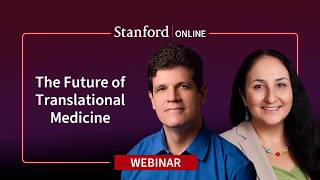
In this webinar, Drs. Dean Felsher and Joanna Lilienthal discuss the evolving field of translational research, emphasizing the need for interdisciplinary collaboration and early consideration of downstream factors. They highlight how AI and computational biology are transforming discovery and how Stanford's TRAM program prepares leaders to navigate the entire translational arc.
Translational research is taking an idea from the lab and making it relevant to the real world, such as a treatment, therapeutic, or diagnostic. The process of turning basic science observations into tangible, useful applications requires translation.
A major challenge is that scientists and clinicians often struggle to communicate. Scientists may not know clinical needs, and clinicians may not know available science. This disconnect hinders translational progress.
Drug development requires more than science; it needs clinical understanding, manufacturing, IT, commercialization, and regulatory knowledge. A great discovery can fail if these questions aren't asked early enough.
The biggest change is that the boundaries between discovery, development, and commercialization are blurring. Downstream questions about biomarkers, patient selection, and regulatory considerations must be considered early in the research process.
Dr. Felsher's work on the MYC oncogene illustrates that solving cancer requires understanding science, clinical circumstances, and chemistry simultaneously. The science existed for decades, but translation required a holistic approach.
Unlike past training, translational researchers today must be aware of all aspects: tools for scientific questions, clinical proof, regulatory approval, and adoption. Even specialists need to understand the whole ecosystem.
Solutions in one disease area can lead to breakthroughs in another. For example, a cardiologist's discovery might help cancer, or immunology insights might inform psychiatry. Being siloed can cause you to miss opportunities.
Over the last five years, AI and computational biology have become the biggest change, driving discovery in every medical discipline. Half of TRAM's cohort now uses AI to solve problems, making medicinal chemistry more robust.
Sometimes the most valuable action is connecting people who wouldn't otherwise meet, such as a cardiologist with a computational biologist. Mechanisms are finite, but ways to address them are infinite.
TRAM has organically evolved over 20 years, adding courses in diagnostics, vaccines, and AI mentorship. The program adapts to new scientific areas and student interests, staying dynamic like the biotech field.
TRAM has expanded experiential components, allowing students to work on individual projects (CREP) or in multidisciplinary teams on real challenges. Team projects mirror how drug development actually happens.
The acceleration in translation means everyone—scientists, engineers, CEOs, doctors—needs to stay aware of the state of the art. For doctors, diagnostics are changing; for scientists, understanding value is key; for investors, access to knowledge is crucial.
TRAM is not just an educational program but an ecosystem around computational medicine, bringing together clinicians, scientists, industry experts, entrepreneurs, and learners. The common thread is improving patient lives.
The curriculum takes students from forming a scientific question to clinical studies, capital, patents, commercialization, and regulatory approval. It includes specific didactics like chemistry, patent law, and vaccine development.
TRAM creates a large network of alumni, faculty, and advisors. Graduates often return as lecturers or advisors, helping each other with jobs and collaborations, forming a family of like-minded leaders.
There is a practical tension due to time constraints, but TRAM reduces it by creating an environment that encourages collaboration. Team approaches allow people to appreciate each other's expertise without becoming experts in everything.
Translational research applies to healthcare-grade software, clinical devices, diagnostics, computational platforms, and preventative measures. TRAM's holistic approach includes all these aspects.
TRAM aims to develop leaders in medical translation who are team players. Graduates go on to become professors, pharma leaders, clinical researchers, attorneys, and venture capitalists, each contributing to the field.
The graduate certificate is designed for working scientists, clinicians, and industry professionals who need knowledge but can't commit to a full degree. It aims to change the translational medicine mindset globally.
The program creates synergy where students have epiphanies, realizing what they didn't know. This deeper appreciation makes them better and encourages them to help the next group, creating a collective improvement.
Translational research is evolving to require a holistic, interdisciplinary approach, with AI and computational biology playing a central role. Stanford's TRAM program exemplifies how education and ecosystem-building can prepare leaders to navigate the entire translational arc, ultimately improving patient lives.
Definition of Translational Research
Provides a clear, foundational definition that anchors the entire discussion.
00:03:11Boundaries Between Stages Are Disappearing
Highlights a paradigm shift in how translational research is approached, emphasizing early integration of downstream considerations.
00:07:45AI and Computational Biology Driving Discovery
Identifies AI as the biggest change in the field, with significant implications for research and education.
00:14:58TRAM as an Ecosystem
Shows how an ecosystem approach, not just education, is key to advancing translational research.
00:25:01Synergy and Epiphanies
Captures the transformative learning experience that leads to deeper appreciation and collective improvement.
00:46:02[00:00] Welcome everyone. Thank you so much for joining us today for this webinar on the future of
[00:15] translational research. It's my pleasure to be joined today by Drs. Dean Felsher and Joanna Lilienthal. Before we get started, I just wanted to walk through a few housekeeping items. So first,
[00:30] You should see in the interface that you're looking at, there's a little Q&A button on the left-hand side. If you have any questions at any time during the session about anything, feel free to put those in the Q&A.
[00:44] We'll answer as many of them as we can at the end of the session. I have some colleagues who are also online. They may be able to answer some of those questions as they come in. And then, again, at the end, we'll get to as many as we can.
[00:56] We probably won't be able to get to every question, but we'll do the best that we can. Additionally, if you have to leave or you have a colleague, you really love the webinar, you have a colleague who would enjoy it, we will be sending a recording of the session out in about a week or two weeks.
[01:12] So at that point, you should be able to share that recording with anybody who wanted to or if you have to jump off in 30 or 40 minutes and you missed the very end, you can jump back on and watch the end of it.
[01:24] With that, it's my pleasure. As I said, welcome Dean Felsher and Joanna, Lily, and Paul. So today we're going to be talking about the future of translational research and what that means is where we're going to begin.
[01:37] And I can't think of two better speakers to be with us on this. So Dr. Dean Felsher is an MD and PhD, is a professor of medicine oncology at Stanford University School of Medicine, and he's the director of the Translational Research and Applied Medicine Program,
[01:51] or TRAM, which he's led since 2011. His own laboratory investigates how oncogenes initiate and sustain cancer, and he has pioneered model systems showing that inactivating a single oncogene, such as NIC, can be sufficient
[02:04] to reverse tumor growth, a concept known as oncogene addiction. So he's going to be talking a little bit about his own experience, both as an educator, who's someone who's trying to lead researchers through, and students and clinicians through, this
[02:17] process of translational research, and his own practice. Joanna Lowenthal, a PhD, is the Executive Director of Stanford's Master's in Translational Research in Applied Medicine. She's the Director of the Translational Application Service Center and the Associate Director
[02:32] of the Translational Research in Applied Medicine Program. And since 2011, she has worked alongside Dr. Dean Felsher entering researchers as they move scientific findings from the lab into clinical application, including biomarker
[02:45] research for early cancer detection. So welcome Dean Felsher and Joanna Lilienthal. So great to have you here. I want to start with just a very high-level question.
[02:58] Dr. Felsher, can you tell us what is translational research? Let's just start at a very high level. I'm delighted to answer that question. At the very highest level,
[03:11] translational research is what we describe when you take an idea discovered in the laboratory and you make it relevant and applicable to something in the real world,
[03:24] like a treatment, a therapeutic, or a diagnostic. And the process of making that actual scientific, basic science observation
[03:37] to something real and tangible and useful requires translation, And that's the way we describe it as process of translational research.
[03:49] So following up on that, and this is directed at either of you, what are the challenges? So we're moving it from kind of the research bench all the way into the clinic to an actual therapy that's being used.
[04:01] What are typically some of the challenges or stages that you have to go through in moving a drug or therapy from that researcher's bench to the patient's bedside? Well, I'd like to start answering the question, but like everything we've done about TRAM, it's been a team effort with Dr. Lilliatal.
[04:20] We've been doing this together now for 16 years. We're scientific siblings, basically. And I would say that the part I brought to this was I trained as a doctor, a medical doctor, and a scientist.
[04:35] and I found that it was very difficult sometimes for the two different groups of individuals to talk together in tackling a problem. So scientists in the laboratory sometimes found it hard to know
[04:50] what really were the clinical things that were needed and didn't even know what some science we discovered was useful. And clinicians faced with the challenge of treating and taking care of people
[05:02] sometimes didn't know how to go about actually doing any science or taking science or even knowing what science is available. So I'd say the first challenge is just getting the different kinds and groups of people who
[05:17] are involved that are required to make something like translational research work together. And a big part of actualizing this is what I then recruited Joanna, a living intelligence
[05:29] Dr. Lilienthal to work together with me and she's, I know, has lots of thoughts and examples of how we've thought about together as a team to overcome some of the barriers. Dr. Lilienthal.
[05:44] Yeah, very well said. So to me, one of the biggest challenges is that scientists, and I was trained as a scientist myself, they're often extraordinarily well trained in their own discipline.
[05:59] but drug development really requires more than science. It requires many different disciplines to come together. So you need the science, but you also need to understand the clinical needs,
[06:15] the manufacturing, the IT, the commercialization, and most importantly, each of them needs to enter into a clinical. So I kind of rephrased what Dean said, but more specifically, I just wanted to emphasize that a great discovery can fail because some of those questions weren't asked early enough.
[06:40] That's wonderful. So coming back again at a high level here, we've got kind of, if I were to break it out, it seems like there are three core stages, and I'm sure there's a lot more nuance to that. There's the research that's happening by the scientists in the lab, right, coming up with novel therapies, novel drugs, novel treatments.
[06:59] And then there's this middle stage, which is partly the regulatory stage, which is moving these therapies through the clinical trial, through clinical trials for approval. And then there's that final stage where you had said, you know, this is bringing it to the clinics themselves.
[07:14] This is helping commercialize, get that drug or therapy out into the market. So today we're talking about the future of this translational research. So where, Dr. Lillian-Tall, have you seen, as you've worked on this over the past 15 years as part of
[07:31] TRAN, and even before that in your own work, where have you seen the biggest changes in these three stages and what are the kinds of changes that you've seen? Yeah, so it's very interesting that you describe those so sequentially because
[07:45] to me, the biggest change is that the boundaries between these stages are disappearing. We used to think more sequentially about discovery, then development, then commercialization.
[07:59] But what really strikes me as a biggest change I have seen is that we really need to be thinking about those downstream questions much earlier.
[08:11] For instance, the AI and computational approaches are changing discovery. Biomarkers and patient selection are becoming more and more important in development, as well as the commercial and regulatory considerations really influence what we as scientists do very early on.
[08:34] So people who are entering, the people who are listening now who are entering the field, need to understand the whole ecosystem, even if they ultimately specialize in one or the other part.
[08:50] Dr. Kosher, what would you add to that? Well, I think Joanne explained it outstandingly, as Joanne always does. What I would add is to give an example of where work that we've done together has enabled such process to occur.
[09:10] For example, I work on a gene, the MYC-ONCA gene, and it's relatively absurd to people who are not cancer people, but it turns out it's a cancer gene involved in most of human cancer.
[09:22] the reality is that the science about knowing that his responsible cancers existed for literally decades it's discovered this part of London Nobel Prize for Mike Bishop
[09:35] and Harold Narmus Mike was one of my former mentors the reality is that to that right now the idea of taking the idea that this is a whole group of cancer
[09:48] that's one of the key notable points of cancer and translating exactly as Joanna described, solving the riddle of treating cancer involves not just understanding the science, but at the same time having an idea.
[10:02] Well, what is the clinical circumstance where it would make sense? And knowing chemistry and some of the tricks that have existed to deal with trying to figure out how to target such a gene.
[10:15] In our program, we are even talking to our students. Joanne and I were talking this morning about how taking advantage of world-class chemistry going on at Stanford, taking advantage of insights from our clinicians,
[10:30] and taking advantage of science discovered by me and other colleagues at Stanford, we can enable our students to actually tackle the problem. And like Joanne has said, being aware of all the steps at the same time.
[10:42] I mean, you beautifully summarized the whole translational arc, But it's hard for you to realize, because you understand it so well, that when Joanna and I first trained, nobody was educated in each step of translation.
[10:57] We were usually trained, like Joanna and I both trained at UCLA, we were trained in a very specific scientific domain in a specific part of the arc of translation. Whereas now we don't think about problems that way in translational research.
[11:13] The translational research is aware of all aspects. They're aware of the kinds of tools that can address scientific questions. They're aware of issues in terms of how to think about proving clinically something would work.
[11:28] And they're aware of what we require to get approval and to get adoption. All of these things need to be aspects of what you know. even if it's a Joanna study, if you're an expert in a specific aspect.
[11:41] That's wonderful. I love it. So, I mean, it sounds like actually one of the major things that has changed in translational research is just the field of translational research. It's this greater awareness that you cannot work in these sort of siloed fields.
[11:54] You cannot be a scientist just working on a novel treatment. You also have to have insight into the clinical trial phase, into what it takes to actually implement that in a hospital or in a clinical setting.
[12:06] or how to even tell it, you know, what are those aspects. So it sounds like that's a major part of it. It's just this awareness. That's obviously part of it. Yeah. I would love to explain.
[12:18] Yeah Exactly And another aspect of this is exactly why I recruited Joanna many years ago is that Joanna in her role Dr. Lohenthal
[12:31] facilitates across areas of science because sometimes the solution in cancer will actually lead to a solution in another disease so there has to be a
[12:43] more general understanding And if you're siloed, you could miss something right in front of your face. And many times I've heard Joanna bring together somebody from psychiatry, somebody who's working in immunology,
[12:58] to come up with an idea that could lead to a treatment for a psychiatric disorder that may have been thought of something that was involved in the immune system or inflammation. Or a cardiologist realizing something they discovered would be useful in cancer.
[13:11] So it's this ability to think across basic and clinical, this alterability, like you said, holistically across the areas of different areas of science and having an understanding of what would be a solution.
[13:25] Most importantly, have enough colleagues you know across the areas that you can get help, help at different steps that you may not have the most expertise in. So I want to come back to that because I think that, from what I understand,
[13:38] that's a lot of what the tram is doing here at Stanford, and this kind of unique spot that's a university. Well, not totally unique. There are lots of universities with hospitals or vice versa.
[13:50] But I want to maybe dig in a little bit. Dr. Lilliantola, if you can talk a little bit more about, you had mentioned maybe some recent scientific advances that had also changed this process.
[14:03] You mentioned biomarker research and patient selection. And also, I think what's probably on everybody's mind is some of this stuff around, you know, advances in data science. I mean, here we are at Stanford, right, and obviously artificial intelligence
[14:16] and maybe more broadly speaking data science, this ability to look at a lot of data and coming up with whether that's a novel solution or perhaps in trying to understand the clinical outcomes, et cetera.
[14:29] So I'd love to hear a little bit more if you have some more insights to share what you've seen in those scientific advances and how they've been impacting or influencing these three stages. Yes, definitely the biggest change we have seen over the last five years is the AI and computational biology and how it drives the discovery in probably every discipline of medicine.
[14:58] and not to replace medicinal chemistry, but there's so many new discoveries that make the medicinal chemistry science more robust.
[15:14] and we see a lot of students coming to this area. For instance, five, even five, seven years ago,
[15:26] there was maybe one high product. Right now, half of our cohort is trying to solve the problem using AI and computational biology. So that's probably the strongest example.
[15:39] But overall, just to put it at the higher level, I think what we do at PRAM and how we address that challenge is that sometimes the most valuable thing we can do is simply connect the right people who otherwise might never have found each other.
[15:57] and really seeing those collaborations, you know, bringing in a cardiologist and a computational biology person who can write a code
[16:10] and can use AI platforms for diagnosis versus someone in infectious disease. So basically, it is, you know, we can think of mechanisms as being finite,
[16:23] but ways to address it are infinite. So, collaborations can become very interesting because it doesn't really matter which DB area you're trying to solve the problem in.
[16:37] It can't, one DB area can't affect another DB area, and we can all learn from each other. Dr. Fletcher, is there anything you would add to that in terms of some of the specific signs or advances that you're really seeing impact what you're doing in interesting ways?
[16:57] Well, only to point out, I mean Joanna has summarized it beautifully, I'd only point out that we're incredibly sensitive in the Tramp Center to what are the newest areas, and we've made our program really organically evolve with the students and fellows and faculty.
[17:20] and we have now as you realize we're going on 20 years of experience in doing this and the program is definitely much more
[17:32] than Joanna and I always the intention was exactly to take leverage off of the brilliance of Stanford and the brilliance of the people that we bring into our program so it's all
[17:44] that Joanna described that Joanna and I just before getting started were talking about students that were going to join our program and how excited we were, how much talent they brought. So it's important to realize that that's a very real part of the educational experience
[17:59] in our program is that we incorporate the students who come, people who ask us questions, people who participate in any way, and we are constantly evolving the program, just like translational research is evolving.
[18:12] So we've added new courses. We're adding courses. We're adding, we keep adding other elements. We started mainly with therapeutics. We're adding diagnostics. We've added aspects that enable people to think about vaccine therapy, immune therapy.
[18:29] All of these were based on what we appreciated were new assets of the program, and we're adding formalized elements for mentorship and training in AI, as Joanna has brought up.
[18:41] So it's not just in the big picture we appreciate this, but we're also fine-tuning and making the program a dynamic, just as the field of biotechnology is very dynamic.
[18:54] It's also important that we're in the epicenter of success in biotech, and many of our advisors are successful leaders in some of the most exciting companies. We directly collaborate and interact with these individuals,
[19:08] and so we're very aware of the pulse of what it is that is being successful and exciting, and we bring that into our program. We bring that into all of our programs, into the education. So the speakers that we invite are not just Stanford faculty.
[19:21] Of course, we have world-class faculty, but also people involving the entire, I think I like the way that I described the whole ecosystem. The whole ecosystem involves these individuals.
[19:35] I want to maybe tell this. Oh, go for it. Yes. I just wanted to add one more aspect of it. So, yes, we have added the new courses so that students are exposed to those emerging technologies.
[19:48] But one other thing that we have added strategically is we have greatly expanded the experiential components. So students can now pursue individual projects.
[20:03] We call them CREP, or they work individually in labs of a faculty mentor. but they can also work in team projects where multidisciplinary teams work together on real foundational challenges.
[20:20] And that team experience is particularly important because that is exactly how drug development actually happens. Wonderful.
[20:32] There we go. Perfect, yeah. Okay, that's really fascinating. You already transitioned kind of talking about, and I guess that's part of, it's hard to disentangle these things because you created TRAM or you helped create TRAM here at Stanford exactly to address these kinds of problems.
[20:50] So let's, again, starting at a high level, for those of us, those who are joining us, who maybe are a data scientist or an AI researcher or maybe they're a doctor at a hospital, what, you know, outside of sort of the enrolling in a specific program,
[21:05] what should they be thinking about as they try to think about how to get more involved? Say I'm a clinician and I want to be more aware of the science or I'm a data scientist, you know,
[21:17] Maybe I'm a data scientist and I think, why do I need to know? Why do I need to know? I'm just looking at it. It's just crunching data. Why do I need to know the end stage and how it will work in the clinical trial? So can you maybe back up and sort of pitch it to those specific people?
[21:31] Why do they need to think about these bigger things? Why is it so important for them to be thinking about the bigger picture and kind of the whole ecosystem as opposed to their one slice? Dr. Kelsher, maybe I'll hand it off to you.
[21:43] So I'll start, but I think we've both thought about this deeply. So one very important reason for there to be an interest, pretty much everybody who would be in the audience, is that there's such a dramatic change in the acceleration in which we can translate findings because of advances in science and bioinformatics and the information that we have.
[22:16] That means you will desire, whether you're a scientist or an engineer or a CEO or a medical doctor or a basic scientist, to not feel that you've gotten behind and that you're not aware of the state of the art across the range of what is translational science.
[22:33] If you're a medical doctor, diagnostics and therapeutic decision-making are changing before your eyes. In our education programs, you get exposed to how is it changing? What are people doing?
[22:45] How are they thinking about health care? How are they thinking about delivery of health care? If you're a basic scientist working in an area that you know has translational potential, it can help you engage in thinking, well, what is it that I'm doing that could have high value?
[23:01] And how would I go about finding who to talk to in the clinical world or the business world to recognize that value? If you are a business person or an investor, one challenge is having access in an organized way to the formation of the state-of-the-art knowledge.
[23:22] In many cases, I've interacted with people who are already in biotech doing translational science, but it's hard to keep up with the actual science. It's like the language of the science is challenging.
[23:34] So those are some examples of reasons why I think that the sort of curriculum and education programs we've built would be of interest to not only people who are earlier in their stage of career
[23:47] and they want to figure out what they want to do, but people who have been already engaged in some aspect of the medical establishment and want to buff up their ability to understand what is the state of the art
[23:59] in the full range of going from idea to commercialization. What are the latest thinking of how this happens? What are people doing? What are the most exciting ideas and applications to develop therapeutics, diagnostics, vaccines,
[24:16] immunology agents, bioengineer, medical devices. Dr. Lillian, maybe just digging into that a little bit more,
[24:29] let's go into some of the specific programs that you're doing within SRAM that help address this. So I know you've talked a lot about your educational programs, but there's much more than just the educational programs. So could you give us the broader view of this center and how you have envisioned it again to help address what it sounds like the core issue is and the core change is just facilitating these conversations between practitioners in different stages in the process of bringing a discovery to the clinic
[25:01] Absolutely. So one thing I would emphasize is that time is not simply an educational program. I already referred to this as an ecosystem.
[25:13] It's an ecosystem around computational medicine where we bring together clinicians, scientists, industry experts, entrepreneurs, and, of course, learners. and then we support the project to create collaboration, connect people with expertise,
[25:31] as well as provide education and mentorship. So the Common Thread is helping promising science move forward and actually improve patient life.
[25:43] It's not just creating new applied therapeutic diagnoses. the common theme is actually making a difference in a patient's life. So that basically ties in together.
[26:02] It's not just the classes. It is the entire ecosystem. It's all the horizontal learning. It is the learning from experts.
[26:14] but it is we're making the people meet each other. So people here are more comfortable in this basic solution. And, Dr. Felsher, maybe we could then expand into that.
[26:29] I really like that concept. It's not about – I've laid out this arc, but fundamentally the mission of this, as a lot of things are, is actually improving the patient's life. I mean, that is the end goal, right? We want to bring something from the lab to people to improve their lives, to help cure something, to help treat something.
[26:47] So thinking about that, can you talk through the specific educational process? So you have courses, you have a master's degree, I think a one-year master's degree, as well as the individual courses that are part of a graduate certificate.
[27:03] Again, a data scientist in the area who's not been admitted to Stanford can be approved to take those courses and earn a graduate certificate. So can you talk through what are those courses? How have you structured them to address this problem?
[27:16] And I guess I already have one follow-up question that I'm going to embed in there already. It sounds like there are two aspects to this challenge. One is you need to facilitate and bring people together to constantly be learning
[27:30] and listening to your colleagues. Now, that seems like an ongoing process. And so an educational program can't. They can do it at once, but they can't do it, you know, unless they're retaking the courses all the time. So I guess my question is, my follow-up question embedded in there is,
[27:46] the courses themselves will convene these practitioners and give you the state of the art of what is happening across all these fields. How do you also equip people, therefore, to then go out in the field and continue that education? What is, is it just awareness of those different aspects of their certain skills you're imparting that allow you, you know,
[28:03] allow the data scientists to talk to doctors and the doctors to talk to data scientists. That was a big loaded question, so let me pass it back to you. Well, let me answer the two parts of the question, big picture, and then I'll go into more specific
[28:16] details about the actual structure of the curriculum. So in big picture, the curriculum in some sense is from beginning, middle, and the arc of how to do translation with lectures that go all the way from, well, how do you form
[28:32] a scientific question to how do you test that scientific question, how do you do a clinical study to how do you get the capital, make sure that you have a patent and protection
[28:46] of intellectual property and commercialize and get regulatory approval. So there literally is coursework that takes you through the entire sequence. That's the big picture. In terms of the second question, so we use the word ecosystem, and as Joanna said, we
[29:01] I often talk about horizontal and vertical learning and ecosystem in terms of creating an environment at Stanford, but it's bigger than that. We have trained hundreds of people. We have hundreds of faculty that are associated with the program.
[29:15] We have literally dozens of advisors that are global advisors from Stanford and several dozen advisors that are from industry. Our network is huge. The students who are part of our programs maintain part of that network, and we actively keep them as part of the whole system.
[29:39] So when people graduate from any of our programs, they often come back to us. Many of the people are lecturers who are students or are advisors who went for students or faculty come back and become part of the global advisors.
[29:58] Former students know each other and they help each other build programs, get jobs, serve as advisors. So the program has an aspect of it that is larger than just simply.
[30:13] Joanna and I in the leadership or simply the collection of lecturers. Like most outstanding programs, the intention is to create a network of individuals
[30:28] who will be leaders, who will be mutually supportive, and feel a common identity. Now, the CRIC involves a series of classes that lead through each step in translation,
[30:40] And they're very specific didactics, such as chemistry or patent law or vaccine development.
[30:52] There's other specific classes. And then there are also, we keep expanding the curriculum to include other areas that we realize students have of interest. But they're very deliberate coursework on specific areas of medical translation
[31:07] that you think are part of the core fabric of what everybody needs to have some knowledge about in terms of everybody needs to have some knowledge of how to design a clinical study.
[31:19] Regardless of whether or not you are going to be a clinical researcher, if you're going to do translation, you have to have the concept of what is a clinical study, what are the basics of designing a clinical study. And similarly, in specific domains of science, having some understandable,
[31:34] well, how does one find a small molecule and know that it has some activity? How do you make an assay to detect that? And then how does one get regulatory approval?
[31:47] What are the steps for getting an IND for the FDA? What is it that is required? What are some of the medical affairs issues that are required of a company to remain in compliance with regulation?
[32:00] so there's a lot of granularity but there's also a lot of big picture and the intention is for people to feel comfortable with the full range but it's very important that learning does not end with a program
[32:15] you're part of a world-class university and you're connected with like-minded, very talented individuals who are also part of the program and you become part of that
[32:27] as Joanna described we're creating an ecosystem. The ecosystem includes the students who are part of the program. Yes, and to answer this, for me the goal simply isn't just to teach the students in the classroom,
[32:45] it's to give people a framework to understand the field that will continue to change throughout their careers to give them a different perspective and many of our M-Prom
[33:02] graduates as well as prom scholars belong to either academic positions as faculty or leaders in biotech and pharma and they continue to collaborate with
[33:22] us and then it is so they invite us for um site visits to their companies they um hire our more recent graduates they provide um career development to our current students and more recent graduates
[33:41] so it becomes a sort of large ecosystem of course but a really large family of leaders or like-minded people who really speak the same language. It's not just the classroom, it's much more than that.
[33:57] That's wonderful. You know, we have a great question that I think is worth asking now, and it's just this, is there a tension between, I guess, basic science and applied science in
[34:09] this case? Or, and in fact, from what I'm hearing from you, you're also bringing in people who are doing basic science and finding the applied research, you know, the applied mechanism. So I guess, do you see that as a basic tension?
[34:21] Do you have concerns about, you know, kind of too much of a focus or too much knowledge of these different stages, maybe crowding out something that's just basic science research that maybe doesn't seem to have any applied aspect now,
[34:33] maybe will down the road, or maybe won't. So let me, yeah, that's the, you know, what is that tension, or is there a tension there? I mean, there is a tension, which is part of the reason that
[34:45] the Toronto Adult Program, it's very very time consuming to take care of people clinically it's very very time consuming to do basic research it's very very time consuming to try to run a company to develop a product
[34:59] and there can be a practical tension of just not having enough time to navigate but navigate being able to engage and what Joanna has done is create an environment
[35:13] that encourages this to happen and people who, in an organized way, are excited about this. And on the other side, the reality is that there's daily examples of major, major breakthroughs that are being made.
[35:32] And I don't want to promote any one particular company, but many of the companies that are in the news in breakthroughs in translational research includes science that we provide training and guidance regarding.
[35:51] It's very complicated. There are many examples of breakthroughs happening translationally in the Bay Area. And our goal is not to force people to engage,
[36:03] but what we do is create an environment that makes it very easy and reduces the tension. It makes it easier for an individual with a basic science background to network, connect with somebody with a clinical background.
[36:15] It makes it easier for somebody with a clinical background to find a scientist or find somebody with business experience. Another thing that we haven't talked about but we've implied is a big aspect,
[36:27] and this is a major aspect that John has championed, was to take a team approach. A lot of what we do is encouraging people to work as teams, recognizing that that's often the most effective way of being successful is to bring together people who appreciate each other, but you're not expected to become an expert in every area.
[36:49] You're expected to appreciate the value each person brings. Joanna and I appreciate your expertise. We don have the ability to bring our education programs outside of Sanford you have built a program we known you for years you built a program that enables us to provide access to this knowledge in a way that understandable
[37:12] that people can consume in a way that's practical, and we are revolutionizing education with you as an expert. In our program we embrace you as an example of
[37:24] translation. You are part of the program too. So you're part of the program too. Yeah, that's fantastic.
[37:36] And again, I have another good follow-up question very specific about the program and offering. I've been referring to drugs or treatments, but someone was asking
[37:48] does this translational research, does it apply to people who are interested in creating healthcare-grade software or clinical devices? Does it also apply to them or is that a is that itself a kind of different field?
[38:04] So just very quickly I'm going to answer that and being a lovely but very quickly our intention originally was not to just concentrate on drugs for
[38:19] therapeutic. Our intention is really a very holistic approach to expand the knowledge of translational medicine which includes therapeutic, diagnostic
[38:33] devices, computational platforms, preventative and we can appreciate how every year we get new students who are interested in those aspects of those
[38:49] different aspects of translational medicine and as I mentioned before the more and more computational computer scientists and people who are who know machine learning and AI who want to
[39:05] build platforms for diagnostics or devices so definitely not just the pure it does include all other aspects and we discuss all those other aspects in our courses as well.
[39:26] Anything you would offer that one for Dr. Kulshan? I know I think Joanna stated it perfectly this is something that could completely resonated with both of us from the very beginning. I have one more question I think and again I want to remind
[39:45] I know we've gotten some great questions. If you have more questions, feel free to just put them in the Q&A box near the end of the presentation. But I'd love to hear now, so, again, what do you think,
[39:58] what do you hope that if someone who takes, let's say, the graduate certificate, what do you hope they would walk away from this program having? What do you think they would still be thinking about in five years? Now, again, I think we have the high-level answer, which is that they're thinking across these different aspects of science.
[40:15] and application. But what else would you be hoping? Maybe it's just partnership in this long-standing, you know. Well, at Stanford, if there's one general high-level idea, it's we really are hoping people will recognize that they'll become leaders in medical translation.
[40:38] in whatever aspect of the domain. They'll be team players. We're going to encourage them to work with other people in their leadership capacity. But we want people to use this as a way to launch themselves
[40:51] to become revitalized or motivated in their own arc. And people that have been part of the program have been from students who are right out of college to people who have significant amount of work experience.
[41:06] a lot of people have some work experience. We prefer people to have some idea, some aspect of translations, they have an idea that this sort of program makes sense for them. But we want to build leaders, we want to build teams,
[41:21] and we hope people will be in positions that some people will want to be a dean's felsher, a professor, some people will want to be a Joanna Lilienthal, a director of education, a director of education programs that build education
[41:35] as their major focus, whether it be in academia like Dr. Lohenthal or through programs in industry. We hope people will be involved in journalism and education,
[41:49] as you find a role in education. And we hope people will become pharma leaders. We hope people will become clinical researchers. We hope people will be involved in each step of the process.
[42:01] If they're an attorney, a past attorney, They'll be more capable of helping drive and flush the property. If they're a venture person, they'll have a wiser appreciation in how to make decisions to launch the best companies.
[42:14] If they're a scientist, they'll be able to do their clinical or basic research more vitalized with greater skill and ability. So there's lots of different areas that overall, I hope,
[42:26] recreate people who pay to themselves and train to Stanford. And I feel now that the world is open more for me to have a bigger task as a leader in medical translation, regardless of where specific, after the domain or in a specific setting.
[42:43] And just to add to this, traditionally, we, I mean, traditional education has to do with going to the classroom, doing things internally here at Stanford.
[43:00] But we quickly realized that there is yet another group of people, and these are the working scientists, the clinicians, the industry professionals, who need the knowledge but don't necessarily have the time or ability to complete a full master's degree or PhD degree or, you know, full residential degree.
[43:24] And that's really where the certificate comes in. We really want to change the translational medicine mindset, not only at Stanford because it's already changing,
[43:40] but we want to change it anywhere in the world that needs those changes. And that's the beauty of the certificate course or the certificate program. I appreciate that.
[43:54] I mean, there are a lot of levels where you can get engaged, and it don't sound like that this is broadly applicable to anybody who's in, you know, broadly speaking, the healthcare field, whether you're doing basic science research that might have applications down the road, whether you're an epidemiologist maybe even who's helping run, not an epidemiologist, but someone who's helping run clinical trials to a doctor or a venture capitalist or, you know,
[44:18] or even someone who just works in a hospital, right, and who's maybe an administrator helping run the hospital day-to-day, having that understanding of that whole pipeline, it's very broadly applicable,
[44:30] probably to people beginning and mid to late stage in their career where they can come back and gain this. Absolutely. Absolutely. And, you know, yeah, the VCs, for instance, I mean,
[44:42] How do you make financial decisions about who to invest in if you don't understand the science or if you don't understand some of the more mundane regulatory aspects?
[44:59] I think that in order to make better therapeutic, diagnostic devices, everyone really needs to understand the entire spectrum of knowledge in foundational medicine.
[45:12] And we should point out that so far people who have been part of our program have gone into all these areas. So people have come, started companies. People have gone and become professors.
[45:24] People have gone and become leaders in driving clinical research in emerging nature biotech companies. Many, many different areas.
[45:37] our entire intention was to bring the brilliance and the amazing range of abilities at Stanford to the world
[45:50] to enable translational research on a bigger scale, on a much more managed scale. I mean, Joanna has often used what we're doing as an ambition
[46:02] and, you know, well beyond any kind of individual projects or particular clinical disciplines, exactly as you described. And realize that one of the things we've had is we're both trained as PhD scientists,
[46:17] and one real advantage of the scientific training is there's a mentorship where there are advisors that you learn from the other people in the lab, and in the good lab, there are people who are junior, brand-new students, two great seasoned people who are almost on the range of being professors,
[46:32] to people with technical ability, and you learn from being amongst people with different interests, different backgrounds. It's the circumstance of where somebody asks me a question from another discipline exposes us all to understanding
[46:47] when the more business-oriented person asks a scientific question, the scientists realize that we take for granted we thought we knew the answer, we don't. When the scientists ask a business question to somebody with more business or legal or medical affairs,
[47:01] has more insight, they realize what is not understood by the scientists. It really is the synergy. And our excitement is often
[47:14] when the students will say, they'll have an epiphany, they'll say, Joanna, we love this program because we've actualized things we didn't even know. We didn't even know what we didn't know, and now we know things which are so excited that
[47:26] we have a deeper appreciation. That is the intention. We want to make people better than they were before they joined our program, and we hope that they will be forward and be backward,
[47:40] that they'll appreciate it and then they'll want to help the next group because if we do it collectively together, we can do it much, much, much better. And what's also important is that Joanna and I,
[47:53] when we ask people to participate at Stanford, it's very rare that somebody's not willing to participate. More challenges is fitting in as many people who want to participate. So sometimes people don't really believe that the really famous faculty at Stanford.
[48:10] Now, generally, we are able to accommodate and bring on board many of the most famous scientists, most famous leaders at Stanford will participate.
[48:22] the dean's office, the deans often participate in our program fantastic AI scientists, chemists biologists, cancer biologists, cardiologists
[48:35] infectious disease people, all across different domains that has never been the issue and also that's true across the school Joanna will be modest about it, but I'm not modest
[48:47] Joanna having done this for years knows every other program, every other resource at Stanford over 15 years of doing this.
[48:59] And as a consequence, part of our program, we get questions answered, taking advantage of everything available at Stanford. It's just truly remarkable often what we see
[49:11] that our students and people that are mentored by program are able to accomplish because just the amazing ability that we worked as a team.
[49:24] I want to thank both of you for joining us today. I thank everyone who joined us online.
⚡ Saved you 0h 49m reading this? Transcribe any YouTube video for free — no signup needed.