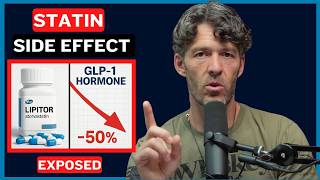

Statins cut GLP-1 by 50%?!
43sReveals a shocking, underreported side effect of the world's most prescribed drug class, challenging common medical advice.
▶ Play Clip"Title promises a media silence exposé; video delivers the study but spends time on tangents and plugs, so it's solid but not exceptional."
This video discusses a 16-week clinical trial showing that statins, the most profitable drug class in history, reduce levels of the protective gut hormone GLP-1 by more than 50%. The presenter highlights the potential unintended metabolic harms of statins, including increased insulin resistance and diabetes risk, and questions why this information is not more widely discussed.
A 16-week study found that atorvastatin (20 mg/day) reduced GLP-1 levels by more than half in overweight or diabetic/pre-diabetic individuals.
30 subjects were randomized to either 20 mg of atorvastatin per day or a control group, with various metabolic biomarkers measured.
Statins are HMG-CoA reductase inhibitors, blocking cholesterol synthesis in the liver, but this also affects other metabolites like coenzyme Q10 and isoprenoids.
Beyond lowering LDL, statins significantly reduce GLP-1, increase insulin, hemoglobin A1C, and C-peptide—all independent cardiometabolic risk factors.
Gut hormones like GLP-1 are crucial for blood sugar regulation; bariatric surgery can resolve type 2 diabetes within hours, highlighting their role.
Statins generate over $20 billion in annual sales and are prescribed to about 1 in 4 people over 40, yet they may increase the need for GLP-1 agonists like semaglutide.
Statins may lower GLP-1 by shifting the gut microbiome and bile acid metabolites (e.g., UDCA), though the exact mechanism is not fully confirmed.
Natural options like berberine (used for 3,000 years in TCM) can support metabolic health by impacting gut hormones, and TUDCA/ox bile supplements may help mitigate bile acid shifts.
Statins effectively lower LDL but come with significant metabolic trade-offs, including halved GLP-1 levels and increased diabetes risk. Patients and clinicians should weigh these risks and consider alternatives or adjuncts like berberine or bile acid supplements.
What is the primary finding of the 16-week statin study?
Statins reduce GLP-1 levels by more than 50%.
00:02
How many subjects were in the study and what dose of atorvastatin was used?
30 subjects; 20 mg of atorvastatin per day.
01:13
What is the mechanism of action of statins?
They inhibit HMG-CoA reductase, blocking cholesterol synthesis.
01:28
What metabolic changes besides LDL reduction were observed with statins?
Increased insulin, hemoglobin A1C, and C-peptide.
04:30
What is the annual sales figure for statins?
Over $20 billion.
05:51
What is the proposed mechanism for statins lowering GLP-1?
Shifts in gut microbiome and bile acid metabolites (e.g., UDCA).
06:47
What natural alternative to statins is mentioned?
Berberine, used in traditional Chinese medicine for 3,000 years.
08:14
GLP-1 halved by statins
Directly quantifies the core finding, making it a key fact for understanding the video's argument.
00:02Statins increase diabetes risk markers
Highlights unintended harms beyond LDL, challenging the monofocus on cholesterol.
04:30Statins as a business model
Connects drug profitability to potential increased demand for GLP-1 agonists, a provocative economic insight.
05:51Bile acid mechanism hypothesis
Offers a plausible mechanistic explanation, useful for further research or clinical consideration.
06:47[00:02] protective gut hormone known as GLP-1 by more than 50%. because we've heard so much about semiglutide and ompc as a pharmacologic agent that can help with fat loss and improving blood sugar regulation
[00:18] it turns out that individuals that are overweight and or have diabetes or pre-diabetes have a reduction in this critically important gut hormone known as glucagon like peptide 1 or GLP1 for
[00:30] short and this 12-week study found that a tovvisatin cuts GLP-1 levels by more than 50%. Now, this is incredible. And I learned about this paper from Nick Norwitz, who we recently did a collaboration. I can link some of
[00:45] that information right here. Uh he has a really good Substack article on this titled The Statin study should have changed medicine. Why is no one talking about this? So, we're going to really dive into this and thank Nick for
[00:58] putting out amazing work uh particularly uh in the realm of metabolic health in interesting here as you can see here from this graphical abstract of the 16we study. Sorry I said 12 week it's 16 weeks uh investigators randomized um 30
[01:13] subjects to either take 20 milligs of a tortoatin per day or a and they had a control group and they looked at various um biomarkers related to metabolic health for example total cholesterol. Now we know that statins are an HMG COA
[01:28] reductase inhibitor and what that means that's a multi- syllabic jargonistic term to talk about how statins actually lower cholesterol because they inhibit they put the brakes on the cellular synthesis of cholesterol which of course
[01:42] has downstream consequences because cholesterol is not the only metabolite that is metabolized through this isoprenoid pathway there's jarn jarol and farnosil and co-enzyme Q10 there's all those sorts of different
[01:56] all those sorts of different uh made downstream of HMG COA reductase which really helps to synthesize the cholesterol molecules because a lot of cholesterol is high because I eat dietary cholesterol. Well, it turns out
[02:09] that dietary cholesterol is poorly absorbed and has relatively no impact on serum cholesterol because most of your blood cholesterol is actually made endogenously in your own body by your liver. And so that's why there's various
[02:22] pharmacologic agents to either inhibit the uh synthesis of cholesterol such as statins or to increase the uh release of that such as the PCSK9 inhibitors with
[02:34] the LDL receptor activation and so forth. So anyway, back to the study. I here of course LDL cholesterol goes down when individuals take statins, right? Because it just puts a ro it just basically stops the synthesis of
[02:49] cholesterol. But what is not widely known by many people is the unintended harms of suppressing this enzyme known as HMD coatase with a statin. Well, as
[03:01] we see here, GLP1 gets cut in half. Now, why is that important? Because it turns out that your gut hormones speak to your peripheral metabolic systems and they are an intimately an intricately connected aspect to blood sugar
[03:16] regulation. the gut hormones. You can take a fullblown type 2 diabetic and give them and manipulate their intestine with various you know uh buriatric surgical procedures whether it's row and y or latb band procedures and within
[03:33] hours they will no longer need to be dependent upon insulin in the hospital. why I wrote the book belly fat effect in 2014. And I was just blown away at this literature. And this is how the GLP-1 agonist as well as the DPP4 inhibitors.
[03:48] There's an enzyme that your intestines make called DPP4 that will actually make called DPP4 that will actually break down GLP-1. GLP1 is protective. It helps to augment insulin functioning in because as you know um these hormones
[04:02] are released from the gut and they go speak to the peripheral parts of your metabolic physiology, your liver, your brain and so forth. There's GLP-1 uh physiology all throughout the body and GLP-1 is just one of many important
[04:15] hormones. But back to the study, the study found that after 16 weeks of statin use, GLP-1 levels are cut by half. Statistical significant decreases half. Statistical significant decreases in GLP-1. And what is temporarily
[04:30] increase in insulin. You see an increase in hemoglobin A1C, increase in ceptide. Uh all things you don't really want. Yes. LDL cholesterol did go down, right? And we know that the medical community is monomatically focused on reducing LDL
[04:45] is monomatically focused on reducing LDL cholesterol, but at what cost does that incur? What are the unintended harms of lowering cholesterol by way of statins, reduce GLP1, increase insulin, increase hemoglobin A1C, increase home? Uh all
[04:58] those things are independent cardiovascular and cardabolic health risk factors. Right? though. Yes, we're theoretically reducing one associated risk factor, LDL cholesterol, but we're causing all these other things
[05:13] to go wrong. And people should be aware of this when they're prescribed a statin because many individuals go and get their annual physical with their nurse practitioner, their physician's assistant, their
[05:25] their physician's assistant, their doctor, their LDL is high, and they're prescribed a satin. Well, shouldn't people know that there's this important people know that there's this important gut hormone known as GLP1 that is known
[05:37] to be low in obesity and diabetes and taking statins would even lower it more. What are the long-term ramifications of this? And so, I think this is really important. So, as Nick goes on to say, the study explores how statins, the most
[05:51] profitable drug in history with annual sales exceeding 20 billion 20 billion, just keep that in mind. contribute to insulin resistance, increase diabetes risk, and significantly lower GLP-1 levels in humans. He goes on to say,
[06:06] "So, in effect, the most profitable drug on the planet prescribed to about 1 in four individuals over the age of 40 may increase metabolic demand for the most popular drug class by disrupting the same biology those drugs are trying to
[06:20] correct." Wild, right? So, you take the statin, then you need the semiglutide, right? I mean that's a brilliant business model if you're in that industry. I mean let's be honest. So uh as you can see here
[06:32] from figure one that we've been talking about GOP1 levels are cut in half. Now the question is why? Why mechanistically do statins do this? Well it turns out that this may have to do with the impact that statins have on the gut microbiome
[06:47] as the paper goes into. Um but they don't really have a formal explanation as to why this may be. But this clinical trial did in fact show that GLPM1 levels are cut in half. And it might have to do with bile acid shifts. And so this is
[07:03] another important thing to consider. Bile acids are not just involved in Bile acids are not just involved in helping to soponify or metabolize fat. Bile acids play a very important systemic role uh and impact the brain
[07:16] and beyond. And by possibly shifting the microbiome, you shift the bile acid metabolites that could then affect the GLP-1 axis. And so they had a secondary arm of the study where they looked at uh mechanistically they looked at mice and
[07:31] they were to sacrifice these mice and uh looked at different metabolites and so forth. So they speculate possibly it could be due to this bile acid shift known as UDCA. And so, you know, if you do take a statin, you could supplement
[07:45] with UDCA potentially and that could help you impact the the shifts there. So, I think that's interesting to consider. I, you know, take bile acids sometimes. Um, but some people could, uh, benefit from, uh, taking
[08:01] uh, benefit from, uh, taking supplemental tudka, uh, TUDCA. These are bile acid. I I'm pretty sure it's ox bile uh, is where that that excuse me, consider. Or you could consider more natural
[08:14] approaches to impacting uh blood lipid levels. For example, bourberine. Bourberine is has been used for like 3,000 years in traditional Chinese medicine. It's a really reliable and effective way to support metabolic
[08:26] by impacting the gut hormones and gut description below. That's a a tool that people can use and and consider. But I about, you know, um especially if you're on a statin or you're considering going
[08:42] on a statin, you should understand that there are are risks um outside of things. So, I would like to know what your thoughts are. And again, I want to his channel. If you like this video, please hit that like button, leave me a
[08:56] comment, and subscribe if you're not already subscribed. and we'll catch you already subscribed. and we'll catch you on a future one down the


⚡ Saved you 0h 09m reading this? Transcribe any YouTube video for free — no signup needed.