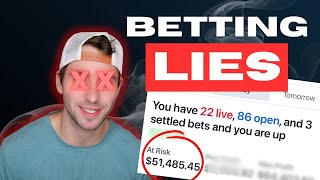

I'm Up $60K This Month (But Lost More Bets Than I Won)
43sThe shocking contrast between a massive profit and a losing win rate challenges common betting assumptions and hooks viewers immediately.
▶ Play Clip"Delivers on the promise of debunking lies, but the $62K figure is a hook; the core content is solid but padded with self-promotion."
The video debunks common sports betting myths, emphasizing that win-loss records are meaningless without considering odds and ROI. The creator, who claims to be up over $60,000 in October, explains that professional bettors focus on value and mathematical edges rather than picking winners. He highlights the importance of understanding implied probability, fair value, and the power of daily compounding, and contrasts high-variance positive EV betting with risk-free arbitrage.
The creator is up over $60,000 in October despite losing more bets than winning, because he bets on underdogs with high odds. Win-loss record is irrelevant; what matters is ROI and value.
Odds have an associated win probability. Betting at -200 requires winning two-thirds of bets to break even. Example: going 3-1 on -400 favorites loses money, while 1-3 on +400 underdogs profits.
Professional bettors focus on ROI and fair value. If a bet's fair price is +700 but you get +800, it's a good bet. Betting on favorites can be good if the price is better than fair value.
The creator locked in SMU moneyline at +178 on Rebet, while other books had SMU at +150 or +140. This was a cross-market bet with positive expected value, found using OddsJam's Sharp Money tool.
A 10% ROI in sports betting with daily bets compounds daily, unlike the stock market's yearly compounding. $1,000 daily at 10% ROI yields $36.5K profit in a year, vs. $100 from the S&P 500.
To maximize profits, place many bets with edges, not just a few 'locks'. Betting limits force quantity. The creator has over 100 bets open on a Saturday, similar to a quant trader making thousands of trades.
EV betting has ups and downs; the creator lost $9,000 in June but is up over $100,000 this year. Recency bias makes bettors change strategies after bad streaks, but a large sample size ensures long-term profit.
Arbitrage betting exploits odds discrepancies between books for risk-free profit. The creator started with arbitrage, making $40,000 in 3 months, and recommends it for beginners to build confidence.
The key to successful sports betting is understanding value, ROI, and mathematical edges, not picking winners. Whether through high-variance EV betting or risk-free arbitrage, consistent profit comes from exploiting market inefficiencies and managing variance.
Why doesn't win-loss record matter in sports betting?
Because it ignores the odds and ROI. You can lose more bets than you win and still profit if you bet on underdogs with high odds.
00:16
What win rate is needed to break even at -200 odds?
You need to win two-thirds (66.7%) of your bets to break even at -200 odds.
01:55
What is the difference between daily and yearly compounding in betting?
Daily compounding means profits are reinvested daily, leading to exponential growth. A 10% ROI on $1,000 daily yields $36.5K profit in a year, vs. $100 from the S&P 500's yearly 10%.
07:49
What is a cross-market bet?
A bet where two sportsbooks have odds so out of sync that one side must be a profitable bet, often found using tools like OddsJam's Sharp Money tool.
05:13
What is arbitrage betting?
A risk-free profit strategy where you bet on all outcomes of an event at different books to guarantee a profit, exploiting odds discrepancies.
13:30
Odds and Win Probability
Explains the fundamental relationship between odds and required win rate, a core concept for any bettor.
01:55Daily Compounding Advantage
Highlights how sports betting's daily compounding can outperform yearly stock market returns, a key insight for bankroll growth.
07:49Volume Over 'Locks'
Challenges the common advice to find a few picks, advocating for placing many bets with edges to maximize profits.
08:37Arbitrage as a Starting Point
Recommends arbitrage for beginners to build confidence and bankroll, a practical strategy for risk-averse bettors.
13:30[00:02] hopefully it stays this way, I'm up over $60,000 in the month of October. Obviously, not every month is like this. But what I figured would be useful is going through some of the biggest lies, the worst advice. There's a lot of
[00:16] people online who give out sports betting advice, and a lot of them, know what they're doing themselves or they're trying to sell something. So, the point of this video is very simple. It's just to cut through a lot of the BS
[00:30] sports betting industry. When I started gambling, the first thing I did is I sports betting. And I watched a ton of videos of people just talking about sports. Nobody was talking about data or price, the odds you're getting.
[00:45] Everybody was just talking about sports analysis. There's so much BS. And what I very quickly learned is the vast majority of people have no idea what research how do syndicates make money? How do professional sports betterers
[00:58] make money? Because there are sports betters who make a living off of sports betting. Just like poker, sports betting is one of the rare few forms of gambling where you can actually get an edge and win long-term. So the point of this
[01:11] video is just to cut through a lot of the BS. And the first thing I see all over the internet is win loss record. Okay, win loss record doesn't matter. You can see this month where I'm up over $60,000. I have lost more bets than I've
[01:27] won. How is that possible? Well, I'm betting on a lot of underdogs like the Bengals where I'm betting a,000 to profit over 2K. So, if you're betting mainly on underdogs, you don't need to win 50% of your bets. But what's very
[01:41] common for recreational sports bers is everybody just wants to bet on the game, they're more likely to win the game, then I should just bet on them, right? But you have to remember, everything in sports betting boils down
[01:55] to price and win rate. Odds have an associated win probability. When you're betting at minus 200, you're betting 200 to profit 100. You need to win twothirds of your bets to break even. I'll give you a simple example is a lot of people
[02:10] like the big favorites is if you go three and one, three wins, one loss, betting on teams at minus 400 odds. Let's say your unit size is $100. You're betting $100 per play. You're actually down 25 bucks, right? You have a
[02:24] down 25 bucks, right? You have a negative 6.25% ROI. You get the feeling of winning more often. You went three in one. You get the feeling of winning more often, but you're actually losing money over the course of the long run. On the
[02:36] other hand, if you go one and three betting on teams at plus400 odds, you're actually up $100 profit. You have a 25% ROI. There's professional sports
[02:48] betterers who basically just bet on golf outrights, like they model golf, and they're betting on players to win tournaments at plus 10,000, plus 5,000 and winning less than 10% of their plays, but they make a living from it.
[03:02] Everything in sports betting boils down to ROI, fair value. If the fair price to ROI, fair value. If the fair price for a bet is, let's say plus 700, and you can get that bet on another sports book on plus 800, you want to play it. I
[03:16] obviously bet on favorites. There are great bets on favorite outcomes. If a team should be priced, the fair of price is minus 250 odds and I can bet them at minus 200, that's a good bet. Everything boils down to fair value. So, the first
[03:32] mistake I see a lot of people make is they bet on big favorites. They have a great win loss record. They have 300 wins, 70 losses, but they're still losing money and they're confused. And usually it's because people don't
[03:46] matter at all. So, I'll give you an example of a great underdog play. I'm recording this video before the game, so I have no idea if this is going to cash or not. A great play I locked in for today was [snorts] SMU moneyline at plus
[04:01] today was [snorts] SMU moneyline at plus 178 odds. So SMU is the underdog, right? They are not favored to win the game, but sports is random. There's always variance, right? Like nobody knows exactly who's going to win in advance.
[04:15] That's why people like sports. So I bet SMU at plus 178 on the sports book called Rebet. [snorts] And as you can see, lines were just ripping towards SMU. You know, just a few days ago, they were plus 300 underdogs. So, three to
[04:30] one underdogs. The market is implying they're, you know, approximately 25% to win the game. As game time got closer, they went down to about plus 150, 40% implied win probability. So, their implied win probability went up by 15%.
[04:46] So, basically, Rebet was stale. That's the word I like to use. Rebet was stale the word I like to use. Rebet was stale still offering SMU at plus 178 when all the other books had ripped them much lower right to plus 150 plus 140. So I
[05:01] picked off rebet and this is an underdog bet. They are not likely to win the game but given the value given the price I'm getting this is a plus EV bet. So long
[05:13] story short I locked this play in. It was across market. I found this play on the odds jam sharp money tool which points out crossed market bets. So basically a cross market bet. It's a very simple strategy. I've done some
[05:27] fulllength YouTube tutorials on it like you can see one right here. I definitely [snorts] cross market betting is really simple. basically whenever arbitrage exists. So whenever two books are so out of sync in this case it was profitex
[05:42] they had Clemson at minus 166 and rebet had SMU at plus 178. So these two books were so out of sync that you can see an arbitrage calculator right here. I could have just hedged this bet to make a
[05:55] risk-free profit. Right? I could have bet SMU on rebet. I could have bet bet SMU on rebet. I could have bet Clemson on Profitex at minus 166 and two books had such different odds. So, one of the two plays by definition has
[06:09] to be a profitable bet. Profitex is a very sharp book. It is a peer-to-peer betting exchange. And a lot of people when they hear peer-to-peer, they think that's the easiest book to beat. Oh, it's just a bunch of my neighbors
[06:21] betting on it. And that is not true. these peer-to-peer books because they have no limits. The people setting lines, offering liquidity on these peer-to-peer books in general are trading firms, quant funds, very smart
[06:35] people. Those are the market makers, the people setting lines, offering liquidity on Profitex. So, it's a super sharp book. So, basically, if these market makers on Profitex are offering Clemson at minus 166, they think the other side
[06:49] SMU plus 166 is a great play. And I'm getting that at plus 178 on rebet. So, literally have no idea if it's going to call me stupid. I don't care because I literally could have cashed out before
[07:05] game time for like a $60 profit. It was obviously a no-brainer bet. That is the first mistake I see a lot of people make is just not understanding win loss record and always betting on favorites. That's not what you want to do. The
[07:18] second mistake I see a lot of people make is they they will just dismiss sports betting altogether. So for example, last year in 2024 I had a 9% ROI about 10%. Let's just round up for easy numbers. A lot of people will say,
[07:33] oh the stock market goes up 10% per year. Who cares? And it's like well the stock market is yearly compounding. Whereas when you're betting on sports in general, you're betting on games that day. So, it's daily compounding. So,
[07:49] I'll give you a little example is if you put $1,000 into the S&P 500 stock market index, right, which goes up approximately 10% per year, after one year, you should have approximately 1.1K in your account. You're up $100 profit.
[08:05] However, in sports betting, if you can get a 10% ROI, and you're betting $1,000 every single day on games happening that day, that's $100 profit per day. and over the course of a year 36.5K profit. So you can see the difference
[08:22] between daily compounding and yearly compounding. That's why even with a relatively small bankroll for sports betting, you can really grow it quickly and it's because of daily compounding. Sports betting is absolutely insane. So
[08:37] the third main lie that gets thrown around is to find a couple picks every single day. just find a few plays you're in love with. What is the pick of the day? What are the locks? And that is absolute BS. If you want to maximize
[08:53] profits, you are placing dozens, if not hundreds of bets every single day. So today, the day I'm recording this video on Saturday, I have over a 100 bets currently open, a lot of games going on, and I'm recording this. Why do I do
[09:07] that? Why don't I just pick the few plays I'm most confident in? And it's a few different reasons. First of all, all of these books have max betting limits. So, if you want to maximize profits, you're going to need to place a lot of
[09:20] bets. If you just play one thing for $800 and you have a 10% ROI, cool, that's $80 in profit you are going to make every single day. But as a sports better and as a trader, I started my career as a quantitative trader. You are
[09:35] thinking, how do I maximize profits? So, here's a play I locked in on FanDuel. Wyoming plus 4 and a half at minus 110 odds. Even just like 20 minutes before game time, they were only letting me bet $825,
[09:50] which it's not nothing, but you have to remember this is a mainline point spread on a main sport, college football. For player props, these betting limits player props, these betting limits sometimes are only $50, $100. So, even
[10:04] if bets have an edge, you're focused on quantity. You want to lock in as many bets as possible that have an edge. And typically I'm just betting things for my max allowed betting limit. You know, because a lot of people ask me about
[10:19] bankroll management. And usually the answer is I'm just shoving for as much as I can at this point because I'm cut down on basically all of these sports books. So why did I like this play on Wyoming is this was another crossmarket
[10:32] plus EV bet. You can see Novig which is a very sharp exchange had Air Force minus4 12 at + 110 with a lot of liquidity. So if the market makers are
[10:44] liquidity. So if the market makers are offering Air Force minus 4 1/2 at + 110 they want to be on Wyoming plus 4 1/2 at - 110. They think that's a good bet right the other side of the market. So I played this on FanDuel. Long story
[10:58] short, it's very normal on a college football Saturday for me to have a football Saturday for me to have a hundred 200 bets open. More bets with an edge is a good thing if you want to maximize profits. There's no guaranteed
[11:10] wins. There's no, oh, just find one pick of the day. That's not how sports betting works. When I was a quantitative trader on Wall Street, my algorithms would make tens of thousands, if not hundreds of thousands of trades every
[11:23] single day. Every trade had a small edge. Some win, some lose. But if you have an edge, a mathematical advantage, you are guaranteed by the law of large numbers to make money over time. And most of these trades, most customers,
[11:39] dollars. A lot of these orders coming in that you're trading against are for that you're trading against are for $100, $200, $300. So, you can't just work on Wall Street and be making one trade a day. That's not how it works.
[11:52] Another thing I wanted to mention is variance. So variance can be brutal depending on the sports betting strategy you're using. So I use EV betting, cross market plus EV. A lot of ups and downs, right? I am not hedging any of these
[12:07] bets. I'm just placing bets that I believe have an edge. They're cross markets like the SMU play. And then I kind of let the math work itself out. I really treat my sports betting kind of like I treated my book as a quantitative
[12:20] trader. Make a bunch of trades. Everything has an edge. manage risk where appropriate. Let the math work itself out. That obviously stinks. Variance stinks. That I've had losing months. So, you can see in June I lost
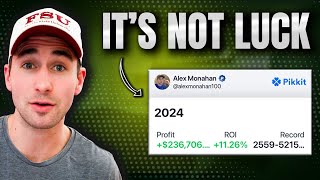
[12:32] over $9,000, but this year I'm still up like over a h 100,000. Last year I had losing months, but made over $200,000 on the year. So, depending on the strategy you're using, there's going to be some ups and downs. And so many
[12:46] sports betterers, the second they go through two, three, four bad days, they just want to switch things up. Oh, let me just buy picks from this handicapper who's winning, right? It's called recency bias. If you are losing a couple
[12:59] days in a row, you want to change things up massively. And especially when I losing streaks, I would think about I shouldn't do this. But again, at this point, I've been sports betting very seriously for six or seven years. So,
[13:13] I'm going to have some down months, some bad weeks, stuff like that. But I know over the course of a year with a massive sample size of bets, I'm going to make a think as a sports better. [snorts] But if you don't like variance, then you
[13:30] should try a sports betting strategy called arbitrage. Okay, so arbitrage is a risk-free profit betting strategy. Here you can see an example of a hockey arbitrage bet between Hard Rock and Novig, which are two books legal in my
[13:44] state. Hard Rock is a major sports book and Novig is a no limit betting exchange that's pretty sharp, but because there's no max betting limits, it's incredible for arbitrage. So here you can see these two books are so out of sync that you
[13:57] can bet the over on Hard Rock, the under on Novig, and you will make a risk-free profit. So there are tons of people who do this. They just day trade the books. They don't want variance. They don't want to have losing days. They just want
[14:10] to day trade these books, make $25 here, $10 there, $30 there, and every day be growing their bankroll. And personally, I don't think that's the most profitable strategy, arbitrage specifically. But it is how I started sports betting. When I
[14:25] got into sharp gambling, I made $40,000 with risk-free profit arbitrage in 3 months. Every single day I was making money. It is not the strategy that maximizes returns, which is ultimately as my confidence grew that hey, I know
[14:39] what I'm doing. I know how to beat these books. As I saw results month after month arbitrage betting, I started to dip my feet into positive EV betting. But initially, I was just arbing or arbitrage betting. And again, I think
[14:51] it's a great strategy actually for new sports betterers to start with because you will win every day. You will see that, hey, I'm actually beating these books. You're going to be making more money. your bankroll will grow and then
[15:04] you can start to invest in more risky and not even risky but higher varant strate strategies like positive EV betting where you will have ups and downs I still try to hit arbitrage bets it's amazing to make risk-free profit so
[15:17] arbitrage is kind of like putting your money in bonds very safe you know you're going to make money when you're investing in bonds like US treasuries but the expected return is lower than you know the stock market like the S&P
[15:32] 500. Historically, stocks have returned a lot more than bonds. But obviously, stocks have risk. Some years they go down 10%, other years they go up 20%. So
[15:44] EV betting is very similar to buying the stock market where, you know, long-term you are going to win. You are going to make money, but you're going to have lose, you know, 10% of your capital in
[15:56] certain years that is invested in the stock market. Whereas bonds is much more that's arbitrage. I hope you enjoyed this video kind of about some of the biggest myths, the biggest lies told
[16:08] about sports betting. If you have any questions, comment them below. Also, let me know other video ideas. I love making sports betting content. So, any other video ideas you guys want to see, let me know. I'm all ears. Trading content,
[16:22] sports betting content, comment other video ideas. Thanks guys.
⚡ Saved you 0h 16m reading this? Transcribe any YouTube video for free — no signup needed.