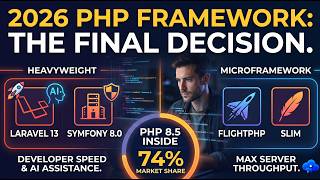

PHP is NOT dead in 2026
45sChallenges the common belief that PHP is dying with a surprising stat (74% market share) and a visual graph.
▶ Play Clip"Title accurately reflects content: PHP is not dead, and benchmarks of frameworks are provided."
Despite persistent rumors of PHP's demise, the language holds a steady 74% market share in 2026, driven by core modernization like PHP 8.5's lazy objects that reduce memory usage by up to 50%. The choice of framework now determines performance and cost, with options ranging from heavyweight Laravel and Symfony to high-speed microframeworks like Flight PHP.
PHP holds 74% market share, dwarfing Ruby and Node.js, driven by core engine modernization.
Lazy objects load tools only when used, cutting memory usage by up to 50% for complex apps.
Laravel 13 prioritizes developer speed with 83k GitHub stars; Symfony 8.0 focuses on enterprise security and predictability.
Spiral uses long-running daemons for Go-like concurrency but has fewer third-party packages.
Flight PHP achieves 190k requests/sec vs Slim's 73k, but lacks built-in database layers and templating.
SaaS startups → Laravel, enterprise → Symfony, high-traffic APIs → Flight PHP.
The best PHP framework in 2026 depends on whether developer time or server hardware is the bigger bottleneck. Modern PHP scales reliably into either extreme when architecture matches performance goals.
What is PHP's market share in 2026?
74%
00:15
What feature in PHP 8.5 reduces memory usage?
Lazy objects
00:43
How much can lazy objects reduce memory usage?
Up to 50%
01:03
Which framework has over 83,000 GitHub stars?
Laravel 13
01:28
What is the trade-off of using heavyweight frameworks like Laravel?
Unmatched developer speed but moderate performance overhead requiring robust caching.
01:44
What is the primary advantage of Symfony 8.0 over Laravel?
Security and predictable error catching for large-scale enterprise systems.
02:00
How does Spiral achieve high concurrency?
By using long-running daemons that stay active in memory instead of starting/stopping on each request.
02:38
What is the raw throughput of Flight PHP?
Over 190,000 requests per second.
03:30
What is a key drawback of microframeworks like Flight PHP?
No built-in database layers or templating engines; engineers must manually build security and data layers.
03:34
According to the flowchart, which framework should a SaaS startup choose?
Laravel 13
04:11
PHP holds 74% market share
Contradicts the narrative that PHP is dying, showing it still dominates the web.
00:15Lazy objects cut memory by 50%
Demonstrates a significant performance improvement in PHP 8.5.
00:43Laravel 13 has 83k GitHub stars
Indicates massive community support and ecosystem.
01:28Flight PHP achieves 190k req/s
Shows extreme performance possible with minimalistic design.
03:30Trade-off: developer time vs server cost
Provides a clear decision framework for choosing a framework.
04:49[00:00] For years, industry chatter suggested
[00:02] PHP was on the way out. In 2026, the
[00:05] structural reality of the web tells a
[00:07] different story. This graph tracks the
[00:09] divide. While the legacy perception
[00:12] trends down, PHP's actual market share
[00:15] is holding steady at 74%
[00:17] dwarfing competitors like Ruby and
[00:19] Node.js. This isn't just about old sites
[00:22] staying online. It's driven by a rapid
[00:24] modernization of the core engine, making
[00:26] the language faster and more secure than
[00:28] it was even 2 years ago. Since the
[00:30] language itself is no longer the
[00:31] bottleneck, the primary risk to a new
[00:34] project is choosing an architecture that
[00:35] doesn't align with your performance
[00:37] needs. PHP 8.5 introduced a technical
[00:40] shift in how the language handles
[00:42] memory, centered around a feature called
[00:43] lazy objects. Traditionally, heavy
[00:46] frameworks wasted resources by loading
[00:48] every background tool into memory on
[00:49] every page request, whether they were
[00:51] needed or not. In this node map, you can
[00:53] see the change. With lazy objects, a
[00:56] tool only wakes up and consumes memory
[00:58] at the exact moment it's used. For
[01:00] complex applications, this shift can
[01:03] reduce memory usage by up to 50%, which
[01:05] directly lowers the hardware
[01:07] requirements for your VPS.
[01:09] With the core language now highly
[01:10] optimized, your choice of framework,
[01:12] alongside your database and caching
[01:14] strategy, becomes the primary factor in
[01:16] your site's speed and server costs.
[01:19] First, we have the heavyweights. These
[01:21] are full-stack frameworks that
[01:22] prioritize how quickly a developer can
[01:24] build a feature over raw server
[01:26] efficiency. Laravel 13 is the leader
[01:28] here with over 83,000 GitHub stars and a
[01:31] massive ecosystem of pre-built tools.
[01:34] Laravel focuses on developer experience.
[01:36] It uses clear code structures that AI
[01:38] assistants like Claude and Cursor can
[01:40] parse easily, allowing teams to ship
[01:42] features faster. This comparison matrix
[01:44] highlights the tradeoff. You get
[01:46] unmatched developer speed, but the
[01:48] performance overhead is moderate,
[01:51] meaning you'll need robust caching to
[01:53] maintain high speeds. If you're building
[01:55] for a strict enterprise environment,
[01:57] Symphony 8.0 is the alternative.
[02:00] Symphony is component-based. It's built
[02:02] for large-scale systems where security
[02:04] and predictable error catching are more
[02:06] important than initial setup speed. The
[02:09] trade-off is complexity. Your team will
[02:12] deal with a steeper learning curve and a
[02:14] more rigid configuration process.
[02:16] Heavyweights make sense when developer
[02:18] payroll and time to market are bigger
[02:20] bottlenecks for your company than server
[02:22] capacity.
[02:23] Traditional PHP hits a limit when you
[02:25] have thousands of users hitting the
[02:27] server simultaneously.
[02:29] The Spiral framework addresses this by
[02:31] acting as a hybrid, combining PHP's ease
[02:34] of use with the high concurrency power
[02:36] of the Go language. Spiral uses
[02:38] long-running daemons. Instead of the
[02:40] application starting and stopping on
[02:43] every click, it stays active in memory
[02:45] to handle requests instantly. However,
[02:48] this isn't a drop-in replacement. You'll
[02:51] be working with a much smaller pool of
[02:52] third-party packages compared to the
[02:54] giants like Laravel.
[02:56] If you need Go-like performance, but
[02:58] want to keep your logic in PHP, Spiral
[03:01] is the choice, provided your team is
[03:03] ready to move away from traditional
[03:05] request cycles. If you only need a
[03:07] high-speed API, micro frameworks strip
[03:10] away everything but the bare essentials
[03:12] to maximize throughput. Slim is the
[03:14] modular industry standard, while Flight
[03:17] PHP is built with a strict
[03:18] zero-dependency philosophy to stay as
[03:21] light as possible.
[03:22] This bar chart shows the impact of that
[03:24] minimalism. Where Slim reaches about
[03:27] 73,000 requests per second, Flight PHP
[03:30] rockets past 190,000 in raw throughput.
[03:34] To get that speed, you lose the
[03:35] plumbing. There are no built-in database
[03:37] layers or templating engines, just the
[03:40] router and the request handler. Your
[03:42] engineers will have to manually build
[03:44] and integrate every security and data
[03:46] layer themselves. That manual work can
[03:49] become a maintenance burden as the
[03:51] project grows and more developers join
[03:53] the team.
[03:54] Microframeworks offer the highest
[03:56] hardware efficiency, but they require
[03:58] you to sacrifice almost every modern
[04:00] developer convenience to reach it.
[04:03] Picking a framework in 2026 comes down
[04:05] to matching the architecture to your
[04:07] project's primary goal.
[04:09] On this flowchart, a SaaS startup
[04:11] follows the path to Laravel 13. Here,
[04:14] rapid development and AI assistants
[04:16] outweigh the server overhead.
[04:18] For enterprise systems needing strict
[04:20] standards, the path leads to Symfony
[04:22] 8.0.
[04:23] For a high-traffic RESTful API, Flight
[04:26] PHP is most efficient. At this scale,
[04:29] every additional dependency slows down
[04:31] the response time, making minimalism a
[04:33] requirement. Mapping technical
[04:35] requirements to your business outcomes
[04:37] narrows the selection down to the
[04:39] architecture that best supports your
[04:40] team's constraints. There is a direct
[04:43] trade-off between how fast your
[04:44] developers can work and how many
[04:46] requests your server can handle per
[04:48] second.
[04:49] Use heavyweight frameworks when your
[04:51] biggest expense is developer time.
[04:53] Switch to microframeworks when the cost
[04:55] of scaling your server hardware becomes
[04:57] the primary bottleneck.
[04:58] Modern PHP infrastructure scales
[05:00] reliably into either extreme, as long as
[05:03] the architecture matches your specific
[05:05] performance goals.
[05:06] The best framework in 2026 isn't the one
[05:09] with the most stars. It's the one that
[05:11] solves your team's specific technical
[05:13] and financial constraints.
⚡ Saved you 0h 05m reading this? Transcribe any YouTube video for free — no signup needed.