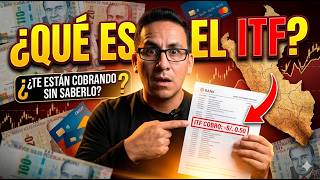

SUNAT Can See ALL Your Transactions!
45sImmediately reveals a shocking truth about government surveillance of personal finances, triggering curiosity and fear of missing out.
▶ Play Clip"Delivers on the promise of revealing how SUNAT tracks movements and how to avoid ITF, though it includes some promotional content."
This video explains the Financial Transactions Tax (ITF) in Peru, how SUNAT monitors all financial movements, and provides practical advice on how to avoid generating this tax. The presenter demonstrates how to check your ITF history on the SUNAT portal and emphasizes the importance of maintaining organized financial records to avoid triggering an audit.
ITF stands for Financial Transactions Tax, a small percentage (approximately 0.005%) applied to financial transactions, equivalent to 5 cents per 1000 soles or dollars.
The main issue is not paying the ITF itself, but lacking control over transactions, leading to inconsistencies, unjustified income, and potential alerts from SUNAT.
SUNAT can flag individuals with excessive or unjustified money flows, leading to investigations if records are not in order.
Log into SUNAT, go to 'Other declarations and applications', select 'Financial Transaction Tax' (ITF), enter dates, and view a report showing bank, taxpayer, period, and ITF generated.
The report shows total income (e.g., 709,000 soles) and ITF generated (0.005%). Dividing by two gives net movement (~350,000 soles), which must be justifiable.
Make transfers of less than 1,000 soles or dollars to avoid generating ITF. For example, move 3,000 soles in four transactions of less than 1,000 each.
Always have receipts or justifications for money movements to avoid problems with SUNAT.
The key takeaway is to operate with knowledge and control, organizing financial information to use the system to your advantage. Moving money strategically and having proper documentation prevents issues with SUNAT.
What does ITF stand for?
Financial Transactions Tax
00:19
What is the ITF rate?
Approximately 0.005% (5 cents per 1000 soles or dollars).
00:34
What is the main problem with ITF?
Not having control over transactions, leading to inconsistencies and unjustified income.
00:48
How can you avoid generating ITF?
Make transfers of less than 1,000 soles or dollars each.
04:50
What should you have to justify money movements?
Receipts or justifications for the money.
05:17
Control over transactions is key
Emphasizes that the real risk is not the tax itself but the lack of financial control.
00:48SUNAT portal demonstration
Shows exactly how to check your ITF history, making the information actionable.
02:51Practical tip to avoid ITF
Provides a concrete strategy (splitting transfers) to legally minimize the tax.
04:50[00:03] tax, it's what SUNAT ultimately sees about you. This video is for our subscribers in Peru. So if you are Peruvian, I suggest you watch this video Peruvian, I suggest you watch this video until the end.
[00:19] you're new and perhaps don't quite understand this. The goal is for you to grasp it so that you can understand it easily. ITF is the abbreviation for the Financial Transactions Tax . It's a small percentage
[00:34] . It's a small percentage because it's approximately 0.0005% the amount because it's 5 cents per 1000 soles or 5 cents of a dollar per $1,000.
[00:48] The important thing is that every transaction is recorded, and this is where many people make mistakes. What is the real problem? The problem isn't so much problem? The problem isn't so much paying the ITF, it's not having control over
[01:02] all the transactions you make and obviously not knowing how to prevent that tax from being generated. Because when you start moving money around without order, without control, without records, without backups, without protection, that's where
[01:20] problems can arise, such as inconsistencies, asset imbalances, income, for example, that you cannot justify, and that that you cannot justify, and that obviously alerts SUNAT,
[01:34] which is the entity in charge of everything related to income, taxes and payments or duties that you have to make to the state. Now imagine this. A person constantly moves money, their account receives transfers, sends money,
[01:50] makes deposits, and this person does not keep track of it. You do it without strategy or already told you. What's going to happen? He doesn't know in the end how much came in, when it came out, and obviously he doesn't know how much or what he has to justify.
[02:06] But from their perspective everything may seem normal, but from the outside there is a flow of money that is unclear. There are excessive incomes and unjustified outflows of money. And then, obviously, SUNAT can alert them and
[02:23] start investigating. And if you don't have anything in order, you'll end up in big trouble. What's the moment, my friends? The moment of alert. This happens more than you think, and it happens to many Peruvians, especially
[02:36] people who work with both income and expenses, that is, everyone. Brenner, how does SUNAT keep track of that? I'm going to show it to you on the screen so you can see it. I have logged into my
[02:51] Sunat page, my account, here is my name and this is my account. If you go to the section for other declarations and applications, which is over here, you will find the financial transaction tax over here . If we click here, we will
[03:04] . If we click here, we will go to the ITF, ITF query. Because? You can, just as you can consult, SUNAT has access to that and I'm going to show it to you. You can enter, for example, the dates you want
[03:16] to see. Let's put everything from the year 2025 on it. Okay? It tells us to put the year first and then we'll put the month. We've been talking since January. month. We've been talking since January. We're going to go all the way through 2026, and
[03:32] we're going to put, sorry, the end or beginning of 2026. We click next and it will give us the report. If you can see it, it basically tells us
[03:44] the bank where that money came in, the taxpayer, who is obviously the person, the period, month and year. And this is where, for example, the ITF is generated. If you can see it here, it says 1000, 1000, 11,000, 38,000 and
[04:02] here is the ITF that is being generated, which is 0.005%. And look, if we look all the way down, it shows me that in that year I had an income of 709,000 soles. You have to divide that by
[04:18] two because it's both input and output. This means there has been a movement of approximately 350,000. If you don't have a basis to justify that, that's where the problems begin. But if you did your homework, there are no details. And
[04:34] you can visualize this according to the dates that I just showed you. So take that test and you'll see how you're doing . Therefore, the importance of knowing how to avoid the ITF is clear. I'm going to give you some advice now so
[04:50] you can check it out. The way you can avoid generating the ITF is by making transfers for amounts less than 1,000 soles or $1,000. That
[05:02] way you avoid generating the ITF. For example, if you want to move 3,000 soles, you could do it in four transactions of less than 1,000 soles each, and you wouldn't generate the ITF (Financial Transaction Tax). That's the first thing you have to do. And number two, you have to have a
[05:17] shield, a receipt, a justification, sorry, for that money so that you don't have any problems. So if you've already checked it and want us to because within our community
[05:32] is a specialized accounting service. If you'd like us to advise you or help you with that, write to us or join our community groups, and we can help you at our accounting firm to avoid those kinds of problems. But
[05:46] something you need to be clear about is that the idea is not just to avoid mistakes, it's to organize the information, have clarity and above all use the system to your advantage and not let it harm you. So, my friends, in conclusion, the
[06:02] problem is operating without knowledge and control, or without having an accounting system control, or without having an accounting system that can help you support it. Because when you understand how this works, in the end there's no problem. It's not
[06:16] money; it's about moving it strategically because, obviously, today more than ever, it's not enough to just win; you have to know how to sustain or justify that. If you want to learn more about how to make smart money, how to optimize your
[06:31] time and money, subscribe to the channel if you haven't already, okay? So entrepreneur and you start moving that kind of money, this amount is money movement, clear. And if you want us to help you, just write and join the
[06:45] community groups. And follow me on social media because we're going to continue sharing this invaluable information that can help you avoid making mistakes. So, see you in the next video. Bye bye.




⚡ Saved you 0h 07m reading this? Transcribe any YouTube video for free — no signup needed.