
AI Summary
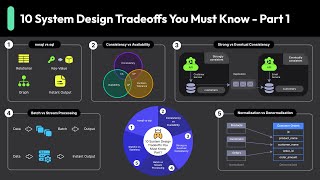
This video provides a concise overview of fundamental system design trade-offs related to data management, including SQL vs. NoSQL databases, normalization vs. denormalization, the CAP theorem, consistency models, and batch vs. stream processing. It emphasizes that there are no universally correct choices, only trade-offs that align with specific application requirements.
Chapters
SQL databases offer strong consistency, structured schemas, and powerful queries but struggle with horizontal scaling and schema changes. NoSQL databases sacrifice consistency and query capability for scalability and flexibility.
Normalization minimizes redundancy and ensures data integrity but leads to expensive joins at scale. Denormalization duplicates data to speed up reads but complicates writes and risks inconsistency.
In distributed systems, during a network partition, you must choose between consistency (always latest data) and availability (system always up). Banking favors consistency; social media favors availability.
Consistency is not binary. Strong consistency reflects updates immediately but requires synchronization, affecting performance. Eventual consistency is faster and more scalable but may show stale data temporarily.
Batch processing is efficient and simple but introduces latency. Stream processing provides real-time results but adds complexity due to out-of-order data and variable latency. Hybrid architectures are common.
Effective system design requires understanding and deliberately choosing trade-offs based on business needs. There is no one-size-fits-all solution; each decision involves balancing competing priorities like consistency, scalability, and performance.
Mentioned in this Video
Study Flashcards (5)
What are the main trade-offs between SQL and NoSQL databases?
easy
Click to reveal answer
What are the main trade-offs between SQL and NoSQL databases?
SQL offers strong consistency, structured schemas, and powerful queries but struggles with horizontal scaling. NoSQL sacrifices consistency and query capability for scalability and flexibility.
00:27
What does normalization optimize for, and what is its main drawback at scale?
medium
Click to reveal answer
What does normalization optimize for, and what is its main drawback at scale?
Normalization optimizes for data integrity and storage efficiency, but the cost of joins between tables becomes prohibitive at scale.
01:25
According to the CAP theorem, what must you choose between during a network partition?
easy
Click to reveal answer
According to the CAP theorem, what must you choose between during a network partition?
You must choose between consistency (always latest data) and availability (system always up).
02:20
What is the difference between strong and eventual consistency?
medium
Click to reveal answer
What is the difference between strong and eventual consistency?
Strong consistency reflects updates immediately across all nodes but requires synchronization, affecting performance. Eventual consistency allows delays, is faster and more scalable, but may show stale data.
03:10
What are the trade-offs between batch and stream processing?
medium
Click to reveal answer
What are the trade-offs between batch and stream processing?
Batch processing is efficient and simple but introduces latency. Stream processing provides real-time results but adds complexity due to out-of-order data and variable latency.
03:36
💡 Key Takeaways
SQL vs. NoSQL is about application needs
Clarifies that the choice isn't about which is better but about matching the database to specific requirements like transactions or massive scaling.
00:12CAP theorem shapes failure behavior
Explains how the consistency-availability trade-off determines system guarantees under failure, a core concept in distributed systems.
02:20Consistency is a spectrum
Highlights that consistency isn't binary, offering a nuanced view between strong and eventual consistency based on business needs.
03:10Hybrid architectures are common
Shows that real-world systems often combine batch and stream processing to balance efficiency and responsiveness.
04:25Full Transcript
[00:00] System design is all about making the right trade-offs, whether building something from scratch or scaling an existing application. Understanding these core trade-offs will help us make better architectural decisions.
[00:12] Let's explore some essential system design trade-offs related to data management that every engineer should understand. When it comes to data storage, SQL and NoSQL databases represent fundamentally different approaches with clear trade-offs.
[00:27] SQL databases provide strong consistency, structured schemas, and powerful query capabilities. This structure ensures data integrity, but it creates challenges for horizontal scaling and when modifying schemas.
[00:42] NoSQL databases invert these priorities. They often sacrifice some consistency and query capabilities to gain horizontal scalability and schema flexibility. With SQL, we are trading scalability for consistency and structure.
[00:56] With NoSQL, we're trading consistency guarantees and query capability for scalability and flexibility. This isn't simply about which is better, it's about understanding the application's specific
[01:09] needs. Do we need rock transactions and complex query capabilities SQL might be the answer Need to scale massively with evolving data models NoSQL could be the better choice Database design typically starts with normalization
[01:25] organizing data into separate tables to minimize redundancy and ensure each piece of information is stored in only one place. This creates a clean model that maintains data integrity.
[01:37] But as application scale and performance becomes critical, the cost of joins between normalized tables can become prohibitive. This is when denormalization enters the picture, deliberately duplicating data across tables
[01:51] to eliminate expensive joins and speed up common queries. The trade-off is clear. Normalization optimizes for data integrity and storage efficiency, while denormalization optimizes for read performance
[02:04] at the cost of increased complexity in write operations and potential inconsistencies. Most large-scale systems evolve from fully normalized designs to a strategic denormalization only where query performance demands it.
[02:20] This evolution reflects the shifting priorities as applications mature, from correctness and simplicity to performance and scale. In distributed systems the CAP theorem tells us we can have it all Consistency is the assurance of getting the most recent data every single time we make a request Availability is about ensuring that
[02:41] the system is always up and running, even if some parts are having problems. When network partitions occur, we have to choose one over the other. Banking systems might favor consistency to ensure account balances are always accurate, while social media platforms might favor availability
[02:58] so users can always access the service. This fundamental trade-off shapes how a system behaves under failure conditions and determines which guarantees we can provide to users.
[03:10] But consistency itself isn't binary, it's a spectrum. Strong consistency is when data updates are immediately reflected across all nodes in the system. It requires synchronization, which can affect performance.
[03:24] Eventual consistency is when data updates a delay before being available across nodes. This approach is faster and more scalable, but users might temporarily see stale data.
[03:36] The tradeoff is between speed and scale versus the immediacy and accuracy of updates. The business requirements dictate where on this spectrum a system should operate. The way we process data presents another fundamental tradeoff Batch processing accumulates data and processes it at scheduled intervals This offers computational efficiency and simpler error handling
[03:59] but introduces significant latency. Users wait hours for insights. Stream processing handles data in real-time as it arrives, providing immediate results and enabling instant reactions to events.
[04:12] However, this introduces complexity because out-of-order data arrivals and variable latency can compromise correctness, requiring sophisticated state management and processing guarantees.
[04:25] The core trade-off is between efficiency and simplicity versus immediacy and responsiveness. Many modern systems end up with hybrid architectures, using streams for time-sensitive processing
[04:37] and batch for comprehensive analysis. Understanding these trade-offs is essential for designing systems that meet our specific requirements. There are no universally correct choices, only trade-offs that align better with our particular use case.
[04:52] If you like our videos, you might like our system design newsletter as well. It covers topics and trends in large-scale system design, trusted by 1 million readers. Subscribe at blog.bybygo.com.