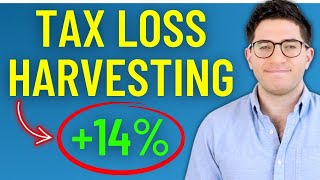

What is Tax Loss Harvesting?
53sBreaks down a complex financial term into a simple concept that anyone can understand.
▶ Play Clip"The title accurately reflects the content, as the video explains tax loss harvesting and cites a study claiming a 14% portfolio boost."
Tax loss harvesting is a simple strategy that involves selling investments at a loss to reduce your tax burden. It can offset realized capital gains or reduce taxable income, with a deadline of December 31 each year. The video explains the rules, limits, and the wash sale rule, and provides examples to illustrate the benefits.
Tax loss harvesting refers to selling investments at a loss to lower your tax burden by offsetting realized capital gains or taxable income.
The deadline to harvest losses for the current tax year is December 31.
If you have no realized gains, you can deduct up to $3,000 of losses from taxable income per year (single or married filing jointly).
The wash sale rule prohibits buying a 'substantially identical' security within 30 days before or after the sale, or the loss is disallowed.
Tax loss harvesting is only possible in taxable brokerage accounts, not retirement accounts.
A study from First Quadrant estimated that tax loss harvesting adds about 14% to the final portfolio value compared to not harvesting.
Selling at a loss lowers your cost basis, meaning greater gains to be taxed later, so you are deferring taxes, not avoiding them entirely.
What is tax loss harvesting?
Selling investments at a loss to lower your tax burden.
0:20
What is the deadline for tax loss harvesting to offset that year's gains or income?
December 31.
0:58
What is the annual limit on deducting losses from taxable income?
You can only deduct up to $3,000 per year if single or married filing jointly.
1:40
What is the wash sale rule?
The wash sale rule prohibits buying a 'substantially identical' security within 30 days on either side of the sale.
2:02
In what type of account is tax loss harvesting possible?
Taxable brokerage accounts.
3:21
According to a study from First Quadrant, how much can tax loss harvesting add to the final portfolio value?
About 14%.
7:27
What is a potential downside of tax loss harvesting?
You have lowered your cost basis, meaning greater gains to be taxed later.
7:48
Definition of Tax Loss Harvesting
Provides a clear, foundational definition that underpins the entire video.
0:20Annual Deduction Limit
Key rule that limits the benefit for investors without realized gains.
1:40Wash Sale Rule
Critical rule that investors must understand to avoid invalidating their harvest.
2:0214% Portfolio Boost
Quantifies the potential long-term benefit, making the strategy compelling.
7:27Tax Deferral, Not Avoidance
Important nuance that clarifies the true nature of the benefit.
7:48[00:00] Tax loss harvesting may sound fancy and complicated,
[00:04] have a better understanding of it after watching
[00:07] Here we’ll explore what tax loss harvesting
[00:12] rules, limits, and deadlines involved, examples,
[00:17] in your portfolio.
[00:18] What Is Tax Loss Harvesting?
[00:20] Tax loss harvesting just refers to selling
[00:25] Simple as that.
[00:26] Specifically, we’re talking about selling
[00:30] at the time of sale in order to offset realized
[00:35] have any realized gains) for that year.
[00:37] If used to offset realized capital gains,
[00:41] the former of which are taxed at higher rates.
[00:43] In other words, realized losses can be used
[00:48] the year.
[00:49] We call this sale “harvesting” the loss,
[00:53] Tax loss harvesting to offset that year’s
[00:58] the calendar year, so the deadline is December
[01:01] Naturally, this encourages many to employ
[01:05] end of the year to harvest any losses, but
[01:10] your position in a security has an unrealized
[01:13] Day traders will use this as a tool to offset
[01:17] If the long term investor is simply holding
[01:22] losses can reduce their income tax liability.
[01:24] So far tax loss harvesting sounds like a great
[01:28] Unfortunately there are some limits and rules
[01:31] First, if the long term investor mentioned
[01:35] to harvest losses to reduce their taxable
[01:40] of $3,000 per year if single or married filing
[01:44] That is, if your realized net loss on your
[01:48] you can only deduct up to $3,000 from your
[01:53] also carry forward the unused loss of $2,000
[01:58] Secondly, there’s an important tax loss
[02:02] wash sale rule that prohibits investors from
[02:08] The rule states that the investor wishing
[02:13] identical” security within 30 days on either
[02:18] a “wash sale” which invalidates the harvesting
[02:22] This rule applies across all your investment
[02:25] It also applies to reinvested dividends and
[02:31] wanting to harvest losses, you’d want to
[02:33] After you sell to harvest a loss, you can
[02:38] or hold cash for 31 days and then buy your
[02:43] While a bit more complicated, the former may
[02:47] only a handful of great days for the stock
[02:53] and those days could very well occur during
[02:57] But of course, in true IRS fashion, they have
[03:02] a “substantially identical” security,
[03:07] disagreement on whether or not two funds from
[03:11] index would be considered “substantially
[03:14] Luckily, we can usually avoid that anyway
[03:19] the same exposure we’re after.
[03:21] Also remember that tax loss harvesting is
[03:25] as the IRS does not tax growth in retirement
[03:30] have a taxable account, you don’t need to
[03:33] Now let’s check out some examples to see
[03:37] The numbers for gains and losses are made
[03:40] The tax brackets and harvesting limits are
[03:44] Consult your tax professional.
[03:45] I’ve included the cursory math on the screen
[03:49] First let’s look at an example of offsetting
[03:53] to simply reduce the capital gains tax liability.
[03:56] Suppose Sarah has sold a position during the
[04:01] of $2,000 and is in the 24% tax bracket.
[04:04] Since short-term capital gains are taxed at
[04:08] pay $480 in taxes on those gains at tax time.
[04:12] Before the end of the year, she notices another
[04:17] By harvesting that loss, she can now offset
[04:22] capital gain is reduced to $500, on which
[04:29] of 75%.
[04:30] Remember short-term capital gains apply to
[04:34] they’re characterized as long-term capital
[04:37] Long-term capital gains are taxed at lower
[04:39] Specifically, if Sarah’s previous position
[04:43] 15% in taxes on it instead of 24%.
[04:46] If she deployed the same tax loss harvesting
[04:50] gains tax liability from $300 to $75, a reduction
[04:55] This illustrates that tax loss harvesting
[04:59] is still useful for long-term gains as well.
[05:02] Now let’s look at an example where the net
[05:06] Assume Ashley has sold a position during the
[05:10] of $2,000 and later notices before the end
[05:15] of the same amount, $2,000.
[05:18] Harvesting the loss offsets the gain in full
[05:23] for the year.
[05:24] For the next example, we’ll look at a situation
[05:29] gain.
[05:30] Assume Ashley’s unrealized loss from the
[05:35] and she still has the realized long-term gain
[05:38] She can offset that gain in full and then
[05:44] reduce her taxable income.
[05:46] If her long-term capital gains rate and effective
[05:51] in capital gains taxes and $150 in income
[05:57] Lastly, we’ll look at an example with a
[06:03] limit and zero realized gains.
[06:05] If you subscribe to the Boglehead philosophy
[06:09] the most likely situation you’ll find yourself
[06:14] Pretend Patrick is a long-term investor who
[06:19] his taxable brokerage account of index funds
[06:24] realize gains until retirement.
[06:26] While his account value has obviously grown
[06:32] groups of shares bought earlier in the year)
[06:38] markets faltered during the year, and he has
[06:43] any of his positions.
[06:44] Remember we can use tax loss harvesting to
[06:50] can book that $5,000 loss, reduce his taxable
[06:56] forward that extra $2,000 in unused losses
[07:02] I’ve seen many ask if tax loss harvesting
[07:07] time and effort required, to which I’d reply:
[07:10] First, it’s a very small amount of time
[07:14] year.
[07:15] Secondly, yes a $3,000 tax write-off each
[07:20] Lastly, we showed earlier how tax loss harvesting
[07:26] marginal tax rate increases.
[07:27] A study from First Quadrant estimated that
[07:33] final portfolio value compared to one that
[07:37] For a $1 million portfolio, that would be
[07:42] So it sounds like tax loss harvesting is always
[07:46] Well, not quite.
[07:48] Recognize that in selling at a loss and re-entering
[07:52] now lowered your cost basis from what it was
[07:57] taxed later in the future.
[07:58] Granted, those greater gains won’t be taxed
[08:02] yourself an interest-free loan, and we’d
[08:07] little to no income for most people.
[08:09] But in that sense, it’s important to note
[08:14] not avoided them entirely.
[08:15] So an obvious situation when it would not
[08:20] be taxed on gains in the first place, which
[08:25] to avoid capital gains taxes altogether.
[08:28] This only applies to long-term capital gains,
[08:32] avoid if your annual income is below about
[08:37] Now let's look at the steps for how to tax
[08:40] 1 - Turn off dividend reinvestment.
[08:42] Make sure you haven’t bought any shares
[08:46] 30 days.
[08:47] 2 - Sell the position at a loss.
[08:49] 3 - Buy an alternative replacement fund (examples
[08:54] the original position.
[08:56] 4 - Turn dividend reinvestment back on unless
[09:01] Here is a non-exhaustive list of groups of
[09:06] out that we can be sure would not be classified
[09:11] I'm not going to go through them one by one
[09:15] link in the description to sift through this
[09:18] In conclusion, tax loss harvesting – selling
[09:24] taxable income – may be a useful part of
[09:27] The tax savings from harvesting losses increase
[09:33] Plan ahead to ensure your tax loss harvesting
[09:37] Follow the steps above and decide whether
[09:42] for 31 days.
[09:43] For those using M1 Finance, note that while
[09:48] harvest tax losses for you, their tax optimization
[09:53] losses first anytime you sell shares.
[09:56] How do you approach tax loss harvesting in
[09:59] Let me know in the comments.
[10:01] Thanks for watching.
⚡ Saved you 0h 10m reading this? Transcribe any YouTube video for free — no signup needed.